Advertisement
Advertisement
March 2025
Sponsored by Terumo Aortic
First Implants Using TREO™ FIT in the United States and Europe
Testimonials from initial use of the TREO FIT physician-modified endovascular graft highlight the system’s potential for rapid treatment of complex abdominal aortic aneurysms with precise alignment to patient anatomy.
With Benjamin W. Starnes, MD, FACS, and Eric Ducasse, MD, PhD


The TREO FIT (Terumo Aortic) is used to facilitate physician-modified endovascular grafts (PMEGs). It guides surgeons in locating and marking fenestrations on the partially deployed TREO abdominal stent graft system to align precisely with the patient’s anatomy, reducing the need for manual measurements of fenestration locations. TREO FIT is indicated solely for use with the TREO abdominal stent graft system.
The TREO FIT system in combination with the TREO abdominal stent graft system is used in complex abdominal aortic aneurysms (AAAs), namely juxtarenal aortic aneurysms presenting with a high risk (eg, large aneurysm size), symptomatic aneurysms, and/or ruptured aneurysms. According to Terumo Aortic, this device provides an innovative solution for patients who require urgent complex AAA treatment and are unable to wait for a company-manufactured device before having surgery.
The TREO FIT System
Product name: TREO Fenestration Into Template (FIT)
Product availability status:
- United States: Under physician-sponsored IDE study
- Europe: Under custom-made program
Overview: The first cases highlight the TREO FIT platform’s potential in managing both emergent and semiemergent complex AAA cases, particularly when swift intervention is critical. Terumo Aortic notes that the successful deployment of the fenestrated device in this context validates the platform’s design and functionality, setting a precedent for the treatment of similar complex aneurysmal pathologies in Europe and potentially worldwide.
Dr. Starnes, what is the indication for TREO FIT in your physician-sponsored investigational device exemption (IDE) study? Which patients do you expect to be treated with TREO FIT, and why?
Dr. Starnes: The indications for TREO FIT as part of our IDE are predominantly males with AAAs that are either symptomatic or ≥ 6.5 cm and females with AAAs ≥ 6 cm. The reason for this is that TREO FIT can be produced very rapidly, and we can get these patients with relatively large aneurysms treated expeditiously.
Which patients are preferable for treatment with TREO FIT in comparison with standard PMEGs or custom-made devices (CMDs)?
Prof. Ducasse: TREO FIT represents a true improvement in both the safety and standardization of the technique (Figure 1). It may replace many indications, such as in the most urgent cases where a CMD cannot be awaited. I believe TREO FIT will also replace the indications for semiurgent cases, such as those with infected native aortas, fast-growing aneurysms, and patients experiencing severe abdominal pain.
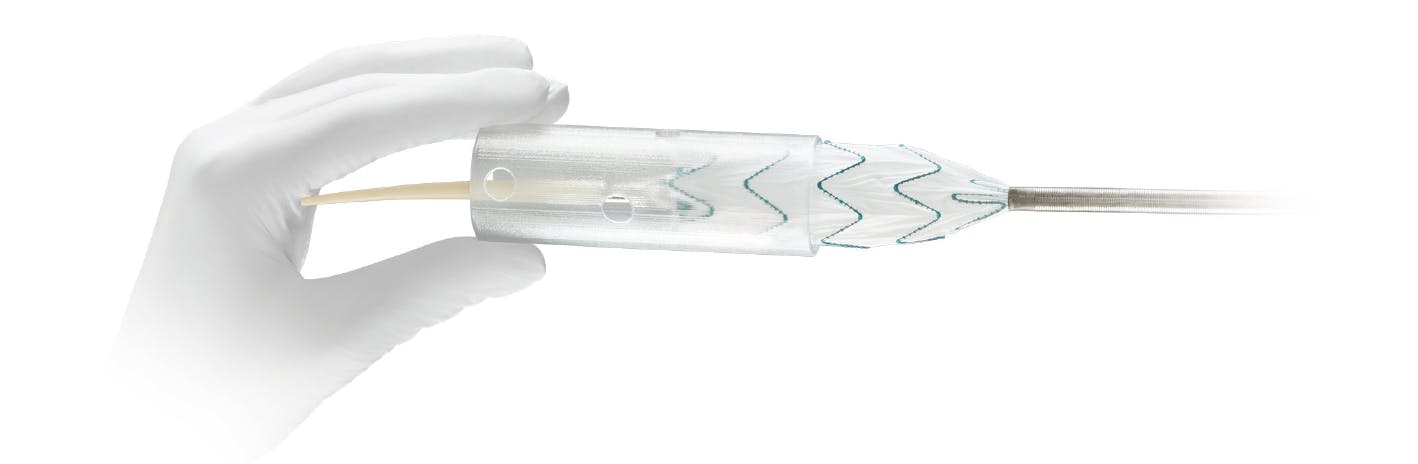
Figure 1. The TREO FIT system.
How was your first procedure, and what makes TREO FIT stand out compared to standard PMEGs?
Dr. Starnes: We performed the entire procedure in < 50 minutes (not including modification time), including 10 minutes of fluoroscopy time. The graft modification took only 24 minutes, which is approximately 20 minutes shorter than usual and includes measurement of the fenestrations. Having the TREO FIT template available really speeds up the case significantly.
Prof. Ducasse: The procedure went very well and was completed quickly. The patient woke up perfectly, and the entire process, including three fenestrations, took approximately 74 minutes. The new tool was a real improvement. TREO FIT offers a dedicated template adapted to align with the patient’s anatomy, and it includes fenestrations for the superior mesenteric artery (SMA) and the two renal arteries.
How might TREO FIT change how you plan future procedures?
Dr. Starnes: I still prefer to plan my own cases and verify the position of the fenestrations. However, I think this will be an easy solution for physicians who don’t perform many of these procedures. It will make it much easier to order a TREO FIT template based on a CT scan alone and receive a customized graft in a very short period of time.
Prof. Ducasse: Since I started implanting PMEGs, I remain old-fashioned in terms of sizing and shaping the fenestrations myself. However, use of TREO FIT will surely help standardize and secure the procedure, ensuring the fenestrations are perfectly adapted to the graft and in alignment with the strut positions. I will continue performing the procedure manually at first and double-check with TREO FIT for the majority of cases to ensure control and secure the process, providing double control and double planning.
Where do you think TREO FIT offers the most value? In which patient morphologies do you think TREO FIT will be most beneficial, and why?
Dr. Starnes: Patients with large or symptomatic aneurysms that really can’t wait for a company-manufactured device are going to benefit the most. I also think that patients with challenging neck morphologies and challenging iliac access will also benefit from this technology.
Prof. Ducasse: I think this applies to all indications—meaning all anatomies, as anatomy is just a combination of diameters, location of the target arteries, and angulation. It is not a question of anatomy but of pure indication. TREO FIT would be intended for the most emergent patients.
Why is the standard off-the-shelf TREO abdominal stent graft (Terumo Aortic) easier to modify than other abdominal grafts available on the market?
Dr. Starnes: That is a very simple question to answer because the construction of the graft is such that it has long main bodies and stents with a wide amplitude, and there is a lot of space between each of the stents. This provides plenty of real estate to place fenestrations for a wide variety of patients.
Prof. Ducasse: Because TREO FIT is fully adapted to the TREO device, it is also quite easy to open on the table. Additionally, we have some tips and tricks, as well as dedicated devices for reloading, that are extremely helpful. Following that, the shape of the struts is quite open and large. This was evident in the case I performed recently, with the V part of the struts extremely open in shape. I built the fenestrations for the SMA and the two renal arteries. Again, the shape and the spacing of the struts seem to be very well suited for creating a PMEG and using the TREO FIT device.
How does an innovation like TREO FIT shape the future for the treatment of complex AAAs?
Dr. Starnes: I think TREO FIT will be the way forward for most patients and physicians who want to treat large or even standard-sized aneurysms at just > 5 cm. I believe the durability of these physician-modified devices will be proven, and they will also be more economical for hospital systems.
Prof. Ducasse: We are continually improving the technique. TREO FIT is very helpful for this indication, both in terms of safety and the legal aspects, which could enhance the skill level required for this technique. Approval may extend the indication and potentially shorten the waiting times for this device. This is particularly important for treating patients, as every year we lose some patients during the waiting period. After seeing patients in clinics, we give them a scheduled date, but the wait time for a CMD is at least 1 or 2 months. This delay results in us losing patients, and for this indication, TREO FIT could be a significant development. This is very exciting, and it’s an honor to participate in this first step alongside all my colleagues and centers, working together to advance the technique. This is why I am very confident and truly trust in these technical improvements.
Based on the gaps that TREO FIT aims to fill—an on-label, safe, validated, and approved modification of standard AAAs—how important is a consistent, modified graft process to you, and why?
Dr. Starnes: It is important to not only me but also the FDA and our societies. For managing these patient populations, a standardized way to modify grafts that is consistent and reproducible is a game changer in this field.
Prof. Ducasse: It is particularly important for physicians and regulatory affairs to have an approved technique. A robust, validated, and standardized technique to modify grafts makes sense to give credibility and legitimacy to the procedure. This is a real step forward in the treatment of complex AAAs.
Disclosures
Dr. Starnes: Expert consultant to Terumo Aortic.
Prof. Ducasse: Consultant to Cook Medical and Terumo Aortic.
Advertisement
Advertisement