Advertisement
Advertisement
November 2025
Sponsored by Inari Medical
Artix™: Redefining Arterial Thrombectomy With Treatment Flexibility and Control
Insights highlight how Artix’s dual thrombectomy approach—combining mechanical and aspiration—expands treatment options for peripheral arterial occlusions.
Acute and chronic arterial thrombus continue to present physicians with some of the most complex challenges in endovascular care. Traditional approaches—whether balloon embolectomy, lytics, or single-modality mechanical systems—often fall short when faced with large clot burden, distal embolization risk, or need for rapid revascularization.
These existing therapies for arterial thromboembolism all have well-documented shortcomings:
- Ineffective complete clot retrieval within one standalone system, leading to additional procedures, open surgery, and amputation1,2
- Significant blood loss1
- Adverse events such as distal embolization and vessel trauma2-4
- High rates of lytic use1,2
The Artix™ Thrombectomy System (Inari Medical) was designed to directly address these unmet needs by delivering a safe, effective, versatile, all-in-one solution.
Note: The Artix Thrombectomy System is FDA-cleared and only available in the United States.
A COMPLETE TOOLKIT FOR PERIPHERAL ARTERIAL THROMBOEMBOLISM
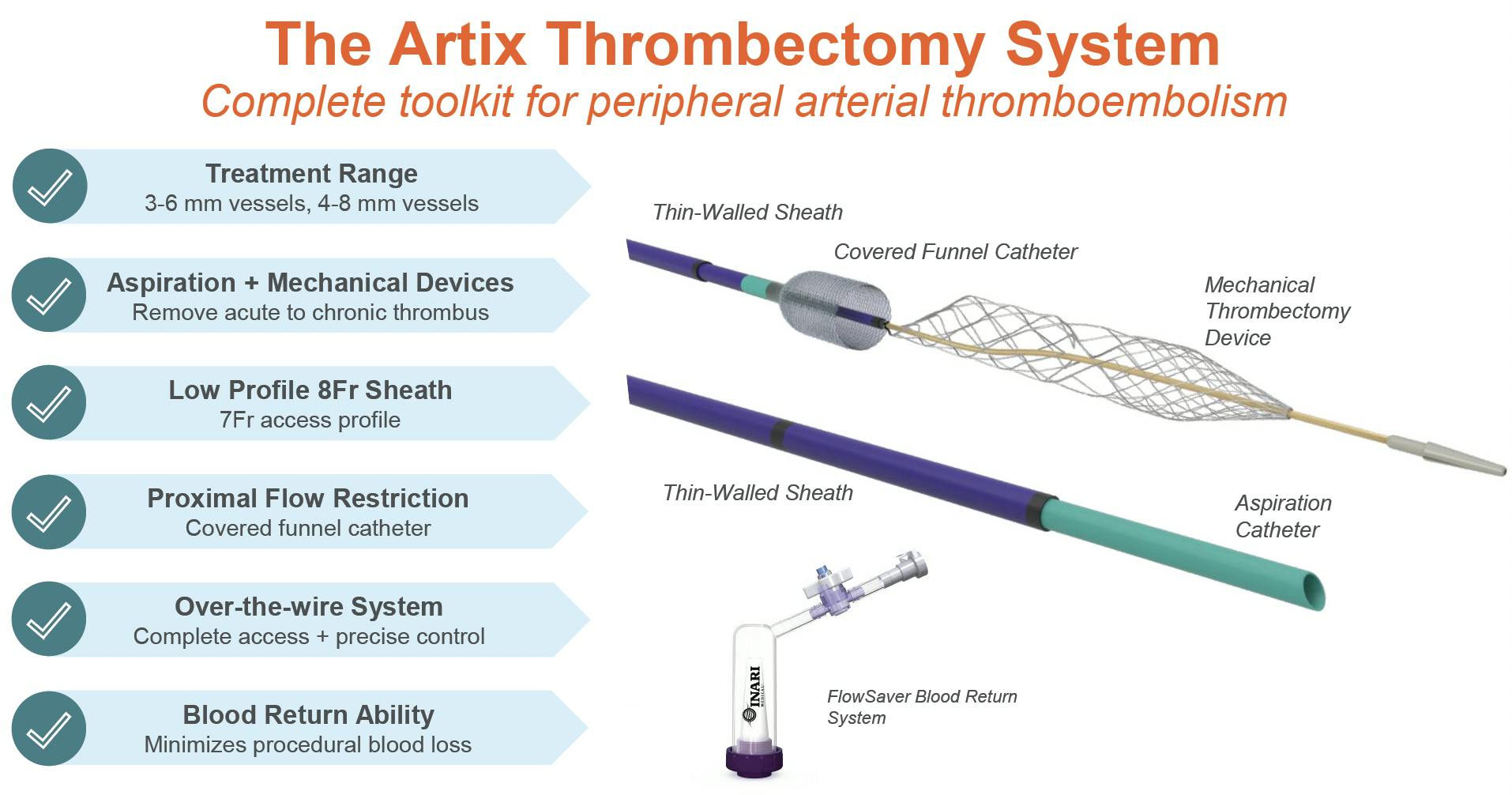
Artix offers physicians a complete toolkit to address peripheral arterial thrombus, in one easy-to-use system:
- Thin-walled sheath: A hydrophilic 8-F sheath—with a low-profile, 7-F access, and 65- and 90-cm lengths—facilitates streamlined access and aspiration.
- Covered funnel catheter: This tool restricts proximal flow to minimize the risk of thrombus migration* while enhancing thrombus capture by compressing it into the catheter.
- MT thrombectomy device: Equipped with a nitinol element, the device is optimized for retrieving thrombi of varying chronicity.5† The Artix MT exerts less than one-third the radial force of a Fogarty balloon, minimizing vessel injury while effectively removing acute-to-chronic thrombus. It is available in two sizes—MT6 for vessels 3 to 6 mm in diameter and MT8 for vessels 4 to 8 mm in diameter.
- AX aspiration catheter: An 8-F, beveled-tip catheter designed for efficient suction thrombectomy.
The system also integrates Inari’s proprietary FlowSaver® Blood Return System, which enables intraprocedural blood return to mitigate blood loss, ensuring a safer and more efficient procedure.
Together, these components give physicians the flexibility to adapt their approach midprocedure without changing platforms, saving time and blood loss while maximizing procedural success.
MEETING CRITICAL CLINICAL NEEDS
Unlike devices limited to either mechanical extraction or aspiration, Artix is the only fully integrated system offering both mechanisms of action in one versatile platform. Real-world adoption has been rapid; > 1,000 patients have been treated within just 4 months of launch. Physicians consistently report strong safety signals, minimal vessel trauma, and reliable efficacy, setting a new benchmark in arterial thrombectomy.

In a late-breaking presentation at the 2025 Amputation Prevention Symposium (AMP), Dr. Khanjan Nagarsheth presented the clinical outcomes from 1,000 commercial Artix cases, demonstrating:
- 95% flow restoration
- 95% median thrombus removal
- Low (14%) lytic use postprocedure, with further reductions as operators gained confidence in Artix’s mechanical performance, compared to 20% to 60% lytic usage in endovascular thrombectomy cases with other devices6-8
Overall, Artix demonstrates very promising results across a variety of clinical presentations.
These results validate Artix as the only comprehensive toolkit that addresses the two greatest unmet needs in arterial thrombectomy—(1) effective removal of all thrombus types, across varying chronicities and (2) a dedicated, purpose-built mechanism to intraprocedurally arrest flow—all delivered in an over-the-wire platform that enables complete vessel access and procedural control.
My Early Experience With Artix (N = 8)


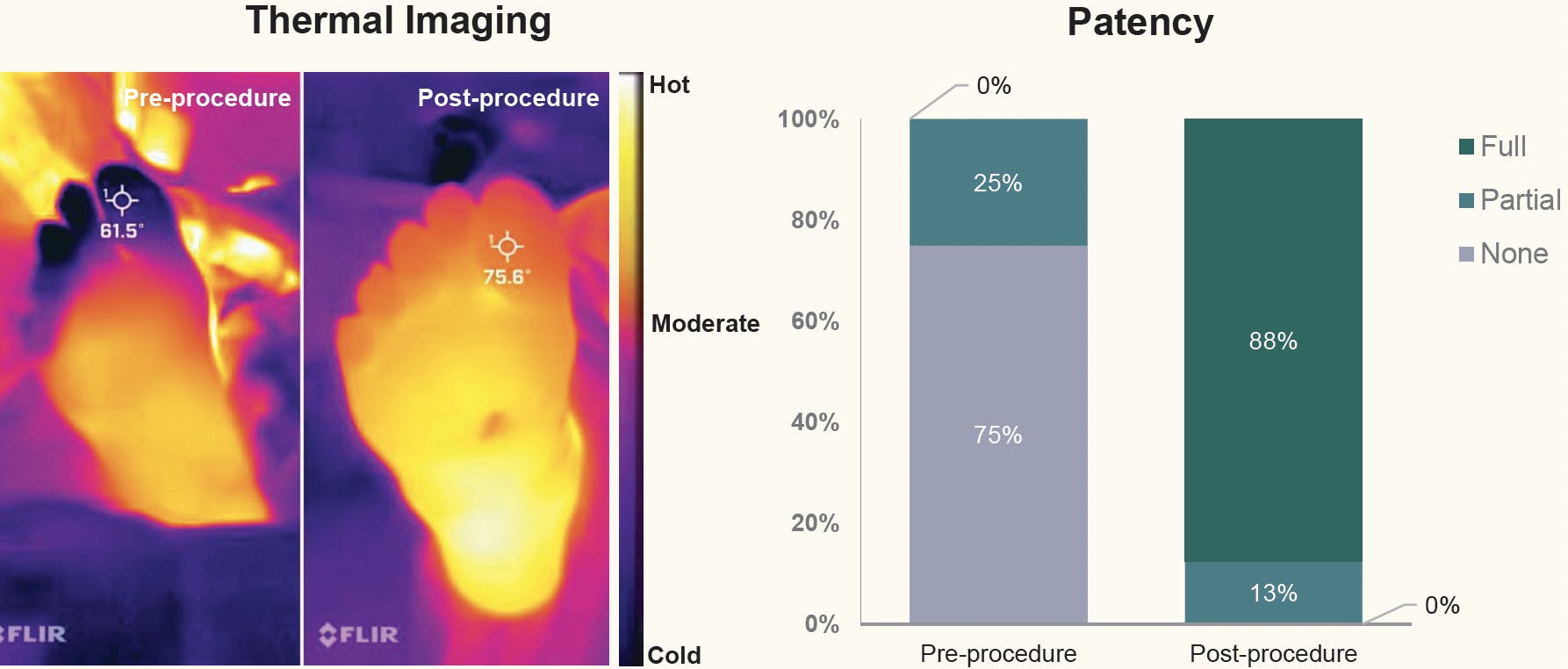
In his early clinical experience in eight patients presented at AMP 2025, Dr. Khanjan Nagarsheth reported highly encouraging outcomes with the Artix Thrombectomy System, achieving 100% flow restoration and a 100% limb salvage rate at 30 days. One illustrative case, captured with thermal imaging, highlights the dramatic improvement in perfusion: A patient’s foot showed full restoration of blood flow after the Artix procedure.
“In my practice, Artix represents a paradigm shift. It’s a single system that delivers both mechanical and aspiration thrombectomy with precision. In real-world cases, Artix has enabled rapid flow restoration without relying on lytics. That dual-action capability, combined with the covered funnel catheter, is what truly distinguishes Artix, and why it is now my first-line therapy for limb ischemia cases.”
—Khanjan Nagarsheth, MD,
Professor of Surgery at University of Maryland in Baltimore, Maryland
LOOKING AHEAD: ArtixASCEND
The journey continues with ArtixASCEND, a prospective, multicenter study enrolling approximately 300 patients across up to 50 sites. With independent adjudication and core lab imaging, ArtixASCEND will generate high-quality evidence on outcomes including limb salvage, revascularization, vessel injury, length of stay, quality of life, and other key measures.
Early commercial adoption and clinical experience presented on podium highlight the strong clinical performance of Artix and underscore the advantages of the Artix system versus other therapeutic options, such as lytics or aspiration-only modalities. Continued evaluation includes ongoing analysis via retrospective and prospective single and multicenter analyses and, now, via ArtixASCEND.
By combining innovation with real-world validation, Artix is not only reshaping arterial thrombectomy today—it is also building the evidence base to advance standards of care tomorrow.
CONCLUSION
The clinical experience to date with the Artix Thrombectomy System underscores its strong potential to transform the treatment of peripheral arterial thromboembolism, addressing a critical gap left by current options. Unlike conventional thrombectomy devices that are limited to a single mode of action, Artix’s dual mechanical plus aspiration platform, in addition to the flow arrest feature of the covered funnel catheter, enable physicians to adapt during the case in real time, ensuring effective treatment across a wide spectrum of thrombus types and chronicities.
In commercial experience to date, Artix consistently delivered efficient clot removal, rapid revascularization, and complete flow restoration via a single session, without reliance on adjunctive lytics. This ability to safely and effectively clear clot of varying chronicity sets Artix apart as a true next-generation solution.
As a versatile, all-in-one system, Artix represents an exciting forward advancement in arterial thrombectomy, bringing efficacy, procedural control, and a complete toolkit to a therapy area long defined by limited solutions and compromise.
Case Example: Real-World Impact

PATIENT PRESENTATION
A man in his early 80s with preexisting moderate-to-severe peripheral artery disease presented with an acutely cold leg and absent pedal pulses. Imaging revealed an occlusion in the superficial femoral artery, with reconstitution in the proximal popliteal artery (Figure 1A and 1B).

Figure 1. Occlusive thrombus in the superficial femoral artery with reconstitution in the proximal popliteal artery prior to thrombectomy (A, B). In-line flow was restored after mechanical and aspiration thrombectomy with Artix (C, D).
PROCEDURAL OVERVIEW
The Artix Thrombectomy System was selected to address the thrombotic occlusion. Using the MT8 catheter with a proximal covered funnel catheter, nine mechanical passes were performed, followed by a single aspiration maneuver. The result was rapid restoration of in-line flow and return of pedal pulses, confirmed with Doppler ultrasound (Figure 1C and 1D).
The procedure had minimal blood loss (~30 mL) and no need for thrombolytics.
”In open surgery, we control embolization by clamping the artery. With its flow arrest capability, Artix gives me that same protection in a percutaneous procedure— delivering the advantages of open surgery while keeping the approach fully endovascular.” –Dr. Siah
DISCUSSION
This case highlights the ability of Artix to enable efficient, complete, controlled clot removal while improving procedural flow.
1. de Donato G, Pasqui E, Sponza M, et al; INDIAN trial collaborators. Safety and efficacy of vacuum assisted thrombo-aspiration in patients with acute lower limb ischaemia: the INDIAN trial. Eur J Vasc Endovasc Surg. 2021;61:820-828. doi: 10.1016/j.ejvs.2021.01.004
2. Heller S, Lubanda JC, Varejka P, et al. Percutaneous mechanical thrombectomy using Rotarex® S device in acute limb ischemia in infrainguinal occlusions. Biomed Res Int. 2017;2017:2362769. doi: 10.1155/2017/2362769.
3. Olinic DM, Stanek A, Tătaru DA, et al. Acute limb ischemia: an update on diagnosis and management. J Clin Med. 2019;8:1215. doi: 10.3390/jcm8081215
4. Creager MA, Kaufman JA, Conte MS. Clinical practice. Acute limb ischemia. N Engl J Med. 2012;366:2198-206. doi: 10.1056/NEJMcp1006054
5. Narula N, Dannenberg AJ, Olin JW, et al. Pathology of peripheral artery disease in patients with critical limb ischemia. J Am Coll Cardiol. 2018;72:2152-2163. doi: 10.1016/j.jacc.2018.08.002
6. Maldonado TS, Powell A, Wendorff H, et al; STRIDE study group. One-year limb salvage and quality of life following mechanical aspiration thrombectomy in patients with acute lower extremity ischemia. J Vasc Surg. 2024;80:1159-1168.e5. doi: 10.1016/j.jvs.2024.05.043
7. Gray BH, Wheibe E, Dicks AB, et al. Pounce thrombectomy system to treat acute and chronic peripheral arterial occlusions. Ann Vasc Surg. 2023;96:104-114. doi: 10.1016/j.avsg.2023.05.019
8. Gong M, He X, Zhao B, et al. Endovascular revascularization strategies using catheter-based thrombectomy versus conventional catheter-directed thrombolysis for acute limb ischemia. Thromb J. 2021;19:96. doi: 10.1186/s12959-021-00349-9
*According to benchtop testing compared to control. Internal data on file. NOTE: To attempt to minimize risk of arterial embolization of blood clots, use of a device that entraps clots may potentially be helpful, but this has not yet been demonstrated to be effective in the arterial system.
† Designed to remove acute to chronic arterial clots. According to benchtop testing compared to control. Internal data on file.
The physicians featured are sharing their views and opinions and are expressing their experience with Inari Medical devices. Their opinions and experiences using these devices were created independently of Inari Medical and may not represent every experience or outcome with the devices.
PRO-2403-USA-EN-v1
Advertisement
Advertisement