Advertisement
Advertisement
November 2025
Sponsored by AngioDynamics, Inc.
Novel Complete Transradial Therapy for Chronic Limb-Threatening Ischemia
Practical application of Auryon Laser Atherectomy in a fully transradial approach to complex below-the-knee CLTI.
Over the past 2 decades, disease processes that have required endovascular intervention have increased in severity and complexity. As medical treatments have improved, patients are now living through conditions that may have resulted in mortality previously. This has resulted in patients presenting to our endovascular practices with peripheral artery disease (PAD) that can be particularly challenging to treat, including vascular chronic total occlusions (CTOs), in-stent restenosis, severely calcified lesions, and multilevel occlusive PAD. As interventionalists, we strive to offer solutions that can address these difficult-to-treat disease processes while offering the minimal amount of procedural risk.
As a dedicated transradial endovascular interventionalist, a transradial solution had been missing that could effectively treat these difficult-to-treat lesions. AngioDynamics has brought to market a novel transradial laser atherectomy device that—due to its unique mechanism of action—is able to treat complex disease from the common femoral artery (CFA) to tibial vessels using a hydrophilically coated, 225-cm length catheter.1
The Auryon Laser Atherectomy Catheter (AngioDynamics, Inc.) is different from prior laser atherectomy catheters due to its unique 355-nm wavelength with < 25 ns pulse width and 3.5 eV of photon energy. This allows for plasma formation at the tip of the catheter, which results in high-energy photoablation of calcium and pathologic mixed-plaque morphology lesions while minimizing the risk of injury to native tissue (which is affected at over 3.6 eV of photon energy). There is no interaction with contrast media or collateral vascular thermal injury. The catheters can provide treatment at 50 mJ/mm2 for 5 minutes and 60 mJ/mm2 for 5 minutes (ie, a total of 10 minutes of lasing time) and do not require specialty wires. Also available in femoral lengths, this is the first laser atherectomy catheter that is available in transradial lengths, thus helping to complete the transradial toolbox for complex disease.
This article highlights the utility of the Auryon Laser Atherectomy Catheter in addition to its safety profile using the case of a patient with chronic limb-threatening ischemia (CLTI) treated at an ambulatory surgical center.
CASE PRESENTATION
The patient was a man in his late 60s with a past medical history significant for coronary artery disease treated with bypass surgery, ischemic cardiomyopathy with ejection fraction of 30% to 35%, type 2 diabetes mellitus, hypertension, hyperlipidemia, and PAD treated with an endovascular intervention nearly a decade prior to presentation. He was a former smoker, compliant with aspirin and clopidogrel dual antiplatelet therapy, and presented upon referral from the wound care center with a progressive left great toe necrotic wound. Lower extremity Doppler arterial duplex ultrasound demonstrated severely calcified and stenotic bilateral CFA stenosis, distal left superficial femoral (SFA) and popliteal artery (PA) stent occlusion, and trickle flow to the left anterior tibial (AT) artery. The decision was made to proceed with transradial peripheral angiography and intervention as indicated.
PROCEDURAL OVERVIEW
Under ultrasound guidance, the right radial artery was accessed, and a 6-F Glidesheath Slender hydrophilic sheath (Terumo Interventional Systems) was initially used for access. Diagnostic angiography was performed transradially that demonstrated severely calcified left CFA stenosis with over 30 mm Hg gradient noted through a 4-F diagnostic catheter (Figure 1A). As suggested by the duplex ultrasound, the distal left SFA and PA stented region was occluded, with profunda femoris and geniculate collaterals reconstituting the AT and posterior tibial arteries distally (Figure 1B-1D). A 119-cm R2P Destination Slender sheath (Terumo Interventional Systems) was used for the intervention with unfractionated heparin used for procedural anticoagulation. The patient continued his dual antiplatelet therapy periprocedurally per his routine dose and schedule.
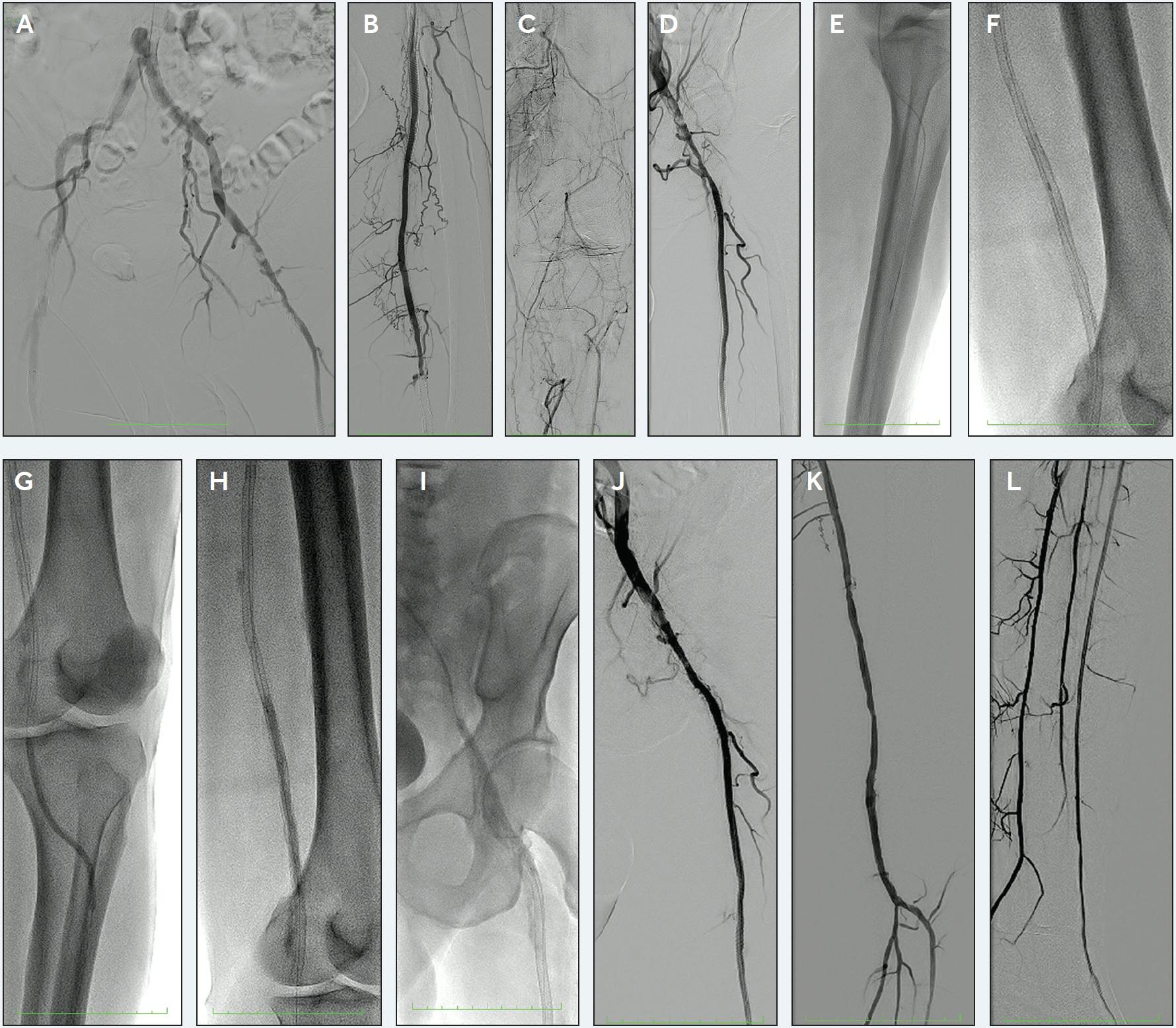
Figure 1. Transradial abdominal aortography demonstrating severely calcified bilateral CFA stenosis (A). Left lower extremity angiography demonstrating occlusion of the distally stented segment in the left SFA (B). Left lower extremity angiography demonstrating long-segment occlusion involving the entire PA and proximal tibial vessels (C). Left lower extremity angiography demonstrating severely calcified eccentric left CFA stenosis (D). Angiogram demonstrating crossing of CTO into the left AT artery (E). Auryon XL 1.5-mm laser catheter being used to treat the area of CTO from the distal SFA into the AT artery (F). 4-mm balloon angioplasty of the distal left PA extending into the AT artery (G). 6-mm noncompliant balloon angioplasty of the distal left SFA and PA (H). 7-mm noncompliant balloon angioplasty of the left CFA (I). Left lower extremity angiography of left CFA after Auryon XL 1.5-mm laser atherectomy at 60 mJ/mm2 and angioplasty (J). Left lower extremity angiography of left SFA and PA after Auryon XL 1.5-mm laser atherectomy at 60 mJ/mm2 and angioplasty (K). Left lower extremity angiography of left AT artery after Auryon XL 1.5-mm laser atherectomy at 50 mJ/mm2 and angioplasty demonstrating resumption of brisk three-vessel runoff (L). Actual procedure results/images. Images courtesy of Dr. Amit Srivastava. These images and results represent the experience of one institution and are not indicative of all procedure results.
A 0.035-inch Glidewire Advantage and R2P NaviCross catheter (both from Terumo Interventional Systems) were used to cross the left SFA and PA total occlusions into the left AT artery (Figure 1E). A radial-length ViperWire (Abbott) was advanced in a prolapsed fashion into the dorsum of the left foot. A 1.5-mm Auryon XL 225-cm-long catheter (AngioDynamics, Inc.) was used to treat the calcific left CFA for 2 minutes and 30 seconds at 60 mJ/mm2 as well as the occluded distal left SFA and PA for 2 minutes and 30 seconds at 60 mJ/mm2. The most distal left PA extending into the left AT artery was treated with this same catheter at 50 mJ/mm2 for 5 minutes (Figure 1F). The distal left PA extending to the left AT artery subsequently underwent angioplasty with a 4-mm semicompliant Crosstella balloon (Terumo Interventional Systems) (Figure 1G). The left SFA and proximal to mid PA occluded segments underwent angioplasty with a 6-mm Jade noncompliant balloon (Abbott) (Figure 1H). The left CFA was treated with angioplasty using a 7-mm Jade noncompliant balloon (Figure 1I). All angioplasty was performed at nominal pressure for 3-minute inflations.
Postintervention, a marked angiographic appearance and no residual pressure gradient were noted in the left CFA (Figure 1J). Brisk three-vessel runoff with no residual pressure gradient was also noted in the areas of distal intervention (Figure 1K and 1L).
DISCUSSION
This case exemplifies the ability to treat very complex disease processes causing CLTI via the transradial approach in an outpatient setting in a medically complex patient. Transradial laser atherectomy was able to provide effective treatment for highly calcific stenosis, CTOs of previously placed stents, and tibial vessel occlusion.
Previous barriers to transradial intervention had included no effective treatment for in-stent restenosis or CTOs. Due to the unique mechanism of action of this version of laser atherectomy, effective as well as safe treatment is now available transradially for these complex disease processes, as evidenced by this case. In the PATHFINDER registry, a < 1% embolization rate was noted with this technology in which 44% of the treated population presented with CTOs.2 This provides for a historically effective and safe treatment modality for these mixed-plaque morphology lesions known to carry higher embolic potential.
Regarding the ability to treat calcium, this case demonstrates safe and effective modification of calcified stenosis via the transradial approach. After Auryon laser atherectomy at 60 mJ/mm2 was performed in a slow manner through the lesion, it is important to note that angioplasty was performed without significant resistance. Calcified lesions such as the one treated in this case example are notorious for being refractory to balloon angioplasty without either rupturing the balloon or needing high pressure to fully inflate angiographically. This is consistent with microCT data that demonstrate impressive fracturing of medial wall calcification in a cadaveric model with Auryon laser technology.3 The unique mechanism of photoablation generated with the Auryon laser allows for ablation of intimal vascular calcium at the catheter tip without collateral thermal injury. Because of the ability to both treat intimal calcification as well as significantly modify medial wall calcification, angioplasty could be performed at subnominal to nominal balloon pressures in our case.
This is an exciting time for endovascular intervention, as medically and procedurally complex patients can now be safely and effectively treated via the transradial approach. AngioDynamics has brought to market the Auryon XL laser catheter, enabling operators to provide effective transradial solutions to an endovascular population that is getting more complex by the day.
1. US Food and Drug Administration. 510(k) Premarket Notification: K233668—Auryon Atherectomy Catheter 0.9 mm XL and 1.5 mm XL (hydrophilic and standard). Silver Spring, MD: FDA; December 15, 2023. Accessed October 22, 2025.
2. Das TS, Shammas NW, Yoho JA, et al. Solid state, pulsed-wave 355 nm UV laser atherectomy debulking in the treatment of infrainguinal peripheral arterial disease: the Pathfinder registry. Catheter Cardiovasc Interv. 2024;103:949-962. doi: 10.1002/ccd.31023
3. Rundback J, Kawai K, Sato Y, et al. Treatment effect on medial arterial calcification in below-knee after Auryon laser atherectomy using micro-CT and histologic evaluation. Cardiovasc Revasc Med. 2023;57:18-24. doi: 10.1016/j.carrev.2023.06.027
AngioDynamics, the AngioDynamics logo, Auryon, the Auryon logo are trademarks and/or registered trademarks of AngioDynamics, Inc., an affiliate or a subsidiary. © 2025 AngioDynamics, Inc. US/PA/SM/3860 Rev 01 10/2025

Amit Srivastava, MD, FACC, FABVM
Director of Cardiology/Vascular Medicine
Florence Wormald Heart & Vascular Institute
St. Elizabeth Healthcare
Edgewood, Kentucky
Disclosures: Paid consultant to AngioDynamics.
Advertisement
Advertisement