Advertisement
Advertisement
November 2025
IMPROVE-AD: Rationale and Progress to Date
Dr. Firas F. Mussa talks about the goals of IMPROVE-AD, its design and what makes it unique, how funding was obtained, the role of the patient advocacy group, and more.

To start, what are the goals of the IMPROVE-AD trial?
The goal of the IMPROVE-AD trial is to study the most appropriate management of uncomplicated type B aortic dissection (TBAD), as defined by all TBAD without signs of rupture or malperfusion.
What are the broad strokes of the trial design, and what makes IMPROVE-AD unique? What can you tell us about the pragmatic design elements?
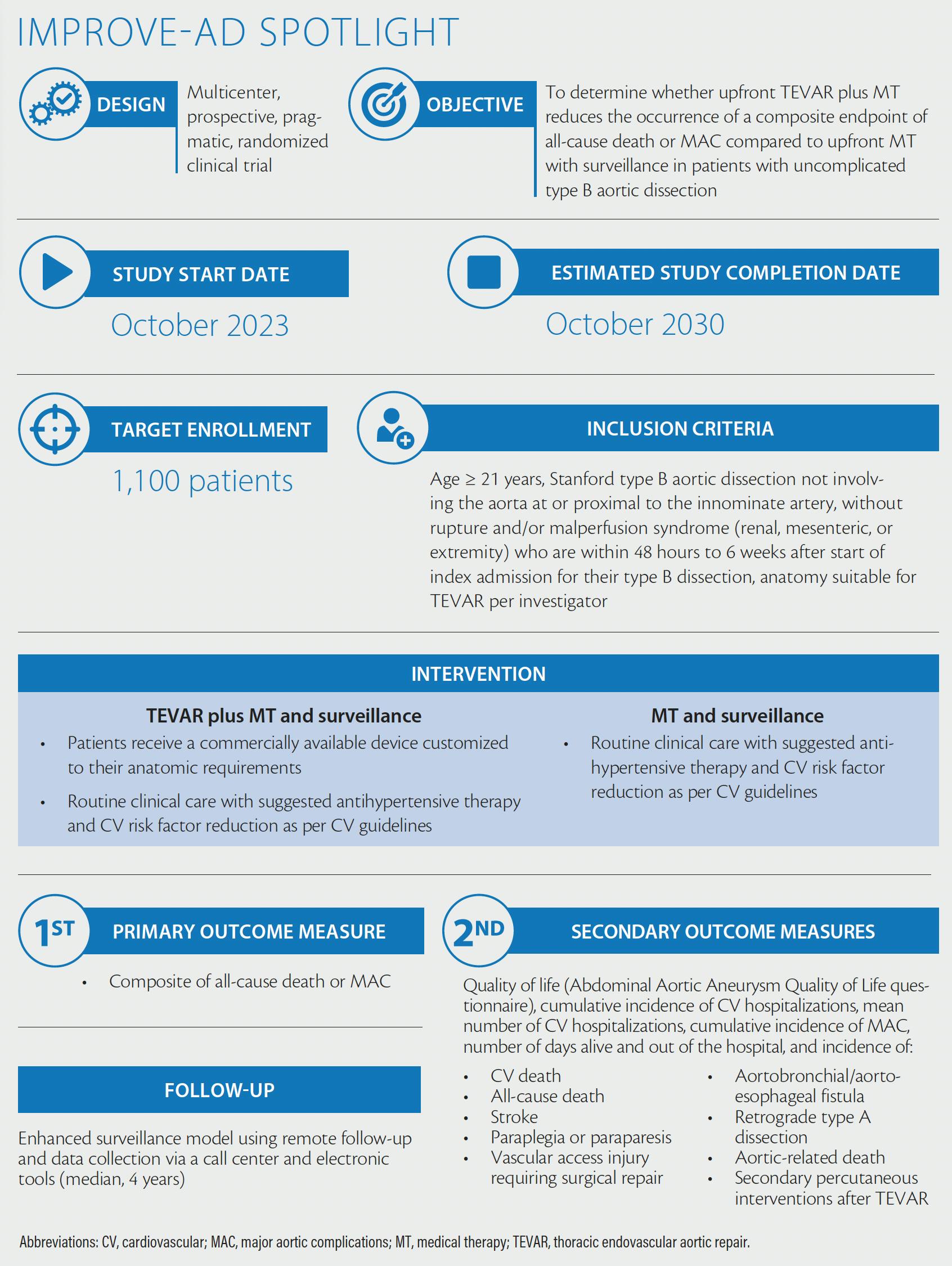
IMPROVE-AD is the first large, multicenter, randomized trial investigating the role of upfront thoracic endovascular aortic repair (TEVAR) compared to medical treatment and selective TEVAR if required during follow-up. The sample size is 1,100 patients and includes all-comers, but we do stratify based on some (not all) of the high-risk features to ensure both arms are similar. The trial is pragmatic, meaning that we are trying to mirror current practices, use hard clinical endpoints (not surrogate endpoints), and remove the burden from sites by conducting remote follow-up through the trial call center.
How did you determine the primary and secondary endpoints?
The primary endpoint is all-cause death and major aortic complications (MAC) at 4 years. MAC includes serious procedures and disease-related complications, such as aortic rupture, malperfusion syndrome, new aortic tear requiring intervention, retrograde aortic dissection, dependence on outpatient dialysis, major amputation, and need for future surgery (open or complex endovascular).
As for the secondary endpoints, we look into safety and efficacy again, but the most important is the quality of life and health economics analysis. Upon study completion, we will have > 10,000 CT images in one prospective database.
What secondary analyses are planned?
Similar to what’s being done with the BEST-CLI data, with IMPROVE-AD, we will have a trove of data on > 1,000 patients with TBAD that, for the first time ever, are prospectively collected. There is no limit to how many ways the data can be analyzed over the next 5 to 10 years for key learnings.
Can you walk us through the process of gaining funding for the trial? What were the challenges, and what most interested National Institutes of Health (NIH) in supporting this trial?
To undertake an NIH trial, one must thoroughly understand the design, steps, and resources required, which includes a nuanced knowledge of event rates, effect size, power calculations, and how to assemble the right team for both the clinical side and data reporting, which for IMPROVE-AD includes a data coordinating center (and that center should have participated in NIH trials previously). For the NIH, it was important to present a credible team of NIH trialists with two to three completed studies under their belt, as well as a well-written grant. The funding depends on how much money the NIH is getting that year (based on Congress).
What is the role of the patient advisory group, and what are some insights that helped shape the overall design and conduct?
The patient engagement committee, led by Dr. Sherene Shalhub and an aortic dissection patient survivor, meets monthly. A patient-to-patient video helps explain the value of trial participation to potential participants. The committee has helped ensure that the outcomes collected reflect what matters to patients (ie, patients prioritize different outcomes than surgeons) and leverages patient insights to understand certain parameters—for instance, low site conversion rates (screened vs enrolled).
What is unique about the follow-up protocols you’ve developed?
Data are collected after discharge through the Duke Call Center, which reduces costs, site visits, and bureaucratic paperwork. This approach was particularly effective during the COVID lockdown.
How is enrollment progressing? How are the trial sites engaging potential patients?
Enrollment has been more challenging than we initially thought, and we have half of our target enrollment. Among 60 active sites, 12 have no patients enrolled at this time. On the other hand, sites that have enrolled successfully have developed a pathway where staff have the trial top of mind from the minute a patient shows up to the emergency department. It takes a culture, and the study sites need to be invested with one champion per site.
IMPROVE-AD is the only ongoing vascular surgery–led trial, and once the trial started, we had hoped to have more society support.
What is the expected timeline for enrollment, and what is the earliest that interim results might be shared?
Enrollment started in February 2024 and ends in 2028. The study will end in 2030 to allow complete follow-up and analysis. We have one planned interim analysis in late 2026, which will be for internal use only with the NIH.
How might the results of IMPROVE-AD impact practice? Will this be the definitive data set to determine treatment for all uncomplicated TBAD moving forward?
IMPROVE-AD is the only hope of providing the highest-quality and highest-level data on management of uncomplicated TBAD since the death of King George II in 1760. With the exception of BEST-CLI, this is the only vascular surgery–led trial of its kind. As for changing practice, IMPROVE-AD will provide the data needed to guide practice in the future. Clearly, the practice of medicine is subject to much more than just evidence, as we see in coronary artery disease, carotid disease, and even peripheral artery disease.
Advertisement
Advertisement