Advertisement
Advertisement

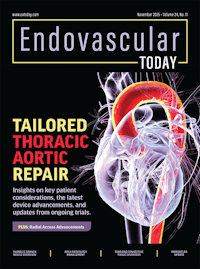
The aortic arch has long been considered the final frontier of endovascular therapy. The pace of innovation has accelerated in recent years, and with a growing arsenal of branched and fenestrated technology, refined hybrid and off-the-shelf solutions, and advanced imaging and planning, we are closer than ever to truly endovascular solutions for complex aortic arch disease.
The recent approval of the Gore TAG thoracic branch endoprosthesis (Gore & Associates) now gives us an FDA-approved option for endovascular therapy involving the head vessels, and with more devices in the clinical trial pathway, the future is bright.
The Gore TAG and other thoracic branch systems that have emerged recently aim to address one of the key limitations of traditional thoracic endovascular aortic repair (TEVAR): the inability to maintain perfusion to critical supra-aortic branches when treating pathologies that extend proximally into the aortic arch. In this issue, we aim to highlight these devices, as well as discuss solutions for more urgent or unusual cases.
To begin, Michael D. Dake, MD; Adam W. Beck, MD; Carlos Timaran, MD; Giovanni Tinelli, MD; Simona Sica, MD; Yamume Tshomba, MD; Robert C. Lind, MD; and Jacob Budtz-Lilly, MD, explore next-generation thoracic branch systems, their design and early clinical experience, and the evolving regulatory landscape.
Jonathan Bath, MD; Brant W. Ullery, MD; and Christopher J. Smolock, MD, follow with a procedural roadmap for endovascular repair of zone 0 aortic arch pathology, highlighting their use of laser in-situ fenestration and the Gore TAG thoracic branch endoprosthesis, respectively. Their insights offer practical guidance for navigating one of the most technically demanding areas of aortic intervention.
In addition to our technologically focused discussion, we wanted to review some important and more nuanced concepts in thoracic aortic disease. J. Westley Ohman, MD, discusses decision-making and the role of endovascular therapy in the treatment of patients with connective tissue diseases, reflecting a challenge to the dogma of open surgery. This discussion emphasizes evidence-based screening protocols, how these inherited genetic aortopathies inform the treatment approach, advice for counseling patients, and the importance of multidisciplinary collaboration.
The treatment of uncomplicated type B aortic dissection has long been a divisive issue, but a new clinical trial hopes to provide guidance regarding the optimal treatment strategy going forward. Rounding out the issue focus, Firas F. Mussa, MD, presents an overview of the IMPROVE-AD trial—a National Institutes of Health–funded, multicenter, randomized study comparing upfront TEVAR versus optimal medical therapy with selective TEVAR. Dr. Mussa outlines the study’s design, objectives, and its potential to redefine management paradigms in type B aortic dissection.
Beyond the aorta, we also explore radial access intervention and its expanding footprint across multiple specialties. Sarah J. Carlson, MD; Daryl Goldman, MD; Darren Klass, MBChB, MD; Andrew Shabila, MD; Shaun Nordeck, MD; and AJ Gunn, MD, share their perspectives on the trends and innovations shaping the future of radial access in peripheral artery disease, neurointervention, interventional oncology, and embolization.
Complementing this discussion, Amanda Baker, MD, and Brian Snelling, MD, detail their patient selection strategies for radial neurointervention, providing valuable clinical insights for operators refining their approach.
As the tools and techniques for treating the thoracic aorta and arch continue to evolve, so too does our understanding of when and how to apply them. The insights in this issue reflect the collective experience of experts who are redefining the limits of endovascular therapy, while keeping patient safety and long-term durability at the forefront. We hope the perspectives presented here will inspire continued discussion, reflection, and innovation in tackling one of the most formidable challenges in endovascular intervention.
Jordan R. Stern, MD
Guest Chief Medical Editor
Advertisement
Advertisement