Advertisement
Advertisement
October 2025
Current TF-CAS and TCAR Technology Landscape
A review of currently available stenting platforms for the treatment of carotid artery disease.
Stroke remains one of the leading causes of death and long-term disability worldwide, with carotid artery disease contributing to approximately 15% to 20% of ischemic strokes.1,2 Revascularization methods include carotid endarterectomy (CEA), transfemoral carotid artery stenting (TF-CAS), and transcarotid artery revascularization (TCAR), as well as optimal medical therapy.
Over the years, TF-CAS saw reduced adoption due to lack of reimbursement in many patients, as well as concerns by some practitioners regarding the risk of periprocedural stroke from embolic debris. In the meantime, TCAR has emerged as an alternative—and reimbursed—stent therapy in suitable candidates. Recently, the technologic advancements of the newest-generation platforms, combined with the expansion of reimbursement by the United States Centers for Medicare & Medicaid Services for TF-CAS, have reignited interest in this least-invasive approach, providing a variety of potential options for treating carotid artery disease.
This article reviews the current and emerging platforms available in the United States for carotid stenting, detailing the technologies driving renewed interest in carotid revascularization (Table 1). They are routinely employed for patients who have ≥ 50% stenosis of the common carotid artery, internal carotid artery, or carotid bifurcation or for asymptomatic patients with ≥ 80% stenosis.
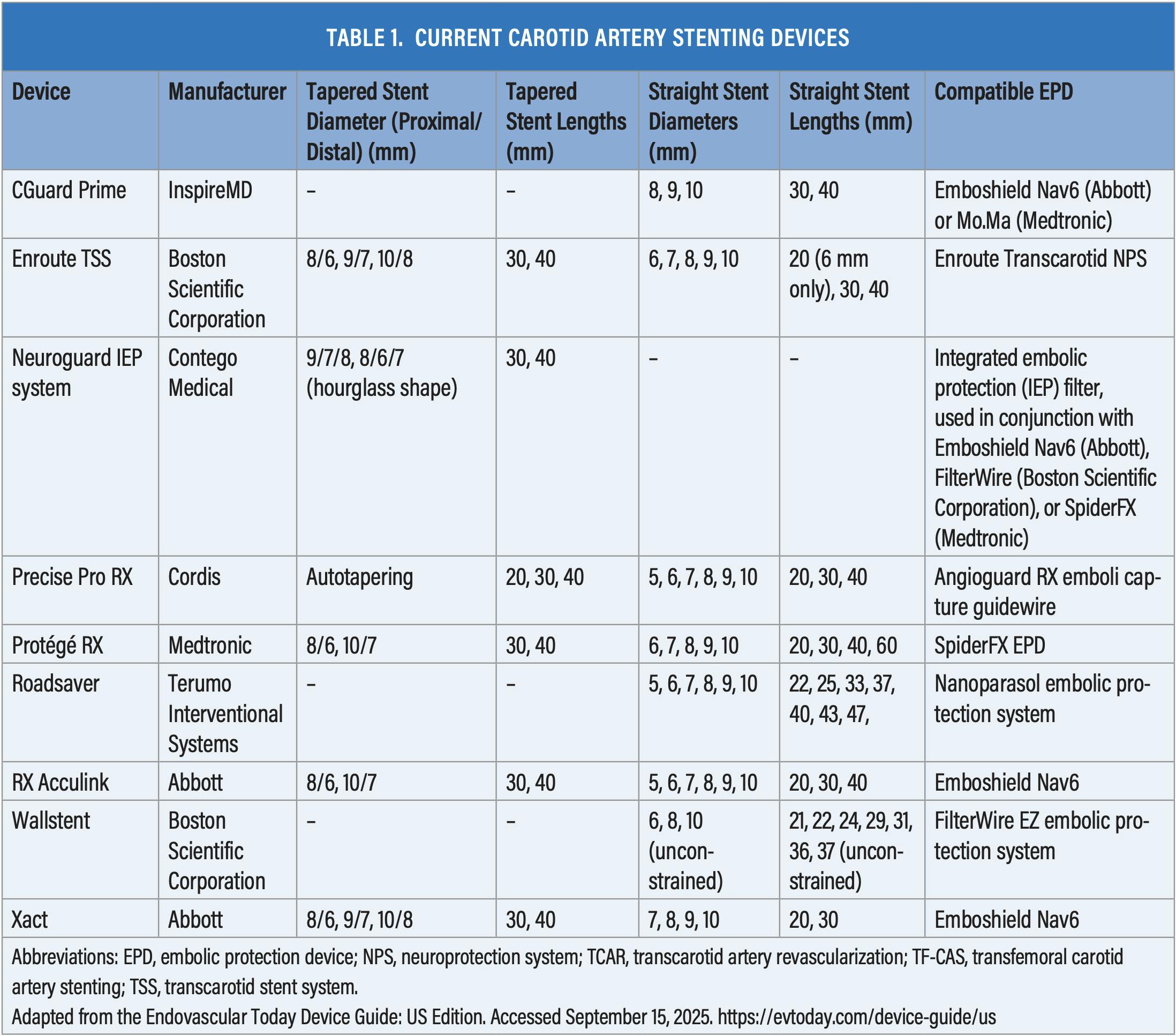
Carotid stents only gained FDA approval when paired with an embolic protection system (EPS), typically a distal filter, which was deployed during the procedure; these are listed with the specifics of each stent herein. Other available EPSs that can be paired with carotid stent devices include proximal flow cessation (Mo.Ma ultra proximal cerebral protection, Medtronic) and flow reversal (Gore Flow Reversal System, Gore & Associates) systems. More recently, the adaptability of the Enroute transcarotid stent system (TSS; Boston Scientific Corporation), which provides embolic protection by high-flow reversal of carotid circulation via direct carotid access, allows (and is approved for) pairing with most carotid stents, and at least two (Carotid Wallstent endoprosthesis, Boston Scientific Corporation; Precise Pro Rx, Cordis) are available in shorter delivery system lengths to enable more favorable procedural ergonomics.
CAROTID WALLSTENT ENDOPROSTHESIS
The Carotid Wallstent endoprosthesis is a closed-cell, woven, Elgiloy, stainless steel, self-expanding stent. The device consists of a self-tapering straight stent that comes in 6-, 8-, and 10-mm diameters and lengths from 21 to 37 mm. The smaller sizes are compatible with 5-F guiding sheaths and 7-F guiding catheters, while the larger sizes are compatible with 6-F guiding sheaths and 8-F guiding catheters. The stent is repositionable up to a limit marker, usually when it is up to about 50% deployed. Navigation through tortuous anatomy is aided by built-in radiopaque markers and flexibility.
The Wallstent endoprosthesis must be used in conjunction with an EPS and is indicated for use with the FilterWire EZ EPS (Boston Scientific Corporation), which uses a 110-µm pore filter to capture any potential embolic material.
FDA approval was based on the BEACH trial, which demonstrated the safety and efficacy of the Carotid Wallstent monorail endoprosthesis and FilterWire EZ EPS.3
ENROUTE TRANSCAROTID STENT SYSTEM
The Enroute TSS is a self-expanding nitinol stent and delivery catheter system used to treat carotid artery disease via TCAR. The stent system is used in conjunction with the Enroute transcarotid neuroprotection system (NPS; Boston Scientific Corporation) and incorporates flow reversal to prevent embolic material from traveling to the brain during the procedure.4
The Enroute device includes a rapid-exchange delivery system consisting of an inner shaft and outer sheath. It is compatible with a 0.014-inch guidewire and is available in 5- and 6-F diameters. The device is suitable for treatment of diseased vessels 4 to 9 mm in length.
The Enroute was recently analyzed in the ROADSTER 3 clinical trial, a single-arm, postapproval study of 320 per-protocol (PP) patients enrolled at 53 sites in the United States. Adverse events were adjudicated by an independent clinical events committee, and there were independent neurologic assessments. The primary endpoint was a composite of major adverse events (stroke, death, or myocardial infarction [MI]) through 30 days postprocedure, plus ipsilateral stroke from day 31 to 365 postprocedure. The PP patients comprised the FDA analysis population. The rate of stroke, death, or MI at 30 days was 0.6% with a 30-day stroke rate of 0.6%. These rates were 0.9% and 0.9% in the intent-to-treat population. There were no deaths or MIs through 30-day follow-up. The results of the ROADSTER 3 study demonstrated that TCAR using the Enroute TSS in conjunction with the Enroute NPS is safe and effective in patients at standard risk for adverse events from CEA.5
PROTÉGÉ RX SELF-EXPANDING CAROTID STENT SYSTEM
The Protégé RX carotid stent system (Medtronic) includes a self-expanding, open-cell, nitinol stent that is delivered via a 0.014-inch rapid-exchange catheter and features a 6-F low crossing profile and flexible atraumatic tip. It can treat a reference vessel diameter of 4.5 to 9.5 mm at the target lesion.
The Protégé RX system is compatible with the SpiderFX embolic protection device (Medtronic). After the embolic protection device is deployed, the Protégé RX system is delivered using a rapid-exchange catheter, and the stent is then deployed at the site. It has tantalum GPS radiopaque markers at both ends to aid in positioning.
The CREATE trial was a prospective, multicenter, single-arm study that evaluated the Protégé self-expanding stent system with the SpiderFX embolic protection device in 419 high-surgical-risk patients across 31 United States sites. It demonstrated a 97.8% deployment success rate and a 30-day major adverse event rate of 4.8%, with a 1-year ipsilateral stroke rate of 5.3%, supporting the device’s safety and effectiveness.6
XACT CAROTID AND TRANSCAROTID STENT SYSTEMS
The Xact stent system (Abbott) is a self-expanding, closed-cell, nitinol stent mounted on a rapid-exchange catheter, indicated for carotid revascularization in both TF-CAS and TCAR therapies and, for embolic protection, is compatible with the Emboshield NAV6 EPS (Abbott) and the Enroute transcarotid NPS (in a shorter delivery system).
The Xact stent system is available in both straight and tapered configurations, with diameters ranging from 6 to 10 mm and lengths from 20 to 40 mm, to suitably address the patient’s anatomy. Its variable cell size—augmented by U- and S-shaped connectors and flared ends—allows for high radial force at the lesion as well as a cell design that minimizes risk of snagging. Its nitinol construction allows for minimal foreshortening and robust crush resistance at the lesion. The system is indicated for patients with a reference vessel diameter of 4.8 to 9.1 mm.
The safety and efficacy of the Xact stent system were evaluated in the PROTECT study, which demonstrated a periprocedural rate of death, any stroke, or MI (DSMI) of 2.3%, death or stroke of 1.8%, and death or major stroke rate of 0.5%.7
RX ACCULINK CAROTID STENT SYSTEM
The RX Acculink carotid stent system (Abbott) is an open-cell, self-expanding, nitinol stent mounted on a rapid-exchange catheter. It is available in both straight (diameter of 5-10 mm; lengths of 20, 30, and 40 mm) and tapered versions (diameters of 6-8 mm and 7-10 mm; lengths of 30 and 40 mm). It features a nested-ring design for conformability, with three longitudinal spines to minimize stent shortening. Its nitinol construction provides strength, crush resistance, conformability, and flexibility.
The RX Acculink employs a 0.014-inch rapid-exchange delivery catheter compatible with 6-F introducer sheaths or 8-F guiding catheters, allowing for single-operator deployment. It also has a unique handle mechanism designed for one-handed stent deployment via a finger-pull retraction system and integrated radiopaque markers to help ensure accurate positioning under fluoroscopy.
The RX Acculink must be used in conjunction with an EPS to minimize the risk of periprocedural stroke from distal embolization (compatible with Emboshield NAV6 EPS).
PRECISE PRO RX CAROTID STENT SYSTEM
The Precise Pro RX carotid stent system is an open-cell, self-expanding, nitinol stent with a multisegmented, micromesh, autotapering design that is contourable but able to resist recoil and prevent kinking. Delivered via a low-profile catheter, the system works with a 0.014-inch guidewire and is compatible with 5-F sheaths for 5- to 8-mm stent diameters as well as 6-F sheaths for 9- to 10-mm diameters, with a working length of approximately 135 cm. It is indicated for patients who have target vessel diameters from 4 to 9 mm.
The Precise Pro RX is used with the Angioguard RX embolic protection device (Cordis). The Angioguard features a basket that can be used in vessels from 3 to 7.5 mm. The Precise Pro RX is also available in a shorter delivery system for use with the Enroute TSS for embolic protection.
ROADSAVER CAROTID STENT SYSTEM
The Roadsaver carotid stent system (Terumo Interventional Systems) has a dual-layer micromesh and a closed-cell design, with a nitinol, outer self-expanding scaffold and an inner ultrafine micromesh layer that serves as an embolic barrier to help reduce the risk of plaque prolapse and distal embolization. The Roadsaver system is used with the Nanoparasol EPS (Terumo Interventional Systems).
The device has a rapid-exchange shaft length of 143 cm, is available in widths from 5 to 10 mm and lengths from 22 to 47 mm, and indicated for a target vessel reference diameter of 3.5 to 9.0 mm. It has a low-profile, 5-F design and is fully resheathable and repositionable, which helps with crossability.
Roadsaver was FDA approved in November 2024 based on the results of the CONFIDENCE investigational device exemption (IDE) trial, which demonstrated a low rate of death, stroke, or MI at 30 days and a low rate of ipsilateral stroke up to 1 year.8
NEUROGUARD IEP SYSTEM
The Neuroguard IEP system (Contego Medical, distributed by Medtronic) is a 3-in-1 system that consists of a self-expanding nitinol stent, a postdilation balloon, and a 40-µm integrated embolic protection (IEP) filter on a single dedicated 6-F delivery catheter, thereby reducing procedural steps by integrating multiple functions into one device and decreasing the need for multiple catheter exchanges. The device is deployed in the femoral artery via a 0.014-inch guidewire and is compatible with ≥ 0.084-inch inner diameter sheaths or guide catheters.
The Neuroguard IEP system was evaluated in the pivotal PERFORMANCE II study, a prospective, multicenter study involving 305 patients across 40 sites. There were no major strokes, no contralateral strokes, one (0.3%) death (cardiovascular), and two (0.7%) non–ST-segment elevation MIs through 30-day follow-up. Among asymptomatic patients, the 30-day stroke rate was 0.81% (2 patients). There was one (0.37%) minor ipsilateral stroke between day 31 and 1 year. There were no major strokes and no neurologic deaths at 1 year. Target lesion revascularization through 1 year was 1.47% (4 patients). Results at 1 year demonstrated the safety, efficacy, and durability of the Neuroguard IEP 3-in-1 device.9
The PERFORMANCE III trial is underway—a prospective, multicenter, open-label, single-arm investigation evaluating the Neuroguard IEP system for direct transcarotid access with blood flow reversal in patients at high surgical risk.10
CGUARD PRIME CAROTID STENT SYSTEM
The CGuard Prime carotid stent system (InspireMD) is a dual-layered stent that combines a self-expanding, nitinol, open-cell framework with an ultra-fine mesh, which is made with nonmetallic polyethylene terephthalate fibers and includes pore sizes of approximately 150 to 180 µm, encasing the scaffold and designed to capture plaque and thrombus while supporting natural vessel healing.
CGuard Prime received FDA postmarket approval in June 2025 based on the results of the C-GUARDIANS pivotal IDE trial, which included 316 patients from 24 sites in the United States and Europe and demonstrated a 0.95% DSMI rate at 30 days and a 1.93% rate of 30-day DSMI plus 31- to 365-day ipsilateral stroke.11
Of note, the CGuard Prime 80-cm stent system is currently being evaluated in the prospective, multicenter, single-arm, pivotal CGUARDIANS II trial using direct carotid access and is not yet approved for use.
1. Joh JH, Cho S. Cardiovascular risk of carotid atherosclerosis: global consensus beyond societal guidelines. Lancet Glob Health. 2020;8:e625-e626. doi: 10.1016/S2214-109X(20)30132-7
2. Petty GW, Brown RD Jr, Whisnant JP, et al. Ischemic stroke subtypes: a population-based study of incidence and risk factors. Stroke. 1999;30:2513-2516. doi: 10.1161/01.str.30.12.2513
3. Iyer SS, White CJ, Hopkins LN, et al. Carotid artery revascularization in high-surgical-risk patients using the Carotid WALLSTENT and FilterWire EX/EZ: 1-year outcomes in the BEACH pivotal group. J Am Coll Cardiol. 2008;51:427-434. doi: 10.1016/j.jacc.2007.09.045
4. US Food and Drug Administration. ENROUTE transcarotid stent system–P140026/S016. Accessed September 5, 2025. https://www.fda.gov/medical-devices/recently-approved-devices/enroute-transcarotid-stent-system-p140026s016
5. Dermody M. Prospective, multicenter evaluation of transcarotid artery revascularization (TCAR) in standard-risk patients: 30-day outcomes of the ROADSTER 3 study. Presented at: Vascular InterVentional Advances (VIVA) 2024: November 4, 2024; Las Vegas, Nevada.
6. Safian RD, Besnahan JF, Jaff MR, et al. Protected carotid stenting in high-risk patients with severe carotid artery stenosis. J Am Coll Cardiol. 2006;47:2384-2389. doi: 10.1016/j.jacc.2005.12.076
7. Matsumura JS, Gray W, Chaturvedi S, et al. Results of carotid artery stenting with distal embolic protection with improved systems: protected carotid artery stenting in patients at high risk for carotid endarterectomy (PROTECT) trial. J Vasc Surg. 2012;55:968-976. doi: 10.1016/j.jvs.2011.10.120
8. Evaluation of the Roadsaver stent used in conjunction with the Nanoparasol embolic protection system for carotid artery stenosis. Clinicaltrials.gov. Accessed September 8, 2025. https://clinicaltrials.gov/study/NCT02657707
9. Gray WA, Metzger DC, Zidar J, et al. The PERFORMANCE II trial: a prospective multicenter investigation of a novel carotid stent system. JACC Cardiovasc Interv. 2025;18:367-376. doi: 10.1016/j.jcin.2024.10.031
10. Direct access carotid artery stenting using the Neuroguard IEP system (PERFORMANCE III). Clinicaltrials.gov website. Accessed September 5, 2025. https://www.clinicaltrials.gov/study/NCT05845710
11. Metzger DC. One-year follow-up results from the C-GUARDIANS pivotal IDE trial of the CGuard™ carotid stent system. Presented at: Leipzig Interventional Course (LINC) 2024; May 28-31, 2024; Leipzig, Germany.
Advertisement
Advertisement
