Advertisement
Advertisement
September 2025
An Interview With Carlota F. Prendes, MD, PhD
Dr. Prendes discusses her current efforts to highlight gaps in data for complex aortic care and develop updated ESVS guidelines, the ideal training program for someone interested in aortic diseases, and the upcoming PRIZE trial.
Your practice has largely revolved around complex aortic management, with a PhD on endovascular treatment of complex aortic pathology and two complex aortic fellowships. What were some of the moments that cemented this as the path you wanted to pursue?
There were a few. The first was watching an open aortoiliac bypass for a standard abdominal aortic aneurysm (AAA) as a medical student. This triggered my curiosity for aortic surgery and ultimately led me to specialize in vascular surgery. Later, during an international residency rotation at Ospedale San Raffaele in Milan, Italy, I saw open and endovascular management of complex thoracoabdominal aortic aneurysms (TAAAs) in a highly specialized, world-renowned center. The surgeons there were not only technically exceptional but also completely dedicated to the field—up to date with every new publication, eager to innovate, and deeply motivated. That experience was a real stepping stone for me.
Your published work covers a wide range of aortic topics, from cell saver use in TAAA repair, to sex-related anatomic differences in aortic arch pathology, to heritable aortic diseases. How would you describe your personal research interests and priorities within the aortic realm?
Working on guidelines and systematic reviews quickly shows how often high-quality data are missing in complex aortic care. My research priorities focus on filling those gaps. At the moment, my main lines of research include contributing to European Society for Vascular Surgery (ESVS) documents, such as the descending thoracic aorta (DTA) guidelines and the female consensus document aiming to establish specific recommendations for females with vascular disease, both with the goal of delivering the best evidence-based recommendations and sparking smaller studies to address specific gaps. I’m also working on initiating the PRIZE trial—a randomized study on preemptive embolization—and to strengthen the evidence base for novel techniques where robust data are still lacking.
Can you tell us about the main objectives for the upcoming PRIZE trial?
PRIZE aims to see if preemptive coil embolization of certain side branches during endovascular aneurysm repair can reduce type II endoleaks, lower reintervention rates, and improve sac regression. We hope to overcome some of the limitations of previous randomized controlled trials, which often focused only on the inferior mesenteric artery or involved small patient cohorts. Right now, we’re in the process of securing funding.
You and colleagues recently published a review on the endo-Bentall procedure for ascending aorta pathologies.1 What kind of research or data do you think will be necessary for this to become a routine treatment?
There is still a long way to go. At present, we have only a handful of partially successful clinical cases. Several device designs have been proposed, but all are off-the-shelf, each with significant pitfalls and demanding substantial technical expertise. Optimized—or, ideally, custom-made—devices will be essential. Beyond that, much more clinical experience is required. Right now, the procedure is offered only very selectively to patients with no other alternatives and only in a handful of centers around the world, and the risk of major complications remains high.
Last year, you played a pivotal role in the creation and publication of the 2024 ESVS clinical practice guidelines for abdominal aortoiliac artery aneurysms, and you’re also working on the upcoming ESVS DTA guidelines (expected in 2026). What prompted these, and what are the main challenges?
These are updates of existing guidelines, intended to convert the latest 5 to 10 years of scientific progress into practical recommendations. The volume of new literature has been enormous, and although a lot of it is retrospective, much high-quality evidence has emerged that needs to be critically assessed and translated into guidance. The challenge is to extract the highest-quality data and frame pan-European recommendations that can work across very different populations, health systems, and reimbursement models. Equally important is building a writing committee that reflects a wide range of expertise and perspectives. Ultimately, the goal is to provide clear, evidence-based guidance that reduces variability in practice and helps drive future research and innovation.
In a recent ESVS podcast, you spoke about a gap in care where AAA ruptures more often in women, and yet women are screened less, diagnosed later, and have worse outcomes. What primary factors do you think have contributed to this disparity? What future research would be most beneficial in addressing this gap?
Women have long been underrepresented in vascular research, meaning that disease patterns and treatment strategies have historically been derived from male data. As more studies have begun to include female patients, it has become clear that presentation and outcomes often differ between the sexes. Recognition of these disparities has grown in recent years, which is crucial to drive further research into their underlying causes—many of which remain poorly understood.
Importantly, the differences aren’t limited to AAA. They span the whole spectrum of vascular disease, with women often presenting differently, at an older age, and with a distinct disease course. Recognizing these differences is critical to tailoring the best treatment strategies.
To address this, an ESVS consensus document has been developed to provide sex-specific recommendations across AAA, peripheral artery, carotid, and general vascular disease, with expected publication in 2026. I’ve had the honor of serving on the writing committee alongside experts from each field. In parallel, trials like WARRIORS are also focusing specifically on women, which will hopefully generate much-needed high-quality data.
As Thoracic and Suprarenal Aorta Section Editor of European Journal of Vascular and Endovascular Surgery (EJVES), how do you see the role of the peer-review journal editor evolving in the near future?
I believe this role is becoming increasingly important in light of the rapid development of artificial intelligence. Editors will need to safeguard that evidence, data, and analyses are meticulously performed and transparently reported, maintaining the highest standards of quality. At the same time, I look forward to the availability of long-term results from complex endovascular aortic interventions, which will be essential to guide practice. Finally, the editor’s role will also involve fostering responsible technical innovation, ensuring that progress is balanced with rigorous quality assurance.
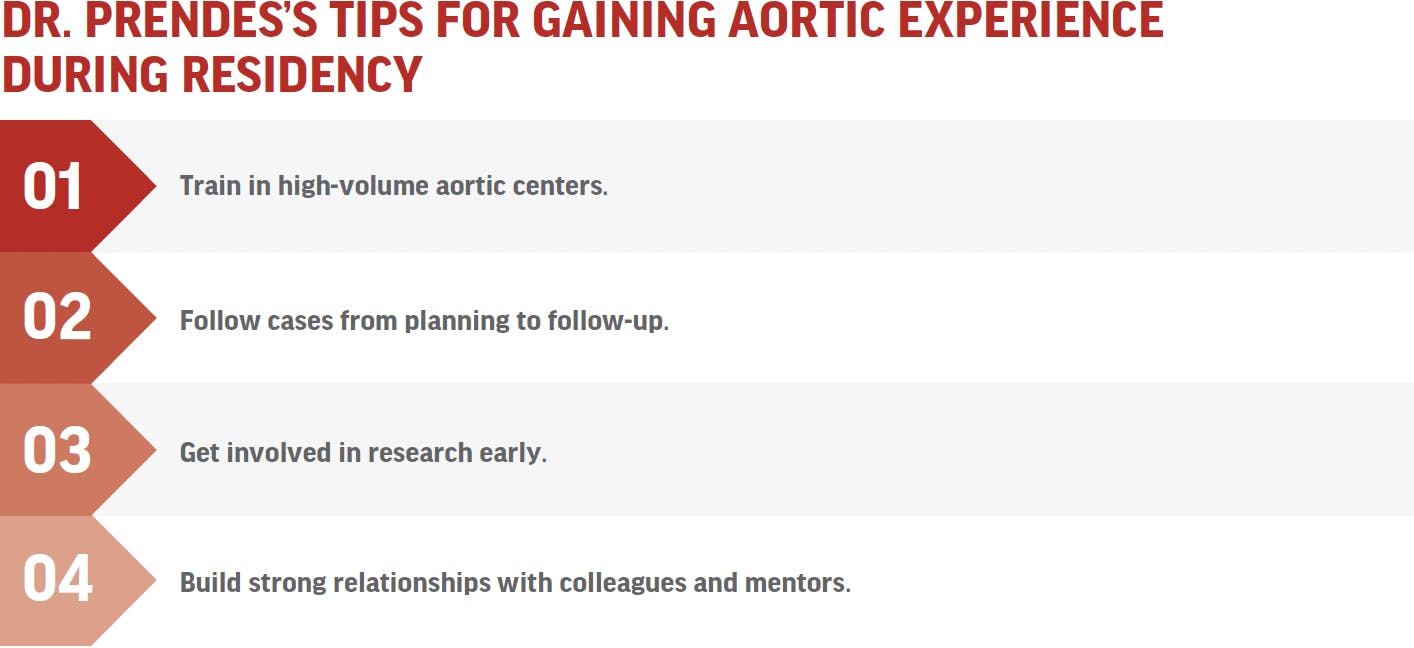
What do you think the ideal training program for someone interested in aortic might look like in 2025 and beyond?
The ideal program should combine high-volume exposure to aortic procedures with structured training in advanced imaging, simulation, and multidisciplinary collaboration. International rotations remain invaluable—not only for broadening technical expertise but also for gaining cultural perspectives on patient care and teamwork. I also think that research should be embedded in training from the start, because critical thinking and scientific curiosity are just as essential as operative skill.
Equally, future programs should place strong emphasis on case planning: using three-dimensional workstations to design and select the most appropriate solutions; employing imaging tools and clinical expertise to anticipate pitfalls and prepare strategies; and discussing each case with the operating team before entering the theater. Embedding these habits early helps trainees build not only technical competence but also the judgment and collaborative mindset essential for complex aortic surgery.
You’ve trained and worked in Spain, Sweden, and Germany. What has this “vascular nomad” path given you?
Besides a confusing mix of languages, it’s given me resilience, perspective, and some incredible colleagues along the way. Tough at times, but worth every step.
1. Shehab M, Prendes CF, Wanhainen A, et al. The endo-bentall procedure in the treatment of ascending aorta pathologies: a scoping review. Eur J Vasc Endovasc Surg. Published online July 21, 2025. doi: 10.1016/j.ejvs.2025.07.026
Advertisement
Advertisement
Interested in reading more interviews?
To read more interviews with thought leaders in the vascular field, check out our Profiles & Perspectives hub.
Read More