Advertisement
Advertisement
September 2025
DVA in the Real World
Multidisciplinary experts discuss the current state of deep vein arterialization and provide practical guidance on predicting success and failure, setting realistic expectations, operator proficiency, and follow-up protocols.
With Nicholas Petruzzi, MD, FSIR, FSVM, FAHA; Mehdi H. Shishehbor, DO, MPH, PhD; Nicholas Alianello, DPM; and Miguel Montero-Baker, MD


Based on trial findings and your own clinical experiences, which patients are most likely to benefit from deep venous arterialization (DVA)? What are the predictors of success?
Dr. Shishehbor: In general, patients deemed “no option” (ie, not candidates for conventional surgical bypass or endovascular option) should be considered for DVA. However, clinical outcomes can vary significantly based on patient characteristics. For example, patients with end-stage renal disease (ESRD) typically experience poorer outcomes. Similarly, individuals with inadequate collateral circulation may develop ischemia shortly after the procedure. Inflow disease is another known predictor of suboptimal results. Importantly, maintaining patency within the first 3 months postprocedure is critical to long-term success.
Dr. Alianello: In my clinical experience from a podiatry perspective, the patients who benefit the most from a DVA procedure are those with either a small ischemic noninfected wound and/or dry gangrene of the distal digits.
About 6 weeks post-DVA, once maturation and new arterialization has occurred, I’ve noticed that these patients with small ischemic wounds begin to heal quickly. Ischemic wounds do not necessarily require much debridement; therefore, once they receive new increased arterial flow, they tend to heal rather well.
Patients with dry gangrene of the distal digits also heal very well. Unfortunately, these patients do require amputation. Successful DVA procedures, for the most part, increase perfusion to the level of the midshaft of the metatarsals. Therefore, amputations of gangrenous digits in the form of toe or partial ray amputations tend to heal quite well. The biggest predictors of success, in wound and/or amputation healing, are patients who have no active infection at the time of DVA and during the maturation process.
Dr. Montero-Baker: The primary candidates for DVA are patients with no-option class 1 or 2 chronic limb-threatening ischemia (CLTI) due to poor distal arterial targets and high medial artery calcification scores.1 The most successful DVA cases show adequate systemic health to support healing (eg, controlled infection, albumin > 3 g/dL), foot with enough tissue to save for functional reconstruction, patent venous targets on preoperative mapping (lateral plantar vein or medial plantar vein > 3 mm), good inflow via femoropopliteal system for robust perfusion, venous valve disruption success confirmed intraoperatively, postoperative volume flow of approximately 100 mL/min, and strong social support and follow-up adherence.
In your experience, which patients have seemed like good candidates but proved otherwise? What are the predictors of failure?
Dr. Petruzzi: Initially, I assumed the best candidates were those who had stable Rutherford 5 changes and a good usable posterior tibial artery and posterior tibial vein on preimaging. However, I’ve found that the greatest predictor of failure is patient comorbidities with significant degrees of coronary artery or valvular disease. A good indicator I now use for those who might otherwise be promising candidates is the number of recent admissions/hospitalizations for cardiac or pulmonary issues. The patients who seem to fair best are staying out of the hospital, and their main issue is stable or slowly progressive Rutherford class 5 tissue loss.
Interestingly, the anatomy is less of an issue on the arterial side, as I’ve performed DVA from any tibial vessel with success. However, the venous anatomy is important, to ensure you have a good outflow and thus a good result. Additionally, patients without a strong support network and/or live in a long-term care facility are poor candidates for a multitude of reasons.
Dr. Alianello: I think the biggest predictor of failure is the presence of infection. The wound care and amputation algorithm calls for open amputation of infected tissue prior to the DVA to give the procedure the best chance of success. Infections that reach the level of the plantar venous arch are the most difficult to manage, given the importance of preserving the plantar venous arch to allow DVA to be performed. It is these proximal infections that pose the biggest risk for DVA failure.
Dr. Montero-Baker: Failure often occurs in patients with hemodynamic steal (steal classification class 3 [Figure 1]), inadequate runoff after the DVA (eg, poor venous outflow, missed valves), postoperative accelerated infection or tissue loss, or noncompliance with wound care or follow-up.
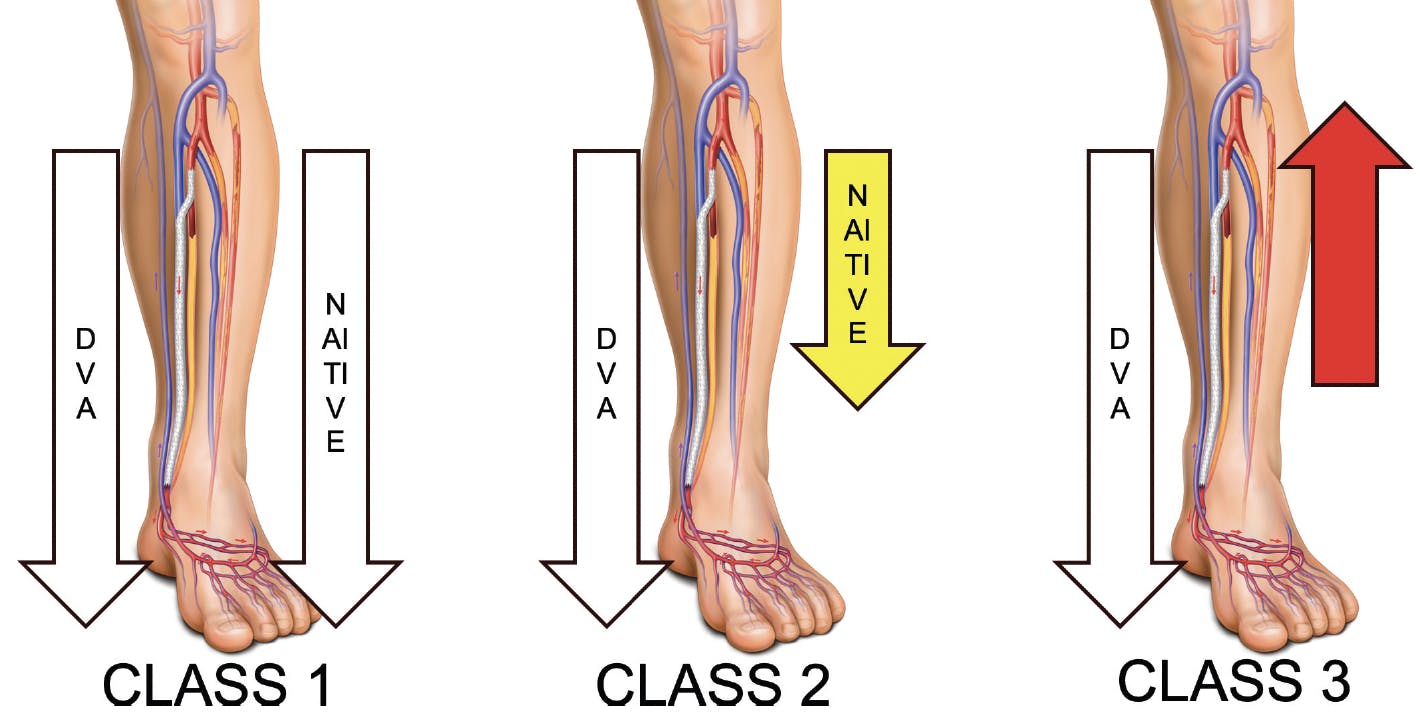
Figure 1. Angiographic patterns immediately after DVA. Class 1: Both endovascular DVA and native system have antegrade flow with the same velocity. Class 2: Endovascular DVA is faster, but native system remains with antegrade flow. Class 3: Endovascular DVA has antegrade flow, native system has stagnated or reverse flow.
Dr. Shishehbor: Predictors of failure include ESRD, poor patient compliance, inappropriate wound care, and failure to maintain patency in the first 3 months.
How do you communicate realistic expectations with patients/families and providers?
Dr. Alianello: From a wound care perspective, the patient and their family need to understand two main principles:
- During the 4- to 6-week maturation phase of the DVA after the procedure, wounds are not to be debrided and must be left alone. This is essential to allow the new arterialization to occur without disrupting the wound.
- In the setting of healing a wound or an open amputation, it is expected to take 4 to 6 months to achieve complete closure.
In discussions with patients who are planning to have a DVA, it is mandatory that my staff and I set the expectation that they will need to be seen every 1 to 2 weeks for close observation and wound care, with the understanding that it will take 6 months to achieve full closure.
Dr. Shishehbor: This procedure offers a limb salvage rate of approximately 75%, which means that a subset of patients will unfortunately progress to major amputation despite intervention. It is essential that we engage in shared decision-making, clearly outlining the potential benefits, risks, and limitations of the procedure. Patients must be fully informed to make a decision that aligns with their values and goals. It is critical that we approach this intervention with seriousness and avoid conveying unrealistic expectations or false hope.
Dr. Petruzzi: I really take the time to explain the procedure and its rationale in the simplest terms possible. I make sure I have that discussion with not only the patient but also their immediate family and support network. I typically quote the chance of limb salvage at 6 months around 65%, based on the randomized trial data we have at this time.
For those younger patients with Buerger disease– or collagen vascular disease–associated CLTI, it is important to have a detailed discussion on what follow-up and ultimate healing will look like. These younger patients should be made aware that a major lower extremity amputation could potentially result in earlier ambulation and recovery with a functional prosthetic. Conversely, DVA has a relatively more demanding initial road to recovery but can still provide long-term limb salvage. I now have many of these patients who are 5 to 7 years out from the initial procedure with durable limb salvage.
How does your DVA team function? Who is involved, and what is each team member responsible for?
Dr. Montero-Baker: We follow a hub-and-spoke model with tight coordination. This involves a vascular surgeon for diagnosis and perioperative care; a podiatrist for wound care, debridement, biomechanics, and offloading; and a registered vascular technologist for pre- and post-DVA imaging and surveillance.
We also follow a specific systematic process, which involves proprietary clinical support software (HOPE flight path) and weekly clinical performance rounds to review cases. We meet weekly to review progress, images, and outcomes, and this tight feedback loop is essential for CLTI.
Dr. Shishehbor: We are fortunate to have the support of the Lorraine and Bill Dodero Limb Preservation Center. Through the generous funding associated with this center, we have dedicated coordinators and navigators who play a vital role in supporting both our patients and the overall program. There is strong collaboration between our team and podiatry, which is essential to the multidisciplinary approach required for optimal limb preservation.
Typically, the workflow begins with a referral from the limb salvage advisory council, which may then lead to consideration for the DVA program. Our coordinators facilitate communication and care coordination between specialties, ensuring seamless transitions and timely interventions. Patients are followed closely, including via serial ultrasound imaging, to monitor progress and outcomes.
Dr. Alianello: At my institution, the DVA team has two components: The team responsible for performing the DVA and the team responsible for wound care/amputation management. In our institution, the wound care and amputation team is provided by podiatry, which has five attendings and nine residents.
It is imperative that both the interventional radiology (IR) and podiatry teams follow these patients closely together. At each wound care visit, a clinical picture of the wound is sent to our IR team through our internal messaging system, so they are constantly aware of the progress of the wound. This continuous communication allows the team that created the DVA to have a complete understanding of the wound healing and/or lack of progression.
Our communication allows for complete patient care and prevents time lapses that can lead to loss of limb in these patients whose wounds are very fragile.
What are the absolute musts for operator proficiency and team capabilities? Who should be offering DVA, and who should be referring it out?
Dr. Petruzzi: This is an important question because I do not think performing DVA is for everyone. In my opinion, the absolute musts include being facile with wiring, strong knowledge of arterial and venous plantar anatomy, experience with reentry devices and fluoroscopy-guided punctures, excellent ultrasound skills to rapidly shift access when needed, and a circulating team familiar with the often-extensive equipment that needs to be found and opened in a timely manner. Simply put, the operator should have years of extensive below-the-knee and below-the-ankle experience, coupled with well-trained tech, nursing, and circulating staff. Straightforward DVA procedures, on average, should take no more than 2 to 3 hours if appropriately planned.
Dr. Shishehbor: Successful implementation of DVA requires a dedicated team and a consistent procedural volume. It is difficult to develop and maintain proficiency by performing the procedure infrequently—particularly early on. In the initial phase, it is important to perform three to six cases within the first 3 to 6 months to truly gain familiarity with the technique and its nuances.
Patient selection is also a critical factor in achieving favorable outcomes. For these reasons, DVA is best performed at centers with established limb salvage programs, where multidisciplinary expertise, appropriate infrastructure, and patient volume can support high-quality care and optimal results.
Procedurally, what is one tip you wish you knew on day 1?
Dr. Montero-Baker: Always perform aggressive flow modulation on the front end. Make the arteriovenous connection as distal as possible and increase outflow resistance by surgical ligation or coil embolization of veins as needed.
Dr. Alianello: When performing an amputation, never primarily close the wound. Primary wound closure in amputations after DVA leads to immediate tissue necrosis in nearly 90% of patients. It is imperative that surgeons perform amputations open and use negative pressure wound therapy to allow them to heal via secondary intention.
Dr. Petruzzi: Try to wire the venous outflow first. I believe that the greatest limiting factor in creating a good DVA that maintains patency long enough to allow for neoarterialization is almost always the venous outflow. If the plantar veins are massive, I may make the proximal or distal anastomosis first; otherwise, I prefer to stick the opposite end of the venous loop in an antegrade fashion, obtain a venogram, and try to wire across the venous arch. If I can do that, I can be almost certain that procedure will be a technical success.
Dr. Shishehbor: Not all no-option patients are good candidates for DVA. I wouldn’t start with patients with ESRD, patients with noncompliance, or those with very advanced wounds.
What are your follow-up protocols? When are patients seen again, and what evaluations are your team doing at each visit?
Dr. Petruzzi: We follow all of our Rutherford 5 and 6 CLTI patients postprocedure at 2 and 4 weeks. For DVA specifically, we obtain a duplex ultrasound at 2 weeks to ensure patency and identify any early risk factors or signs of failure. I typically bring the DVA patient back in 2-week intervals until week 6. I now routinely obtain a second-look angiogram at 6 to 8 weeks depending on the clinical scenario and appearance of the conduit. Sometimes this may be purely diagnostic, and other times you may find early restenosis in your inflow or potentially identify sites of steal with poor forefoot perfusion. In this setting, you may want to coil outflow to increase the resistance or attempt further venous recanalization, allowing you to focus further on this aspect of the DVA without the time-consuming aspects of initial creation.
Dr. Shishehbor: We obtain an ultrasound the day after the procedure and then monthly after. Wound care involves weekly negative pressure wound therapy, with a specialized podiatrist familiar with Limflow (Inari Medical, now part of Stryker) and DVA.
Dr. Alianello: Our wound care patients are seen weekly until complete closure is achieved. Our entire staff understands that this likely means weekly visits for about 6 months until healing is noted.
What complications/sequelae do you discuss ahead of time, and what complications have you spotted early on?
Dr. Alianello: From a foot and ankle perspective, we always advise our patients of increased pain and swelling to the limb after DVA. Patients and outside providers sometimes confuse the increased swelling, erythema, and pain as infection, which at times can be problematic. For the most part, because we are following these patients on a weekly basis, our seasoned podiatrists are able to discern infection from post-DVA swelling/pain.
At what point do you decide the patient needs an amputation? And, how do you prep your foot and ankle surgeon before DVA?
Dr. Petruzzi: This is a critical step in having successful outcomes with DVA. You can create a beautiful open DVA with good flows and stable necrosis, but if you lack good preoperative communication on the state of the venous outflow and staged postprocedure care, the limb can still be lost.
I wait as long as possible prior to amputation, assuming I know I have a good DVA with reasonably expected patency. The longer you can let it mature, the better the neovascularization will be to allow tissue healing. I work with a select few podiatrists and surgeons who are familiar with the procedure and pitfalls that can occur. In general, we advocate for leaving the amputation site open and allowing closure by secondary intention and skin grafting. Occasionally, we primarily close the site when there is minimal tissue loss and good perfusion without signs of deep necrosis or infection, but this is rare. I have also gotten into the practice of marking the venous outflow since the venous arch anatomy is variable and the venous outflow is unique and different for every DVA. I will obtain an angiogram or use ultrasound and permanent marker to indicate the outflow veins prior to amputation to help guide the surgeon.
Dr. Alianello: The IR team at our institution does a fantastic job of providing us with the angiogram images pre- and post-DVA (immediate and monthly follow-ups). This is necessary to allow us to understand the level at which the foot is being perfused and to plan amputations to the appropriate level. It also allows us to provide the patient with realistic expectations regarding their specific wound healing chances.
What hurdles do you see in determining best practices for DVA?
Dr. Alianello: At our institution, we have been providing post-DVA wound care for more than 5 years. Based on our in-depth experience, we have been able to construct multiple algorithms specific to each patient’s disease state (eg, diabetic foot ulcer, dry gangrene, wet gangrene, heel eschar). These algorithms are specific and detailed. Currently, our biggest challenge is educating the podiatric community on the true specifics of DVA patient wound care.
Dr. Montero-Baker: Remaining hurdles include:
- Patient heterogeneity in CLTI makes trial design hard
- There is a lack of unified procedural protocol
- Centers with poor follow-up
- Reimbursement structures are fragmented
- There are few standardized training pathways—everyone’s doing DVA a little differently
- There are no objective performance goals for tissue perfusion
Dr. Petruzzi: One of the biggest hurdles is that we are still evolving techniques and types of DVA. Several years ago, all of my DVAs were done in proximal fashion and using a stent graft. However, I may now opt for a distal/lower-flow DVA in certain patients, which I view as an almost “adjunctive” perfusion rather than the dominant pipeline to the foot. I’ve had good success with both techniques, and we all are still learning who might be best served with each type. This variability in DVA type and the individuality of every case (inflow, flow rates, venous outflow, patient tissue loss, comorbidities, etc) creates “messy” data sets that are difficulty to analyze and accurately determine best practice.
In terms of continued data collection, what challenges and opportunities are there with off-the-shelf and hybrid options?
Dr. Petruzzi: Because the “off-the-shelf” options have such variability in types of equipment, it becomes even more difficult to collect meaningful data. For example, stent graft type (when used) may differ, coronary stents or stentless anastomoses may have different failure modes, and lack of low-profile or push-type valvulotome can impact true valve disruption.
What’s on your tech wish list? If you had a blank check, what would you like to see developed to further this procedural offering?
Dr. Alianello: From a podiatry perspective, my wish list includes an in-office device that would allow us to measure pedal acceleration time for real-time wound site perfusion assessment.
1. Kim TI, Vartanian SS, Schneider PA. A review and proposed classification system for the no-option patient with chronic limb-threatening ischemia. J Endovasc Ther. 2021;28:183-193. doi: 10.1177/1526602820963911
Disclosures
Dr. Petruzzi: Consultant to Boston Scientific Corporation; speaker for Boston Scientific Corporation, BD, Shockwave Medical, and Abbott; Site Primary Investigator, PROMISE III (LimFlow) and Boomerang (Aveera Medical, Inc.).
Dr. Shishehbor: Consultant and advisor to Medtronic, Abbott Vascular, Boston Scientific, Inari, Inquis Medical, and AdvNanoT (ANT).
Dr. Alianello: Medical advisory board/Director of Wound Care for Aveera Medical.
Dr. Montero-Baker: Consultant to Stryker; research investigator for Aveera Medical.
Advertisement
Advertisement