Advertisement
Advertisement
September 2025
Utilizing Duplex Ultrasound in Venous Arterialization
Key hemodynamics metrics available through duplex ultrasound guide treatment and follow-up care in venous arterialization.
By Jill Sommerset, RVT, FSVU; Brian Lepow, DPM; and Miguel Montero-Baker, MD
As venous arterialization (VA) becomes more widely adopted for type I and II no-option chronic limb-threatening ischemia (CLTI),1 ultrasound assessment must evolve to reflect the physiologic complexity of this therapy. Patency and flow volume offer valuable data but may not reliably predict tissue-level perfusion or healing outcomes. In many cases, VA conduits eventually occlude, yet wounds still go on to heal.2 This paradox underscores the need for a paradigm shift in ultrasound surveillance, emphasizing functional tissue perfusion rather than relying solely on conduit patency.
Duplex ultrasound (DUS) offers a noninvasive way to evaluate both conduit performance and downstream perfusion in the foot. The true value of DUS emerges when we move beyond conventional metrics to physiologic metrics, specifically resistive index (RI), arterial pedal acceleration time (aPAT), venous pedal acceleration time (vPAT), and pedal venous maturation (PVM). These hemodynamic markers track perfusion over time and provide meaningful feedback on healing potential.
One of the most revealing hemodynamics is PVM—defined by arterialized, pulsatile waveforms in the terminal pedal veins—that signals effective microvascular recruitment and sustained tissue perfusion, even after conduit occlusion (Figure 1). Improvements in aPAT into class 1 to 2 (< 180 ms) reflect enhanced arterial inflow, while low vPAT (≤ 120 ms) in the lateral plantar vein and in the presence of PVM suggest favorable hemodynamic improvements. Popliteal artery RI also serves as an upstream marker of distal hemodynamics. The expected post-VA popliteal RI ranges from 0.6 to 0.75, whereas an elevated RI (> 0.8) early after VA creation may indicate an outflow issue requiring further attention. Together, these markers identify patients physiologically progressing toward wound healing and limb preservation.
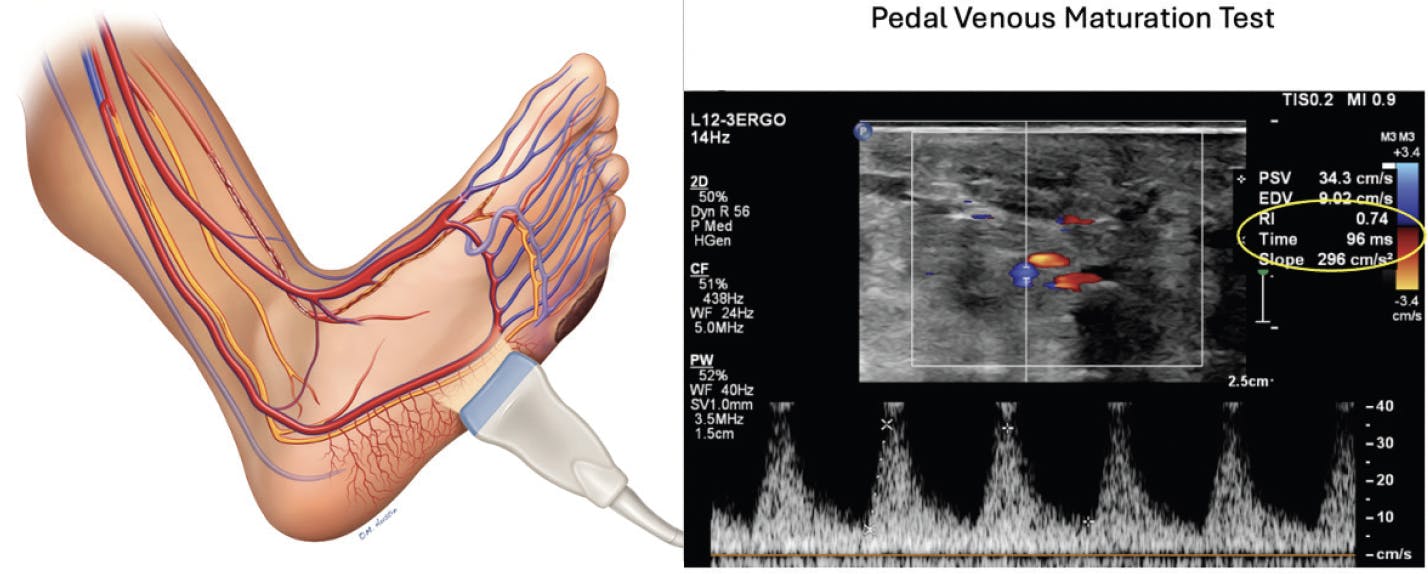
Figure 1. PVM test demonstrating a low resistive arterialized signal in the terminal veins with vPAT measurement.
These hemodynamic changes unfold gradually over weeks to months. Real-world follow-up requires a structured, longitudinal DUS protocol to monitor arterial and venous adaptation over time. Serial exams allow us to track flow shifts, determine when intervention is needed, and determine when conditions support safe foot reconstruction.
CASE EXAMPLE
A man in his mid-60s with prior contralateral below-knee amputation presented with right forefoot gangrene and no revascularization options. He underwent superficial hybrid arterialization based on favorable pedal venous anatomy. The conduit remained patent early on, during which a PVM was achieved (vPAT < 120 ms) and aPAT improved to class 1 (Figure 2). Based on these findings, a transmetatarsal amputation was safely timed, and the patient achieved complete wound healing (Figure 3). Although the arterialization later occluded, hemodynamic maturation was sustained. This case illustrates how DUS milestones can guide care in complex CLTI patients.
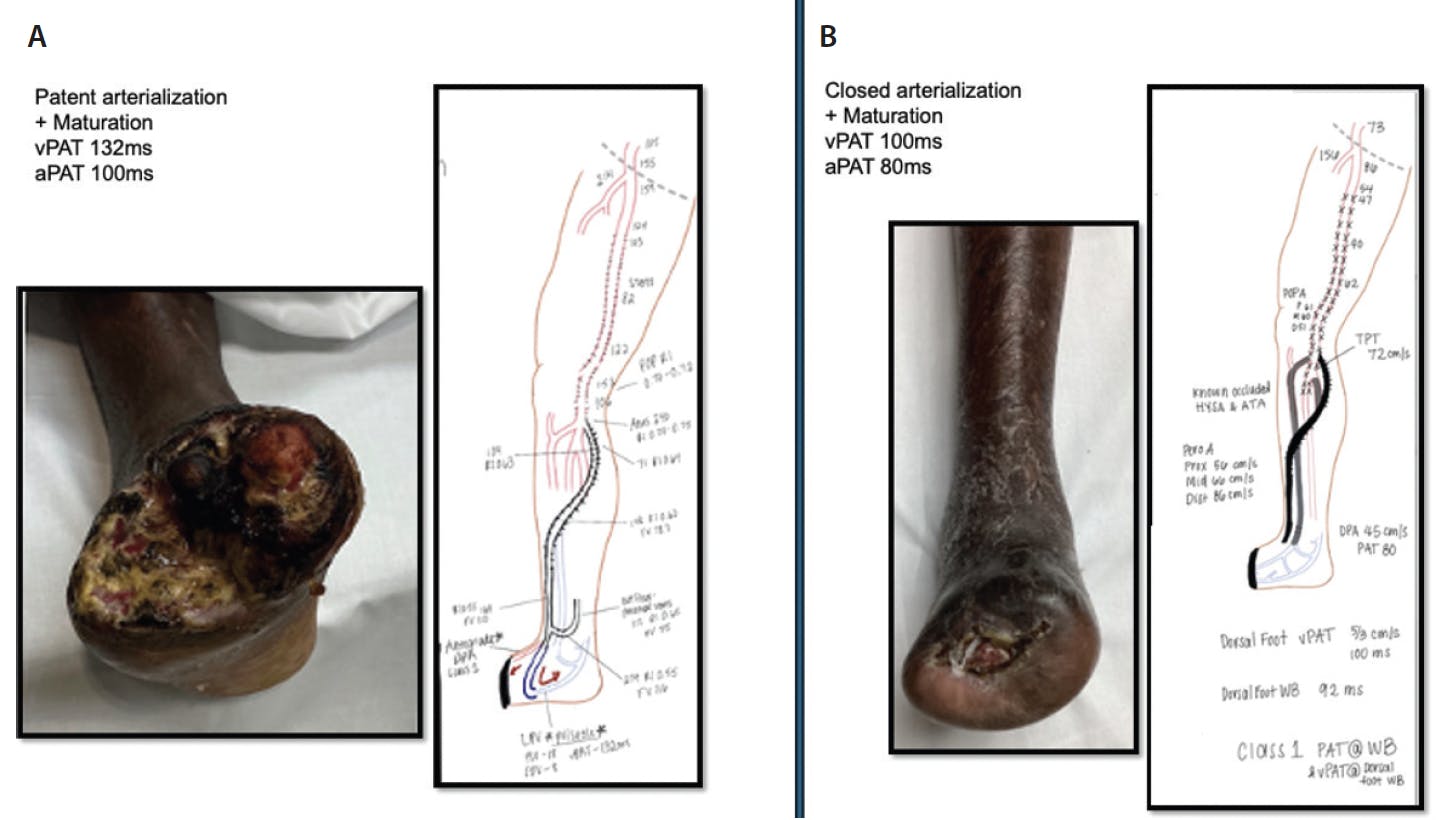
Figure 2. Serial DUS demonstrating hemodynamic changes during the wound healing process. Patent VA with positive PVM; aPAT and vPAT are optimized (A). Occluded VA with preserved PVM; aPAT and vPAT remain favorable (B). Near-complete healing of the transmetatarsal amputation is noted.
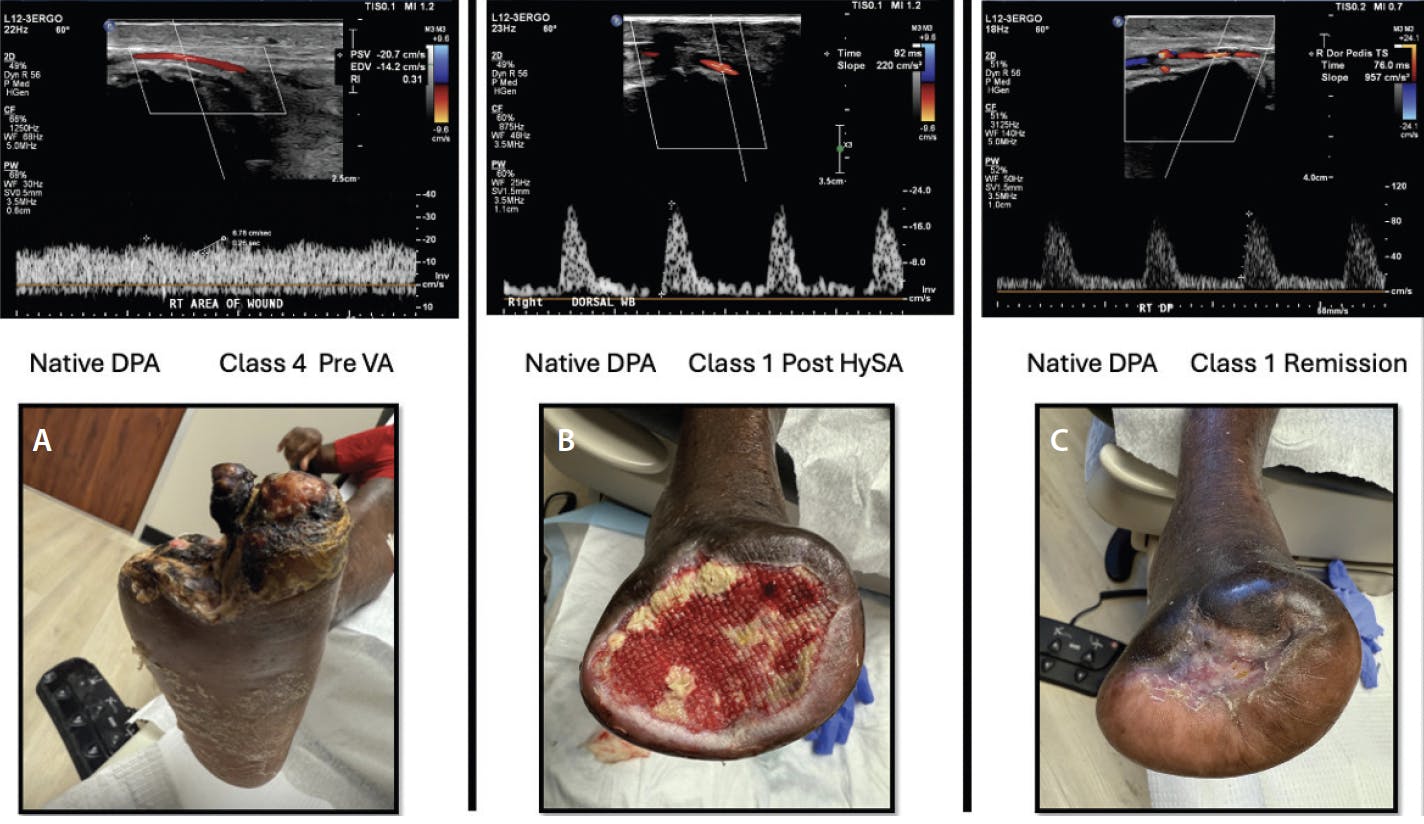
Figure 3. Serial DUS demonstrating physiologic changes before and after VA. Preintervention: abnormal class 4 aPAT with nonhealing wound (A). Postintervention: improved aPAT and progressive wound healing (B). Final follow-up: complete wound healing with normalized class 1 aPAT (C).
CONCLUSION
DUS is not ancillary in VA—it’s the roadmap. Hemodynamic markers such as PVM, vPAT, aPAT, and RI guide decisions: when to intervene, when to monitor, when foot surgery is safe, and when the patient is truly on the path to remission.
1. Kim TI, Vartanian SS, Schneider PA. A review and proposed classification system for the no-option patient with chronic limb-threatening ischemia. J Endovasc Ther. 2021;28:183-193. doi: 10.1177/1526602820963911
2. Ng JJ, Choong AMTL. More data are needed to elucidate the Achilles' heel of percutaneous deep venous arterialization. J Endovasc Ther. 2020;27:873. doi: 10.1177/1526602820943851
Advertisement
Advertisement