Advertisement
Advertisement
April 2026 Supplement
Sponsored by Terumo Interventional Systems
Radial and the ASC Opportunity: The Future of PAD Treatment
How radial-to-peripheral procedures in the ambulatory surgical setting align safety, patient satisfaction, and cost-efficiency.
The procedural environment for endovascular cases in the United States has changed significantly. Due to cost containment strategies for the ever-burgeoning rise in peripheral vascular cases, both the Centers for Medicare & Medicaid Services and private payors are encouraging outpatient-based intervention for peripheral artery disease. This can look like same-day discharge from hospital-based procedures or performance of endovascular cases in an office-based lab or ambulatory surgical center (ASC).
WHY R2P IN THE AMBULATORY SETTING?
Radial-to-peripheral (R2P) cases are ideal for ASCs for many reasons: (1) access site risk is minimized; (2) patient satisfaction is higher, with less need for nursing; and (3) patient recovery is done in a dignified manner in radial lounges. As a result, outpatient R2P cases provide a lower overall cost to the system in their entirety.
For experienced radial operators, the inherent procedural risk of access site complications is essentially negated with transradial access (TRA). It has been well-established in contemporary interventional literature that significant bleeding complications have a direct relationship with mortality. By pursuing TRA for endovascular procedures, the risk of a major bleeding complication is minimized as much as possible, making it ideal for an ASC.
CASE REPORT: R2P LIMB SALVAGE IN AN ASC
Figure 1 represents a sample R2P case performed in an ASC setting. The patient presented with a right pedal wound after prior aortic endograft repair of an abdominal aortic aneurysm. His right superficial femoral artery (SFA) and profunda femoris were noted to have significant disease. Transradial endovascular intervention was successful for limb salvage via the right radial approach, with excellent outcomes in less than 1 hour of procedure time. This showcases what is possible today and what is achievable in the future as a standard of care in the ambulatory setting.
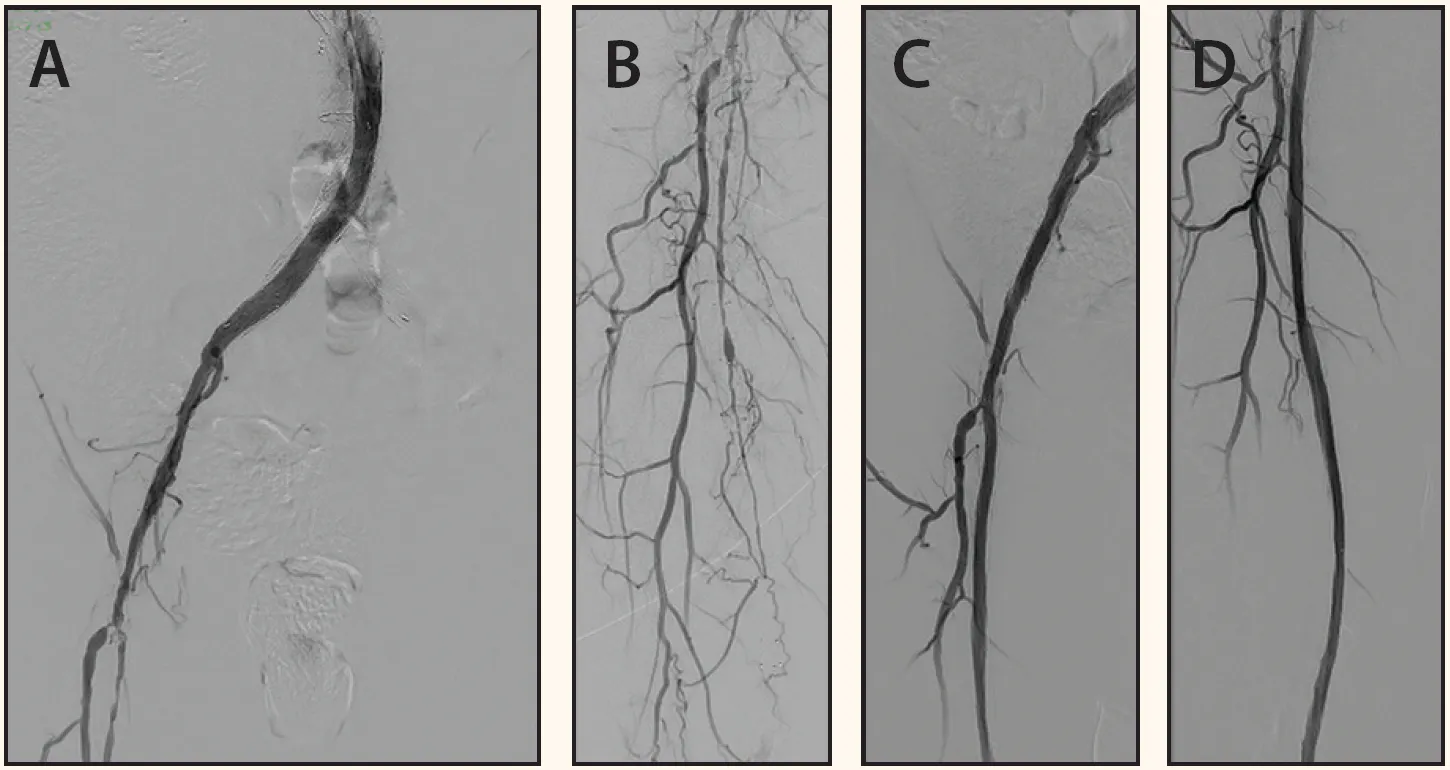
Figure 1. Preprocedure peripheral angiography via the right radial approach with selective right aortic engograft limb angiography demonstrating severe complex distal right common femoral artery (CFA) stenosis involving the origins of the profunda femoris and SFA (A). Preprocedure peripheral angiography demonstrating long-segment right SFA occlusion (B). Angiography post-TRA peripheral intervention with Auryon laser atherectomy (AngioDynamics) and balloon angioplasty, demonstrating a markedly improved right CFA, profunda femoris, and proximal SFA stenosis (C), as well as a widely patent right SFA (D).
Importantly, patient satisfaction is tied to metrics for reimbursement, and patient satisfaction with TRA procedures is consistently higher than with transfemoral (TFA) procedures. For those who have had cases done via both TFA and TRA, patients invariably prefer TRA due to both the reduced access-related pain and the less taxing recovery. When recovery is performed in radial lounges, there is significantly less intense postprocedural nursing necessary, thereby optimizing recovery while minimizing nursing use. This translates consistently to less overhead and improved procedural cost-efficiency.
CONSIDERATIONS FOR SUCCESS
When considering performing these procedures in an ASC, being facile with TRA and R2P procedures is a strong asset. One should be able to manage the nuances of TRA, including addressing spasm, navigating the aortic arch, and delivering equipment. The endovascular space continues to evolve with more equipment and tools coming to market with intended radial use. As this field continues to progress, obtaining training and familiarity with TRA procedures is certainly a key to success in the ASC setting.

Advertisement
Advertisement