Advertisement
Advertisement
April 2026 Supplement
Sponsored by Terumo Interventional Systems
R2P and the OBL Opportunity: Radial-First Hybrid Access for Lower Extremity Intervention
Advancing outpatient endovascular therapy beyond the groin.
Lower extremity intervention via the radial approach became part of our routine outpatient practice in 2016. At that time, the availability of dedicated long radial platforms for peripheral intervention remained limited, and femoral access for lower extremity procedures continued to dominate. As ambulatory facilities increasingly emphasized rapid ambulation and predictable recovery profiles, select patients appeared well suited to benefit from the safety and efficiency gains already established in coronary radial practice.
Early experience relied primarily on standard coronary tools to access inflow, femoropopliteal, and tibial segments. The radial approach served as a stable, atraumatic conduit, whereas selective pedal access was incorporated to provide distal control when antegrade traversal proved ineffective or anatomically challenging. With accumulated experience, this approach evolved into a more organized combined radial-pedal strategy, wherein forearm access provides inflow support and pedal access is employed selectively to facilitate retrograde lesion traversal when indicated.
Importantly, this strategy has not replaced femoral access. Instead, it has expanded access options for patients at increased risk of bleeding complications, those with renal disease requiring contrast minimization, individuals with unfavorable access site anatomy, or patients whose recovery needs favor nongroin approaches. Conversely, patients with radial anatomy not amenable to access, severe ostial disease, hemodynamic instability, or anticipated need for large-bore therapy continue to undergo femoral access. Throughout this experience, access selection has been guided by patient anatomy and clinical context rather than operator preference.
CASE REPORT 1: Radial-Only Infrapopliteal Revascularization After Prior Groin Complications
A man in his early 80s with CLTI of the right lower extremity presented with anatomy unfavorable for femoral access. His history was notable for a left below-knee amputation performed in 1998 and prior groin access complications, prompting avoidance of femoral puncture. Radial access was therefore selected as the sole viable access strategy.
Baseline angiography demonstrated limited distal runoff to the right foot (Figure 1). The intervention was performed entirely via right radial access, with successful traversal and treatment of infrapopliteal disease. Completion angiography demonstrated restoration of inline flow with two-vessel runoff to the foot. Hemostasis was achieved with manual compression at the radial access site. The patient was discharged back to a nursing facility within 2 hours, without functional limitation.
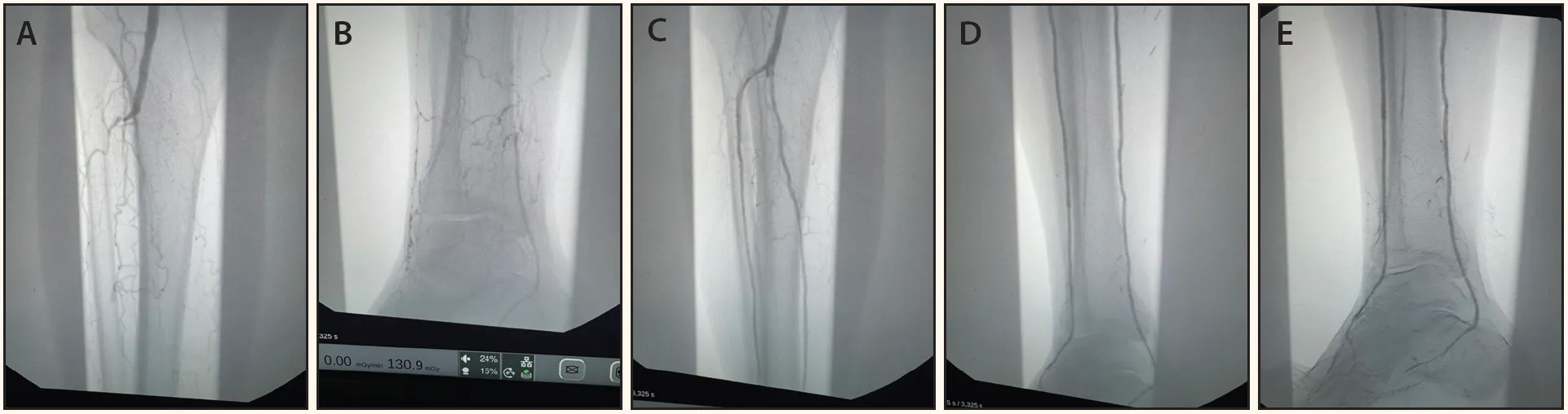
Figure 1. Radial-only infrapopliteal revascularization after prior groin complications. Baseline angiography demonstrating infrapopliteal occlusive disease with limited distal runoff (A, B), images obtained via right radial access after traversal and treatment of the tibial circulation. Completion angiography showing restoration of inline flow (C, D). Final angiographic frame confirming two-vessel runoff to the foot after radial-only intervention (E).
RATIONALE FOR AVOIDING THE GROIN IN THE OUTPATIENT SETTING
An integrated radial-pedal laboratory workflow aligns well with outpatient procedural goals, including early mobilization and predictable discharge. Radial access minimizes postprocedural immobility and obviates the need for prolonged groin compression. With contemporary 119- to 150-cm platforms, treatment from the wrist can reliably extend beyond inflow to include the superficial femoral and popliteal arteries and, in many cases, the infrapopliteal circulation. In my experience, below-the-knee intervention via radial access is feasible even in patients with single-vessel or peroneal-only runoff. Pedal access is incorporated selectively when lesion morphology, calcific burden, vessel course, or anticipated crossing complexity suggests that a retrograde strategy may improve efficiency or safety. This access flexibility has proven particularly valuable in the treatment of chronic limb-threatening ischemia (CLTI), where achieving durable outflow often requires adaptive and anatomically driven access planning.
CASE REPORT 2: Distal Tibial Intervention via Radial Access
A 6-ft 3-in man with symptomatic posterior tibial artery disease underwent laser atherectomy and balloon angioplasty entirely via left radial access (Figure 2). Using a 150-cm platform and long balloon catheters, adequate torque control was maintained within the distal tibial circulation. No additional access was required, and the patient ambulated immediately postprocedure.
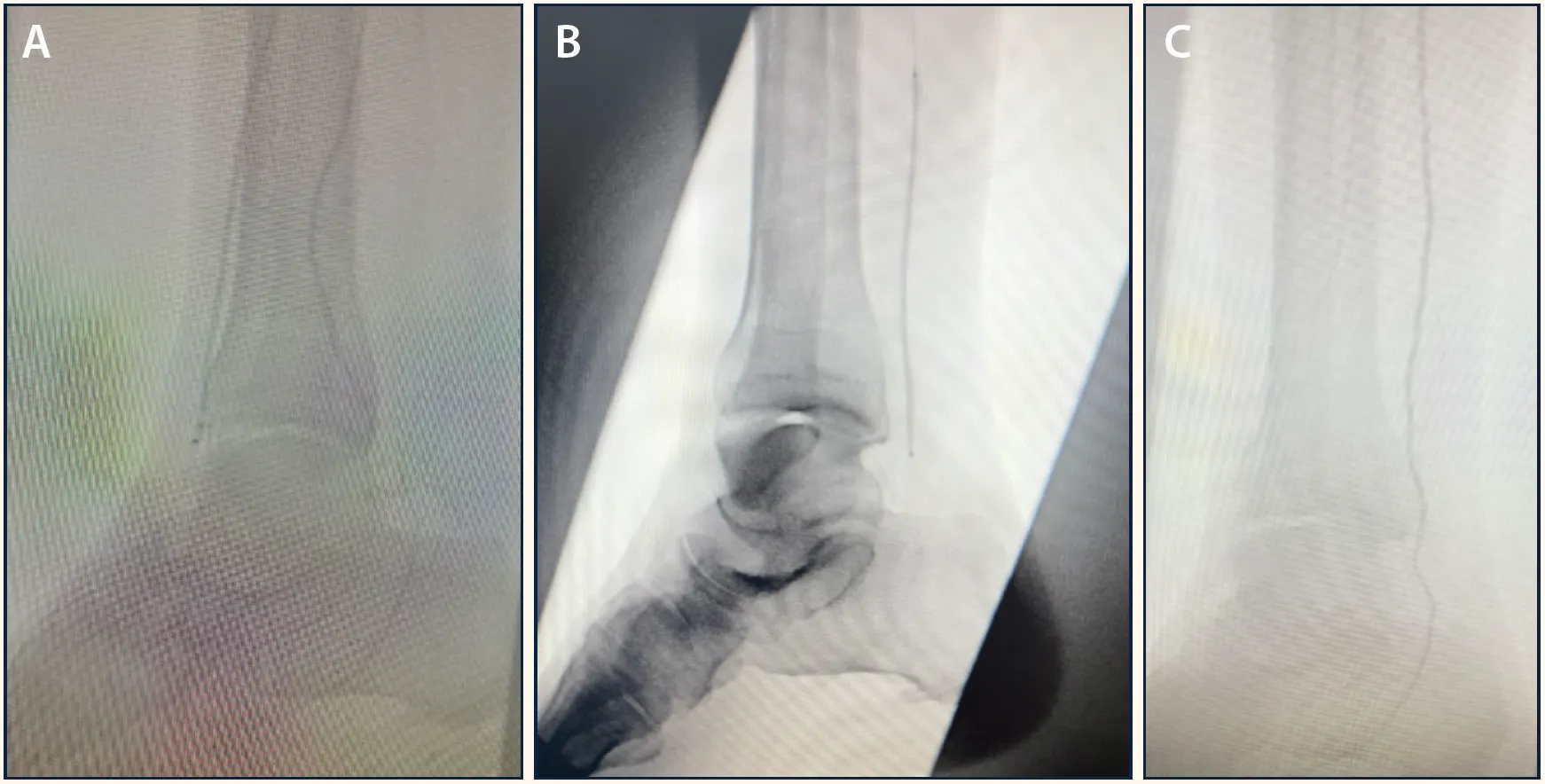
Figure 2. Distal posterior tibial intervention performed entirely via left radial access. Advancement of a long-shaft catheter and guidewire from the left radial artery into the distal posterior tibial artery (A). Maintained wire control and catheter support at the ankle level (B). Completion angiography demonstrating restored inline flow without femoral or pedal access (C).
PROCEDURAL WORKFLOW
Radial Access and Arterial Assessment
Preprocedural ultrasound is used routinely to characterize radial artery diameter and wall morphology. Vessels measuring ≥ 2.2 mm are generally preferred. Circumferential calcification is documented, as it may affect sheath advancement and withdrawal.
Antihypertensive medications are typically held the evening before the procedure. This practice has minimized spasm-related resistance during sheath manipulation without routine reliance on intra-arterial vasodilators.
Radial Hemostasis
Hemostasis is achieved using a two-person technique based on patent hemostasis principles with continuous Doppler monitoring. In arteries with greater circumferential calcium or increased reactivity, brief adjunctive manual compression is applied during decompression to maintain antegrade flow and prevent sheath withdrawal difficulties. Using this approach, radial sheath removal complications have remained < 1% in our experience.
EXPERIENCE AND SAFETY PROFILE
Drawing on experience from nearly 1,000 combined radial and pedal procedures performed by a single operator across outpatient and hospital-based settings, access-related complications have remained infrequent and consistent with rates reported in the published radial and pedal literature. Observed access site events have included radial artery occlusion, radial spasm requiring access conversion, isolated instances requiring surgical retrieval of a trapped catheter, and pedal hematoma.
Conversion to femoral access was undertaken when dictated by anatomic constraints, device limitations, or procedural complexity. A 100-patient analysis from the early phase of this experience has been published previously1 and provides detailed outcome reporting. A formal statistical analysis of a larger cohort exceeding 750 cases is currently underway, with planned reporting of procedural success, access-related events, conversion rates, and real-world outcomes.
DISCUSSION
In this experience, the combined radial-pedal technique has proven to be a safe and versatile access strategy in carefully selected patients. Key factors contributing to its integration into practice include bleeding avoidance, early patient mobilization, renal preservation through low-contrast strategies, and anatomic flexibility in cases where antegrade approaches are inefficient or higher risk.
Importantly, this approach is complementary rather than a substitute for femoral access. Access planning remains patient-based, anatomy-driven, and procedure-dependent.
LIMITATIONS AND FUTURE DIRECTIONS
These results reflect experience from a single institution with a predominantly solo-operator practice, which may introduce selection bias. Comparative outcome data relative to femoral access are not available. Additionally, proficiency with radial techniques developed over time may limit generalizability to centers earlier in their learning curve.
Ongoing efforts focus on complication stratification, radiation exposure, procedural efficiency analysis, learning curve assessment, and comparative evaluation relative to femoral access.
CONCLUSION
In experienced hands, hybrid radial-pedal access techniques represent a practical alternative to femoral access for selected lower extremity interventions in the outpatient setting. This approach expands access options and procedural flexibility without supplanting conventional techniques for infrapopliteal revascularization.
Disclosure of Artificial Intelligence (AI) Use: AI tools were used to refine language and organize the manuscript. All clinical content reflects the author’s original experience and interpretation.
1. Ansaarie I, Goldfaden RF, Hardy J, et al. A Retrospective cohort study to evaluate the efficacy, safety, and cost of MáLEI via transradial vs transfemoral peripheral revascularizations. Vasc Dis Manage. 2021;18:E178-E183.

Advertisement
Advertisement