Advertisement
Advertisement
February 2026 Supplement
Sponsored by Cook Medical
Real-World Data: The REALDES Study
A look at real-world outcomes from the REALDES study, its key clinical outcomes, and how physicians are translating these data into everyday practice.
With Koen R. Deloose, MD; Constantino S. Peña, MD; and Katherine K. McMackin, MD, MS
REALDES: CONTEXT, COMPARISON, AND KEY RESULTS
By Koen R. Deloose, MD
Setting the Stage
It is a fact that drug-eluting technology in general—drug-eluting stents (DESs) specifically—significantly reduce the incidence of restenosis and reinterventions. There are two DESs on the market today: Zilver PTX (Cook Medical) and Eluvia (Boston Scientific Corporation) (Table 1).
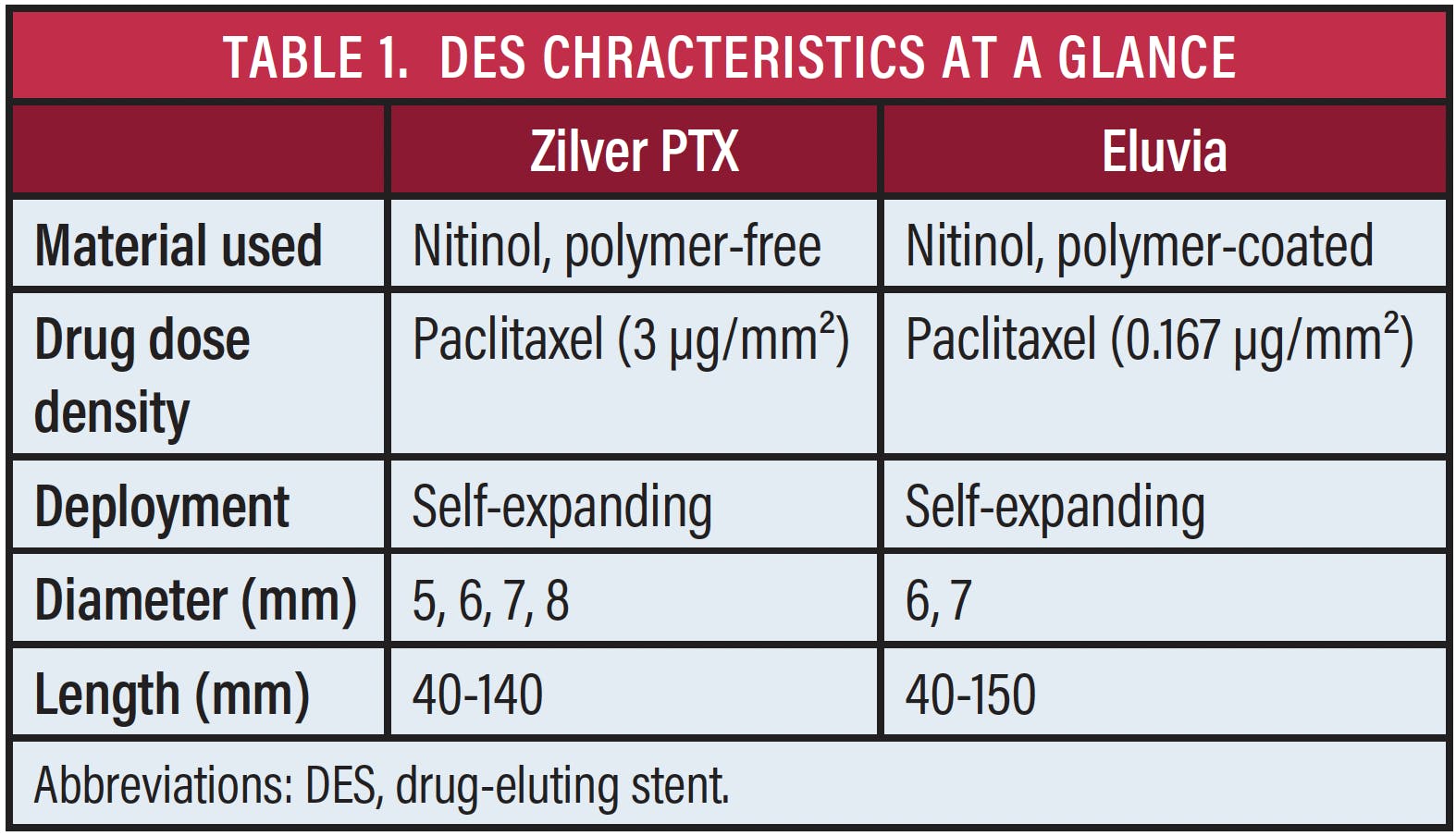
These two devices were compared in the head-to-head randomized controlled IMPERIAL trial.1 At 1 year, Eluvia was found to be noninferior to Zilver PTX (primary patency, 92.1% vs 81.8%). At 2 years, any statistically significant difference diminishes (83% efficacy with Eluvia vs 77.1% with Zilver PTX).2 However, looking at the 5-year data, there was no longer any difference between the two devices in terms of target lesion revascularization (TLR), primary patency, or assisted primary patency.3
However, a randomized controlled trial is a strict context, and it’s not completely comparable with the real-world setting. Consider the lesion characteristics in the IMPERIAL study: 8 or 8.5 cm, one-third with no calcification, one-third with moderate calcification, and one-third with severe calcification; the same was true for chronic total occlusion (CTO), with only one-third of patients with complex CTOs. Patient characteristics were also not my daily reality: 30% characterized as Rutherford classification 2, the vast majority characterized Rutherford 3, and a noticeable lack of chronic limb-threatening ischemia (CLTI) patients.
This gap between trial conditions and daily practice emphasized the importance of real-world data, ultimately leading to the launch of the REALDES study.
What Is REALDES?
REALDES is not a randomized trial—it is a multicenter, prospective, observational study in a real-world setting where the DES (Zilver PTX or Eluvia) was chosen at the physician’s discretion.4 The trial also distinguished itself from IMPERIAL and earlier trials by a requirement in the protocol for extensive vessel preparation. REALDES characterized restenosis by a peak systolic velocity ratio cutoff of 2.4 on duplex ultrasound. Importantly, as the REALDES study was not financially supported by industry, there was no potential for financial biases.
REALDES Key 3-Year Findings: Safety, Patency, and Long-Term Outcomes
REALDES comprised 184 enrolled patients and 200 limbs. Patients were assigned to groups at the discretion of the operator, with 86 patients in the Zilver PTX group and 98 in the Eluvia group. At 36-month follow-up, there were 52 patients in the Zilver PTX group and 47 in the Eluvia group.4
The patient characteristics, demographics, and comorbidities clearly reflect real-world data: claudication in two-thirds of the cases, and CLTI in one-third of cases. There was no statistical difference in terms of demographics or comorbidities between the groups.
Lesion complexity reflected a real-world population:
- High PACSS (peripheral arterial calcium scoring system) score was common
- TASC (TransAtlantic Inter-Society Consensus) C and D lesions in 60% of cases
- Lesion length: 185.7 ± 92 mm in the Zilver PTX group versus 160 ± 98.5 mm in the Eluvia group (P = .029)
- CTO was present in half of patients
- Predilation was performed in nearly all cases, with postdilation in 100%
DIVING DEEPER
Were results of REALDES surprising? In my opinion, no. In the CAPSICUM registry,5 reocclusion accounted for 71.1% of restenosis cases, 25.9% of which were due to stent thrombosis. The remaining 28.9% were due to nonocclusive restenotic disease.
The same can be said about the Zilver PTX reocclusion rate. Data at 1 year from the ZEPHYR registry point to a < 25% Tosaka 3 class in-stent reocclusion versus 75% with more restenotic disease.6 This coincides with REALDES data.
Comparing Zilver PTX to Eluvia, clinical outcomes up to 3 years highlight the following:
- Primary patency at 1 and 3 years: 82.5% and 70% versus 86.3% and 65.2%, respectively; there was no statistical difference between groups at 3 years (P = .7)
- Freedom from TLR at 1 and 3 years: 88.9% and 79.4% for Zilver PTX versus 90.1% and 76.3%—again with no statistical significance
The between-group difference becomes evident when you look at restenosis:
- In a univariable analysis of the 3-year risk of restenosis, there were no significant parameters or variables when looking at Zilver PTX versus Eluvia.
- In the Zilver PTX group, the rate of reocclusion was 29.2% versus 70.8% with just restenosis.
- In the Eluvia group, rate of reocclusion was 57.7% versus 42.3% with just restenosis.
REALDES STUDY KEY TAKEAWAYS
- Early advantage from previous trials disappears: Statistically significant differences seen in the IMPERIAL trial at 1 year were no longer present at years 2 to 5, indicating comparable long-term performance between Eluvia and Zilver PTX.
- Real-world performance: REALDES showed that in real-world, complex femoropopliteal disease, Eluvia and Zilver PTX showed similar 3-year outcomes, with no significant difference in primary patency or freedom from TLR between devices.
- A notable difference emerges: In REALDES and similar nonrandomized studies, Eluvia showed a higher incidence of total reocclusions than Zilver PTX.
Limitations
As REALDES does not have a randomized design, there are potential confounding factors and selection biases. This trial also has relatively small numbers at 3-year follow-up, and there was variation in vessel prepping methods, which may influence results. Lastly, there was no core laboratory review for duplex ultrasound or angiography. And yet, REALDES gives us very clear trends to consider in relation to these two DESs, as well as some key takeaways (see Key Takeaways Sidebar).
HOW DOES REALDES INFORM YOUR DAILY PRACTICE?
With Koen R. Deloose, MD; Constantino S. Peña, MD; and Katherine K. McMackin, MD, MS
What stands out to you about the REALDES study and its implications for clinical practice?
Dr. Peña: REALDES demonstrated similar patency and target lesion revascularization (TLR) rates with the two devices after the first year, which is in line with results from the IMPERIAL trial. REALDES is real-world data, with longer lesions, more occlusions, and more patients with CLTI—and outcomes are still similar among this patient population.
Also important are the morphologic differences in failure rates. Although we can’t hypothesize why there are differences in terms of reocclusions versus restenosis, we know that we need more research into the clinical relevance of this finding.
How do these findings translate to your real-world decision-making process?
Dr. McMackin: I love the idea of real-world data. It’s nice to have this equipoise out to 3 years between the two stents, because not everyone has access to both. These 3-year data reinforce that either stent is a “safe choice.”
Regarding reocclusion versus restenosis, once we get into the 3-year data, we’re looking at very small patient numbers. Although this is not something that would currently change my practice, it is something to look out for in future databases whether this trend continues to play out in 5, 10, 15 years.
What’s the main message clinicians should take from REALDES?
Dr. Deloose: To echo Drs. Peña and McMackin, we need more long-term data. Our payers want to know the long-term durability, while patients are concerned with quality of life, which is directly related to reintervention rate. Long-term data on TLR and reintervention are crucial.
The morphology of the restenotic pattern is also pivotal. Globally, we are in the days of “leave nothing behind.” At least in Belgium, this remains a dream when dealing with complex lesions. I almost always end up with at least some scaffolding. It can be argued that reocclusions are then more difficult to treat if something is left behind, which is a fair point. When these findings show that one device potentially creates more in-stent reocclusions, that becomes a meaningful conversation when choosing my stent. Of course, we do want to confirm these trends in larger, more robust data sets, but this is an observation that informs my clinical decision-making.
How do these findings fit into your broader treatment algorithm?
Dr. Peña: As we refine our treatment algorithms for the superficial femoral artery, we have to ask: Where does DES fit? Even though we’re talking about relatively small numbers of patients, the REALDES data give us a holistic view of how these devices perform beyond the first year. How does restenosis versus reocclusion affect our algorithm, and what does that mean when comparing the devices to other strategies, like the “leave nothing behind” approach?
It’s always a balance—a long, calcified lesion may require scaffolding, but then what happens in 4 or 5 years? These decisions are where the long-term, real-world REALDES data become quite valuable.
How might this influence intraoperative decision-making today and in the future?
Dr. McMackin: It’s the choices we make now that will affect our patients 5 to 10 years down the line, and it really comes down to balancing the short with the long term. For example, vessel preparation was a key component to this trial, and it points to something potentially important. I think this is worth exploring moving forward.
How do you think these data might influence clinical practice in Europe?
Dr. Deloose: Although these data are quite new, there is an increasing concern about the higher rates of in-stent reocclusion, because this is not easy to treat. I also see a slight shift toward the issue of the local toxicity of paclitaxel. Combine these concerns, and I think we will see some physicians change their mind. But importantly, I think we all agree that we need more long-term, real-world data to confirm the findings of the REALDES study.
1. Gray WA, Keirse K, Soga Y, et al; IMPERIAL investigators. A polymer-coated, paclitaxel-eluting stent (Eluvia) versus a polymer-free, paclitaxel-coated stent (Zilver PTX) for endovascular femoropopliteal intervention (IMPERIAL): a randomised, non-inferiority trial. Lancet. 2018;392:1541-1551. doi: 10.1016/S0140-6736(18)32262-1
2. Müller-Hülsbeck S, Benko A, Soga Y, et al. Two-year efficacy and safety results from the IMPERIAL randomized study of the Eluvia polymer-coated drug-eluting stent and the Zilver PTX polymer-free drug-coated stent. Cardiovasc Intervent Radiol. 2021;44:368-375. doi: 10.1007/s00270-020-02693-1
3. Gray WA, Soga Y, Fujihara M, et al. Polymer-based drug-eluting stent treatment extends the time to reintervention for patients with symptomatic femoropopliteal artery disease: clinical evidence and potential economic value. J Comp Eff Res. 2024;13:e240025. doi: 10.57264/cer-2024-0025
4. Shibata T, Iba Y, Shingaki M, Y, et al. Editor’s choice - comparative analysis of three year results of two paclitaxel related stents for the management of femoropopliteal disease in a real world setting. Eur J Vasc Endovasc Surg. 2025;69:865-873. doi: 10.1016/j.ejvs.2025.03.010
5. Iida O, Takahara M, Soga Y, et al; CAPSICUM Investigators. 1-Year outcomes of fluoropolymer-based drug-eluting stent in femoropopliteal practice: predictors of restenosis and aneurysmal degeneration. JACC Cardiovasc Interv. 2022;15:630-638. doi: 10.1016/j.jcin.2022.01.019
6. Iida O, Takahara M, Soga Y, et al; ZEPHYR Investigators. 1-Year results of the ZEPHYR registry (Zilver PTX for the femoral artery and proximal popliteal artery): predictors of restenosis. JACC Cardiovasc Interv. 2015;8:1105-1112. doi: 10.1016/j.jcin.2015.03.022
Watch It Now! Explore the full conversation here.


Advertisement
Advertisement