Advertisement
Advertisement
February 2026 Supplement
Sponsored by Cook Medical
ZILVERPASS at 5 Years: Evidence Shaping Strategies for Femoropopliteal Intervention
A clinical discussion on how the long-term findings of the ZILVERPASS study inform decision-making for challenging above-the-knee femoropopliteal disease.
With Koen R. Deloose, MD; Katherine K. McMackin, MD, MS; and Constantino S. Peña, MD
ZILVERPASS STUDY: METHODS AND RESULTS
What was the objective of the ZILVERPASS study? Can you talk a little bit about its design?
Dr. Deloose: The objective of the study was to evaluate the performance of the Zilver PTX paclitaxel-eluting stent (Cook Medical) compared to prosthetic bypass surgery for the treatment of above-the-knee (ATK) femoropopliteal TASC (TransAtlantic Inter-Society Consensus) C and D lesions using the same assessment methods. It is a prospective, randomized, noninferiority, multicenter study where we randomized 220 patients in four countries and 13 clinical centers in a 1:1 fashion.
The primary endpoint of the study is very clear primary patency at 1 year, and this is quite important. In the endovascular studies, we are always looking at the absence of binary restenosis or occlusion within the treated lesion, and we do this very objectively with color flow duplex ultrasound and a peak systolic velocity ratio (PSVR) cutoff of 2.4 without target lesion revascularization (TLR) at 1 year. In the bypass surgery literature, sometimes this is analyzed differently, and it is more like an open or closed bypass or a patent or nonpatent bypass, and it is not measured on color flow duplex ultrasound. In the ZILVERPASS study, bypass results were assessed based on binary restenosis at the proximal distal anastomosis over the entire length of the bypass with the same PSVR cutoff of 2.4, and also without clinically driven TLR to restore the flow in the bypass.
ZILVERPASS STUDY KEY TAKEAWAYS
- Noninferiority of Zilver PTX versus prosthetic bypass in challenging lesions with a mean lesion length of 25 cm and 95% chronic total occlusions
- Zilver PTX 5-year results: 49.3% primary patency based on objective measurements by duplex ultrasound and 63.8% freedom from TLR—not statistically significantly different compared with the prosthetic bypass
- Zilver PTX group had a significant reduction of complication rate, shorter procedural time, and shorter hospital stay
- Consistent, positive clinical status over 5 years in a very diseased population
Who comprised the patient population?
Dr. Deloose: Only Rutherford class 2 to 5 patients were enrolled, stenotic or reocclusive lesions, de novo lesions in the femoropopliteal area, and a minimum total lesion length of 15 cm. Exclusion criteria included any previous surgery or endovascular procedure in the target vessel, perioperative unsuccessful dilatation or treatment of the inflow, any other planned surgical intervention or procedure within 30 days, and major distal amputations in the study or nonstudy limb.
If we are looking at patient demographics, the Zilver PTX group had 70% claudicants versus 30% chronic limb-threatening ischemia (CLTI) patients, as compared with the bypass group that had more CLTI patients—45% versus 55% claudicants. This is an important difference in terms of patient demographics. Having said that, when we look at risk factors, such as smoking history, diabetes, coronary disease, cardiovascular disease, and renal insufficiency, there were no statistical differences between groups, but there was a significantly higher number of patients with hypertension, obesity, and hypercholesterolemia in the bypass group compared to the Zilver PTX group.
As mentioned, the study included very complex lesions ≥ 15 cm: Mean lesion length was 25 cm in both cohorts, and the chronic total occlusion rate was 95%. There are few clinical studies available with these lesion characteristics in both cohorts.
What were some important differences in procedural characteristics and freedom from complications at 30 days?
Dr. Deloose: There are two important differences when looking at the procedural characteristics. We noticed that the procedural time in the Zilver PTX group was almost half of the time compared to the open surgery group. In addition, mean hospital stay was 2.5 days in the Zilver PTX group versus 8 days in the bypass group.
The safety endpoint of freedom from complications at 30 days was 95.6% in the Zilver PTX group versus 88.7% in the bypass group. It is not surprising that there was a statistically significant difference between groups. In the bypass group, there were wound infections (most of them superficial but also some deep wound infections), lymph fistulas, and lymphedema. In the Zilver PTX group, there were only a few puncture side hematomas or postprocedural bleeding.
Can you elaborate on the ZILVERPASS 5-year results?
Dr. Deloose: The survival rate at 5 years between the Zilver PTX and bypass groups was similar at 69% and 71%, respectively (Figure 1). Importantly, primary patency at 5 years was 49.3% for Zilver PTX versus 40.7% for the bypass, so there was no statistically significant difference between groups with the same assessment methods (Figure 2).
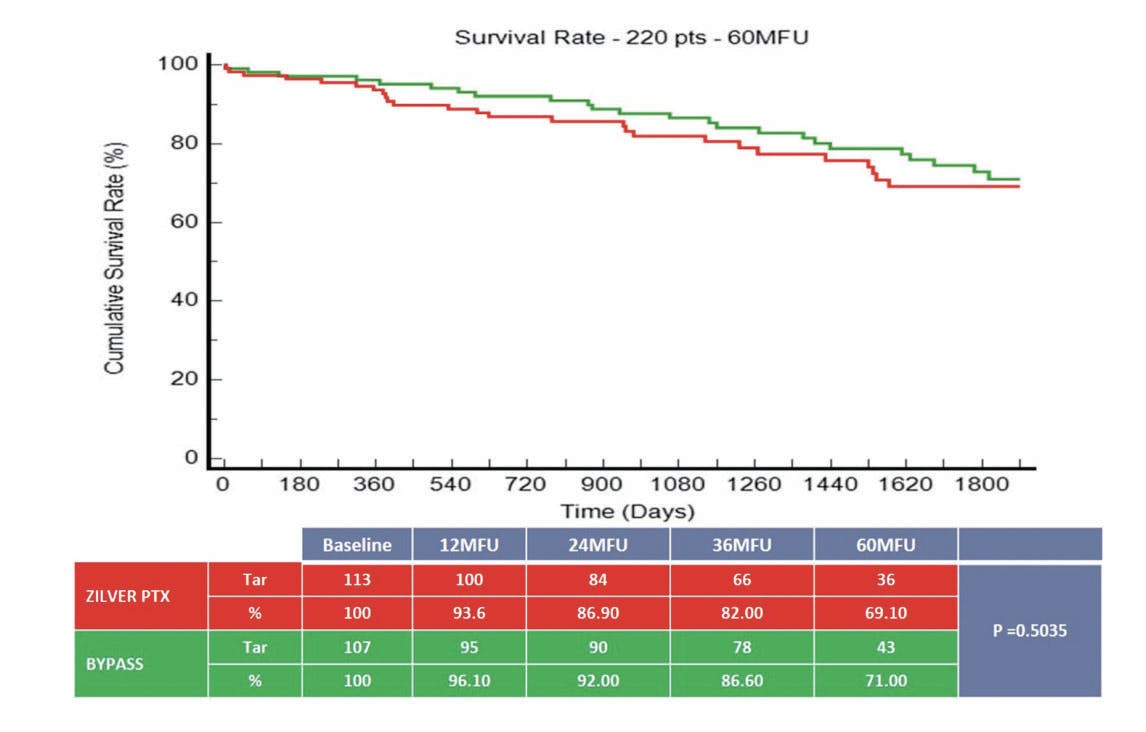
Figure 1. Survival at 5 years. Reprinted from Bosiers MJ, De Donato G, Torsello G, et al. ZILVERPASS Study: ZILVER PTX stent versus prosthetic above-the-knee bypass surgery in femoropopliteal lesions, 5-year results. Cardiovasc Intervent Radiol. 2023;46:1348-1358. doi: 10.1007/s00270-023-03549-0
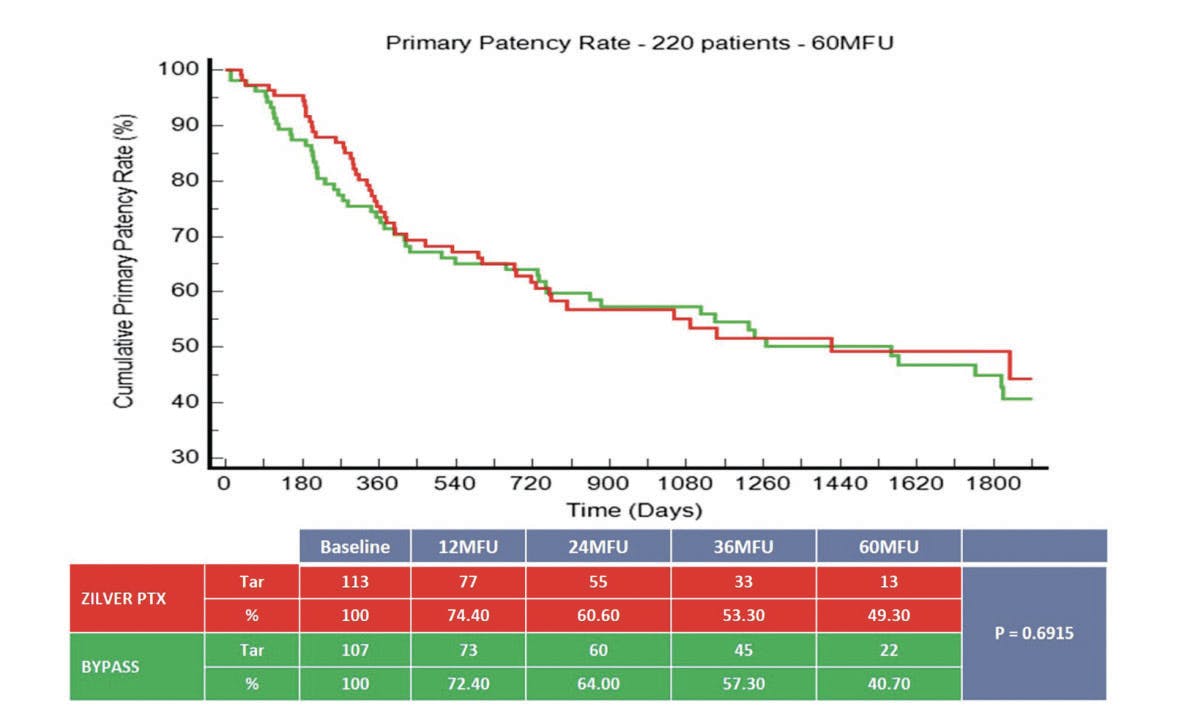
Figure 2. Primary patency at 5 years. Reprinted from Bosiers MJ, De Donato G, Torsello G, et al. ZILVERPASS Study: ZILVER PTX stent versus prosthetic above-the-knee bypass surgery in femoropopliteal lesions, 5-year results. Cardiovasc Intervent Radiol. 2023;46:1348-1358. doi: 10.1007/s00270-023-03549-0
Freedom from TLR at 5 years for Zilver PTX was 63.8%, and this is an amazing result—more than 6 out of 10 didn’t have any reintervention after 5 years of their primary treatment. This was 52.8% in the bypass group, so there was no difference between groups (Figure 3).
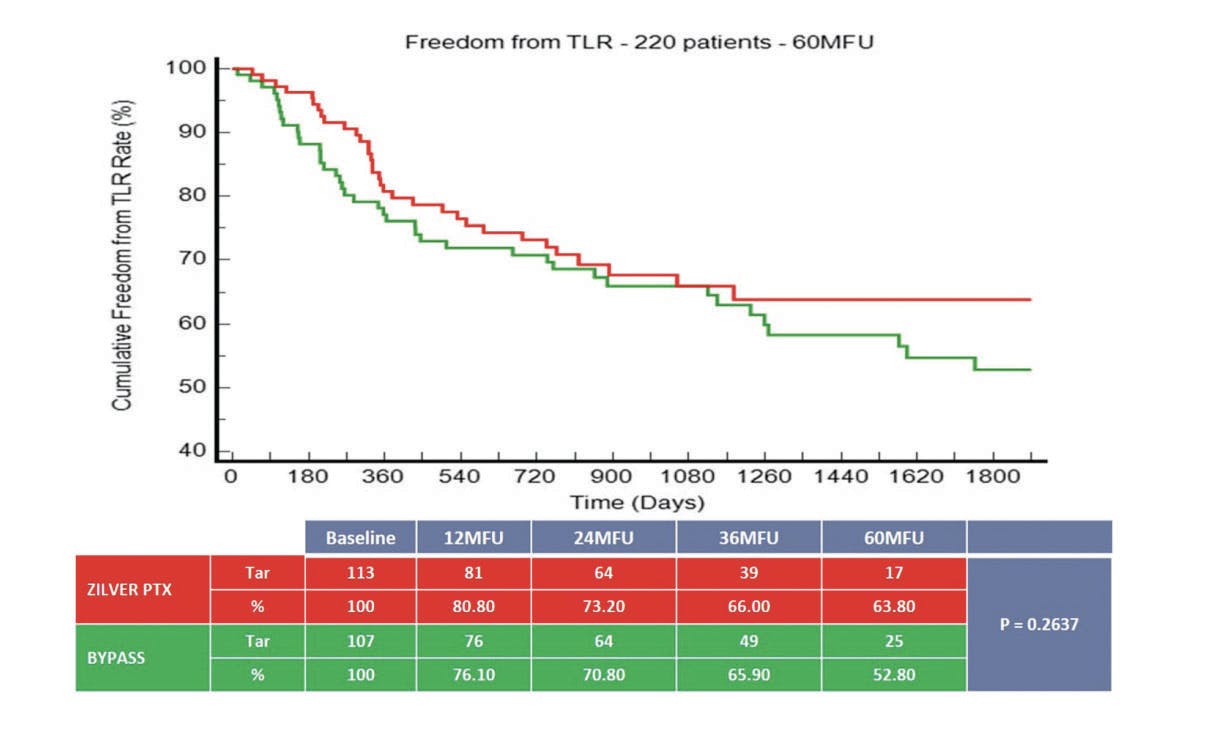
Figure 3. Freedom from TLR at 5 years. Reprinted from Bosiers MJ, De Donato G, Torsello G, et al. ZILVERPASS Study: ZILVER PTX stent versus prosthetic above-the-knee bypass surgery in femoropopliteal lesions, 5-year results. Cardiovasc Intervent Radiol. 2023;46:1348-1358. doi: 10.1007/s00270-023-03549-0
In terms of clinical assessment of Rutherford class, the results between groups were consistent over the years, where up to 5 years, the vast majority is a Rutherford 0 or 1 and a maximum of Rutherford 2 in both groups.
CLINICAL CONVERSATION: APPLYING THE EVIDENCE
Dr. McMackin: This study touches on all of the pieces that I think about when deciding between an endovascular or a surgical option. These are long lesions (even longer in the study than what they initially thought), very diseased, completely calcified, completely occluded. Those risks that we’re always weighing all came up: access complications, infection of the prosthetic bypasses, obese patients—these are the real-world patients that we’re dealing with every day. One surprising result that goes against common teaching is the reinterventions. You think if you’re going with endovascular, patients are coming back again and again. However, in this study, primary patency was the same between groups, and reinterventions were actually less for TLR in the Zilver PTX group.
Dr. Peña: When you’re making a decision on a long superficial femoral artery (SFA) lesion, you always consider surgery. I think we have to ask the question: If this was a vein graft, would results be different? Looking at a prosthetic versus a long-segment stenting of the SFA, these data tell us a lot; particularly in patients with CLTI and those with a lot of comorbidities, stenting is an equal option.
Dr. Deloose: Addressing the point concerning the vein or prosthesis, we had long discussions with the investigators, the committee, and the sponsor, and the rationale of the study was to stay as close as possible to the daily clinical practice, and the patient population is a clear proof of this. Also, again, we determined if our patient population is real world, we also need to do this in our treatment modality. All 13 participating centers re-looked at our daily vascular surgery practices, and in most centers, we are using prostheses in the majority of cases for ATK bypass, and we try to save the vein for the below-the-knee bypasses.
Additionally, the prostheses that were used were the modern heparin-bonded expanded polytetrafluoroethylene bypasses, where the results to an available vein are quite close, especially in ATK settings in terms of durability and patency. This was the reason we opted for prosthesis in this particular study rather than the vein.
Dr. McMackin: Our practice is similar in this way in the United States; we have that same failing forward idea where if we can save the vein for that long distal bypass instead of using it for ATK popliteal, we will mostly use those heparin-bonded grafts for our ATK femoropopliteal as well.
Dr. Deloose: One thing that we need to discuss is that, although patients were randomized head-to-head by computer, it appeared that the bypass group had a more diseased population based on significant risk factors and the CLTI cohort. So probably, stratification was the solution. Today, I’m running another randomized controlled trial for the common femoral artery where we are comparing an endo approach versus an open approach, and with my experience in the ZILVERPASS study, I did a stratification process in advance to be 100% sure that at the time of the randomization we have equal cohorts in the open and endo groups. What do you think about this?
Dr. Peña: This is an important point as we start looking at these data and how they are going to affect practice. These study results kind of went against our dogma, and I think because of that, it’s going to take a little bit more to move the needle and change practice. In the right patient, you can place a scaffold in a significant length in the SFA, and it is comparable to surgery with a prosthetic. But, the challenge is getting operators to understand and implement this going forward. These are the necessary data that we need to move forward, and it’s going to be interesting to see how the practice will change over the next years and decades.
Dr. McMackin: As we look at these studies going forward, when there’s a difference in the number of CLTI patients between groups, people immediately think about differences in outflow. That means we need to look beyond lesion length and consider the downstream vessels as well, whether through GLASS scoring or other scoring systems, so we understand what’s happening downstream that may affect patency and the need for intervention. I think these are things we’ll need to include in future studies.
Dr. Deloose: Dr. McMackin, I have a final question for you. As a vascular surgeon, you can offer both of these treatment modalities. Knowing these data, which kind of parameters will define one or the other decision, open or endo approach first?
Dr. McMackin: You definitely have to consider all of the risk factors; obesity is one of the biggest ones. Am I worried about the infection risk? Does that risk go up with one option over the other? Am I worried about surgery time or hospital stay? A long hospital stay can definitely affect a patient. For a claudicant, I think that an endovascular approach first makes perfect sense. For the CLTI patient, the decision is a little more nuanced. You still may have that endo option first, but you have to ask, what do I need to be doing first to get them more flow right now?
Watch It Now! Explore the full conversation here.


Advertisement
Advertisement