Advertisement
Advertisement
February 2026
An Interview With Bella Hausen, MD, MBChB, MRCS, DipEd, FRCR
Dr. Hausen discusses how innovation, data, and physician well-being are shaping endovascular care, from AI and robotics to radiation safety and the next generation of interventional radiologists.

Throughout your career you’ve helped pioneer new devices and procedures, and as Head of Endovascular Research and Innovation at Lancashire Teaching Hospitals, you’re deeply involved in shaping what comes next. What current research directions excite you the most?
My answer is twofold. First is the future of robotics and artificial intelligence (AI), which I became involved in through radiation protection. I was trying to find solutions to help all operators because no matter the specialty—interventional radiology (IR), interventional cardiology, neurosurgery—we’re all in the same boat when it comes to radiation. We do have some tools, but it would be wonderful if we could fast-track this. The world of robotics and AI has huge potential, not just in the actual clinical/procedural aspect but also in protecting physicians. This field has definitely been high on my agenda, and it continues to be a priority.
Further, virtual reality allows trainees to practice basic procedural skills without radiation exposure and can bridge gaps in learning. If you’re practicing in a center that doesn’t have the volume or case numbers to routinely perform something like a fenestrated aortic graft, virtual reality learning (combined with robotics and AI) can really help.
Second, I’m excited about the future of calcium and inflammation. I have a huge interest in the effects of inflammation and the vascular system, particularly the peripheral vasculature, in both healthy adults like us as clinicians and our vascular patients.
These are the two fields I tend to go between. There’s still so much to be done, so much to be explored. It’s an exciting year ahead!
You have become a leading voice in radiation protection, speaking widely on the topic through conference presentations, publications, and even spearheading a dedicated radiation safety meeting. What led you to champion this issue so passionately?
Prior to IR, I was actually a surgical trainee. I came through plastic surgery and microvascular, and then took a long path to eventually arrive at IR. But inflammation was always of interest. As young woman in IR, the prospect of potentially having kids, or not, is on your mind. But the understanding and awareness regarding the importance of radiation safety and musculoskeletal health was not quite there at the time. I was also heavily interested in aortic work then, which involved long hours and tilting at all angles. Of course, this is not specific to women; it applies to anyone in the lab. Scatter goes into your eyes, your thyroid, your skin. It just seemed that whenever I asked about or pursued these concerns, it was received as almost irrelevant. No one was really aware about these issues.
It became an expedition of: Let’s get to the bottom of this. What can we do, and how can we prevent it? It spurred me to figure out what I can do to help not only myself but everyone in the lab.
What do you feel are the radiation safety questions or issues that most need addressing in the near term?
I can’t take credit for this, but at a Society of Interventional Radiology meeting a few years ago, a few people said something to the effect of, “If we treated everybody as a pregnant operator and we put all those necessary precautions in place, we would all be safe.”
When entering the operating room, we should constantly ask ourselves, “Would I put a loved one carrying a fetus in this kind of scenario?” If the answer is no, we need to ask why, and then do something about it. Ultimately, it’s not a case of male or female—it’s about safety. This is the main question I tend to focus on.
In 2025, you and colleagues published an analysis of current radiation protection practices in the United Kingdom (UK), highlighting gaps in how radiation protection is practiced.1 What practical steps should hospitals and IR departments prioritize now to make radiation protection truly meaningful?
We need more collaboration between the physicists, the individuals involved in obtaining the radiation protection equipment, and the actual operators. The three must be in communication, no matter where they are. As an operator, it doesn’t matter how concerned I am if the person in charge doesn’t understand the urgency and see a need for these tools. On the physicist’s side, they may not be aware of the procedures I’m actually doing and how they have changed over time. What we were doing with endovascular aneurysm repair 5 years ago is not necessarily what’s happening now. Fluoroscopy machines are better, but we are also performing procedures with higher scatter.
These three groups need to be in a triangle—collaborating and equally invested in the importance of radiation safety. Of course, it is ultimately down to the operator to push for this, because only you can take care of you.
For early career physicians who want to prioritize radiation safety and musculoskeletal health as you have done, what guidance would you offer?
You are not wrong to be concerned and seek answers. It isn’t over the top—this is absolutely what we should be doing. A skier wouldn’t go down the slopes without ski gear. You wouldn’t go on a motorbike without your helmet or drive without a seat belt. Radiation safety should be common sense. No matter who you are, if you’re working with radiation or scatter, it should be your right to say: “Do I have all the correct gear? Okay, I don’t have glasses that fit me. Who can I approach to get the appropriate glasses? Who do I ask to get the appropriate lead for my stage of training?” These should be normal, healthy questions.
If you are running into difficulties, seek help. There is so much more awareness about this now; you’re definitely in a luckier position than I was. Things have changed. People are willing to listen, and industry is very approachable and willing to help trainees. Some companies even offer discounts if your trust isn’t able to provide gear.
You are also a strong advocate for the mental well-being of physicians. What changes in culture do you think would most improve sustainability, balance, and long-term satisfaction for interventional radiologists?
In the field of medicine, we are seen as the people who make other people better. It’s easy to forget that we too can be a patient. The first step is to realize that it’s okay not to be okay. It’s okay to be depressed. But what do we do about that? Ask for help. There is so much more awareness about this issue now and different avenues for help. In the UK, we have the British Medical Association, which offers free helplines for all kinds of situations—from full-on depression to anxiety about a failed exam. Your family doctor also has pathways to assist.
When I was in training, this all felt taboo. You could be seen as a failure, like you did something to get yourself there. This is not true. We’re all humans, and we are both mind and body. While you have to take care of your body, you also need to take care of your mind. This is a high-pressure job, and there is only so much a human can take. Outside of the actual field of saving a life, there is also your exams, your audits, your portfolio, the politics. On top of all this is maintaining your physical health, a partner, families, and all the drama that goes on with a normal life.
Sometimes the balance is off, and you find yourself not well. Understand that this is okay. You can’t be at 100% all the time. You just need to find what works for you—some people have very good family and friendship networks, and some don’t. But there are other pathways that exist for support.
Unfortunately in this world, there is a lot of negativity and bullying that goes on behind the scenes. There’s a lot of exams and pressures. Our junior doctors are poorly paid and have to fund so many things. But there is light at the end of the tunnel, and these hardships don’t last forever.
You have been heavily involved with the British Society of Interventional Radiology (BSIR). What do you envision for the society for this year?
I hope for balanced variety. Of course, I’m biased toward vascular. I definitely want to know the future of AI and robotics specific to aortic treatment and management. What is the latest there? Because the BSIR meeting is in November, there is still plenty of time. I feel that we’re going to have a robust amount of fresh data on this topic to discuss at the meeting, so I’m super excited.
You’re very involved in chronic limb-threatening ischemia and peripheral artery disease management, including research into new peripheral drug delivery devices. Given the rapid pace of innovation and the limits of long-term trial data, what have we learned so far about adopting new technologies and personalizing treatment in real-world practice?
This is difficult because I think most endovascular clinicians get excited by new technology. We constantly want the best for our patients, and we don’t have time to wait 6 or 7 years for long-term data. In an ideal world, you would have more than 6,000 or so patients in heavily focused, randomized controlled trials over a 5- or 6-year period. The reality is that this can’t always happen. I don’t think this will change.
What we can do with the drugs we are currently using is to regularly input and share that data. High-volume centers are often just working away, and people don’t know that they are actually a gold mine of beautiful, wonderful data that could potentially change how you practice.
Looking ahead, I would love to see every center to participate in registries—registries that cross institutional and national boundaries. The goal would be to make it straightforward to enter data while still capturing enough information to give us a true global picture of real-world practice and real-world outcomes. Whatever the drug and wherever it’s used, this kind of data would be powerful. As we move further into the era of AI, improved technology, and stronger connection, I see this becoming reality.
In a recent meta-analysis, you proposed the “SAFE” framework for treating mild stroke.2 What are the crucial next steps in research to strengthen or evolve care for this population?
Stroke medicine is how I started my vascular journey. After medical school, my focus was the carotid artery. Unfortunately, over the last 20 years, strokes have not gone down. We have stents, pharmaceuticals, better understanding, algorithms, and pathways, and this is all great. We are better at rapidly imaging patients and, within 6 hours of symptom onset, determining whether thrombectomy, thrombolysis, or no intervention is appropriate. But ultimately, stroke care has not caught up as quickly as other treatments, and there are other aspects that are getting worse. We have higher rates of diabetic patients and hypertensive patients. We don’t know what effect vaping will have—I personally think it will have a huge impact on the future of stroke morphology and inflammation.
All in all, stroke and carotid research are so paramount, and I am excited about the potential for new technologies that might solve some of our issues, making the procedure smooth, quick, and with as little side effects, contraindications, or complications as possible. Of course, if we can prevent stroke, that’s even better.
Given your investment in the next generation of interventional radiologists, from improving training pathways to widening representation in the field, what is one lesson today's trainees will need from their programs that wasn’t emphasized when you entered the field?
The ability to think and to dream. I know it sounds so cliche and cheesy, but it’s the truth. The world of IR is magnificent if you allow your mind to troubleshoot freely—without prejudice or being adulterated by what you’ve been taught, but to actually think through it. That’s how the next generation of inventors and innovators will emerge. If they continue with that belief of free thinking and dreaming, I think great things will come along.
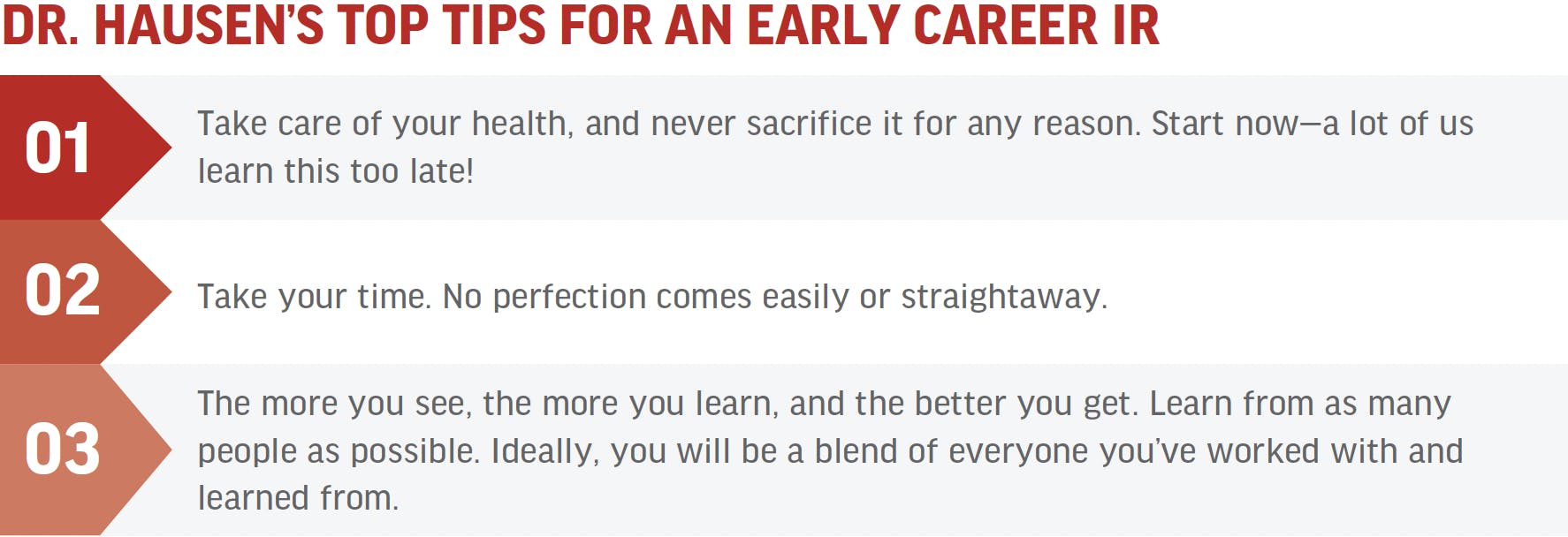
What are some practices that help support your own well-being outside the IR suite?
I really love walking, almost pathologically so! If you leave me, I could walk the entire day and not get bored. So of course I love hiking. Wherever I travel, I always try to hike as much as I can. I have been a marathon runner, although I have to admit the last 2 years I’ve done none of that. I don’t recommend it for the knees and ankles, but I do enjoy walking and hiking.
The thing that I am most passionate about though is actually children—anything that involves their well-being. This was true for me even before I was a doctor, whether through my illustrations, helping at local nurseries, or supporting play areas. One of the local schools near me had limited bikes, so I worked very hard with the school to try to get more bikes in for the kids. I love doing things for the younger generation that helps their ability to think, to enjoy, and to live, because they are our future. One of them is going to be the doctor that will treat my stroke, so I need to invest in that!
I love illustrating, writing books, and storytelling. I doodle all over! Often I will read a story at the local library reading club and will doodle a sketch, encouraging the children to do that as well. If we read the The Three Little Pigs, I want them to sketch what they are thinking of, because my three little pigs will look different from yours. It’s that ability to think and dream that is key—because whatever field these little ones go into, imagination and the ability to be a free thinker will be paramount!
1. Gasiea RY, Rogers A, Lakshminarayan R, et al. Radiation protection: safety measures and knowledge among interventional radiologists- a UK-based analysis of current practices and recommendations for improvement. CVIR Endovasc. 2025;8:32. doi: 10.1186/s42155-025-00540-3
2. Rajeswaran P, Huasen BB, Stanwell P, et al. Prevalence and outcomes of mild stroke patients undergoing reperfusion therapy: A meta-analysis and SAFE recommendations for optimal management. J Cent Nerv Syst Dis. 2025 Feb 12;17:11795735251314881. doi: 10.1177/11795735251314881. PMID: 39944087; PMCID: PMC11815822.
Bella Hausen, MD, MBChB, MRCS, DipEd, FRCR
Endovascular & Interventional Radiology Consultant
KOL MedTech
Illustrator
BSIR, NICE Guidance Representative
BSIR/VITALS, Vascular Scientific Committee
United Kingdom, Italy, United Arab Emirates
doctorbella.h@gmail.com
Disclosures: None.
Advertisement
Advertisement
Interested in reading more interviews?
To read more interviews with thought leaders in the vascular field, check out our Profiles & Perspectives hub.
Read More