Advertisement
Advertisement
February 2026
Sponsored by Medtronic
A Collaborative Approach to Treatment Algorithms for Pelvic Venous Disorders


Pelvic venous disorder (PeVD) is a broad umbrella term that encompasses chronic pelvic pain or varicose veins originating from the perineal region or lower extremities and predominantly affects up to 27% of people with female-assigned anatomy globally each year.1 PeVD mainly involves reflux or blocked blood flow through the ovarian and internal iliac veins. Symptoms include venous hypertension or endothelial damage and present as varicosities, pelvic pain, or abdominal pain.2 Hormones and pregnancy can increase a patient’s susceptibility to developing PeVD. The Symptoms-Varices-Pathophysiology (SVP) instrument (Figure 1) provides a standardized tool to characterize PeVD severity.2 Differential diagnosis potential for PeVD makes established physician paradigms essential to appropriate treatment.
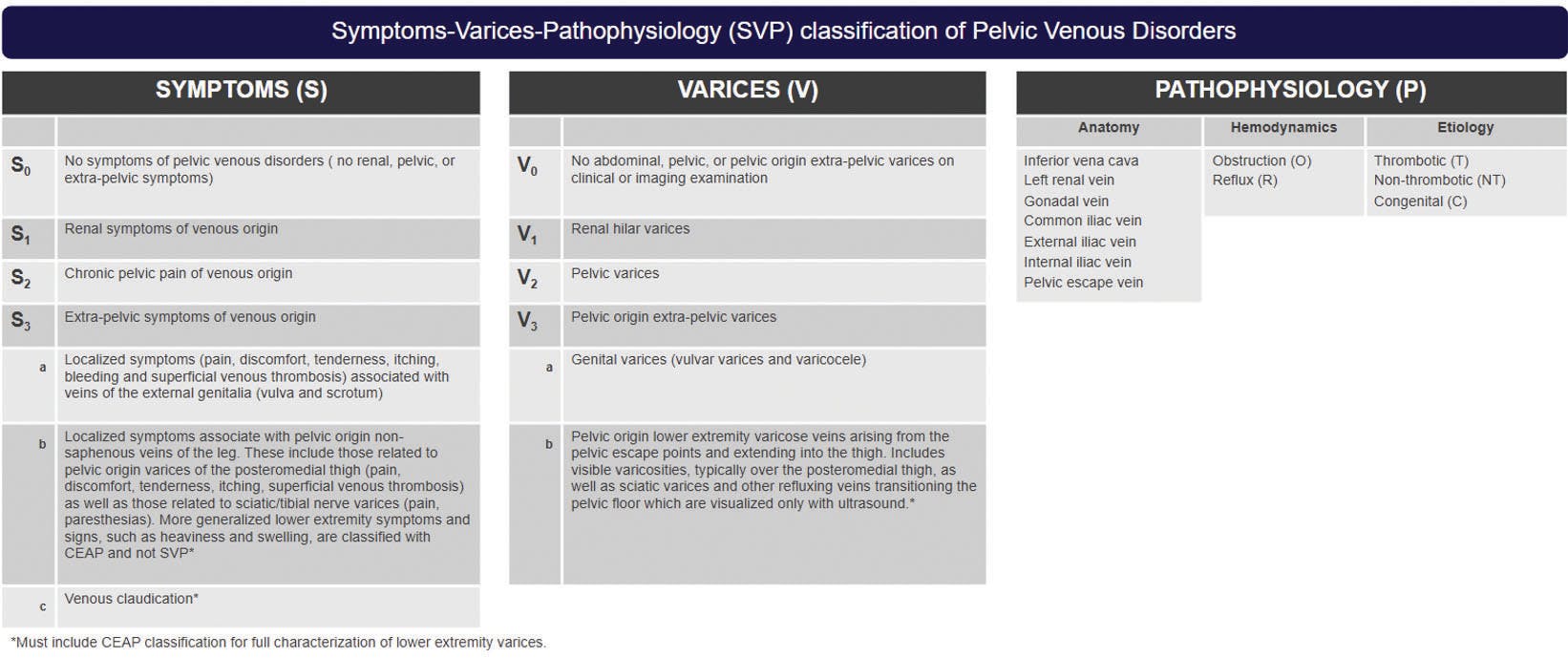
Figure 1. The SVP classification tool with diagnostic acronyms. Reprinted from Journal of Vascular Surgery: Venous and Lymphatic Disorders, Vol 9, Meissner MH, Khilnani NM, Labropoulos N, The Symptoms-Varices-Pathophysiology classification of pelvic venous disorders: a report of the American Vein & Lymphatic Society International Working Group on Pelvic Venous Disorders, Pages 568-584, Copyright (2021), with permission from Elsevier.
How prevalent is PeVD in your practice, and how has this changed over time?
Dr. Daye: PeVD is unfortunately underrecognized, which often leads to significant delays for patients to be evaluated by venous specialists. The key to building a practice in this area is increasing awareness among gynecologists and primary care providers about this condition. After giving a few grand rounds on PeVD throughout the years, my practice significantly grew to weekly consultations.
Dr. Ozsvath: PeVD encompasses approximately 25% to 30% of my venous practice. Over time, a better understanding of PeVD has occurred in my area as patient word of mouth and provider understanding have increased. I think asking patients direct questions about their symptomatology helps bring to light potential pathologies.
What are your thoughts on the importance of making an appropriate PeVD diagnosis?
Dr. Ozsvath: A combination of listening to the patient’s history, physical exam findings, ultrasonography, cross-sectional imaging, and venography with intravascular ultrasound (IVUS) are necessary tools to evaluate for PeVD.
Dr. Daye: Many patients with PeVD have been misdiagnosed for years and have undergone multiple procedures and surgeries to address their symptoms, without much relief. Making an appropriate PeVD diagnosis early is critical for improved patient care and outcomes. Tools such as the implementation of the SVP classification system (Figure 1) have led to increased standardization and diagnosis in the evaluation of PeVD.
There are many components to treating this disorder and achieving symptom resolution. How do you approach treating these patients? What is your preferred treatment algorithm for PeVD?
Dr. Daye: The treatment of PeVD is relatively complex, highly dependent on a patient’s SVP classification, and targeted at addressing the patient’s symptoms. Many of the patients we see present with venous-origin chronic pelvic pain (VO-CPP). Upon further evaluation with imaging and physical examination, we are usually able to discern the variceal reservoir and pathophysiology, and ultimately address the underlying disease.
For example, a patient with S2V2 disease secondary to left gonadal vein reflux would likely benefit from left gonadal vein embolization and pelvic variceal reservoir sclerotherapy. We recently wrote about a proposed evaluation and treatment approach for PeVD in an UpToDate article.3
Dr. Ozsvath: I obtain a thorough history and physical examination, relying on the patient’s gynecologist and other consulting physicians for reports and notes regarding the current issues. I try to obtain an understanding of the patient’s discomfort or pain. Using the SVP classification system and the diagnostic studies to date, I will perform either MR venography (MRV) or CT venography to rule out other pelvic pathologies. Next, after a discussion with the patient and review of risks and benefits, I will recommend pelvic venography to look at the renal veins, gonadal veins, and iliac veins, including the common iliac, internal iliac, and external iliac veins. IVUS is also used to evaluate the veins for either compression or intraluminal disease.
When treating patients with PeVD, what role does device selection play in your procedural planning, and what key factors influence your choice of device?
Dr. Ozsvath: For coil embolization, I prefer detachable coils in varying sizes. With the advent of dedicated venous stents, the choice is clearly to use a dedicated venous stent that is sized correctly in diameter and length.
Dr. Daye: When treating patients with PeVD, device selection is critical for optimal patient outcomes. I personally focus on choosing the right device for the right patient to best address their symptoms. I look carefully at the data available for each device, including reported failure rates and complications, and I consider the design advantages that each device design confers for each case. I typically incorporate those points in my discussion with and counseling of patients in the clinic, as I find many of them asking about the devices that will be used.
What are your primary goals in regard to treatment outcomes, symptom resolution, and patient-reported outcome measures (PROMs)?
Dr. Daye: Although some solely focus on technical success as the main outcome measure when performing procedures, I believe that the main outcomes to track when treating any patient should be patient-centric. Many patients with PeVD have debilitating symptoms that have significant implications on quality of life. Accordingly, one of the key metrics I track is patient-reported symptoms and outcome measures to assess the success of any intervention. I currently use the EQ-5D instrument in my practice, and I am looking forward to the upcoming PeVD-specific PROM tool that is currently being developed through Dr. Neil Khilnani’s ongoing study (NCT06083597).
Dr. Ozsvath: I feel very strongly that addressing patient expectations is the most important. The goal is for the patient to feel better and have less pain postintervention.
A Case Study With Dr. Daye
A female patient in her 30s presented to our clinic with a history of many years of debilitating pelvic pressure and pain, especially pronounced on the left side. She also reported bulging vaginal and vulvar varicosities, left lower extremity varicose veins, and increasingly worse pelvic pain after intercourse. She reported some relief with nonsteroidal anti-inflammatory drug treatment. The patient underwent an abdomen/pelvis MRV that showed an enlarged left gonadal vein and left pelvic varices abutting the uterus (Figure 2A and 2B). The SVP classification was S2V2PLGV,R,NT. The decision was made to proceed with left gonadal vein embolization and sclerotherapy of pelvic varicosities given the patient’s presentation (Figure 2C). At 4 weeks and 3 years postprocedure, the patient reported a significant improvement in pelvic pain and remained symptom free.
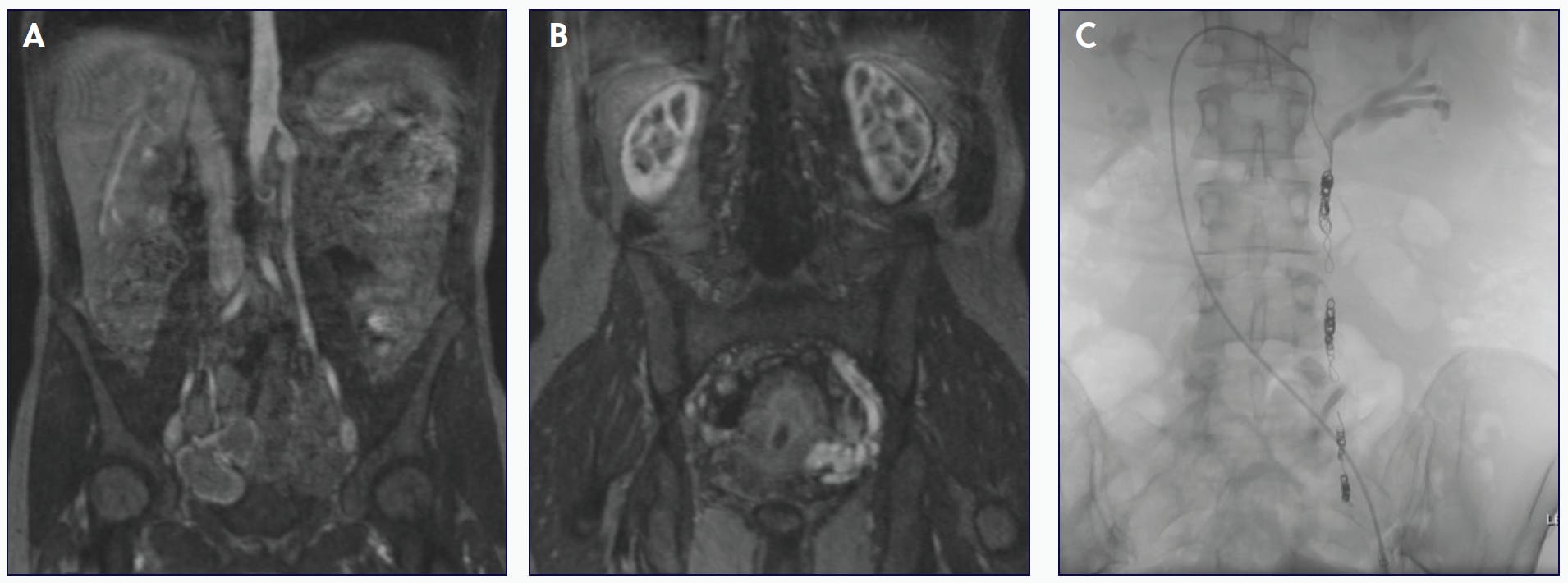
Figure 2. MRV shows a dilated left gonadal vein (A) with left-sided pelvic varices (B). The patient underwent successful left gonadal vein embolization with the 6-8–mm Concerto™ Helix detachable coil system (Medtronic), following sclerotherapy of the pelvic varices (C).
Do you have any concluding remarks to share?
Dr. Ozsvath: The most important thing I have learned is that even if a patient has undergone an intervention, either at my institution or another institution, there may still be another pathology that has developed or that has not been clearly defined. I feel strongly that patients must be heard. Taking time to really try to help the patients understand symptomatology and diagnosis should be the first step, then reassessing along the way. I follow the patients we treat over time to make sure they are doing well and that no new concerns have arisen.
Dr. Daye: I am encouraged to see the increased focus on PeVD in the past few years. The SVP classification system has been a great step forward in standardizing the description and evaluation of this patient population. With the increased interest in this entity, I am hoping to subsequently see increased awareness among different specialties about this disease, as well as increased early referrals to vascular specialists to provide improved care and deliver better outcomes for this patient population.
Disclosures
Dr. Ozsvath: Consultant to Medtronic, Boston Scientific, Convatec, and IAC.
Dr. Daye: Consultant to Medtronic, Sigilon, Boston Scientific, Cook Medical, and TriSalus.
1. Clark MR, Taylor AC. Pelvic venous disorders: an update in terminology, diagnosis, and treatment. Semin Intervent Radiol. 2023;40:362-371. doi: 10.1055/s-0043-1771041
2. Meissner MH, Khilnani NM, Labropoulos N, et al. The Symptoms-Varices-Pathophysiology classification of pelvic venous disorders: a report of the American Vein & Lymphatic Society International Working Group on Pelvic Venous Disorders. J Vasc Surg Venous Lymphat Disord. 2021;9:568-584. doi: 10.1016/j.jvsv.2020.12.084
3. Johnson NR, Daye D. Pelvic venous disorder in females: clinical presentation, evaluation, and diagnosis. UptoDate. Accessed January 1, 2026. https://www.uptodate.com/contents/pelvic-venous-disorder-in-females-clinical-presentation-evaluation-and-diagnosis
Concerto™ Helix and 3D detachable coil system
Reference Statement
Important Information: Indications, contraindications, warnings and instructions for use can be found in the product labeling supplied with each device. Not all patients achieve the same results.
Indications for Use:
The Concerto™ detachable coil system is indicated for arterial and venous embolizations in the peripheral vasculature.
Potential Adverse Effects of the Device on Health:
The potential complications include, but are not limited to, the following: puncture site hematoma, thromboembolic episodes, vessel perforation, neurological deficits including stroke and death, vasospasms, vascular thrombosis, hemorrhage, and ischemia.
CAUTION: Federal (USA) law restricts these devices to sale, distribution and use by or on the order of a physician.
501904 ©2026 Medtronic. Medtronic, Medtronic logo are trademarks of Medtronic.
All other brands are trademarks of Medtronic. For global distribution. 02/2026
Advertisement
Advertisement