Advertisement
Advertisement
February 2026
Sponsored by Terumo Interventional Systems
Clinical Experience With the Enhanced Glidewire GT-R™: An Indispensable and Reliable Tool for Endovascular Interventions
The 0.016- and 0.018-inch Glidewire GT-R™ microwire platforms offer a durable, shapeable tip that enables effective and safe proximal and distal superselective microcatheterizations.
By Marcelo Guimaraes, MD, MBA, CPE, FSIR, and Joe Khoury, DO, MBA, RPVI
The recently launched Glidewire GT-R™ (Terumo Interventional Systems) is a microwire made of super-elastic nickel-titanium alloy with a coiled radiopaque tip marker. The inner layer is entirely coated with polyurethane containing tungsten, while the outer layer is coated with a hydrophilic polymer. Due to the hydrophilic coating, the surface of the guidewire becomes lubricious once wet with saline solution or blood and thereby reduces friction resistance.
The Glidewire GT-R is available in 0.016- and 0.018-inch platforms, compatible with microcatheters featuring minimum inner diameters of 0.017 and 0.022 inches, respectively. Each wire features a straight, shapeable tip with a tapered length ranging from 25 to 30 cm. Both diameters incorporate a 3.5-cm radiopaque tip and are offered in 180- and 220-cm working lengths. These extended lengths provide reliable support and smooth navigation for long microcatheters (165-175 cm), enabling a full spectrum of proximal and superselective embolization procedures via femoral or radial access.
DURABLE SHAPEABLE TIP: A KEY COMPETITIVE ADVANTAGE
A defining performance advantage of Glidewire GT-R is the durability of its shapeable tip, which maintains integrity during repeated manipulation. This resilience assists operators in negotiating challenging vascular anatomies and crossing difficult lesions without premature deformation.
With its durable shaping technology, the distal tip is slightly heavier, giving the operator a distinct tactile experience compared to traditional soft-tipped microwires. A deliberate, slow, and controlled approach is recommended to achieve optimal results.
PERFORMANCE SUMMARY
The performance characteristics of Glidewire GT-R speak for themselves. Its combination of torque response, durability, and navigability make it a highly capable tool in both simple and complex embolization work. The case examples in this article further demonstrate how Glidewire GT-R can expand the operator’s ability to navigate demanding anatomy and achieve successful endovascular outcomes.
CASE EXAMPLES: GLIDEWIRE GT-R IN PRACTICE
Case 1: Prostatic Artery Embolization
A male patient in his early 60s who was on hemodialysis for end-stage renal disease and had diabetes and severe atherosclerotic disease presented with benign prostatic hyperplasia with lower urinary tract symptoms and urinary incontinence with long-term Foley catheter dependence. After a multidisciplinary discussion with urology, the patient was referred to interventional radiology for prostatic artery embolization. Pelvic angiography demonstrated extremely tortuous iliac vessels with multifocal stenoses in the pelvic vasculature (Figure 1A). Superselective angiography of the left internal iliac artery showed pin-hole severe stenosis of the prostatic artery origin (Figure 1B and 1C). Multiple 0.014- and 0.016-inch microwires were utilized with differing tip shapes. Ultimately, the 0.016-inch Glidewire GT-R microwire was used, which crossed a tight stenosis relatively quickly despite seeming initially impossible to traverse. Later in the case, the durable shapeable tip and reshapeable nature of the wire came in handy when crossing additional stenoses on the contralateral side.
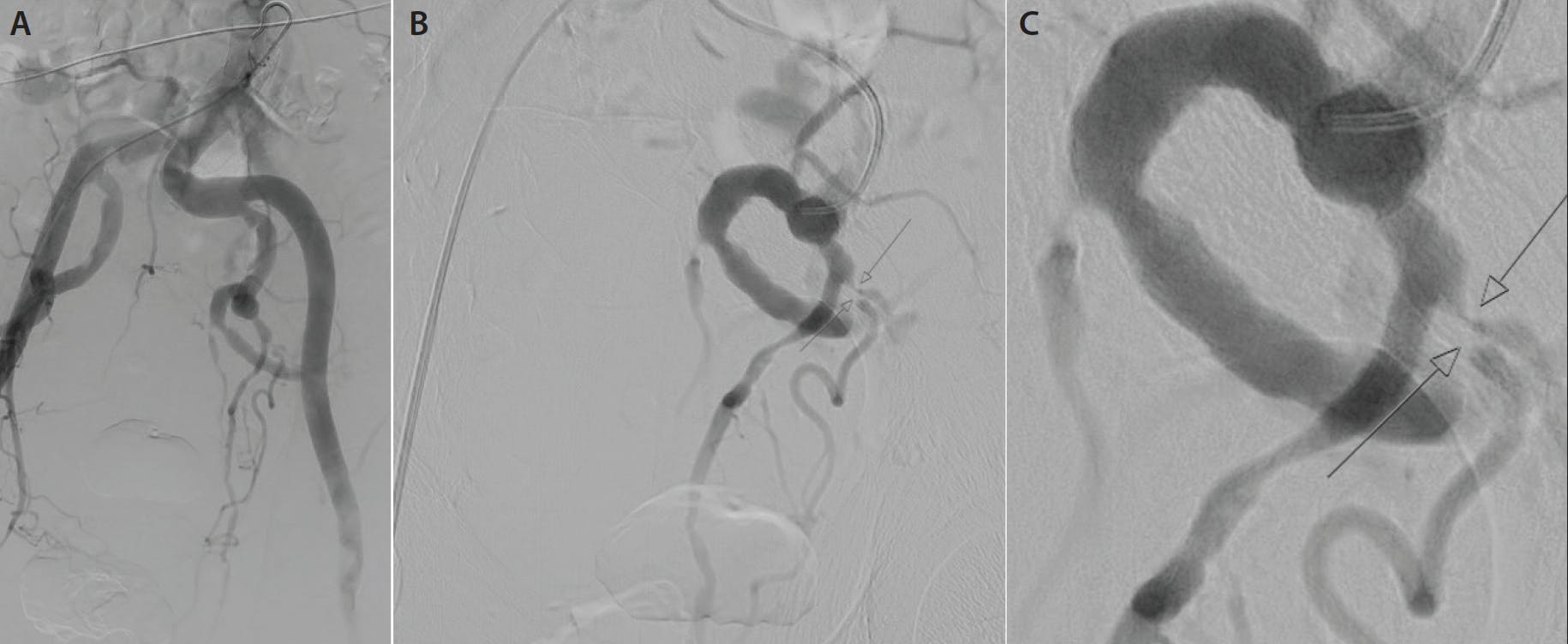
Figure 1. Pelvic angiogram showing extremely tortuous iliac vessels with multifocal stenoses in the pelvic vasculature (A). Superselective angiography of the left internal iliac artery shows pin-hole severe stenosis of the prostatic artery origin (B, C).
Case 2: Hepatic Artery Pseudoaneurysm
A woman in her early 60s with cholangiocarcinoma presented with external brisk bleeding through the left percutaneous transhepatic biliary drain skin tract during internal-external biliary tube exchange. Hepatic vascular injury was suspected. A celiac angiogram showed a distal left hepatic artery pseudoaneurysm (Figure 2A). A 0.016-inch Glidewire GT-R microwire was used for superselective microcatheterization in very tortuous anatomy, and a “front door-back door” coil embolization technique was used to treat the vascular injury effectively, utilizing a 0.018-inch, 3mm X 8cm AZUR™ CX coil for backstop and a 20-cm AZUR HydroPack™ coil (both Terumo Interventional Systems) (Figure 2B-D).
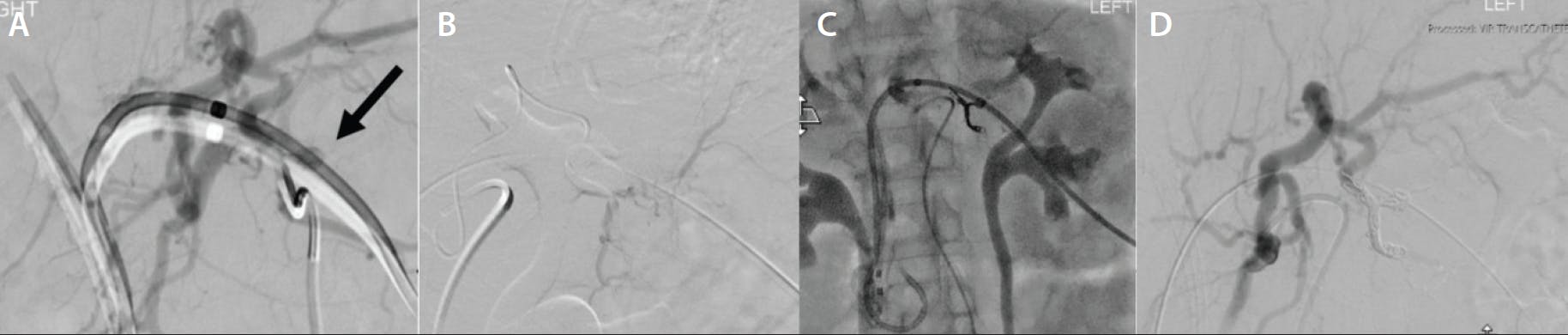
Figure 2. Celiac angiogram showing the distal left hepatic artery pseudoaneurysm (arrow) (A). Superselective microcatheterization with the 0.016-inch Glidewire GT-R microwire in very tortuous anatomy and a “front door-back door” coil embolization used to treat the vascular injury (B-D).
Case 3: Large Hepatic Hemangioma
A woman in her early 30s presented with right upper quadrant abdominal pain. Contrast-enhanced abdominal CT showed a large hemangioma occupying the entire right hepatic lobe (Figure 3A). The patient was referred for preoperative embolization. A selective common hepatic angiogram showed a mass effect and displacement of the common hepatic artery branches and high-grade stenoses involving the origin of the right and left hepatic arteries (Figure 3B). A 0.016-inch Glidewire GT-R microwire was used to carefully cross the stenoses that allowed superselective microcatheterizations of the distal right and left hepatic arteries. Embolization of the large hemangioma was performed using a combination of Trufill™ liquid embolic (Johnson & Johnson Medtech) and 0.018-inch, 4mm X 13cm AZUR™ CX coils. The final angiogram showed preferential flow toward the splenic artery (Figure 3C). The occlusion of the hepatic hemangioma feeding arteries allowed an uneventful resection of a large hemangioma.
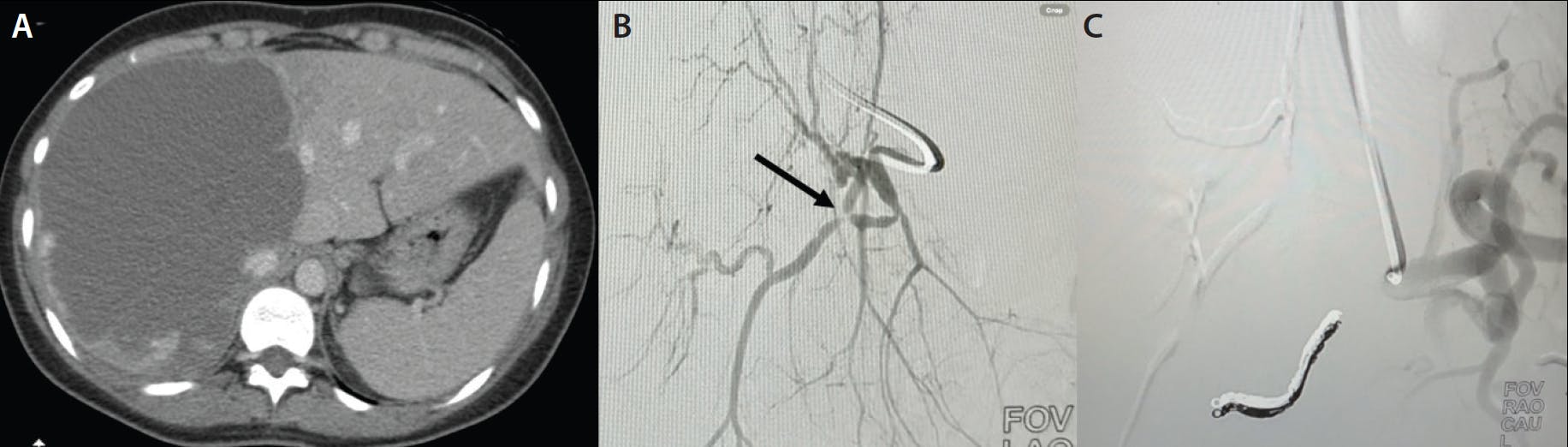
Figure 3. Abdominal CT with contrast showing a large hemangioma occupying the entire right hepatic lobe (A). Angiogram showing a mass effect and displacement of the common hepatic artery branches and high-grade stenoses at the origin of the right and left hepatic arteries (arrow) (B). Final angiogram showing preferential flow toward the splenic artery (C).
Case 4: Segmental Stenosis After Liver Transplantation
A man in his mid 50s presented with liver dysfunction 25 days after liver transplantation. An initial celiac trunk angiogram showed a segmental stenosis at the liver transplant arterial anastomosis (Figure 4A). A superselective angiogram of the hepatic artery revealed a short, nonlimiting flow dissection proximally (likely related to clamping of the hepatic artery during transplantation) as well as a subocclusive stenosis more distally (Figure 4B). A 0.016-inch Glidewire GT-R was used for careful lesion crossing that allowed for placement of a 6mm X 5cm Viabahn® balloon-expandable stent (Gore & Associates) in the hepatic artery and preservation of the graft (Figure 4C).
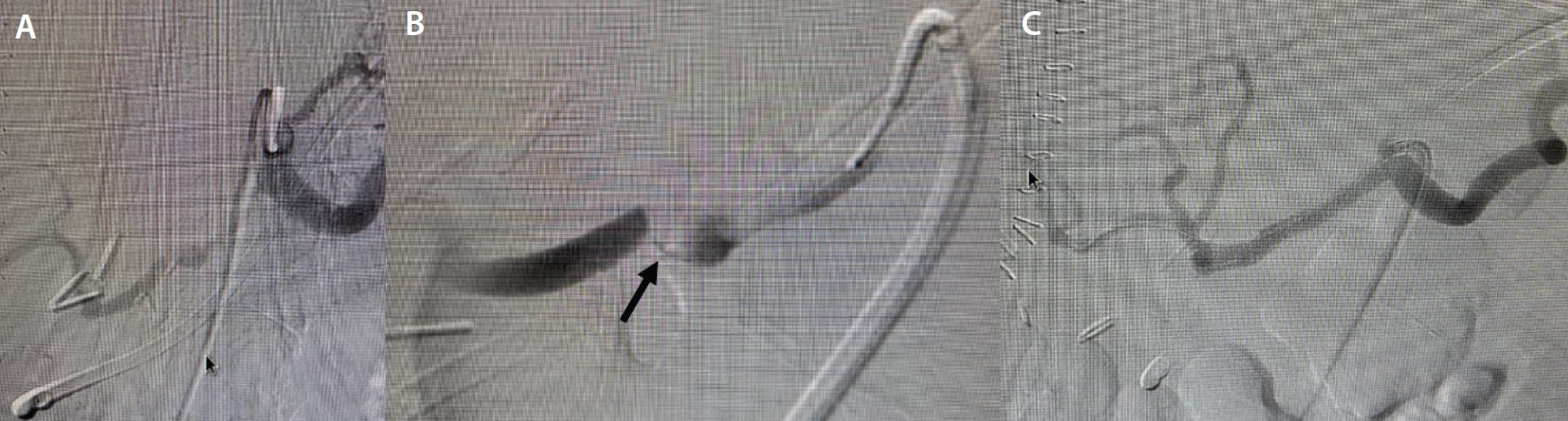
Figure 4. Initial celiac trunk angiogram showing segmental stenosis at the liver transplant arterial anastomosis (A). Angiogram showing proximal, short, nonlimiting flow dissection and subocclusive stenosis (arrow) (B). Lesion crossing with the 0.016-inch Glidewire GT-R (C).
Case 5: Renal Artery Occlusion
A man in his mid 60s presented to the emergency department with acute left flank pain and severe hypertension (212/167 mm Hg). Contrast-enhanced abdominal CT showed proximal occlusion of the left renal artery and poor left kidney perfusion (Figure 5A). An abdominal aortogram and selective left renal angiogram revealed total occlusion of the left renal artery (Figure 5B and 5C). The coaxial combination of a long sheath, a 5-F diagnostic catheter, and a 2-F microcatheter provided enough support for a 0.016-inch Glidewire GT-R microwire to cross the total occlusion after other microwires failed (Figure 5D). The renal artery revascularization with a 6 X 37mm Express™ balloon-expandable stent (Boston Scientific Corporation) resulted in blood pressure normalization and abdominal pain control.
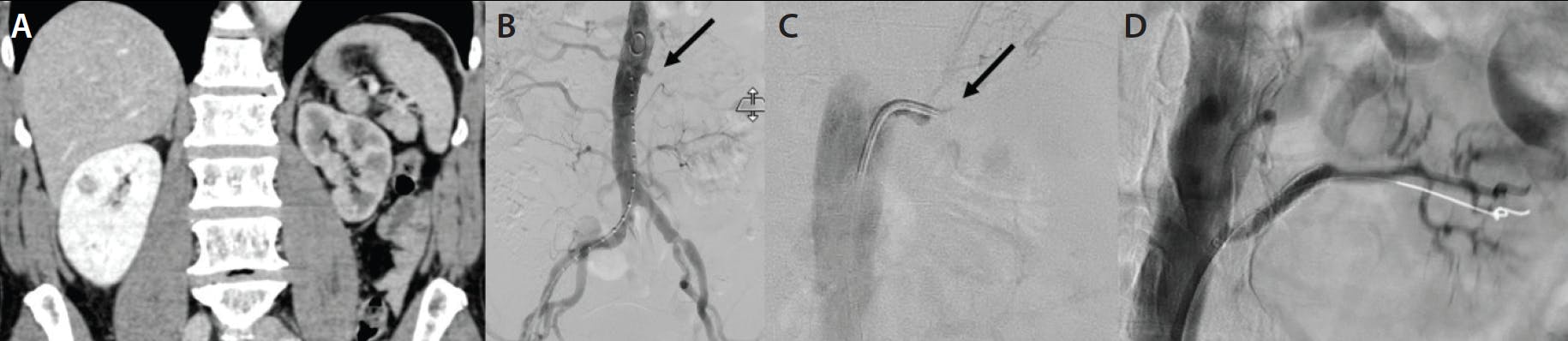
Figure 5. Contrast-enhanced abdominal CT showing a proximal occlusion of the left renal artery and poor left kidney perfusion (A). Abdominal aortogram (B) and selective left renal angiogram (C) showing total occlusion of the left renal artery (arrows). The 0.016-inch Glidewire GT-R microwire crossed the total occlusion (D).
CONCLUSION
Glidewire GT-R proved instrumental in achieving successful outcomes across all cases by enabling precise navigation through tortuous anatomy and crossing severe stenoses or total occlusions where other microwires failed. Its durable, shapeable tip and excellent torque response facilitated superselective microcatheterization and secure device delivery, allowing effective embolization, stent placement, and revascularization. These features underscore its reliability as a versatile tool for complex endovascular interventions.


Advertisement
Advertisement