Advertisement
Advertisement
February 2026
Sponsored by Merit Medical Systems, Inc.
From Beginning to Embo™ and Beyond: A Complete Procedural Partnership for PAE
With Alexander Misono, MD, MBA, RPVI, and Charles Nutting, DO, FSIR
As prostatic artery embolization (PAE) continues to gain recognition as a proven, minimally invasive treatment for symptomatic benign prostatic hyperplasia (BPH), Merit Medical is redefining how physicians approach the procedure. Merit’s comprehensive solutions go beyond individual devices, offering a complete system designed to simplify complexity, enhance reproducibility, and ensure consistent, predictable, high-quality care for patients.
Merit’s From Beginning to Embo™ approach was created with this philosophy at its core. By offering a unified system—from access and navigation tools to microcatheters, embolics, procedural preparation, and comprehensive physician and patient educational resources—Merit supports the entire embolization workflow.
To understand the impact of this integrated approach, Endovascular Today spoke with Alexander Misono, MD, MBA, RPVI, Chief of Interventional Radiology (IR) for Hoag Hospital, and Charlie Nutting, DO, FSIR, leading expert in embolizations and advanced image-guided procedures in the Rocky Mountain region. Both recently completed PAE procedures using a variety of products from Merit’s complete system offerings.


Let’s start with your practice models. What patient populations do you primarily serve?
Dr. Misono: I’m a private practice interventional radiologist who serves the broader Orange County community in Southern California. Our main facilities for interventional radiology (IR) are in Newport Beach and Irvine, California, although our imaging capabilities extend throughout the county. Our patients hail from all over Orange County and come to us for all varieties of IR needs, from the simplest to the most complex of procedures.
Dr. Nutting: I practice in an office-based lab (OBL) focused almost entirely on embolization: PAE, liver cancer therapies, and other targeted procedures. Because we specialize so deeply in embolization, efficiency and reproducibility are essential to how we deliver care.
You both recently completed PAE cases using all Merit products. What did your setup look like?
Dr. Misono: We used an entire suite of Merit products from beginning to end: Embopack for setup, Micro ACE™ Advanced Micro-Access System, FLO 30™ Hemostasis Valve, Prelude PRO™ Femoral Sheath, SplashWire™ Hydrophilic Steerable Guide Wire, Impress® Carnavale CPC-15 Diagnostic Catheter, TrueForm™ Reshapable Guide Wire, SwiftNINJA® Steerable Microcatheter, and finally, Embosphere® Microspheres—my go-to embolic. When you rely on one vendor for the full system, the entire process becomes smoother. Merit’s ability to take an intricate procedure in a complex world and simplify it is certainly a breath of fresh air.
Dr. Nutting: In our OBL, we used Merit’s MAK™ Mini Access Kit, FLO 30 Hemostasis Valve, Prelude PRO Femoral Sheath, SplashWire Hydrophilic Steerable Guide Wire, Impress Modified Hook and Carnavale CPC-15 Diagnostic Catheters, TrueForm Reshapable Guide Wire, SwiftNINJA Steerable Microcatheter, and Embosphere Microspheres. For me, having a true soup-to-nuts system is crucial. It allows me to perform PAE safely, consistently, and reproducibly. Merit’s products help me to accomplish these goals (Figure 1).
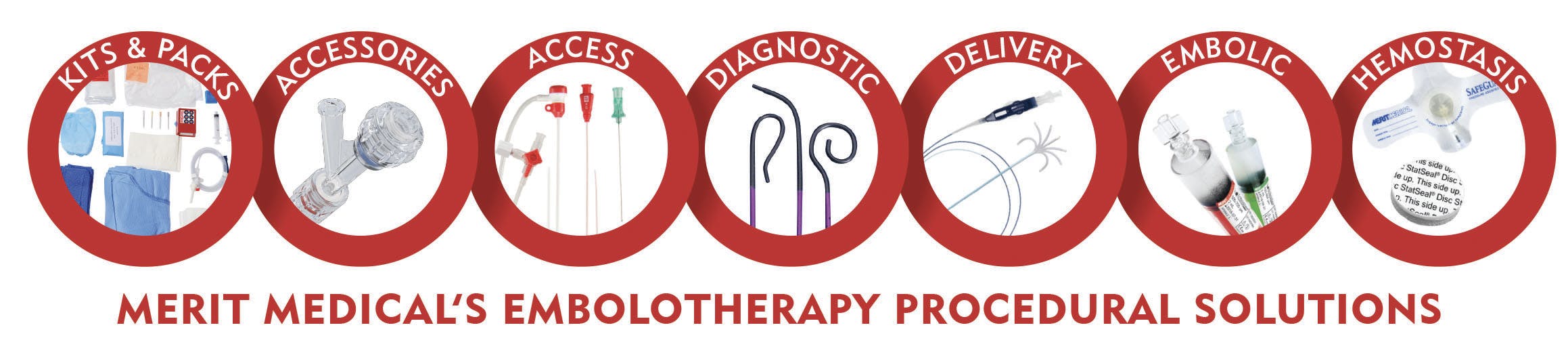
Figure 1. Merit Medical’s From Beginning to Embo™ approach.
Each of you works in a different environment, hospital versus OBL. How does a single-vendor system affect your workflow?
Dr. Misono: In hospital environments, having too many vendor options can create confusion. Different doctors may use entirely different systems for the same procedure, and the staff often opens unnecessary products trying to anticipate what’s needed. A system that encompasses all key products needed for an intervention such as PAE has a great opportunity to standardize, simplify, increase efficiency, and decrease waste.
Dr. Nutting: In an OBL, if something isn’t on the shelf, you can’t use it. There’s no borrowing from another department. That makes forecasting vital. A vendor that serves as a partner, understands this dynamic, and helps us stay ahead—that’s incredibly valuable.
Dr. Misono, you used the Impress Carnavale CPC-15 Diagnostic Catheter for the first time during your PAE case. What stood out?
Dr. Misono: I used to rely on specialty uterine fibroid embolization catheters and steerable sheaths when cannulating the hypogastric arteries in my PAE procedures, but the Carnavale CPC-15 exceeded my expectations. After I completed this procedure, I immediately asked my lab manager to stock them, and I’ve used them in several cases since. I’m a convert!
Dr. Nutting, how did the full system, from setup to embolic, perform in your case?
Dr. Nutting: For the past ten years, I’ve relied on much of the Merit portfolio. The combination of Merit’s base catheters, microcatheters, and embolics delivers consistent performance, making complex interventions more efficient and predictable. For difficult anatomy, including type 1 prostate artery origins, the SwiftNINJA is a revolutionary catheter. For more straightforward cases, Merit’s Maestro® swan neck performs beautifully. The system provides stability, control, and precision—something we’ve trusted for years.
SwiftNINJA plays a central role in both of your workflows. What makes it so valuable during PAE?
Dr. Misono: SwiftNINJA has long been my go-to microcatheter for tough anatomy, whether mesenteric cases, complex embolizations, or PAEs. Few innovations truly change procedural efficiency, but SwiftNINJA does just that. Prostate artery cannulation can be notoriously difficult, but this device makes it faster and easier. With every case, I become even more efficient. It’s the most impactful tool in my arsenal for speed and precision.
Dr. Nutting: It’s a premium product with no true equivalent. In type 1 origins where you’re making 90° turns off the umbilical artery, it performs in ways a standard microcatheter cannot.
One of the biggest advantages is that in thirty to forty percent of cases, we can catheterize the intended vessel without a wire. I attach a syringe of full-strength contrast to the SwiftNINJA, deflect the catheter, inject as I advance, and often find the artery much faster. It is a huge time saver when appropriate.
Predictability is essential in PAE. Why has Embosphere earned your trust?
Dr. Misono: Embosphere has always stood for consistency, reliability, and reproducibility in embolization. Merit’s growing data across multiple disease states reinforces that trust. Simply put, it’s “old reliable,” free of issues and controversy for as long as I’ve used it.
Dr. Nutting: Embosphere is tightly calibrated, and regardless of the patient, delivery of the microspheres is highly reproducible. Predictability is everything.
How do you view Merit’s role as a partner in providing devices, education, patient resources, and procedural support? In what ways can this type of comprehensive support benefit physicians and patients going forward?
Dr. Misono: Imagine being able to pull the same setup every single time for your procedures. You can realistically only do that when the system is comprehensive as well as flexible enough to meet your needs. Few—if any—vendors besides Merit can offer this when it comes to embolotherapy platforms. Simplicity allows for reproducibility, which in turn leads to the efficiency we all crave.
Merit’s positioning in medical education, available technologies, and investment in innovation is ensuring that the future of PAE as well as other embolization procedures will be further democratized, enhancing the ability of all doctors to learn and perform these procedures. It is a truly wonderful time to be a patient, as there has never been so much structure and support than there is now and will be in the future.
Dr. Nutting: Merit has been at the forefront of patient and physician education in the embolotherapy space. Many of these procedures can be technically challenging. Merit provides the educational and practical support that help to standardize physician education and training in this specialized area of IR. Merit sets itself apart because the company doesn’t just offer supplies. It offers webinars, live courses, simulators, and patient education tools. For PAE, that support is invaluable.
Case Snapshot From Dr. Misono
A man in his early 70s presented with a history of hypertension, hyperlipidemia, diabetes, atherosclerosis, and BPH. He previously underwent transurethral resection of the prostate, which initially helped but is no longer effective. Currently, he urinates up to 30 times daily, about half urgently and often resulting in incontinence. The patient experiences nocturia as well as recurrent episodes of hematuria, sometimes passing up to a cup of bloody urine with clots.
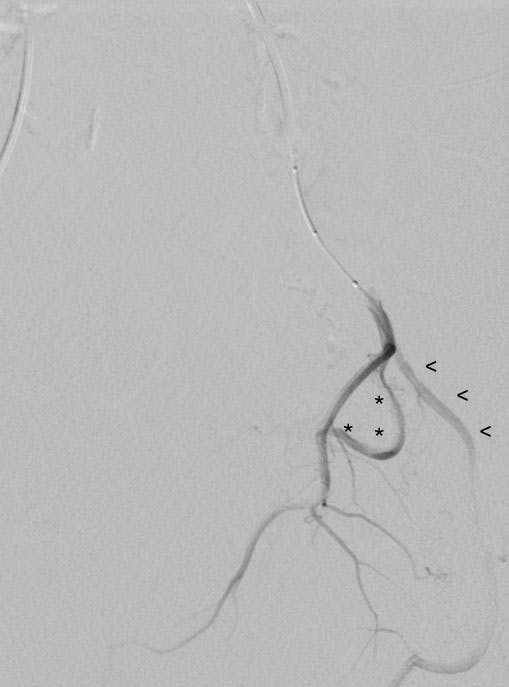
Figure 1. The prostate artery arising from the internal pudendal.
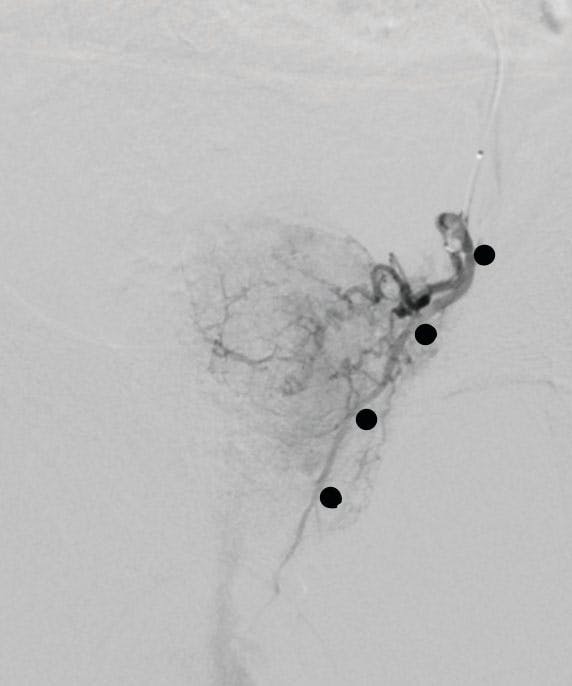
Figure 2. The rectal branch just proximal to the prostate artery—must cannulate past this branch.
What advice would you give physicians looking to start or expand PAE services?
Dr. Misono: One of the most important steps is to partner with a company like Merit to build out your capabilities and competencies. Merit specifically has great depth in embolization, and the company is truly peerless when it comes to developing these platforms in concert with physicians. Why reinvent the wheel? Leverage Merit’s deep experience and catapult your practice forward.
Dr. Nutting: Become deeply educated—on anatomy, devices, patient selection, expected results, and complications. Webinars are helpful, but nothing replaces hands-on training or simulators. Master the common arterial origins. One suggestion would be to use the Carnevale classification system, which lays out approximately ninety-five percent of all origins. Once I really started to understand the anatomy and where the common origins were, it streamlined my process and decreased procedure times.
Case Snapshot From Dr. Nutting
A man in his mid 60s presented with BPH and moderate lower urinary tract symptoms. His IPSS (International Prostate Symptom Score) was 18, with a quality of life of 4. The patient noted urinary frequency, urgency, weak stream, and nocturia, with worsening symptoms over the last 5 years. The patient was started on α-blockers, but urinary symptoms recurred after a couple of years. His prostate volume was 108 g. Cystoscopy revealed trilobar hypertrophy and bladder outlet obstruction.
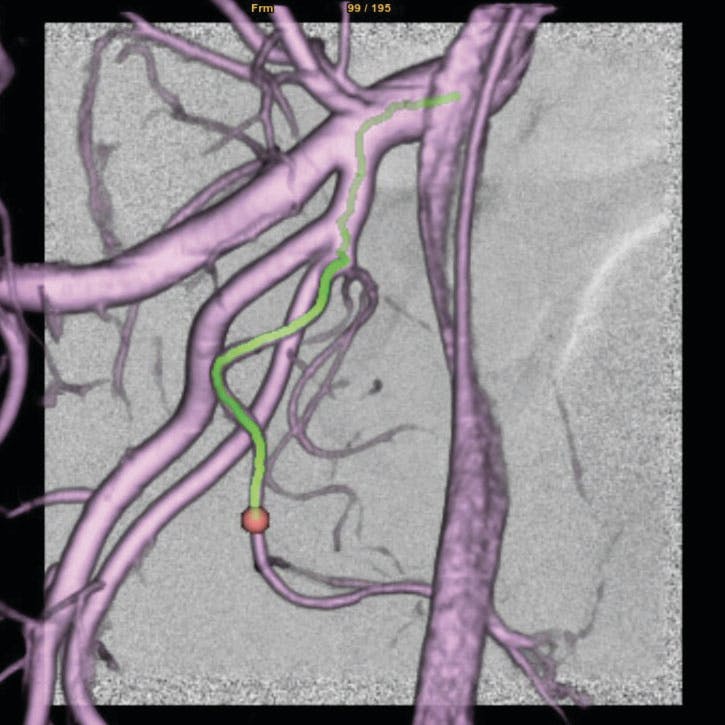
Figure 1. Embo ASSIST (GE HealthCare) navigation software with three-dimensional overlay demonstrating a type 1 prostate artery.
The patient refused transurethral therapies. A bilateral PAE was performed in the OBL. The procedure was technically successful and completed in 56 minutes.
How has Merit Medical evolved from being a product provider to becoming a true procedural partner in your practice?
Dr. Misono: Merit has been known to be a top-notch provider of the interventional products that are used daily in the lab. As such, Merit has always been an indispensable partner in our ability to effectively perform interventions. Most of us who have worked in the lab for years recognize the Merit name and associate it with quality and durability.
As Merit has developed new technologies and devices, introduced dedicated training platforms, and invested in new innovations, I view modern-day Merit as a therapeutic interventional partner, which is a distinct break from the past.
Dr. Nutting: The deflectable microcatheter changed everything. A decade ago, there were prostate arteries we simply couldn’t catheterize. Now, with tools like SwiftNINJA® and the full Merit system, it’s rare not to complete a bilateral PAE. That allows me to deliver the quality of care I’d expect for my own family.
Delivering efficient, reproducible, high-quality PAE requires more than a set of devices; physicians need a cohesive workflow, predictable performance, and a partner dedicated to continuous education and innovation. Merit’s From Beginning to Embo approach supports physicians at every step: procedural preparation, access, navigation, embolization, and beyond, including patient resources and physician education.
For Dr. Misono and Dr. Nutting, this comprehensive partnership has streamlined their workflows and elevated procedural confidence, offering consistent, safe, and high-quality care for their patients.
Advertisement
Advertisement