Advertisement
Advertisement
February 2026
Sponsored by Inari Medical, a division of Stryker
Artix™ Thrombectomy System and the Road Ahead
A dialogue with Co-PIs of the ArtixASCEND postmarket study, Drs. Anahita Dua and Shang Loh.


Peripheral arterial thromboembolism continues to challenge endovascular specialists. Existing strategies often require trade-offs between completeness of thrombus removal, blood loss, efficiency, and the need for adjunctive thrombolytics or open surgery.
The Artix™ Thrombectomy System (Inari Medical, now part of Stryker) was designed to address these gaps via a purpose-built, all-in-one platform that integrates mechanical thrombectomy, aspiration, proximal flow control, and blood return in a single system. As clinical adoption grows, attention is also turning toward ArtixASCEND (NCT07135895), a forthcoming prospective, multicenter clinical study designed to build a robust evidence base for arterial thrombectomy.
In this Q&A, Drs. Anahita Dua, Vascular Lab Director at Massachusetts General Hospital, and Shang Loh, Chief of Vascular Surgery & Endovascular Therapy at Penn Presbyterian Medical Center—vascular surgeons, nationally recognized experts in peripheral artery disease (PAD), and Co–Principal Investigators of ArtixASCEND—discuss the clinical rationale behind Artix, why its design resonates with vascular surgeons, and what questions ArtixASCEND aims to answer as the field evolves. Practitioner adoption of the Artix system has been rapid, with over 2,500 commercial cases completed since the March 2025 launch to mid January 2026.
From a clinical standpoint, what unmet needs in arterial thrombectomy led to the development and adoption of Artix?
Dr. Dua: Arterial thrombectomy has historically been fragmented. Physicians often have to choose between aspiration-only devices, mechanical systems, thrombolytics, or open surgery—each with limitations. Aspiration alone can struggle with organized or chronic thrombus and may result in significant blood loss. Mechanical systems may lack flow control. Thrombolytics take time and carry bleeding risk. Open surgery is invasive.
Prior to Artix, none of the pre-existing systems were over-the-wire or offered flow arrest, so you were always giving up procedural control, particularly in aspiration-only solutions. Artix was designed to consolidate what we value most into a single platform: effective thrombus engagement across a range of chronicities,* the ability to arrest flow proximally, and procedural control that feels familiar to surgeons. That combination directly addresses the real-world complexity we see in acute and acute-on-chronic* peripheral arterial thromboembolism.
Dr. Loh: What resonates clinically is that Artix acknowledges that not all clot is the same. In many cases, you’re dealing with mixed morphology—fresh thrombus layered on chronic disease. Unlike aspiration-only devices, Artix combines mechanical and aspiration thrombectomy, which improves thrombus engagement and clearance, leading to better overall efficiency and more complete thrombus removal.* Having both mechanical and aspiration capabilities in one system allows you to adapt during the procedure without changing devices or strategies midstream.
Case 1: Fifteen-Minute Technical Clearance of the Popliteal Artery With Zero Blood Loss in a Single Session
By Shang Loh, MD
PATIENT PRESENTATION
A patient who had undergone endovascular aneurysm repair 1 week prior presented with arterial thrombus that had embolized to the right popliteal artery.
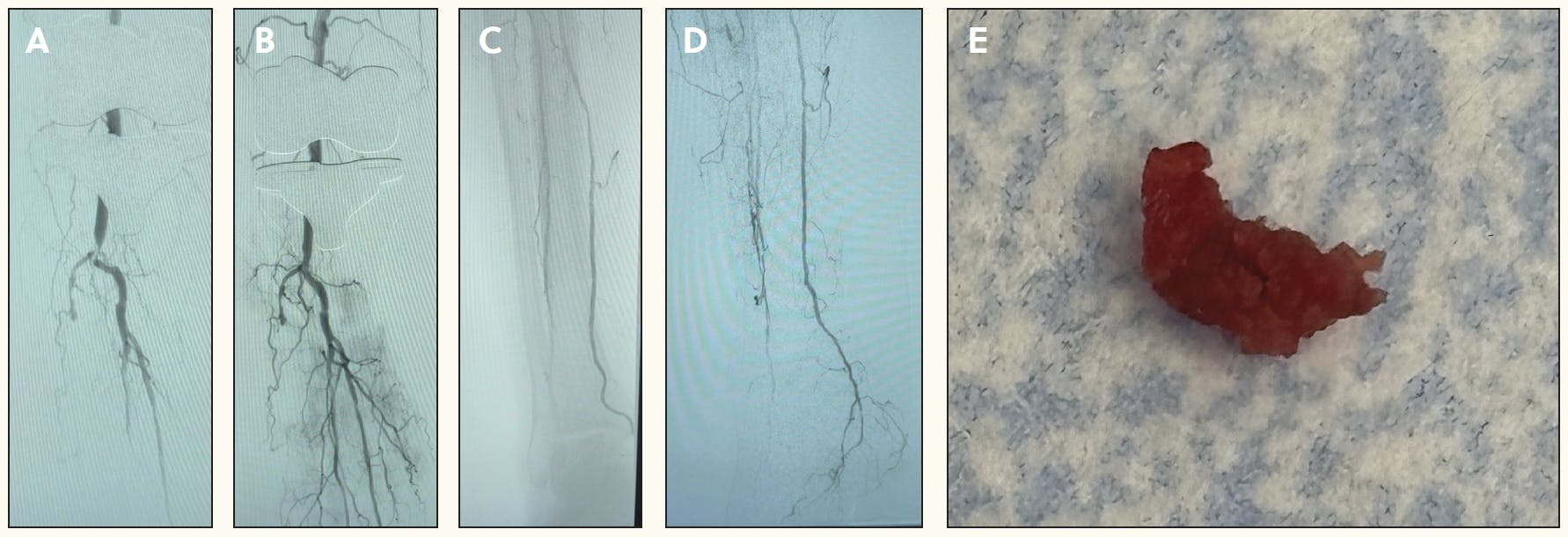
Figure 1. Preprocedure angiograms (A, C), postprocedure angiograms (B, D), and clot removed (E).
PROCEDURAL OVERVIEW
Right common femoral artery antegrade access was obtained with a 65-cm Thin-Walled Sheath and Covered Funnel Catheter (Inari Medical) for flow arrest. The Artix MT6 was utilized over a 0.014-inch guidewire for just 2 passes, clearing the entire occlusion. Balloon angioplasty was then performed. Total device time was 15 minutes, with full restoration of flow and no blood loss.
Artix incorporates proximal flow restriction via a covered funnel catheter. Why is this feature particularly meaningful for vascular surgeons?
Dr. Loh: Vascular surgeons are trained with open principles in mind. In open thrombectomy, we clamp the vessel to control flow and assess back bleeding. Flow arrest is second nature to us. The Artix covered funnel catheter essentially recreates that principle in a percutaneous setting. Artix is the only device that has anticipated the value of full flow arrest and created a dedicated mechanism to deliver on this.
That sense of control—knowing you’re minimizing clot migration risk† while actively managing clot—is a major differentiator. It makes the procedure feel deliberate rather than reactive.
Dr. Dua: I agree. Proximal flow control is foundational in arterial thrombectomy. Without it, there is always concern for clot migration and loss of procedural control, particularly in vessels supplying an already threatened limb. The covered funnel catheter in Artix enables temporary flow arrest, allowing thrombus to be engaged, disrupted, and removed in a controlled hemodynamic environment.† This lets you methodically clear clot while maintaining procedural efficiency—an important advantage when treating situations where distal perfusion is already compromised.
How does the dual mechanical-plus-aspiration approach change procedural decision-making in practice?
Dr. Dua: It simplifies it while lending greater treatment flexibility and control. Instead of deciding up front which modality might work best—and then pivoting if it doesn’t—you can start with one approach and seamlessly incorporate the other. Aspiration-only systems have limited efficacy and applicability. Mechanical thrombectomy helps disrupt and mobilize more organized thrombus,* while aspiration allows you to efficiently clear what you’ve captured.
The ability to make multiple passes quickly, with minimal blood loss when paired with blood return, supports a single-session strategy rather than staged interventions.
Dr. Loh: From a workflow standpoint, that flexibility matters. You’re not losing time exchanging platforms, and you’re not escalating to thrombolytics simply because you’ve hit a technical or therapeutic ceiling. For many cases, that translates into faster revascularization and potentially shorter hospital stays.
Case 2: Successful Clearance of 21-Day-Old Clot Without Thrombolytics
By Anahita Dua, MD
PATIENT PRESENTATION
A man in his early 20s presented to the emergency department with preexisting arterial thrombosis.
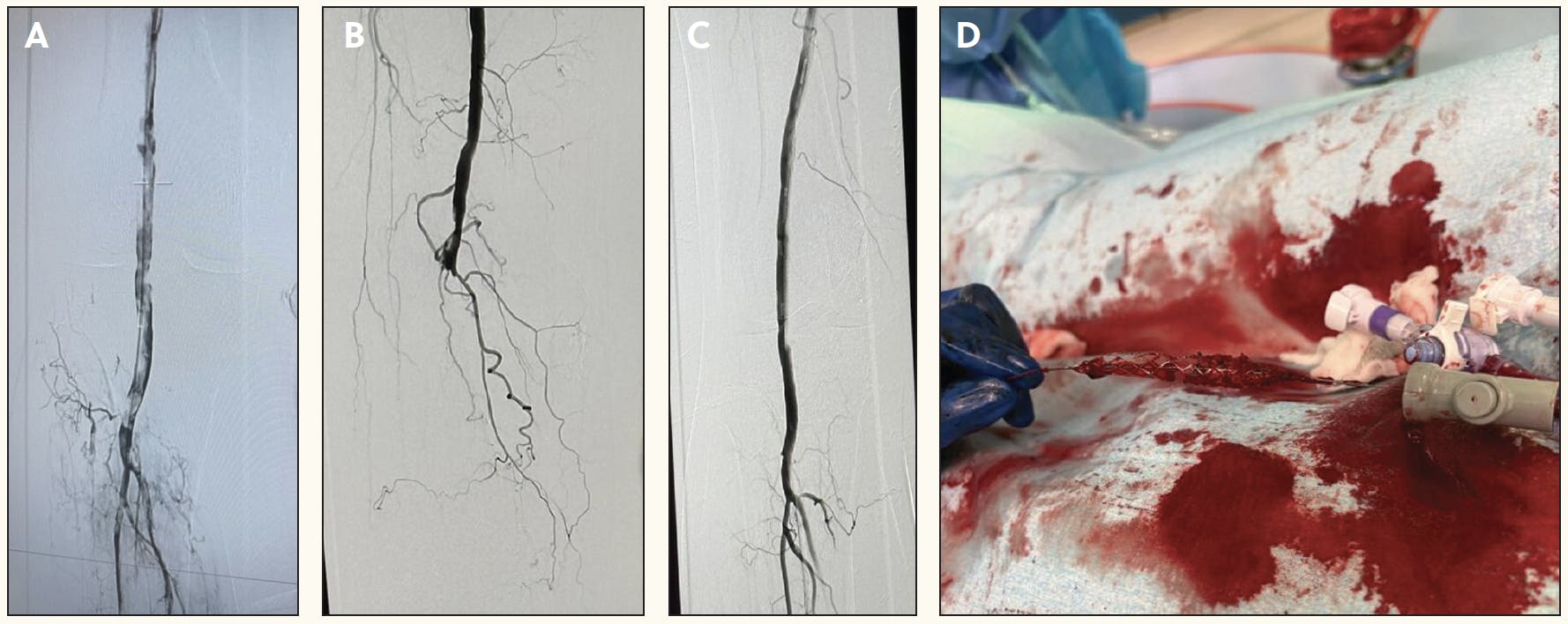
Figure 1. Preprocedure angiograms (A, B), postprocedure angiograms (C), and mixed-morphology clot removed (D).
IMAGING FINDINGS
CTA showed a thrombosed left femoral artery and left popliteal artery. The clot age appeared to be 21 days.
PROCEDURAL OVERVIEW
Access was obtained in the right common femoral artery with the 65-cm Thin-Walled Sheath. After 5 passes with the Artix MT8, the femoral and popliteal thrombus was cleared. The device time was 35 minutes, with complete flow restoration, minimal blood loss, and no need to use catheter-directed thrombolysis.
Artix has been described as particularly intuitive for surgeons. What design elements contribute to that perception?
Dr. Loh: The over-the-wire design is a big part of it. Maintaining wire access throughout the case is critical, especially in complex anatomy or long-segment disease. It allows precise control and preserves options. The Artix covered funnel catheter and its ability to arrest flow is also key. Vascular surgeons can appreciate the ability Artix provides to replicate open surgery principles in an endovascular approach. Artix is the only platform that provides these advantages.
Dr. Dua: I agree that Artix contains all the hallmarks of an ideal device: over-the-wire, well-designed MT element that safely engages and removes clot, and flow arrest. In open surgery, we can control the hemodynamic environment by clamping the artery—with its flow arrest feature, Artix effectively reduces the risk of clot migration in a percutaneous approach.† It allows me to achieve the benefits of open surgery while staying endovascular.
What do the clinical results with Artix show to date, based on early commercial experience?
Dr. Dua: Although trial enrollment on ArtixASCEND has not yet begun, the early commercial and clinical experience with Artix has been highly encouraging. At the 2025 Amputation Prevention Symposium, Dr. Khanjan Nagarsheth (Professor of Vascular Surgery, University of Maryland) presented outcomes from the first 1,000 commercial, real-world Artix cases. These data demonstrated high rates of technical success, including approximately 95% flow restoration and a median thrombus removal of about 95%.
What stood out to me was not just efficacy, but consistency across a wide range of presentations—from emergent arterial thromboembolism cases to more complex, mixed acute-on-chronic disease.* That speaks to the value of having both mechanical and aspiration modalities in one system, supported by flow control—three key benefits that only the Artix platform provides.
Dr. Loh: Another important signal from the 1,000-patient experience was the relatively low reliance on adjunctive thrombolytics—around 14% overall, with use declining further as operators became more comfortable with the mechanical performance of Artix. That’s meaningful when you consider historical lytic utilization rates reported with other endovascular approaches.
For vascular surgeons, these early results reinforce the idea that Artix can support a single-session, endovascular-first strategy while maintaining procedural control and minimizing downstream risk.
Looking forward, what is the rationale behind launching the ArtixASCEND study?
Dr. Dua: Early clinical and commercial experience with Artix has been very encouraging, and the market uptake has been quite rapid because the device fills key procedural and clinical needs. However, physicians need high-quality, prospective data. ArtixASCEND is designed to systematically evaluate outcomes that matter—limb salvage, revascularization durability, vessel injury, quality of life, and health resource utilization.
As Co–Principal Investigators, our goal is to help generate evidence that informs practice patterns, guideline discussions, and future innovation.
Dr. Loh: Importantly, ArtixASCEND is not about proving feasibility, efficacy, or safety—we already know Artix works in real-world practice. It’s about characterizing device performance across a broad patient population with independent adjudication and core lab imaging. That level of rigor is essential as arterial thrombectomy continues to mature as a therapy area and elevate the quality and consistency of clinical evidence to guide real-world practice.
The study has not yet enrolled. What excites you most about its future impact?
Dr. Loh: For me, it’s the opportunity to move arterial thrombectomy toward a more standardized, evidence-driven approach with a best-in-class device like Artix. We’ve seen this evolution in other vascular procedures, and it’s overdue here.
Dr. Dua: I’m excited about shifting expectations—away from prolonged lytic infusions or default open surgery, and toward efficient, controlled, endovascular-first strategies. Artix is the right device for this given its distinctive design and benefits. If ArtixASCEND helps clarify which patients benefit most and how outcomes can be optimized, that’s a win for both physicians and patients.
Finally, how do you see Artix influencing the future standard of care?
Dr. Dua: Artix represents a step toward consolidation—doing more with one system, in one setting, with greater control. That aligns with where vascular care is heading.
Dr. Loh: I would add that it bridges the mindset of open surgery and endovascular therapy. For vascular surgeons especially, that’s deeply meaningful. It allows us to stay true to core surgical principles while fully embracing minimally invasive techniques.
CONCLUSION
Artix brings together mechanical thrombectomy, aspiration, flow control, and blood conservation in a single arterial-specific platform—addressing long-standing limitations in the treatment of peripheral arterial thromboembolism. As clinical experience expands and the ArtixASCEND study prepares to enroll, Drs. Dua and Loh see an opportunity not only to set a new clinical benchmark for arterial thrombectomy, but to advance the broader standard of care.
ArtixASCEND has not yet enrolled patients. Drs. Dua and Loh serve as Co–Principal Investigators. For information on Artix or ArtixASCEND, please refer to clinicaltrials.gov.
Indications for Use:
The Artix Thin-Walled Sheath is indicated for: (1) The non-surgical removal of emboli and thrombi from blood vessels. (2) Injection, infusion, and/or aspiration of contrast media and other fluids into or from a blood vessel. (3) Use as a conduit for endovascular devices. (4) Use in facilitating the insertion and guidance of an intravascular catheter into a selected blood vessel. The funnel provides temporary vascular occlusion during these and other angiographic procedures. The Artix Thin-Walled Sheath is intended for use in the peripheral vasculature. The Artix MT thrombectomy device is indicated for (1) the non-surgical removal of emboli and thrombi from a blood vessel; and (2) injection, infusion, and/or aspiration of contrast media and other fluids into or from a blood vessel. The Artix MT thrombectomy device is intended for use in the peripheral vasculature. The Artix AX aspiration catheter is indicated for (1) the non-surgical removal of emboli and thrombi from blood vessels; and (2) injection, infusion, and/or aspiration of contrast media and other fluids into or from a blood vessel. The Artix AX aspiration catheter is intended for use in the peripheral vasculature. The FlowSaver Blood Return System is used with Inari Medical catheters and sheaths for autologous blood transfusion. Review complete Instructions for Use, Indications for Use, Warnings, Precautions, Possible Adverse Effects and Contraindications prior to use of the product. For all non-Inari products, please refer to manufacturer Instructions for Use/Intended Purpose for complete indications for use, contraindications, warnings and precautions. Caution: Federal (USA) law restricts this device to sale by or on the order of a physician. All trademarks are property of their respective owners.
PRO-2622-USA-EN-v1
*Designed to remove acute to chronic arterial clots. According to benchtop testing compared to control. Internal data on file. Narula et al. JACC 2018;72:2153-63.
†According to benchtop testing compared to control. Internal data on file.
Advertisement
Advertisement