Advertisement
Advertisement
February 2026
Managing Acute Limb Ischemia: A Contemporary Workflow
A step-by-step approach to evaluation, decision-making, and revascularization strategies in acute limb ischemia.
Acute limb ischemia (ALI), characterized by the sudden decrease or cessation of perfusion to a limb, carries potentially devastating consequences. Although studies suggest the annual incidence of ALI is decreasing, the rate in 2020 was estimated at 4.2 per 100,000 person-years, and the associated morbidity and mortality remain stubbornly high. Recent estimates suggest an in-hospital mortality of almost 6% and in-hospital amputation rates around 7%, with a 1-year amputation-free survival of only 50% to 60%.1,2 As such, the prompt recognition and surgical revascularization of affected limbs is crucial to future limb viability.
The array of open surgical and percutaneous techniques has exploded in the last decade, and guidelines regarding treatment are ambiguous. For example, the European Society for Vascular Surgery (ESVS) recommends consideration of thrombolysis for the treatment of Rutherford 2 ischemia, with a combination of percutaneous thrombectomy (PT) techniques in class 2b ischemia. This is largely in contrast to the classical teaching that patients with an immediately threatened limb should undergo open revascularization.3 The goal of this article is to serve as a workflow for evaluating a patient for ALI.
INITIAL EVALUATION
Classically, ALI is associated with the “6 Ps”: pain, pallor, pulselessness, paresthesia, poikilothermia, and paralysis. Careful assessment of sensory and motor function will characterize the Rutherford classification for ALI—for example, no sensory loss or muscle weakness and a limb that is not immediately threatened would indicate class 1, while profound anesthetic sensory loss, profound paralysis (rigor), and major tissue loss or permanent nerve damage inevitable would indicate class 3.4
A thorough patient history is critical to the appropriate diagnosis of ALI and for procedural planning. Previous vascular interventions may influence surgical decision points, such as bypass and conduit type (whether prosthetic or vein), history of aneurysm or aneurysm intervention, and reoperative fields. Knowledge of previous interventions will also guide key findings in the physical exam. Findings such as a significantly scarred groin, an open wound at a prior incision, and saphenectomy scars on the arms or legs can inform surgical decision-making, particularly if prior operative reports are unavailable. Pulse exam of the contralateral leg can point toward acute-on-chronic disease or embolic phenomenon.
Furthermore, chronicity of symptoms will influence treatment timing, options, and adjunctive therapies, such as fasciotomy. Symptom duration > 2 weeks is often considered chronic and may be characterized by more organized thrombus.
IMAGING
Patients who present to the emergency department or are transferred from outside hospitals will likely already have imaging by the time of evaluation. CTA imaging is informative for aortoiliac disease and often for femoropopliteal occlusion, but infrapopliteal resolution may be compromised due to more proximal occlusions and contrast timing. Arterial duplex can confirm bypass or stent occlusion.5,6 Angiography carries the advantage of being both diagnostic and potentially therapeutic. Finally, in patients with known embolic risk, such as atrial fibrillation without anticoagulation and normal pulse exam in the nonaffected extremity, decision-making can be made on exam alone, with imaging foregone entirely.
It should be noted that adjunctive imaging is often necessary for complete evaluation of the patient, often postoperatively. Patients with cardioembolic disease and new diagnosis of atrial fibrillation should undergo transthoracic echocardiography, and those with suspected aortoembolic disease should receive complete aortic imaging, including the chest, to evaluate for embolizing lesions.
MEDICAL ADJUNCTS
Unless contraindicated, patients should be promptly initiated on unfractionated heparin anticoagulation, beginning with a weight-based bolus of 70 to 100 IU/kg or 5,000 IU, followed by infusion titrated to an activated partial thromboplastin time. Proper multimodal analgesia should also be considered.
FASCIOTOMY
Compartment syndromes are described as being more common with prolonged periods of ischemia and more severe ischemia, and they can occur in up to 30% of revascularizations. Prophylactic fasciotomy is strongly recommended in cases of severe ischemia > 6 hours, but there are little data to support this, and practice patterns vary substantially.7 When elective fasciotomy is not performed, patients should undergo close postoperative monitoring with periodic compartment checks.
THERAPEUTIC DECISION-MAKING
Ultimately, the decision for surgical revascularization will depend on duration of symptoms, expertise of the facility and interventionalist, etiology of disease, patient characteristics and comorbidities, therapeutic risk, and shared decision-making with the patient. Options include any combination of open thromboembolectomy, bypass, catheter-directed thrombolysis (CDT), percutaneous aspiration or mechanical thrombectomy, and, in some cases, even primary amputation.
SURGICAL APPROACHES
Open Embolectomy
Open embolectomy with Fogarty balloon remains the optimal approach for acute occlusions in relatively normal arteries, which are typically embolic in nature. It can be effective in prosthetic bypass thrombectomy or acute iliac occlusion disease when used in conjunction with balloon occlusion to protect the contralateral limb. A single femoral incision can address proximal disease, the superficial femoral artery (SFA), and even as distal as the popliteal artery, with special consideration of bifurcation points; a below-knee popliteal incision can address the SFA, popliteal, and tibial arteries. In the case of acute-on-chronic disease or heavily calcified vessels, open embolectomy alone may not adequately address the underlying etiology of occlusion. In these cases, over-the-wire thrombectomy and angiography to address and treat underlying disease should be considered. Alternative approaches may be preferable.
Bypass
Bypass may be considered as a primary treatment modality for ALI, but it is more often a conversion or reintervention. It may be appropriate in situations of acute-on-chronic disease when intravascular recanalization cannot be achieved. It is also frequently used for the treatment of popliteal aneurysms, often in conjunction with lysis or open thrombectomy of the tibials. Axillary bifemoral bypass remains the preferred treatment in acute aortic occlusion requiring urgent revascularization. Although it has been suggested that bypasses performed for ALI have similar patency rates as bypasses for chronic limb-threatening ischemia (CLTI), it should be noted that studies have also demonstrated higher rates of limb loss and mortality despite bypass patency.8,9
INTERVENTIONAL APPROACHES
When appropriately selected, minimally invasive approaches can be associated with lower physiologic stress and potentially improved outcomes compared to open surgical interventions, especially in an older, frail patient population.
CDT
CDT is the oldest and most studied percutaneous therapy for the management of ALI. However, CDT can require 24 to 48 hours of thrombolytic infusion to clear thrombus and restore perfusion. Thus, it is often not feasible in those with high bleeding risk or Rutherford 2b ischemia, who have a dense motor deficit requiring prompt revascularization. Systematic reviews do suggest equivalent limb-related outcomes and decreased mortality compared to open revascularization, with the exception of patients with symptom duration > 14 days.3,10,11 CDT may also be preferred over open revascularization in acute bypass occlusion.10,11
The CDT procedure involves placement of an infusion catheter within the area of thrombus, through which tissue plasminogen activator is continuously delivered at a rate of 0.5 to 2 mg/hr; the catheter is left in place for 12 to 48 hours. The delivery system requires a sheath, which will typically infuse fixed-rate heparin (ie, 500 IU/hr). Patients are monitored in the intensive care unit for serial labs, which will often include a complete blood count and fibrinogen every 4 to 6 hours, with serial exams.
CDT can used as an adjunctive or standalone therapy and may be particularly useful in the treatment of thrombosed bypass, with up to 80% success rate in prosthetic bypasses and 60% success in autologous vein.12 It should be noted that CDT is often aborted due to its inability to cross lesions and may require lesion preparation for technical success.11,13
After CDT therapy, patients may require endovascular therapy adjuncts, such as angioplasty or stenting, to address the underlying etiology of occlusion PT and resolve residual adherent clot. Endovascular therapy with CDT may be abandoned altogether and converted to an open approach in the case of worsening clinical examination. CDT carries an 8% to 10% risk of major bleeding, and its use may be precluded in patients with absolute or relative contraindications.14
PT
PT is accomplished through mechanical or suction methods, which may involve thrombolytics as well. It has similar in-hospital amputation and mortality rates to open thrombectomy, although with higher reintervention rates.1 However, PT may have a mortality benefit compared to lengthier procedures such as bypass.15,16 Patient selection is of the utmost importance when considering PT as primary therapy; for example, recent studies have suggested higher risk of limb loss in PT-first therapy in women and in those with embolic lesions.17 Device decision often depends on chronicity, availability, and the proceduralist’s familiarity.
PT DEVICES: OUR INSTITUTIONAL APPROACH
There are several PT products in the United States, with a variety of others available internationally. This article focuses on a few products that are commonly used in the acute setting at our institution. Rapid proliferation of technology has made a comprehensive list of available devices nearly impossible to maintain. However, available devices can be categorized broadly as follows.
Pharmacomechanical Thrombectomy Devices
The AngioJet peripheral thrombectomy system (Boston Scientific Corporation) is a rheolytic device that uses saline jets to macerate thrombus and create a low-pressure zone, which also fragments thrombus. AngioJet has some of the longest-term data of the PT devices, with results from the industry-sponsored PEARL registry reporting 1-year amputation-free survival and freedom from mortality of 81% and 91%, respectively.18 In retrospective analysis of AngioJet versus open thrombectomy, the two therapies demonstrated similar amputation risk but lower 30-day mortality in the PT group.16
Suction/Aspiration Thrombectomy
Aspiration thrombectomy can be as simple as using negative pressure on a catheter to mechanically aspirate thrombus or embolus (Figure 1). One of the most prominent devices in this category is the Indigo system catheters (Penumbra, Inc.), now including the Lightning Bolt 7 and Lightning Flash, which use computer-assisted vacuum thrombectomy technology. This newest iteration uses algorithms that detect clot and rapidly modulates between vacuum and ambient pressure to fatigue and ultimately ingest clot, with the added benefit of quicker clot and patent flow detection to minimize blood loss compared to their prior technology. In the industry-sponsored STRIDE registry, the Indigo aspiration system demonstrated a 98% 30-day limb salvage rate and 3% 30-day mortality.19
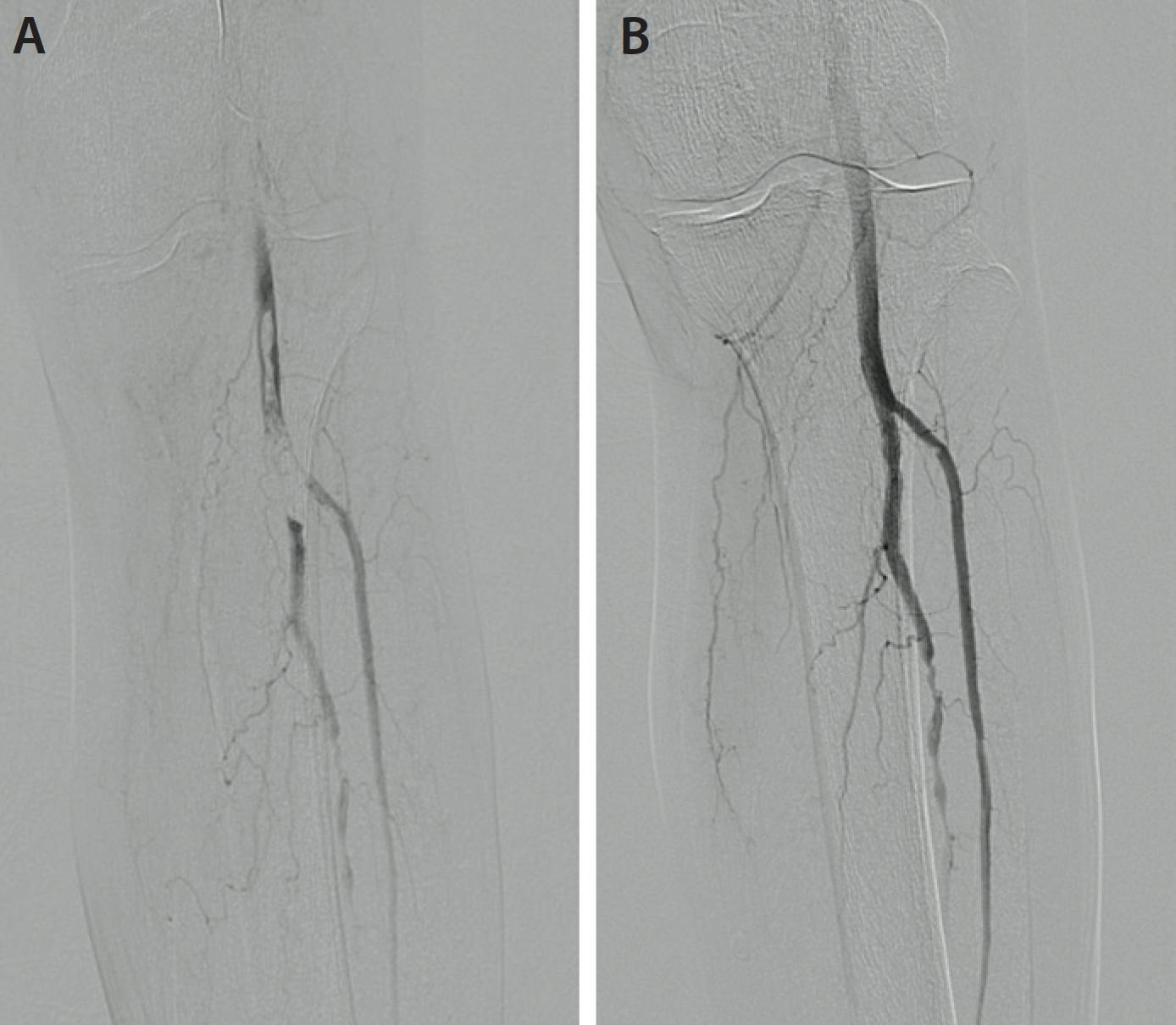
Figure 1. Angiogram before (A) and after (B) Indigo CAT6 (Penumbra, Inc.) aspiration.
Other available systems offering aspiration thrombectomy include the following:
- The Prodigy thrombectomy system (Imperative Care); this system also includes the Prodigy Twist, an optional mechanical element.
- The Laguna thrombectomy system (Innova Vascular), which includes the Laguna clot retriever system and Malibu aspiration catheter system.
- The Liberant thrombectomy system (Medtronic), a mechanical aspiration device that is compatible with the Excipio thrombectomy devices (Medtronic), rapid-exchange catheters with a mechanical basket designed for controlled aspiration.
Mechanical Thrombectomy
Primary mechanical thrombectomy devices are currently gaining popularity and availability. Examples include the Pounce thrombectomy system (Surmodics, Inc.), Artix system (Inari Medical), and pVasc (Vesalio). These devices typically comprise nitinol baskets that entrain the thrombus, working in tandem with a sheath with or without aspiration capability. Preliminary results from the Pounce PROWL registry indicate 73.3% and 86% freedom from all-cause major adverse events at 30 days in females and males, respectively, despite better technical success in females (91.4% vs 78.3%; P = .0261).20 This finding of differential sex-based outcomes after ALI revascularization is consistent with previous literature. One retrospective study of 548 patients (46% female) found that despite no sex-based difference in Rutherford classification on presentation, females who underwent an endovascular-first approach had 2.6-times the odds of amputation compared to males, in addition to higher rates of mortality.21
COST-EFFECTIVENESS CONSIDERATIONS
Currently, there is little literature addressing the cost-effectiveness of open and endovascular strategies, particularly in the case of mechanical thrombectomy. A study of 205 patients compared total costs of open, endovascular, hybrid, and CDT techniques. CDT demonstrated the highest costs and relatively low effectiveness; however, endovascular therapy had an incremental cost-effectiveness ratio over the surgery group of $4,609.23 per life year gained.22 Further studies are required before drawing conclusions regarding cost-effectiveness.
COMPLETION ANGIOGRAPHY
Completion angiography should be considered as an adjunct to any open or hybrid technique and is a class I level C recommendation by the ESVS.3 This practice can evaluate residual disease that can be addressed at index operation to reduce reintervention rates and should be strongly considered if there is a suboptimal pulse or signal exam.
ROLE OF AMPUTATION
Primary amputation is the most appropriate treatment of choice for an unsalvageable limb, such as one with a prolonged and dense motor deficit with high suspicion for muscle necrosis. Timing of amputation is important as tissue necrosis can result in toxicity, sepsis, and rhabdomyolysis.
FOLLOW-UP
Prior to discharge, it is prudent to identify the etiology of a patient’s thrombosis. As noted previously, this may include adjunctive imaging and laboratory studies, such as hypercoagulable or cancer workup in patients with family history of thrombophilia, young patients without prior vascular disease, or patients with recurrent thrombosis of unclear etiology. Consideration should also be given to the patient’s long-term antiplatelet and anticoagulation regimen, which can be influenced by the etiology of ALI and treatment approach used.
In addition to antithrombotic regimen, patients should follow appropriate risk factor modifications, including smoking cessation and medical management of comorbidities (hypertension, diabetes, hyperlipidemia). This patient population also requires routine surveillance similar to that of a CLTI patient, with follow-up at 1, 3, and 6 months in the first year, with annual or semiannual follow-up thereafter. Surveillance should also include with ankle-brachial index assessment and arterial duplex imaging. In patients with embolizing aortic lesions, the lesion should be reimaged at 1 month, with subsequent imaging surveillance at the surgeon’s discretion.
CONCLUSION
In the management of ALI, time is tissue. Patient history, physical characteristics, and imaging will inform the clinician’s decision for appropriate and swift management. While open approaches were traditionally preferred in patients with severe ischemia, PT can be considered in select populations, and CDT is an option in patients who do not have an immediately threatened limb. At the time of this article, there are no nonindustry-sponsored randomized controlled trials comparing PT to open surgery in ALI, and many of the long-term outcomes of newly developed devices are yet to be established.
1. Jarosinski M, Kennedy JN, Khamzina Y, et al. Percutaneous thrombectomy for acute limb ischemia is associated with equivalent limb and mortality outcomes compared with open thrombectomy. J Vasc Surg. 2024;79:1151-1162.e3. doi: 10.1016/j.jvs.2024.01.014
2. Jarosinski MC, Kennedy JN, Iyer S, et al. Contemporary national incidence and outcomes of acute limb ischemia. Ann Vasc Surg. 2025;110:224-235. doi: 10.1016/j.avsg.2024.06.032
3. Jongkind V, Earnshaw JJ, Bastos Gonçalves F, et al. Editor‘s choice - update of the European Society for Vascular Surgery (ESVS) 2020 clinical practice guidelines on the management of acute limb ischaemia in light of the COVID-19 pandemic, Based on a scoping review of the literature. Eur J Vasc Endovasc Surg. 2022;63:80-89. doi: 10.1016/j.ejvs.2021.08.028
4. Rutherford RB, Baker JD, Ernst C, et al. Recommended standards for reports dealing with lower extremity ischemia: revised version. J Vasc Surg. 1997;26:517-538. Published correction appears in J Vasc Surg. 2001;33:805. doi: 10.1016/s0741-5214(97)70045-4
5. Collins R, Burch J, Cranny G, et al. Duplex ultrasonography, magnetic resonance angiography, and computed tomography angiography for diagnosis and assessment of symptomatic, lower limb peripheral arterial disease: systematic review. BMJ. 2007;334:1257. doi: 10.1136/bmj.39217.473275.55
6. Hingorani AP, Ascher E, Marks N, et al Limitations of and lessons learned from clinical experience of 1,020 duplex arteriography. Vascular. 2008;16:147-153. doi: 10.2310/6670.2008.00014
7. Rothenberg KA, George EL, Trickey AW, et al. Delayed fasciotomy is associated with higher risk of major amputation in patients with acute limb ischemia. Ann Vasc Surg. 2019;59:195-201. doi: 10.1016/j.avsg.2019.01.028
8. Baril DT, Patel VI, Judelson DR, et al; Vascular Study Group of New England. Outcomes of lower extremity bypass performed for acute limb ischemia. J Vasc Surg. 2013;58:949-956. doi: 10.1016/j.jvs.2013.04.036
9. Marqués de Marino P, Martínez López I, Revuelta Suero S, et al. Results of infrainguinal bypass in acute limb ischaemia. Eur J Vasc Endovasc Surg. 2016;51:824-830. doi: 10.1016/j.ejvs.2016.03.023
10. Comerota AJ, Weaver FA, Hosking JD, et al. Results of a prospective, randomized trial of surgery versus thrombolysis for occluded lower extremity bypass grafts. Am J Surg. 1996;172:105-112. doi: 10.1016/S0002-9610(96)00129-8
11. Weaver FA, Comerota AJ, Youngblood M, et al. Surgical revascularization versus thrombolysis for nonembolic lower extremity native artery occlusions: results of a prospective randomized trial. The STILE investigators. Surgery versus thrombolysis for ischemia of the lower extremity. J Vasc Surg. 1996;24:513-521; discussion 521-523. doi: 10.1016/s0741-5214(96)70067-8
12. Ebben HP, Jongkind V, Wisselink W, et al. Catheter directed thrombolysis protocols for peripheral arterial occlusions: a systematic review. Eur J Vasc Endovasc Surg. 2019;57:667-675. doi: 10.1016/j.ejvs.2018.11.018
13. Beschorner U, Boehme T, Noory E, et al. Catheter-directed thrombolysis in the management of thrombotic peripheral artery occlusions-acute and mid-term clinical outcomes. J Clin Med. 2024;13:5732. doi: 10.3390/jcm13195732
14. Feugier P, Loffroy R, Picquet J, et al. Expert consensus: the place of thrombolysis in the treatment of peripheral arterial thrombosis. Endovasc Today Europe. 2019;7(suppl):4-9.
15. de Athayde Soares R, Matielo MF, Brochado Neto FC, et al. Analysis of the safety and efficacy of the endovascular treatment for acute limb ischemia with percutaneous pharmacomechanical thrombectomy compared with catheter-directed thrombolysis. Ann Vasc Surg. 2020;66:470-478. doi: 10.1016/j.avsg.2019.11.038.
16. Taha AG, Byrne RM, Avgerinos ED, et al. Comparative effectiveness of endovascular versus surgical revascularization for acute lower extremity ischemia. J Vasc Surg. 2015;61:147-154. doi: 10.1016/j.jvs.2014.06.109.
17. Jarosinski MC, Li K, Andraska EA, et al. Comparison of open and endovascular therapy for infrainguinal acute limb ischemia in the era of percutaneous thrombectomy. J Vasc Surg. 2025;82:952-960.e3. doi: 10.1016/j.jvs.2025.03.195
18. Leung DA, Blitz LR, Nelson T, et al. Rheolytic pharmacomechanical thrombectomy for the management of acute limb ischemia: results from the PEARL registry. J Endovasc Ther. 2015;22:546-557. doi: 10.1177/1526602815592849
19. Maldonado TS, Powell A, Wendorff H, et al; STRIDE study group. Safety and efficacy of mechanical aspiration thrombectomy for patients with acute lower extremity ischemia. J Vasc Surg. 2024;79:584-592.e5. doi: 10.1016/j.jvs.2023.10.062
20. Monteleone P. Results of a novel percutaneous mechanical arterial thrombectomy device in lower extremity ischemia: sex-specific analysis. Presented at: TCT Symposium 2025; October 25-28, 2025; San Francisco, California.
21. Lowenkamp MN, Jarosinski MC, Li K, et al. Female patients at increased risk for adverse outcomes after acute limb ischemia. J Vasc Surg. Published online August 26, 2025. doi: 10.1016/j.jvs.2025.08.026.
22. Vaidya V, Gangan N, Comerota A, Lurie F. Cost-effectiveness analysis of initial treatment strategies for nonembolic acute limb ischemia using real-word data. Ann Vasc Surg. 2017;39:276-283. doi: 10.1016/j.avsg.2016.05.125
Advertisement
Advertisement