Advertisement
Advertisement
February 2026
Ask the Experts: What Factors Most Influence Your ALI Therapy Decisions?
Experts weigh in on how the patient, anatomy, and technology shape ALI treatment choices.
With Dejah R. Judelson, MD; Britt H. Tonnessen, MD, FSVS, FACS; and Alexander Ushinsky, MD

The management of acute limb ischemia (ALI) has transformed dramatically over the past several decades. Today, with the advent of single-session thrombectomy devices, we can offer patients effective revascularization without the bleeding risks of thrombolysis or the morbidity of open surgery. These technologies span a wide spectrum—aspiration (Indigo system, Penumbra, Inc.), mechanical (Rotarex, Aspirex, both BD Interventional), combined aspiration and mechanical, rheolytic (AngioJet, Boston Scientific Corporation), ultrasound-assisted (Ekos, Boston Scientific Corporation), and laser-based (Auryon, AngioDynamics, Inc.).
My decision-making hinges on four key factors: the patient, severity of symptoms, anatomy, and the underlying cause of ALI.
- Embolic ALI (often atrial fibrillation–related). These patients typically present with Rutherford class 2b ischemia and require urgent revascularization. In this setting, I often favor open thrombectomy or a single-session device, provided I believe the clot can be adequately removed. Embolic thrombus is usually well-formed and rubbery, making it resistant to maceration and less responsive to lysis. However, as device technology evolves, our ability to tackle large, organized clot percutaneously continues to improve, for example, with the Indigo Lightning Bolt 12.
- In situ thrombosis, stent thrombosis, or graft thrombosis. Historically, these Rutherford class 2a patients would undergo several days of thrombolysis. Single-session devices have changed that paradigm. We can now remove clot and treat the culprit lesion in one procedure—reducing thrombolytic use, lowering the risk of life-threatening bleeding, and conserving intensive care unit resources. Patients benefit from effective revascularization through a single percutaneous access point, avoiding the morbidity of large groin or leg incisions.
The bottom line: Single-session thrombectomy devices have shifted ALI care toward safer, faster, and more resource-efficient interventions. They allow us to tailor therapy to the patient and the pathology while minimizing risk and maximizing outcomes.

The “cold leg” is one of the essential emergencies that a vascular surgeon will be asked to care for throughout their career. The decision-making up front always begins with a history, most importantly including the duration of symptoms and any prior vascular procedures. Rapid CTA is useful for planning critical aspects of the procedure: access, device selection, and identification of multilevel disease. Historically, Rutherford classification for ALI has driven the level of urgency and remains a valuable stratification tool in modern vascular surgery practice.
Percutaneous thrombectomy devices have emerged as disruptive technology that have altered the algorithm of the acutely ischemic limb. These devices include rheolytic thrombectomy such as AngioJet, mechanical rotational such as Rotarex, and mechanical/aspiration thromebectomy devices such as Artix (Inari Medical) and Indigo (Penumbra, Inc.). An endovascular-first approach for ALI is attractive to patients and physicians. Advanced devices can treat from the iliac arteries to the foot. Advantages include lower blood loss, decreased morbidity, and more rapid reperfusion than thrombolysis or even surgery. Patients who are critically ill or have extensive comorbidities may also benefit. In my practice, percutaneous aspiration thrombectomy is a top choice because of its versatility, the power of the newest generation of devices, and the low embolization risk (Figure 1). Bailout conversion to open thrombectomy or catheter-directed thrombolysis is still an option if percutaneous thrombectomy is unsuccessful.
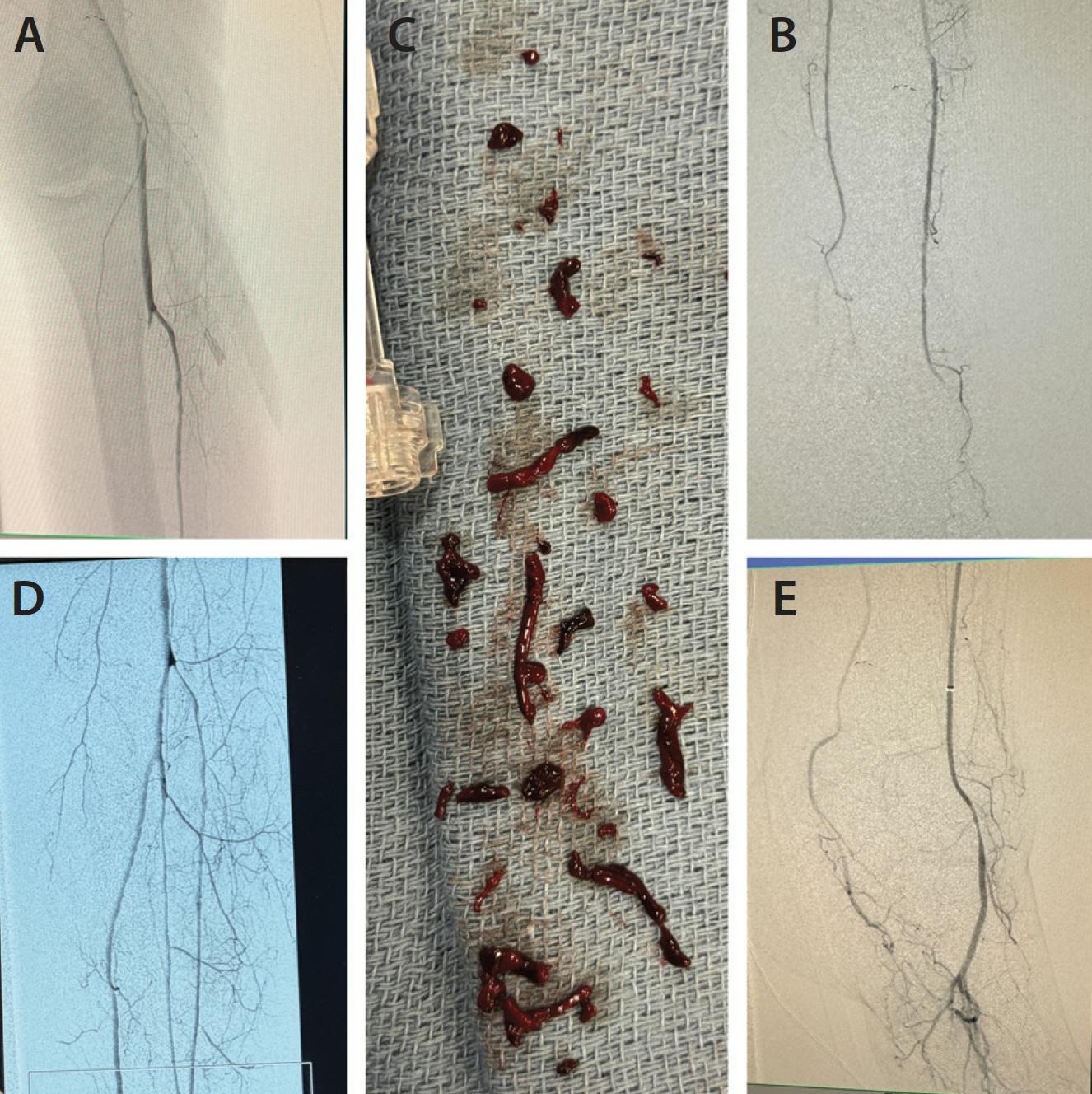
Figure 1. Patient with ischemic limb and multilevel emboli (A, B). Indigo Lightning Bolt 6x (Penumbra, Inc.) was used for superficial femoral artery and tibioperoneal trunk and tracked well into the anterior tibial and posterior tibial arteries to clear thrombus down to the ankle (C). Three-vessel runoff into foot established (D, E).
As experience with percutaneous thrombectomy grows exponentially, the question becomes: Why not use percutaneous thrombectomy for everyone with ALI? Decades ago, pivotal randomized trials (eg, STILE, TOPAS) set the standard for this challenging condition.1,2 New technology will need to match or improve those outcomes. Although observational data are promising, head-to-head comparisons with open thrombectomy and percutaneous thrombectomy are lacking. The 2020 European Society for Vascular Surgery clinical practice guidelines on ALI endorse percutaneous thrombectomy as a consideration with a low grading of evidence from their systematic review.3 Single-center studies have demonstrated safety and good outcomes with percutaneous thrombectomy but are limited by heterogeneous treatment arms.4,5 A large national database study showed comparable outcomes between percutaneous thrombectomy and open thrombectomy, with more reinterventions for percutaneous thrombectomy.6 National database research is limited by ICD coding and cannot provide more granular information such as Rutherford class or device type.
Even within ALI, there are special groups that need additional attention. Patients with Rutherford class 2b ischemia are of specific interest because expedited reperfusion is needed. Traditionally, these patients were treated with open surgery. In the STRIDE trial using Indigo aspiration thrombectomy, one-third of patients with class 2b ischemia had high limb salvage rates that were comparable to those with lesser degrees of ischemia.7 Thrombosed bypasses are another a special category of limb ischemia. Despite successful thrombectomy or thrombolysis, a salvaged vein bypass has poor long-term patency. Finally, evaluating the efficacy of percutaneous thrombectomy in women with small blood vessels and diverse populations is important. Percutaneous thrombectomy is undoubtedly a valuable tool, but maintaining competence and training future vascular surgeons in open techniques for thrombectomy is still a critical skill.
There are many nuances when treating patients with ALI. ALI harbors a high risk of major limb amputation and mortality that extends well beyond the postoperative period. The interventionalist is charged with choosing the best procedure for the best possible outcome.
1. Results of a prospective randomized trial evaluating surgery versus thrombolysis for ischemia of the lower extremity: the STILE trial. Ann Surg. 1994;220:251-266. doi: 10.1097/00000658-199409000-00003
2. Ouriel K, Veith FJ, Sasahara AA. Thrombolysis or peripheral arterial surgery: phase I results. TOPAS investigators. J Vasc Surg. 1996;23:64-73. doi: 10.1016/s0741-5214(05)80036-9
3. Björck M, Earnshaw JJ, Acosta S, et al. Editor's choice —European Society for Vascular Surgery (ESVS) 2020 clinical practice guidelines on the management of acute limb ischaemia. Eur J Vasc Endovasc Surg. 2020;59:173-218. doi: 10.1016/j.ejvs.2019.09.006
4. Jarosinski MC, Li K, Andraska EA, et al. Comparison of open and endovascular therapy for infrainguinal acute limb ischemia in the era of percutaneous thrombectomy. J Vasc Surg. 2025;82:952-960.e3. doi: 10.1016/j.jvs.2025.03.195
5. Loh SA, Nasir A, Strosberg D, et al. Outcomes of mechanical thrombectomy for acute limb ischemia at a tertiary referral center. J Vasc Surg. 2025;82:205-215.e2. doi: 10.1016/j.jvs.2025.02.027
6. Jarosinski M, Kennedy JN, Khamzina Y, et al. Percutaneous thrombectomy for acute limb ischemia is associated with equivalent limb and mortality outcomes compared with open thrombectomy. J Vasc Surg. 2024;79:1151-1162.e3. doi: 10.1016/j.jvs.2024.01.014
7. Maldonado TS, Powell A, Wendorff H, et al. Safety and efficacy of mechanical aspiration thrombectomy for patients with acute lower extremity ischemia. J Vasc Surg. 2024;79:584-592. doi: 10.1016/j.jvs.2023.10.062

Endovascular management of ALI has become increasingly common and successful as technology has progressed and techniques have matured. There is a growing body of literature supporting a primary endovascular approach as having similar limb salvage outcomes to a traditional open revascularization.1 However, there is not a clearly delineated guideline on which patients may do best with an endovascular, open, or hybrid approach.
Operator experience is a critical factor. As an interventional radiologist, my expertise lies in endovascular techniques. Others may prefer an open surgical approach or even hybrid. Staying current with available devices and techniques is important. Global categories of thrombus management include thrombolytic infusion, aspiration (including adjuncts such as rheolytic systems), basket-based systems, and combined atherectomy thrombectomy systems (laser and rotational systems). Personal experience and device availability at a particular facility where I see patients influence my decision. Some devices have combined indications for atherectomy and thrombectomy and are well suited to sites where maintaining dedicated thrombectomy systems is not feasible. It is unlikely that all devices are available, but it is helpful to be facile with a variety of approaches.
Patient factors are the other driver in my decisions. Bleeding risk limits lytic administration. Those with a higher Rutherford grade are not well suited for lytic infusion, as patency may not be restored for many hours. Other devices or open approach are more likely to achieve limb salvage. Site of thrombosis is important; some devices are better suited for large vessels (like the larger basket devices) while others do well in small vessels (like laser). Surgical and endovascular history is also relevant to my approach. Thrombosed preexisting stents are well suited to smaller-form-factor, over-the-wire devices (eg, laser, rotational atherectomy, infusion catheter) and limited for larger devices (eg, basket systems, large-bore aspiration). Similarly, these combined atherectomy/thrombectomy devices can concomitantly address chronic stenoses as the thrombus is removed. Thrombosed bypass grafts can be a challenge due to their large thrombotic burden and, in our experience, have done best with prolonged lysis. The presence of an aortic endograft limits our approach and may require radial or brachial access with appropriately long devices, for instance with the extended-length 355-nm laser system.
The landscape of endovascular approaches to the ALI patient has significantly grown. This, along with increasing operator comfort with complex endovascular approaches, is leading to successful limb salvage with improved morbidity for many patients.
1. Konstantinou N, Argyriou A, Dammer F, et al. Outcomes after open surgical, hybrid, and endovascular revascularization for acute limb ischemia. J Endovasc Ther. 2025;32:1499-1507. doi: 10.1177/15266028231210232
Advertisement
Advertisement