Advertisement
Advertisement
February 2026
From Patient Selection to Fibroid-Level Prediction: Defining the Era of Precision UFE
Advances in imaging, procedural customization, and artificial intelligence are transforming uterine fibroid embolization into a precision medicine intervention, enabling more accurate patient selection, optimized technique, and improved clinical outcomes.
By Dominie Miyasato; Erica M. Knavel Koepsel, MD; Gretchen M. Foltz, MD; and Dania Daye, MD
Uterine fibroids can present with bothersome symptoms in 25% to 40% of affected women.1 Symptoms include menorrhagia and bulk symptoms such as pelvic pain and pressure, urinary frequency or retention, and constipation.2 Although hysterectomy remains most frequently utilized in treating symptomatic uterine fibroids, many women desire a less invasive option to reduce morbidity and recovery time. Uterine fibroid embolization (UFE) was first described in 1995 and has become a widely accepted minimally invasive alternative for the treatment of fibroids.3
Patients interested in a minimally invasive approach for the treatment of symptomatic fibroids must first undergo evaluation to determine if UFE is an appropriate option. This includes a general medical history, gynecologic history, discussion of future pregnancy plans, physical exam, and pelvic imaging.4 MRI is the preferred modality for the evaluation of uterine anatomy and determining the extent and characterization of fibroid disease. Particular attention is paid to fibroid location, size, number, and extent of contrast enhancement as well as evaluation for potential malignancy.5 Absolute contraindications to UFE are current pregnancy, active untreated infection, and suspected gynecologic malignancy.5 Relative contraindications include contrast allergy, coagulopathy, and renal failure.4
Angiographic procedure techniques were initially developed using the common femoral artery for arterial access. However, over the past decade, transradial access has become a popular approach.6 Bilateral uterine artery catheterization and embolization is necessary due to arterial cross-communication within the uterus.4 Embolization is performed with microbeads with the endpoint of embolization being near stasis of the uterine artery and pruning of the distal uterine artery branches.4,5 The 1- to 2-hour procedure is performed under local anesthetic or conscious sedation. For several hours after embolization, patients experience pain from uterine cramping due to ischemia of the tissue. Postprocedural pain management options include opioids, nonsteroidal anti-inflammatory drugs, intravenous (IV) acetaminophen, superior hypogastric nerve block, and/or epidural anesthesia. Although patients traditionally required an overnight admission for monitoring and pain control, UFE is increasingly being done as an outpatient procedure, allowing it to be performed in outpatient-based labs as an alternative to hospitals.2
There have been numerous retrospective and prospective studies supporting UFE as a safe and effective treatment option for symptomatic fibroids.7-12 The most studied outcome is symptom improvement, which can be measured by self-reported questionnaires like the Uterine Fibroid Symptom and Quality of Life (UFS-QOL) questionnaire.13 Volume reduction of the dominant fibroid is another outcome that has been studied. There is evidence to suggest that a higher percentage of volume reduction correlates with greater symptom improvement and a lower rate of reintervention.9 The REST randomized controlled trial enrolled 157 patients and compared UFE to surgery, including hysterectomy or myomectomy. It reported no significant difference in quality-of-life (QOL) symptom scores at 5 years, with symptom score reduction and high patient satisfaction in both groups.11 A 5-year follow-up study of contrast-enhanced MRI findings of the REST trial recruits reported a mean uterine volume decrease from 670 mL (SD, 503 mL) at baseline to 292 mL (SD, 287 mL) after 5 years. The mean diameter of the dominant fibroid decreased from 7.6 cm (SD, 3 cm) at baseline to 5 cm (SD, 2.9 cm) after 5 years.10
The FEMME trial was a multicenter, randomized controlled trial of 254 patients comparing myomectomy to UFE for the treatment of fibroids. Using the UFS-QOL questionnaire, the study found significantly higher QOL scores for patients who underwent myomectomy compared to UFE at 2-year follow-up.12 A recent article reported the 4-year follow-up of the FEMME trial. Investigators found that while women in the myomectomy group still reported higher QOL scores than those in the UFE group, the difference was no longer statistically significant as it had been at the 2-year follow-up. Both groups experienced substantial improvements in their QOL scores compared to preintervention.14
Because both UFE and surgery are safe and effective options for the treatment of fibroids, careful patient selection is paramount. Current research investigates patient and fibroid characteristics that may increase the likelihood of a positive and durable outcome following UFE. The results of these studies can help guide providers as they counsel patients on expected or predicted outcomes following this procedure, bringing UFE into the era of precision medicine.
PRECISION MEDICINE AND UFE
Precision medicine, also known as personalized or individualized medicine, is the concept that every patient has unique genetic, environmental, and behavioral factors that may influence response to treatment for disease.15 Therefore, interventions should be tailored to individual characteristics to ensure the best possible outcome.15 There is growing evidence to suggest that some patients may benefit from UFE more than others based on several patient and fibroid characteristics. For these patients, there are opportunities to customize the procedural technique to optimize intraprocedural technical success and comfort as well as postprocedure pain control.
Studies have investigated the association between the anatomic location of fibroids and post-UFE outcomes. Naguib et al found that submucosal fibroids had the greatest percent change in volume after UFE, while subserosal tumors demonstrated the least reduction.8 Another study reported that pedunculated subserosal fibroids were more common in patients who did not have symptom improvement after UFE. These fibroids also had a significantly lower reduction in volume compared to fibroids in other locations.16 There has been conflicting evidence regarding the correlation between size of the fibroid and percent volume reduction after UFE, with some studies showing a negative correlation between baseline fibroid volume and volumetric response while others show a positive or no correlation.8,17-19
Recently, studies have explored using MRI features of fibroids to predict response to UFE. Employing a logistic regression model, two studies found that submucosal location and increased T2 signal intensity of fibroids prior to treatment were predictive of a greater volume reduction after UFE.20,21 Age, number of leiomyomas, and baseline uterine volume were not identified as predictive factors.21 Another study demonstrated that the signal intensity ratio between the dominant fibroid and iliacus muscle on MRI T2-weighted sequences can be used to predict post-UFE fibroid volume reduction.22
Artificial intelligence (AI) studies have used deep learning models to predict symptom improvement and fibroid volumetric response after UFE. Luo et al designed a residual convolutional neural network model trained on manually segmented fibroids on T1-weighted contrast-enhanced MR sequences to predict symptom improvement after UFE. The model achieved a test accuracy of 0.847, outperforming the average of four radiologists.23 Janghorbani et al developed two deep learning-based models to predict symptom relief and shrinkage of fibroid by > 50%, respectively. The features extracted included patient characteristics such as age and body mass index as well as characteristics of manually segmented fibroids primarily from sagittal T2-weighted MRI slices such as fibroid volume, location, and vascularity. The first model achieved an accuracy of 75% for overall clinical outcome and 81% to 88% for likelihood of relief of various symptoms. The second model achieved 76% accuracy at predicting success of fibroid shrinkage.24
In addition to patient selection, procedural technique, vascular access site, and pain management options can be personalized. Studies have shown that transradial access (TRA) and transfemoral access (TFA) for UFE have similar low rates of access site complications and overall adverse events.6,25 Both access techniques also result in similar improvement in symptoms, devascularization of the fibroids, and uterine volume reduction after UFE.25 Therefore, access site can be tailored to the individual patient’s preferences and physical characteristics.
Another procedural component that can be customized is the embolic agent used. Han et al conducted a randomized controlled trial to compare nonspherical polyvinyl alcohol (PVA) particles and tris-acryl gelatin microspheres (TAGM) in UFE. Although there was no difference in pain scores and fentanyl dose during the first 24 hours, use of rescue analgesics was significantly higher in the PVA group. Transient global uterine ischemia of normal myometrium on MRI day 1 after UFE was found more frequently in the PVA group. Three months after UFE, symptom severity score, health-related QOL score, and complete dominant fibroid necrosis on MRI were not different between groups.26 Therefore, this study suggests that while clinical outcomes are similar, the type of embolic agent may influence the degree of ischemia and thus pain immediately following UFE. Another randomized prospective study evaluated PVA particle size and outcomes of UFE. Group A was started with 350–500-µm particles, while group B was started with 500–700-µm particles. UFE in both groups finished with larger particles when necessary. Group A had significantly higher pain scores post-UFE. At 6 months, there was no significant difference in size of dominant fibroid or clinical outcome as reported on UFS-QOL questionnaires.27
Mapping the vascular supply to fibroids is yet another way to tailor the treatment approach to the patient. Although preprocedure MRI is critical for evaluating uterine anatomy, it can also be used to evaluate common sources of collateral uterine blood supply like the ovarian arteries. For the small number of patients who report minimal or no symptom improvement postprocedure, additional collateral supply should be considered and patients could benefit from further evaluation with CTA, which would better delineate complex vascular collateral anatomy (Figure 1). A case report by Alabdulghani et al highlights the utility of intraprocedural CTA to demonstrate the extensive collaterals that could be additionally embolized for improved symptom control.28
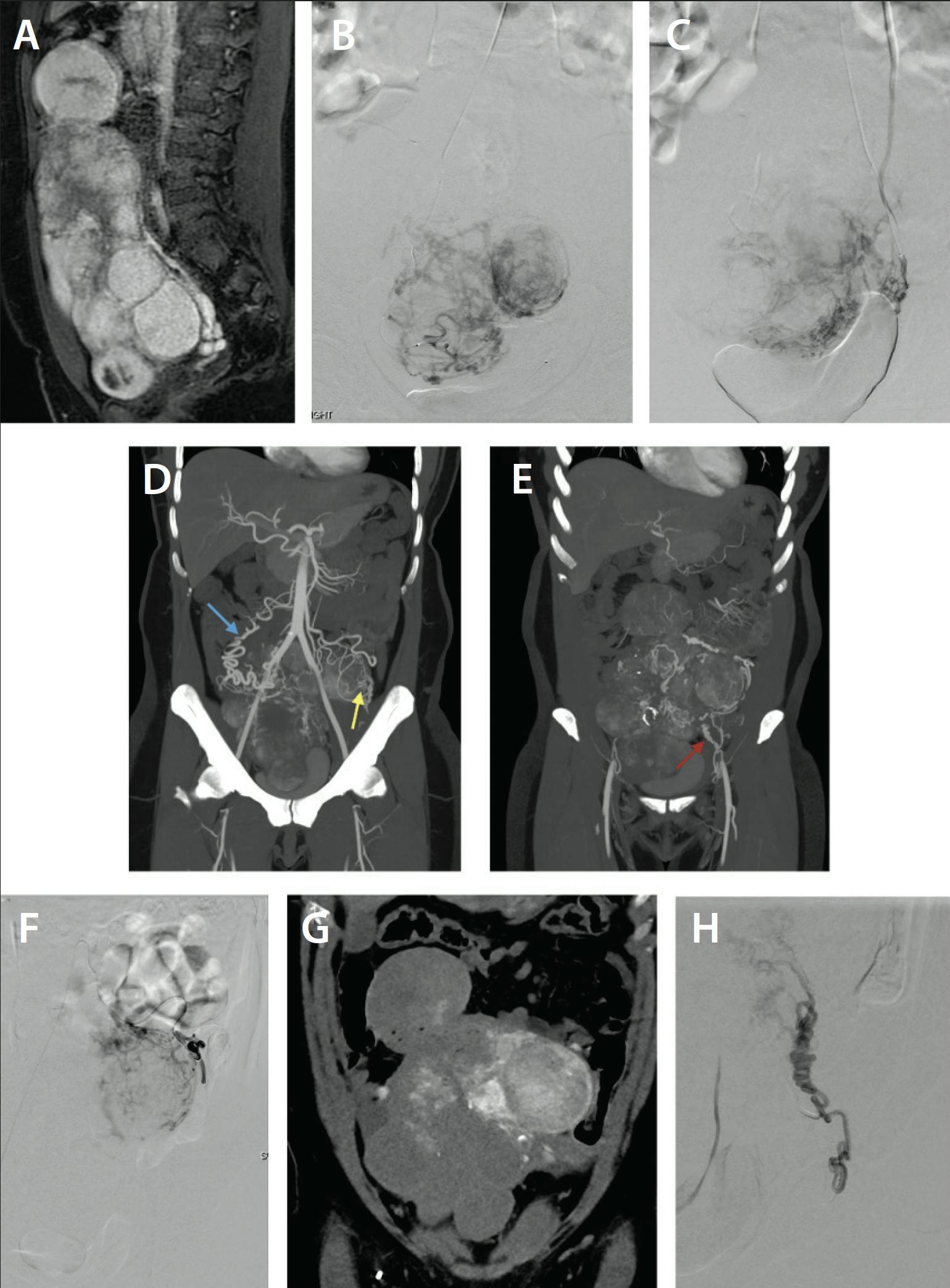
Figure 1. A woman in her early 40s with preprocedure sagittal T1 MRI demonstrating enhancement of multiple uterine fibroids (A). Digital subtraction angiography (DSA) showed catheterization of the right uterine artery (B) and left uterine artery, with filling of inferior fibroids but not the complete uterus (C). CTA demonstrated collateral blood supply from right ovarian artery (D, blue arrow) and branch of inferior mesenteric artery (IMA; yellow arrow) and left round ligament artery (E, red arrow) to the fibroids. DSA showed selective catheterization of a branch of the IMA (F) and intraprocedural CTA confirmed filling of the fibroid without filling of the bowel (G). DSA showed selective catheterization of the left round ligament artery with filling of the fibroid (H). In total, the bilateral uterine arteries, right ovarian artery, a branch of the IMA, and a left round ligament artery were embolized.
Besides customizing procedural techniques, pain management protocols for UFE can be personalized to maximize patient comfort. Standard intraprocedural pain management and sedation often includes IV fentanyl, midazolam, or ketorolac, as well as injection of lidocaine at the vascular access site.29 Superior hypogastric nerve block (SHNB) is another option that is utilized by some providers for pain management. A randomized double-blinded clinical trial demonstrated that SHNB led to a significantly lower pain score immediately post-UFE and lower amount of fentanyl needed in the postanesthesia care unit compared to a sham procedure.30 A recent report details the case of a patient allergic to most opiates and with a history of becoming agitated with IV midazolam who underwent successful UFE with intra-arterial ropivacaine, SHNB with ropivacaine, and IV acetaminophen with good pain control. This provides an example of how pain regimens can be tailored to the individual patient case.31
Lastly, it is generally believed that the degree to which near-stasis of uterine artery flow is achieved influences long-term symptom control.29 Operators often must strike a balance between ensuring fibroid devascularization and limiting normal myometrial ischemia to minimize postprocedural pain. Indeed, Katsumori et al conducted a retrospective study to evaluate the relationship between the degree of infarction of fibroids on enhanced MRI 1 week after embolization and long-term symptom control. They found that the group with 100% infarction on MRI had a significantly higher rate of symptom control and lower rate of gynecologic intervention after embolization at 5 years.32 Thus, tools to assist operators in finding the right combination of embolization techniques and pain management protocols for each patient may be a future direction of research.
EMERGING APPLICATIONS FOR PRECISION UFE
There is great potential for further personalization of UFE, especially as AI models become more sophisticated and integrated into the clinical workflow. For example, AI can be leveraged to create a calculator, combining patient- and fibroid-specific factors, to predict percent decrease in the volume of fibroids and improvement in menorrhagia and bulk symptoms. A randomized controlled trial across multiple institutions would be necessary to investigate the efficacy of the prediction calculator. AI can also be used for chart review to assist referring providers in identifying patients who may be appropriate candidates for UFE.
Another potential application of AI is using patient-facing chatbots to improve patient education about UFE. A recent study evaluated the use of the large language model ChatGPT 4.0 to provide personalized, evidence-based treatment recommendations for fibroids. Overall, patients and gynecologists found the algorithm to be user-friendly and helpful for understanding treatment options.33 As current literature suggests that public popularity of UFE lags behind myomectomy, chatbots may increase awareness of UFE to encourage more shared decision-making in patient-provider conversations.34
There are many opportunities to build on the current research highlighted in this paper. Similar to a recent study investigating four-dimensional flow measurements,35 vasculature can be quantified to predict the amount of embolic required to optimize fibroid infarction. AI tools can assist with choosing vascular access site based on height, vascular anatomy on imaging, and physical exam to reduce site complications, prioritize patient comfort, and reduce recovery time in the hospital. Future research can investigate which patients would benefit the most from adding a SHNB to the pain management protocol.
CONCLUSION
Precision UFE aims to select the right patient for the procedure to maximize the likelihood of symptom improvement postprocedure. Personalization could focus on optimizing the procedural technique and pain management regimen to achieve the best clinical response, limit postprocedure pain, and maximize patient satisfaction. There has been a recent surge in research efforts for precision UFE, and there is immense potential for future progress, particularly as more AI tools are developed for this application. A multisite clinical trial that integrates AI tools will be needed to demonstrate improved outcomes and value for patients. Research can also be expanded to other indications of uterine artery embolization, such as adenomyosis and postpartum hemorrhage. The goal of precision UFE is to enhance the shared decision-making between physician and patient and provide tools to physicians to tailor treatment plans optimizing outcomes and patient experience.
1. Yu O, Scholes D, Schulze-Rath R, et al. A US population-based study of uterine fibroid diagnosis incidence, trends, and prevalence: 2005 through 2014. Am J Obstet Gynecol. 2018;219:591.e1-591.e8. doi: 10.1016/j.ajog.2018.09.039
2. Khan AT, Shehmar M, Gupta JK. Uterine fibroids: current perspectives. Int J Womens Health. 2014;6:95-114. doi: 10.2147/IJWH.S51083
3. Worthington-Kirsch RL. Uterine artery embolization: state of the art. Semin Intervent Radiol. 2004;21:37-42. doi: 10.1055/s-2004-831403
4. Bulman JC, Ascher SM, Spies JB. Current concepts in uterine fibroid embolization. Radiographics. 2012;32:1735-1750. doi: 10.1148/rg.326125514
5. Keung JJ, Spies JB, Caridi TM. Uterine artery embolization: a review of current concepts. Best Pract Res Clin Obstet Gynaecol. 2018;46:66-73. doi: 10.1016/j.bpobgyn.2017.09.003
6. Gjoreski A, Gjoreski J, Nancheva A. Uterine fibroid embolization via transradial versus transfemoral arterial access: technical results. Open Access Maced J Med Sci. 2019;7:579-582. doi: 10.3889/oamjms.2019.163
7. Hirst A, Dutton S, Wu O, et al. A multi-centre retrospective cohort study comparing the efficacy, safety and cost-effectiveness of hysterectomy and uterine artery embolisation for the treatment of symptomatic uterine fibroids. The HOPEFUL study. Health Technol Assess. 2008;12:1-248, iii. doi: 10.3310/hta12050
8. Naguib NNN, Mbalisike E, Nour-Eldin NEA, et al. Leiomyoma volume changes at follow-up after uterine artery embolization: correlation with the initial leiomyoma volume and location. J Vasc Interv Radiol. 2010;21:490-495. doi: 10.1016/j.jvir.2009.12.388
9. Lohle PNM, Voogt MJ, De Vries J, et al. Long-term outcome of uterine artery embolization for symptomatic uterine leiomyomas. J Vasc Interv Radiol. 2008;19:319-326. doi: 10.1016/j.jvir.2007.10.011
10. Ananthakrishnan G, Murray L, Ritchie M, et al. Randomized comparison of uterine artery embolization (UAE) with surgical treatment in patients with symptomatic uterine fibroids (REST trial): subanalysis of 5-year MRI findings. Cardiovasc Intervent Radiol. 2013;36:676-681. doi: 10.1007/s00270-012-0485-y
11. Moss JG, Cooper KG, Khaund A, et al. Randomised comparison of uterine artery embolisation (UAE) with surgical treatment in patients with symptomatic uterine fibroids (REST trial): 5-year results. BJOG. 2011;118:936-944. doi: 10.1111/j.1471-0528.2011.02952.x
12. Manyonda I, Belli AM, Lumsden MA, et al. Uterine-artery embolization or myomectomy for uterine fibroids. N Engl J Med. 2020;383:440-451. doi: 10.1056/NEJMoa1914735
13. Coyne KS, Margolis MK, Bradley LD, et al. Further validation of the uterine fibroid symptom and quality-of-life questionnaire. Value Health. 2012;15:135-142. doi: 10.1016/j.jval.2011.07.007
14. Daniels J, Middleton LJ, Cheed V, et al. Uterine artery embolization or myomectomy for women with uterine fibroids: four-year follow-up of a randomised controlled trial. Eur J Obstet Gynecol Reprod Biol X. 2022;13:100139. doi: 10.1016/j.eurox.2021.100139
15. Goetz LH, Schork NJ. Personalized medicine: motivation, challenges, and progress. Fertil Steril. 2018;109:952-963. doi: 10.1016/j.fertnstert.2018.05.006
16. Toor SS, Tan KT, Simons ME, et al. Clinical failure after uterine artery embolization: evaluation of patient and MR imaging characteristics. J Vasc Interv Radiol. 2008;19:662-667. doi: 10.1016/j.jvir.2007.12.454
17. Czuczwar P, Woźniak S, Szkodziak P, et al. Predicting the results of uterine artery embolization: correlation between initial intramural fibroid volume and percentage volume decrease. Prz Menopauzalny. 2014;13:247-252. doi: 10.5114/pm.2014.45001
18. Zlotnik E, Lorenzo Messina M de, Nasser F, et al. Predictive factors for pelvic magnetic resonance in response to arterial embolization of a uterine leiomyoma. Clinics (Sao Paulo). 2014;69:185-189. doi: 10.6061/clinics/2014(03)07
19. Spies JB, Roth AR, Jha RC, et al. Leiomyomata treated with uterine artery embolization: factors associated with successful symptom and imaging outcome. Radiology. 2002;222:45-52. doi: 10.1148/radiol.2221010661
20. Chung YJ, Kang SY, Chun HJ, et al. Development of a model for the prediction of treatment response of uterine leiomyomas after uterine artery embolization. Int J Med Sci. 2018;15:1771-1777. doi: 10.7150/ijms.28687
21. Kurban LAS, Metwally H, Abdullah M, et al. Uterine artery embolization of uterine leiomyomas: predictive MRI features of volumetric response. AJR Am J Roentgenol. 2021;216:967-974. doi: 10.2214/AJR.20.22906
22. Duvnjak S, Ravn P, Green A, Andersen PE. Magnetic resonance signal intensity ratio measurement before uterine artery embolization: ability to predict fibroid size reduction. Cardiovasc Intervent Radiol. 2017;40:1839-1844. doi: 10.1007/s00270-017-1721-2
23. Luo YH, Xi IL, Wang R, et al. Deep learning based on MR imaging for predicting outcome of uterine fibroid embolization. J Vasc Interv Radiol. 2020;31:1010-1017.e3. doi: 10.1016/j.jvir.2019.11.032
24. Janghorbani S, Caprio A, Sam L, et al. Predicting clinical outcomes and symptom relief in uterine fibroid embolization using machine learning on MRI features. AI. 2025;6:200. doi: 10.3390/ai6090200
25. Nakhaei M, Mojtahedi A, Faintuch S, et al. Transradial and transfemoral uterine fibroid embolization comparative study: technical and clinical outcomes. J Vasc Interv Radiol. 2020;31:123-129. doi: 10.1016/j.jvir.2019.08.016
26. Han K, Kim SY, Kim HJ, et al. Nonspherical polyvinyl alcohol particles versus tris-acryl microspheres: randomized controlled trial comparing pain after uterine artery embolization for symptomatic fibroids. Radiology. 2021;298:458-465. doi: 10.1148/radiol.2020201895
27. Bilhim T, Pisco JM, Duarte M, Oliveira AG. Polyvinyl alcohol particle size for uterine artery embolization: a prospective randomized study of initial use of 350-500 μm particles versus initial use of 500-700 μm particles. J Vasc Interv Radiol. 2011;22:21-27. doi: 10.1016/j.jvir.2010.09.018
28. Alabdulghani F, O’Brien A, Brophy D. Application of cone-beam computed tomography angiography in a uterine fibroid embolization procedure: a case report. Radiol Case Rep. 2018;13:130-134. doi: 10.1016/j.radcr.2017.09.027
29. Pisanie JL du, Commander CW, Burke CT. Management of postprocedural uterine artery embolization pain. Semin Intervent Radiol. 2021;38:588-594. doi: 10.1055/s-0041-1739161
30. Yoon J, Valenti D, Muchantef K, et al. Superior hypogastric nerve block as post-uterine artery embolization analgesia: a randomized and double-blind clinical trial. Radiology. 2018;289:248-254. doi: 10.1148/radiol.2018172714
31. Ho E, Tan KT. Novel pain management strategy for uterine fibroid embolization. CVIR Endovasc. 2025;8:8. doi: 10.1186/s42155-025-00516-3
32. Katsumori T, Kasahara T, Kin Y, Nozaki T. Infarction of uterine fibroids after embolization: relationship between postprocedural enhanced MRI findings and long-term clinical outcomes. Cardiovasc Intervent Radiol. 2008;31:66-72. doi: 10.1007/s00270-007-9187-2
33. Psilopatis I, Lotz L, Sipulina N, et al. Leveraging artificial intelligence for evidence‐based recommendations in uterine fibroid therapy: addressing the unmet need in German healthcare—a clinical trial. Intl J Gynecol Obstet. 2026;172:1104-1113. doi: 10.1002/ijgo.70407
34. Jahangiri Y, Gabr A, Huber TC, et al. Uterine fibroid embolization or myomectomy: how much marketing is enough? Comparative analysis of public search trends in Google and medical publications in PubMed. J Vasc Interv Radiol. 2023;34:182-186. doi: 10.1016/j.jvir.2022.11.017
35. Malone CD, Banerjee A, Alley MT, et al. Pelvic blood flow predicts fibroid volume and embolic required for uterine fibroid embolization: a pilot study with 4D flow MR angiography. Am J Roentgenol. 2018;210:189-200. doi: 10.2214/AJR.17.18127
Advertisement
Advertisement