Advertisement
Advertisement
February 2026
Embolization for Hemorrhoids: Why, When, and How
A review of the hemorrhoid artery embolization technique, clinical outcomes, and patient selection considerations.
By Layth Alkhani, BS; Mikin V. Patel, MD; and Osman Ahmed, MD
Hemorrhoids are the most common anorectal condition, with a global prevalence of 4% to 40%. In the United States, hemorrhoids are the third most common gastrointestinal diagnosis, with nearly 4 million annual encounters in the ambulatory setting.1 Synonymous with chronic hemorrhoidal disease, hemorrhoids are a naturally occurring part of the anorectum, consisting of a collection of submucosal, fibrovascular, and arteriovenous sinusoids.2-5 Hemorrhoidal cushions provide bulk within the anal canal and are believed to facilitate stool continence and aid with anal closure.2 Hemorrhoids are classified by their location relative to the dentate line. Hemorrhoids located distal to the dentate line are referred to as external hemorrhoids and are primarily associated with pain (particularly when thrombosed) when pathologic.2,6,7 Those proximal to the line are defined as internal hemorrhoids and present clinically with rectal bleeding when diseased.2,6-8 Internal hemorrhoids are further graded using the Goligher classification system (grade I-IV) based on the extent of prolapse.6,9
First-line treatment for internal hemorrhoids regardless of severity involves lifestyle modifications, including dietary measures to increase fiber and fluid intake.10-12 Conservative medical management can also include drug therapy and topical agents such as corticosteroids and anesthetics to control acute symptoms.10,13,14 For patients whose symptoms are refractory to conservative methods, office-based treatments can be administered. Rubber band ligation, sclerotherapy, infrared photocoagulation, and transanal Doppler-guided hemorrhoidal artery ligation are minimally invasive treatment options; however, these are often painful and associated with up to a 50% recurrence rate.10,15-17 In about 10% of patients with grade III to IV hemorrhoids or recurrent hemorrhoids refractory to office-based treatments, surgical intervention is required.18 Surgery can be painful, and its invasive nature results in a median recovery time of 6 weeks, with a risk of complications that include pain, bleeding, infection, anal stenosis, and fecal incontinence.19,20
Given the limitations in existing therapies, hemorrhoid artery embolization (HAE) has emerged as a nonsurgical, minimally invasive option for this patient population. This article reviews the role of HAE as a nonsurgical alternative for patients with internal hemorrhoids.
HAE TECHNIQUE
HAE involves selective embolization of the terminal branches of the superior rectal arteries (SRAs) to reduce arterial inflow to the corpus cavernosum recti and resolve bleeding symptoms. Since its initial description by Vidal et al, different iterations of this approach have been utilized in attempts to optimize safety and efficacy.21
Following placement of a 5-F vascular sheath in the femoral artery, a flush aortogram is obtained to identify the origin of the inferior mesenteric artery (IMA). The IMA is then catheterized with a 4- or 5-F catheter and a microcatheter is advanced into the SRA. Selective angiography from the SRA is subsequently performed to identify SRA branches supplying the corpus cavernosum recti within the hemorrhoidal cushions. These angiographic images are also used to define the pattern of hemorrhoidal hypertrophy, which typically falls into distinct types: type 1 (bilateral SRA hypertrophy only), type 2 (unilateral SRA and contralateral middle rectal artery [MRA] hypertrophy), and type 3 (bilateral hypertrophy of the MRA without hypertrophy of the SRA).12 Terminal branches demonstrating an abnormal hyperemic “blush” are then selected, and the microcatheter is advanced as distally as possible before repeat angiography for confirmation.
Once the microcatheter is in the ideal position, selective embolization is performed. Embolization can be performed using particles, microcoils, or a combination of both. Permanent microspheres are diluted to a 1:20 ratio with iodinated contrast and can also be used to occlude distal arterial anastomoses within the MRA and/or inferior rectal artery. Microsphere size can range from 500 to 1,200 µm. Larger microspheres (900-1,200 µm) have shown more favorable long-term outcomes and reduced complications, with one study reporting no minor ischemic findings compared to smaller-sized particles.22 Rather than complete stasis, the desired endpoint for embolization using permanent particles is decreased blush within the corpus cavernosum recti to reduce the risk of off-target embolization and mitigate ischemic complications. Microcoils can then be used to embolize the distal SRAs of interest to ensure durable occlusion. A 2021 meta-analysis reported lower rates of rebleeding in patients who underwent HAE with both particles and coils.23
Once all arteries are embolized, the microcatheter is withdrawn, and a final angiogram confirms the absence of residual hemorrhoidal tissue blush below the pubic symphysis and patency of the major parent vessels. In patients with type 2 or 3 hemorrhoidal hypertrophy, primary catheterization and embolization of the MRA is recommended. In type 1 patients, if an MRA was visualized during SRA catheterization, some practices choose to catheterize the bilateral internal iliac arteries and selectively catheterize the MRA from the anterior division prior to embolization. Others may choose to embolize only if traditional SRA embolization is unsuccessful in controlling bleeding symptoms.
Following procedure completion, patients are observed for 2 to 6 hours postprocedure and may be discharged the same day. Postprocedure discomfort may occur and can be treated as needed using nonsteroidal anti-inflammatory drugs. Follow-up should be done at 1 to 3 months to assess clinical success and evaluate the need for further intervention.
EVIDENCE
Vidal et al first described HAE in 2014, establishing the potential utility of this novel therapy.21 Since then, more than 450 patients have been reported in the literature, highlighting the clinical safety and efficacy of HAE relative to alternative treatments.23,24 Current noninvasive treatment options include rubber band ligation, injection sclerotherapy, infrared coagulation, and Doppler-guided hemorrhoid artery ligation, with associated recurrence rates of 15% to 60%.25-29 In contrast, the recurrence rate for HAE is estimated at 20%.30 Across 22 studies, technical success (defined as successful embolization of at least one artery) rates range from 93% to 100%, while clinical success rates, determined by reduction in French bleeding scores (FBS), range from 63% to 94%.12,15,31-36 Rebleeding was the primary indication for clinical failure; however, re-embolization has led to clinical success for many patients.15 The variability in clinical success rates highlights the importance of patient selection, as most failures occurred in Goligher grade III and IV hemorrhoids, which represent the most advanced cases of internal hemorrhoidal disease. In addition to statistically significant reduction in FBS (average, 2.7), > 40% improvements in size of hemorrhoids, pain, and prolapse scores have been reported.24,32,34
HAE outcomes have also been shown to be comparable to surgery. A 2023 randomized controlled trial for HAE versus surgical Ferguson hemorrhoidectomy in 33 patients (16 HAE, 17 surgery) found similar rates of hemorrhoidal symptom control at 12 months posttreatment with no statistically significant differences in rates of bleeding, prolapse, or pruritus.37 Postprocedure pain and medication usage were lower for the embolization groups, with an average visual analog pain score of 0/10 during the first bowel movement compared to 6.6/10 for the hemorrhoidectomy group.37 Procedure satisfaction was similar across both groups at 6-month follow-up, suggesting embolization as a clinically effective procedure that offers similar efficacy to hemorrhoidectomy but with reduced postprocedure pain and a shorter recovery time.
HAE also presents a favorable safety profile with a low incidence of major complications. Due to its minimally invasive nature and mechanism of action, anal sphincter damage or mucosal resection is avoided; consequently, fecal incontinence and anal stenosis have not been observed. The collateral circulation from the MRA and inferior rectal arteries generally reduces the risk of ischemic complications. However, a recent 2025 report described a case of severe ischemia following HAE that required a Hartmann's procedure, indicating that major ischemic events, though rare, are possible.38
Mild transient symptoms such as pelvic or anal aches have been reported but are typically managed with conservative measures. Severe pain following HAE is rare; however, small superficial ulcerations may be seen in up to 45% cases.22 These are often asymptomatic and resolve without intervention.22 Risk within HAE procedures can be further mitigated through careful patient selection, precise embolic choice/placement, and the use of coils.12 Specifically, if performing particle embolization, the use of larger beads (> 900 μm) can help reduce the risk of complications.
PATIENT SELECTION
Patient selection is critical for maximizing clinical success and minimizing procedural complications. The primary indication for HAE is chronic bleeding refractory to conservative treatment. Thus, an ideal patient is one whose internal hemorrhoids have had a significant impact on their life primarily through bleeding and who is looking to avoid surgery or deemed a nonsurgical candidate. Although patients may present with pain and prolapse simultaneously with bleeding, caution and clear expectations should be communicated with patients presenting primarily for nonbleeding hemorrhoidal symptoms. In cases without bleeding, the SRAs that supply the corpus cavernosum recti may not be hypertrophied, thus limiting procedural efficacy.
CASE EXAMPLE
A female patient in their early 70s presented with daily bright red blood per rectum, requiring iron supplementation due to chronic anemia. She reported a FBS of 7 and had previously failed conservative management, including diet modification, Preparation H, Tucks medicated cooling pads, bidets, and sitz baths. She had also undergone rubber band ligation about a year prior to presentation, with symptomatic recurrence after 3 months. Her medical history was significant for atrial fibrillation, for which she was anticoagulated with apixaban. Thus, she was a high-risk candidate for surgery. A recent colonoscopy was negative for pathology.
Arteriogram of the IMA demonstrated multiple dominant, hypertrophied SRA branches (Figure 1A). These terminal branches were selected and embolized using a combination of 800-µm particles and 2- to 3-mm coils. Final arteriography confirmed the absence of residual hyperemic blush (Figure 1B).
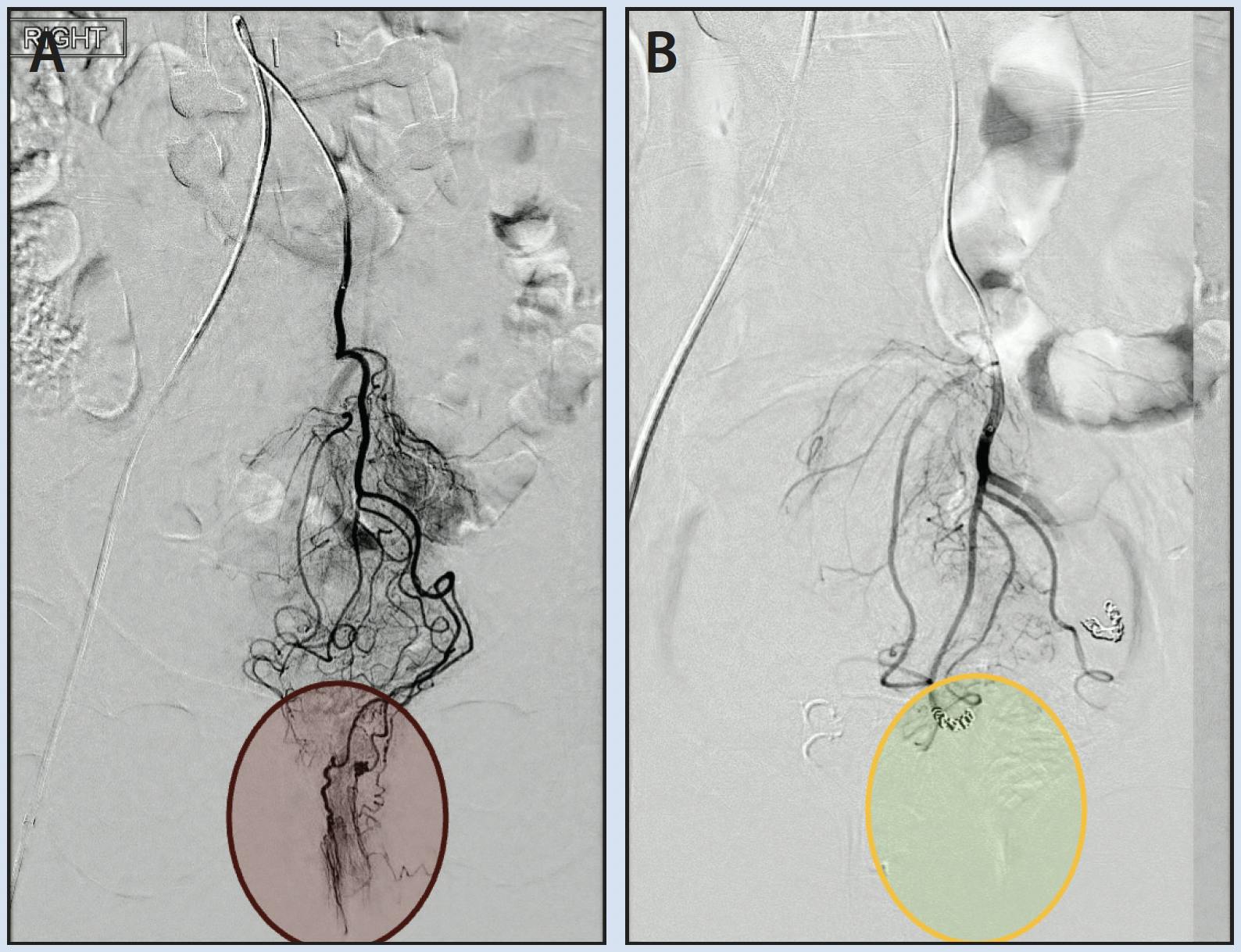
Figure 1. IMA arteriogram demonstrating multiple dominant, hypertrophied SRA branches supplying the corpus cavernosum recti. The hyperemic blush in the hemorrhoidal cushion region is circled in red (A). Final arteriogram following embolization of the dominant SRA branches using particles and coils. The image confirms the successful absence of residual hyperemic blush (circled in green) (B).
The patient experienced mild tenesmus for approximately 1-week postprocedure. She reported no bleeding at her first bowel movement 2 days postprocedure. At 6-month follow-up, the patient reported bleeding less than once per month and was safely taken off iron supplementation. No complications were noted, and the patient expressed satisfaction with the outcome, achieving clinical success without the risks associated with surgery.
During the initial consultation with an interventional radiologist, a comprehensive physical examination and medical history should be taken. Patients should also have an up-to-date colonoscopy confirming the location and grade of hemorrhoids as well as the absence of other anorectal pathology (eg, cancer, ulcerations, polyps). If a patient has anorectal cancer or a history of radiation to the pelvis, HAE should be avoided due to potential compromise of collateral vasculature. The FBS (ranging from 0-9) should be used to assess hemorrhoidal bleeding severity, with a score ≥ 2 typically considered appropriate for intervention. Additionally, Goligher classification (grade I-IV) should be used to determine the degree of prolapse. Historically, office-based interventions have targeted grade I, II, and select grade III hemorrhoids in the literature.
CONCLUSION
HAE has emerged as a safe and highly effective nonsurgical alternative for patients with symptomatic internal hemorrhoids, particularly those presenting with chronic, refractory bleeding. Across > 450 patients, evidence has demonstrated high technical success rates and competitive clinical success, particularly when compared to minimally invasive office-based procedures.23,24 Evidence has also suggested a similar efficacy to surgical hemorrhoidectomy with reduced postprocedure pain and a shorter recovery time. Despite promise, more studies aimed at defining optimal patient demographics and reporting long-term outcomes are necessary to further establish the role of HAE in clinical practice.
1. Peery AF, Crockett SD, Barritt AS, et al. Burden of gastrointestinal, liver, and pancreatic diseases in the United States. Gastroenterology. 2015;149:1731-1741.e3. doi: 10.1053/j.gastro.2015.08.045
2. Jacobs D. Hemorrhoids. N Engl J Med. 2014;371:944-951. doi: 10.1056/NEJMcp1204188
3. Sandler RS, Peery AF. Rethinking what we know about hemorrhoids. Clin Gastroenterol Hepatol. 2019;17:8-15. doi: 10.1016/j.cgh.2018.03.020
4. Fontem RF, Eyvazzadeh D. Internal hemorrhoid. In: StatPearls. StatPearls Publishing; 2025. Updated July 31, 2023. Accessed September 7, 2025. http://www.ncbi.nlm.nih.gov/books/NBK537182/
5. Sun Z, Migaly J. Review of hemorrhoid disease: presentation and management. Clin Colon Rectal Surg. 2016;29:22-29. doi: 10.1055/s-0035-1568144
6. Mott T, Latimer K, Edwards C. Hemorrhoids: diagnosis and treatment options. Am Fam Physician. 2018;97:172-179.
7. Margetis N. Pathophysiology of internal hemorrhoids. Ann Gastroenterol. 2019;32:264-272. doi: 10.20524/aog.2019.0355
8. Sheikh P, Régnier C, Goron F, et al. The prevalence, characteristics and treatment of hemorrhoidal disease: results of an international web-based survey. J Comp Eff Res. 2020;9:1219-1232. doi: 10.2217/cer-2020-0159
9. Riss S, Weiser FA, Schwameis K, et al. The prevalence of hemorrhoids in adults. Int J Colorectal Dis. 2012;27:215-220. doi: 10.1007/s00384-011-1316-3
10. Acheson AG, Scholefield JH. Management of haemorrhoids. BMJ. 2008;336:380-383. doi: 10.1136/bmj.39465.674745.80
11. Cengiz TB, Gorgun E. Hemorrhoids: a range of treatments. Cleve Clin J Med. 2019;86:612-620. doi: 10.3949/ccjm.86a.18079
12. Panneau J, Mege D, Di Bisceglie M, et al. Rectal artery embolization for hemorrhoidal disease: anatomy, evaluation, and treatment techniques. Radiographics. 2022;42:1829-1844. doi: 10.1148/rg.220014
13. Altomare DF, Giuratrabocchetta S. Conservative and surgical treatment of haemorrhoids. Nat Rev Gastroenterol Hepatol. 2013;10:513-521. doi: 10.1038/nrgastro.2013.91
14. MacRae HM, McLeod RS. Comparison of hemorrhoidal treatment modalities. A meta-analysis. Dis Colon Rectum. 1995;38:687-694. doi: 10.1007/BF02048023
15. Vidal V, Sapoval M, Sielezneff Y, et al. Emborrhoid: a new concept for the treatment of hemorrhoids with arterial embolization: the first 14 cases. Cardiovasc Intervent Radiol. 2015;38:72-78. doi: 10.1007/s00270-014-1017-8
16. Pastor Peinado P, Ocaña J, Abadía Barno P, et al. Quality of life and outcomes after rubber band ligation for haemorrhoidal disease. Langenbecks Arch Surg. 2023;408:243. doi: 10.1007/s00423-023-02990-6
17. Albuquerque A. Rubber band ligation of hemorrhoids: a guide for complications. World J Gastrointest Surg. 2016;8:614-620. doi: 10.4240/wjgs.v8.i9.614
18. Guttadauro A, Maternini M, Chiarelli M, et al. Evolution in the surgical management of hemorrhoidal disease. Ann Ital Chir. 2018;89:101-106.
19. Cristea C, Lewis CR. Hemorrhoidectomy. In: StatPearls. StatPearls Publishing; 2025. Updated February 24, 2024. Accessed September 7, 2025. http://www.ncbi.nlm.nih.gov/books/NBK549864/
20. Bouchard D, Abramowitz L, Castinel A, et al. One-year outcome of haemorrhoidectomy: a prospective multicentre French study. Colorectal Dis. 2013;15:719-726. doi: 10.1111/codi.12090
21. Vidal V, Louis G, Bartoli JM, Sielezneff I. Embolization of the hemorrhoidal arteries (the emborrhoid technique): a new concept and challenge for interventional radiology. Diagn Interv Imaging. 2014;95:307-315. doi: 10.1016/j.diii.2014.01.016
22. Küçükay MB, Küçükay F. Superior rectal artery embolization with tris-acryl gelatin microspheres: a randomized comparison of particle size. J Vasc Interv Radiol. 2021;32:819-825. doi: 10.1016/j.jvir.2021.02.011
23. Makris GC, Thulasidasan N, Malietzis G, et al. Catheter-directed hemorrhoidal dearterialization technique for the management of hemorrhoids: a meta-analysis of the clinical evidence. J Vasc Interv Radiol. 2021;32:1119-1127. doi: 10.1016/j.jvir.2021.03.548
24. Nguyenhuy M, Xu Y, Kok HK, et al. Clinical outcomes following rectal artery embolisation for the treatment of internal haemorrhoids: a systematic review and meta-analysis. Cardiovasc Intervent Radiol. 2022;45:1351-1361. doi: 10.1007/s00270-022-03154-7
25. Salgueiro P, Garrido M, Santos RG, et al. Polidocanol foam sclerotherapy versus rubber band ligation in hemorrhoidal disease grades I/II/III: randomized trial. Dis Colon Rectum. 2022;65:e718-e727. doi: 10.1097/DCR.0000000000002117
26. Komporozos V, Ziozia V, Komporozou A, et al. Rubber band ligation of symptomatic hemorrhoids: an old solution to an everyday problem. Int J Colorectal Dis. 2021;36:1723-1729. doi: 10.1007/s00384-021-03900-2
27. Poen AC, Felt-Bersma RJ, Cuesta MA, et al. A randomized controlled trial of rubber band ligation versus infra-red coagulation in the treatment of internal haemorrhoids. Eur J Gastroenterol Hepatol. 2000;12:535-539. doi: 10.1097/00042737-200012050-00010
28. Ding Z, Xuan J, Tang G, et al. Rubber band ligation versus coagulation for the treatment of haemorrhoids: a meta-analysis of randomised controlled trials. Postgrad Med J. 2023;99:946-953. doi: 10.1136/pmj-2022-141941
29. Pucher PH, Sodergren MH, Lord AC, et al. Clinical outcome following Doppler-guided haemorrhoidal artery ligation: a systematic review. Colorectal Dis. 2013;15:e284-294. doi: 10.1111/codi.12205
30. Panneau J, Mege D, Di Bisceglie M, et al. Hemorrhoidal disease: what role can rectal artery embolization play? Front Surg. 2025;11:1474799. doi: 10.3389/fsurg.2024.1474799
31. De Gregorio MA, Guirola JA, Serrano-Casorran C, et al. Catheter-directed hemorrhoidal embolization for rectal bleeding due to hemorrhoids (Goligher grade I–III): prospective outcomes from a Spanish emborrhoid registry. Eur Radiol. 2023;33:8754-8763. doi: 10.1007/s00330-023-09923-3
32. Bagla S, Pavidapha A, Lerner J, et al. Outcomes of hemorrhoidal artery embolization from a multidisciplinary outpatient interventional center. J Vasc Interv Radiol. 2023;34:745-749. doi: 10.1016/j.jvir.2023.01.023
33. Sun X, Xu J, Zhang J, et al. Management of rectal bleeding due to internal haemorrhoids with arterial embolisation: a single-centre experience and protocol. Clin Radiol. 2018;73:985.e1-985.e6. doi: 10.1016/j.crad.2018.07.105
34. Zakharchenko A, Kaitoukov Y, Vinnik Y, et al. Safety and efficacy of superior rectal artery embolization with particles and metallic coils for the treatment of hemorrhoids (Emborrhoid technique). Diagn Interv Imaging. 2016;97:1079-1084. doi: 10.1016/j.diii.2016.08.002
35. Tradi F, Louis G, Giorgi R, et al. Embolization of the superior rectal arteries for hemorrhoidal disease: prospective results in 25 patients. J Vasc Interv Radiol. 2018;29:884-892.e1. doi: 10.1016/j.jvir.2018.01.778
36. Moussa N, Sielezneff I, Sapoval M, et al. Embolization of the superior rectal arteries for chronic bleeding due to haemorrhoidal disease. Colorectal Dis. 2017;19:194-199. doi: 10.1111/codi.13430
37. Falsarella PM, Nasser F, Affonso BB, et al. Embolization of the superior rectal arteries versus closed hemorrhoidectomy (Ferguson technique) in the treatment of hemorrhoidal disease: a randomized clinical trial. J Vasc Interv Radiol. 2023;34:736-744.e1. doi: 10.1016/j.jvir.2023.01.022
38. de Oliveria DS, Hora JAB, de Assis AM, et al. Embolization of rectal arteries for treating hemorrhoidal disease using a combination of microspheres and microcoils: a pilot study. Cardiovasc Intervent Radiol. 2025;48:388-394. doi: 10.1007/s00270-024-03942-3
Advertisement
Advertisement