Advertisement
Advertisement
January 2026 Supplement
Sponsored by Inquis Medical, Inc.
Bailout Treatment of Occluded Left PA With the AVENTUS® Thrombectomy System
As an interventional radiologist at Palmetto General Hospital, I have over 15 years of experience treating venous thromboembolic disease and have completed over 750 cases. In that time, our care team has acquired extensive experience with all the commercially available treatment options. These devices have proven to be effective, but they are not without drawbacks that have limited utilization due to complexity and length of the procedure. We recently have gained experience with the new AVENTUS® Thrombectomy System, which solves many of these problems and simplifies the pulmonary embolism (PE) procedure in meaningful ways.
CASE PRESENTATION
A female patient in her early 70s was admitted to the hospital with right lower leg pain and swelling. She had severe shortness of breath and pain on inspiration. Her medical history was significant for hypertension, dyslipidemia, osteoporosis, and recent displaced fibular fracture for which she had been scheduled for surgery in 4 days. She was tachycardic (> 150 bpm) and had sustained hypotension as low as 78/53 mm Hg. A “Code PERT” (PE response team) was immediately called, which in our system triggers a power plan with all necessary labs, imaging, admissions, and consults automatically preordered. This also serves to notify CT to leave a suite open for immediate patient imaging. A call also goes out to the PERT physician on call. A CTA for PE was performed within 20 minutes and demonstrated bilateral PE involving the right and left main pulmonary arteries (PAs) and the lobar and segmental branches (Figure 1). There was right heart strain with a RV/LV (right ventricular/left ventricular) ratio of 2.0 (Figure 2). Laboratory results were significant for elevated lactate of 3.7 mmol/L, troponin of 5.7 ng/L, B-type natriuretic peptide of 2,360 pg/mL, and signs of respiratory alkalosis. As the Code PERT physician on call, I immediately identified this as a massive PE per risk stratification guidelines, and the team was called in for emergent thrombectomy. Meanwhile, an intravenous heparin drip was started as per PE protocol with bolus.
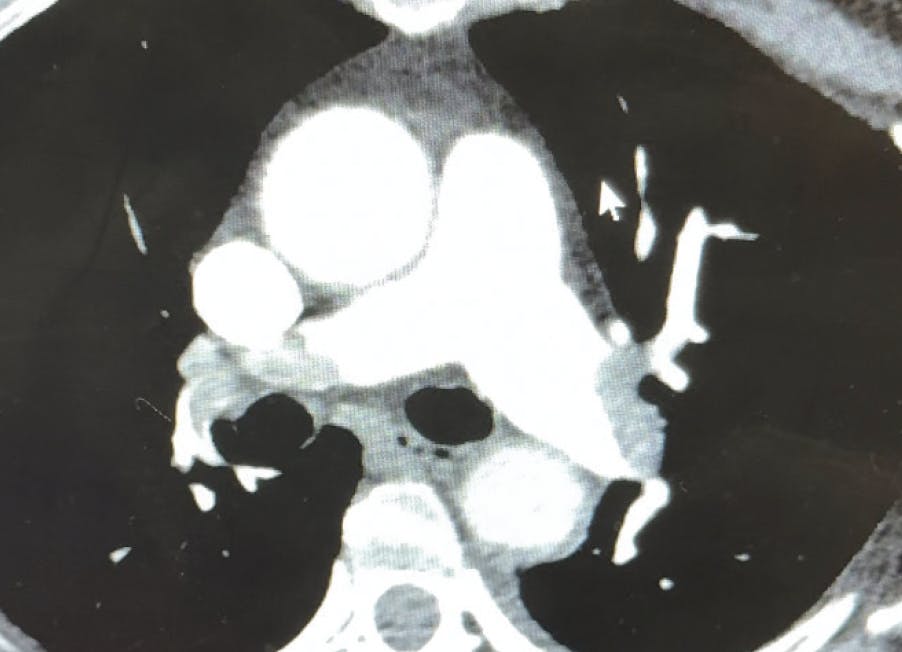
Figure 1. CT scan showing bilateral clot without a saddle, with both the right and left PA occluded with thrombus.
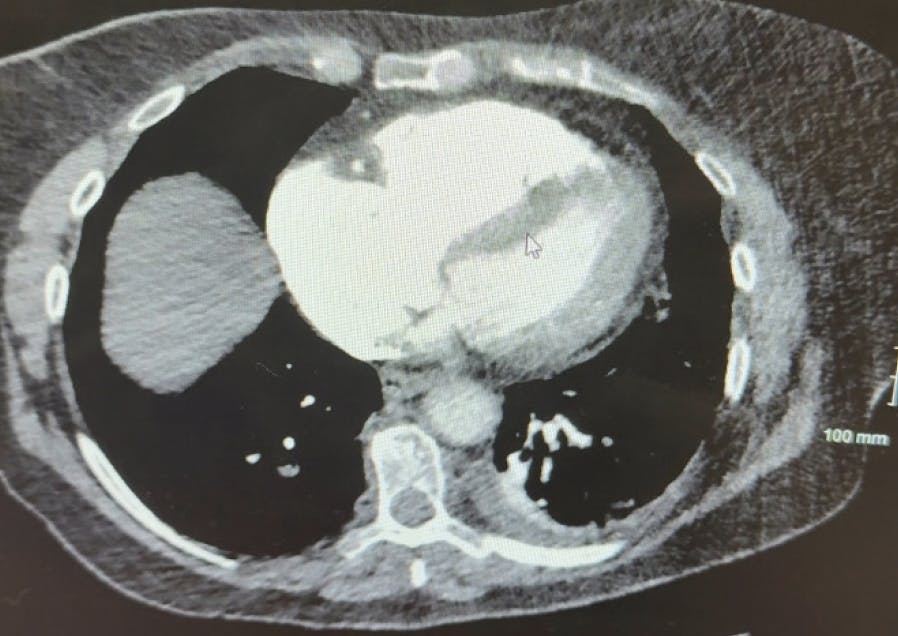
Figure 2. Echocardiogram (A) and CT image (B) showing RV dilation with an RV/LV ratio of 1.4.
INDEX PROCEDURE OVERVIEW
Given the patient's hemodynamic instability and contraindications for systemic thrombolysis, large-bore mechanical thrombectomy was chosen. This has become our first-line procedure of choice due to its efficacy, speed, and safety profile.
We made the decision to use a 24-F mechanical thrombectomy device from a different manufacturer for the index procedure due to our staff being most familiar with it and the severity of the presenting patient symptoms. We achieved common femoral access, inserted the 24-F thrombectomy catheter, and delivered it to the right PA. Due to the emergent nature of the case, we did not measure PA pressures. An angiogram of the right PA showed complete occlusion of the right upper lobe branch and multiple incomplete emboli in the middle and lower lobe branches.
After completing aspirations in the right PA but prior to obtaining a right-sided angiogram, the 24-F catheter “flopped” to the left PA, dragging with it the tip of the 0.035-inch super stiff Amplatz wire with 1 cm tip. The patient felt immediate discomfort and became slightly agitated. Because I was already in the left PA, I thought it prudent to proceed with left thrombectomy, but when I advanced the guidewire, it took a cephalad course and then wrapped around the superior mediastinum, eventually descending the right-side lateral to the superior vena cava. I immediately injected a little contrast through the 24-F catheter, which confirmed pericardial leak. Although the patient complained of some pain, her vital signs were strong. I placed an ultrasound probe on her heart and confirmed the hemopericardium. I placed an 8-F pigtail catheter in the caudal pericardial space and evacuated 1 L of blood, by which time we had ordered two units of packed red blood cells for transfusion. I then pulled out the groin access and sealed it with dual Perclose® devices (Abbott) using preclose technique. The pericardial drain was sutured in place.
The patient was transferred to the intensive care unit for observation. She improved overnight and expressed a desire for us to complete the embolectomy procedure. Her vital signs still showed tachycardia in the 130s bpm and her systolic blood pressure was in the 110 to 120 mm Hg. She still had positive biomarkers, and the cardiac two-dimensional echocardiogram showed RV dilatation and tricuspid regurgitation, surrogates for elevated PA pressure, which could not be measured.
BAILOUT PROCEDURE WITH THE AVENTUS SYSTEM: LEFT PA THROMBECTOMY
After extensive multidisciplinary discussion, we decided to proceed with treatment. With the benefit of time and freedom for choice, I decided to use the AVENTUS Thrombectomy System to treat her left PA. Given the clinical context, I selected the AVENTUS Thrombectomy System based on several procedural considerations: (1) I would be able to cross the left PA apex with a softer wire due to its flexibility, negating risk of worsening pericardial damage; (2) the left upper lobe and lingular thrombus were eccentric, and I thought that the directional aspiration would help target this thrombus; (3) I wanted to do the procedure as quickly as possible, minimizing wire and catheter exchanges and need for adjunctive devices yet ensuring a good result; (4) her hemoglobin had since dropped to 8.0 g/dL (from initial of 10.3 g/dL), so I was wary of blood loss and the proprietary TrueClot™ Sensing would help identify what was at the tip of the catheter for more precise and targeted aspiration to reduce the procedure time and limit blood loss from unnecessary aspirations, and (5) the AVENTUS Clot Filtration and Blood Reinfusion System would return healthy blood to avoid wasting valuable hemoglobin.
Standard common femoral access was obtained and the access site was preclosed. The AVENTUS 24-F Catheter was then advanced through the right heart and main PA pressure was assessed, which was 34/14 mm Hg (mean, 21 mm Hg). I easily entered the right PA and obtained an angiogram to ensure that we had cleared the thrombus from the index procedure, which we had. I then carefully navigated to the left PA using a floppy-tip wire placed in the left lower lobe. Although clot was present in the upper lobe, I decided to start by treating in the left lower lobe.
After delivering the AVENTUS Catheter to the left lower lobe, we performed one aspiration, and TrueClot™ Sensing indicated we had latched on the vessel wall with a blue indicator light, and no clot was being sensed in that location. I realized that the bulk of the clot must be in the posterior segment. With other devices, this would mean pulling back the catheter, exchanging for a curved catheter or hydrophilic wire or replacing with the stiff wire, then reengaging the dilator to advance the catheter distally. Although not unmanageable, it is frustrating and usually results in a loss of 5 to 10 minutes. However, with the AVENTUS System, I simply pulled back the catheter and used the integrated guiding catheter to select the appropriate vessel. I advanced the AVENTUS Catheter until the TrueClot™ Sensing indicated an orange light signaling the presence of clot. I then performed an aspiration while slowly pulling the catheter back with the aspiration orifice directed toward the lateral side as I retracted past the lingula and left upper lobe branches. As we passed the left apical branch, the syringe filled with clot and blood. I then advanced the aspiration syringe forward, which sent the extracted blood to the AVENTUS Clot Filtration and Blood Reinfusion System.
I was not expecting much after one aspiration, but when I looked at the clot filter, I was shocked that there was a very large amount of evenly mixed morphology clot (Figure 3). I performed left pulmonary angiography through the AVENTUS Catheter and was impressed when I saw that we achieved 100% clot resolution on one single aspiration and from the historically difficult-to-treat left PA (Figure 4).
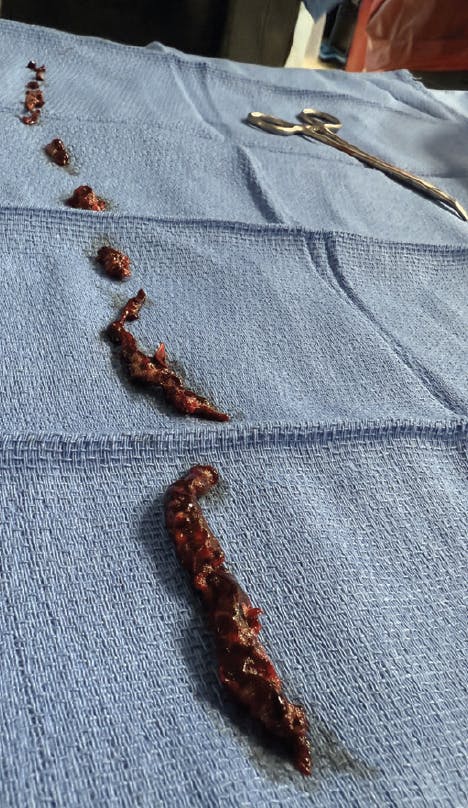
Figure 3. Extracted clot of mixed morphology from left PA using the AVENTUS Thrombectomy System.
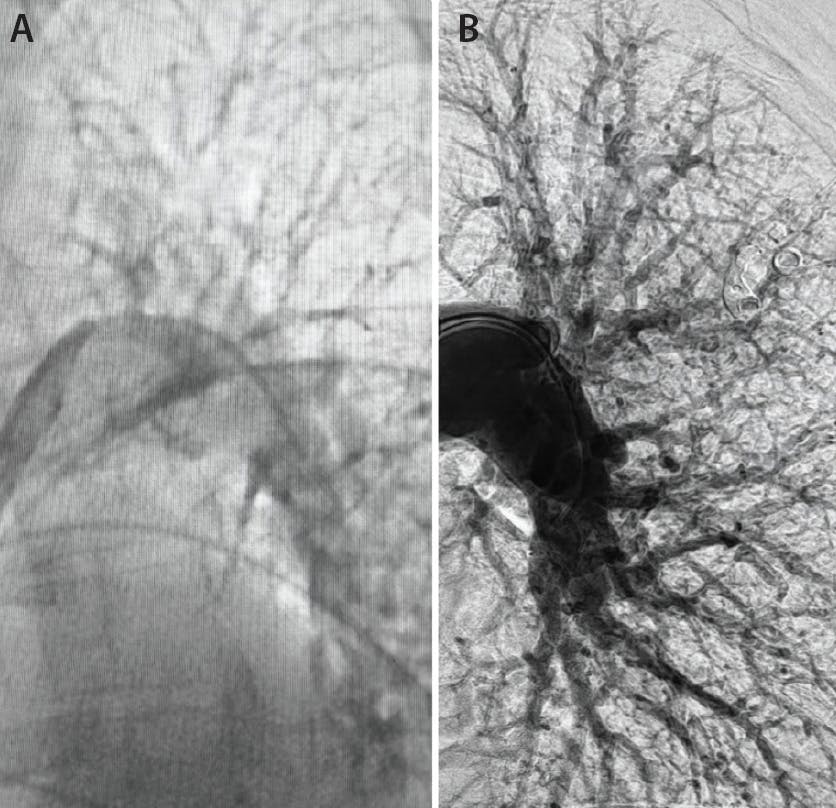
Figure 4. Preprocedure angiogram showing an occluded left PA (A). Postprocedure angiogram showing 100% clot removal and reperfusion (B).
Prior to completing the procedure, PA pressures were 26/5 mm Hg (mean, 14 mm Hg), demonstrating a significant reduction especially for unilobar treatment. We successfully closed the patient using the preclose technique, and she was transferred in stable condition to the intensive care unit.
POSTPROCEDURE OUTCOME AND FOLLOW-UP
The patient demonstrated significant clinical improvement after treatment. By the third postoperative day (hospital day 6), she was eligible for discharge. However, she elected to remain in the hospital to undergo surgical repair of her broken fibula. During her extended stay, her vital signs showed continued improvement; her heart rate stabilized in the low 100s bpm, and her blood pressure normalized to 130/60 mm Hg.
To ensure complete resolution of the PE, a follow-up CTA was ordered on hospital day 9. The CTA results were negative for any residual PE, and the patient's RV/LV ratio had normalized to 0.8, indicating resolution of the right heart strain that was present on admission.
DISCUSSION
The AVENTUS Thrombectomy System solves the particularly laborious and redundant steps inherent with other devices. With the AVENTUS System, there are no catheter and dilator exchanges, as the procedure is done with one aspiration catheter and no separate dilator. In some cases, you can complete the procedure over one guidewire because the 24-F AVENTUS Aspiration Catheter is extremely torqueable and deliverable. The integrated 5-F navigation catheter and built-in dilator tip simplify catheter repositioning, reducing procedural steps and saving time. With directional aspiration, there is no longer a need for extra aspiration catheters with different angulations and curves. You can use the beveled, directional aspiration tip to address eccentric thrombus with complete control in 360° of rotation. TrueClot™ Sensing technology provides useful information to know what is at the catheter tip, eliminating guesswork, improving efficiency, and saving time. Finally, we can maximize treatment efficacy by allowing filtered blood to be returned to the patient immediately, giving you the freedom to remove as much clot as possible.
These procedural improvements allow clinicians to be more successful than previously believed, yet optimally efficient. Procedures with the AVENTUS System can be accomplished safely, successfully, and often in approximately 30 minutes. This means that mechanical thrombectomy can be adopted more widely, which the latest data are consistently showing to be more beneficial to patients than current standard of care.
INDICATIONS FOR USE
The Aventus Thrombectomy System is indicated for:
- The non-surgical removal of emboli and thrombi from blood vessels.
- Injection, infusion, and/or aspiration of contrast media and other fluids into or from a blood vessel.
The Aventus Thrombectomy System is intended for use in the peripheral vasculature and for the treatment of pulmonary embolism.
The Aventus Clot Management System is indicated for use with the Aventus Thrombectomy System for autologous blood transfusion.
AVENTUS® is a registered trademark of Inquis Medical, Inc.
©2025 Inquis Medical, Inc. All Rights Reserved.

Advertisement
Advertisement