Advertisement
Advertisement
July 2026
Sponsored by Stryker Peripheral Vascular
Advancing DVT Care: Lessons From CLOUT
Dr. Dexter discusses how the ClotTriever System and the CLOUT registry are reshaping mechanical thrombectomy, expanding treatment opportunities, and improving long-term outcomes for patients with DVT.

CLOUT was intentionally designed as an all-comer registry with broad inclusion criteria and patients spanning acute, subacute, and chronic thrombus. Looking back, how closely does that population resemble the deep vein thrombosis (DVT) patients you see in everyday practice?
The CLOUT registry was a 500-patient, all-comers registry designed to evaluate what could be achieved with mechanical thrombectomy.1
When we first began treating DVT, the majority of therapies relied on thrombolytic agents. Those drugs work by breaking down fibrin, but the longer a clot remains in the body, the less effective that approach becomes. Over time, a clot evolves from being primarily composed of red blood cells to becoming increasingly fibrin-rich; eventually, it organizes into scar tissue and collagen. At that stage, we would not expect a thrombolytic drug to effectively dissolve the clot.
For decades, most clinical trials focused on thrombolytic therapy. However, after the ClotTriever System (Inari Medical, now part of Stryker) received FDA approval, we began to find that a mechanical device that didn’t rely on breaking down fibrin might be more effective in certain patients, such as those who presented late or those who presented early but received anticoagulation and remained severely symptomatic in a time window where delivery of a thrombolytic agent wouldn’t work. That shift really changed our understanding of which patients could benefit from intervention.
One of the ongoing challenges in DVT management is reducing the burden of postthrombotic syndrome (PTS). How has CLOUT advanced our understanding of the relationship between thrombus removal and long-term patient outcomes?
One of the key questions we looked at was how effectively we could remove clots. We found that we were able to remove the majority of clot (defined as a ≥75% reduction in Marder score) in >90% of patients. More than 70% of patients achieved >90% clot removal.1
Previously, we did not really have a baseline of how much clot we were trying to remove. Looking at prior trials, we thought 75% was a reasonable goal. I don’t think we realistically believed we would have >70% reaching 90% thrombus removal; so, what we found in CLOUT was a pretty big deal.
When we talk about PTS, the “open vein hypothesis” in acute DVT says: The more clot you remove, the better the patient’s long-term outcome is likely to be. Comerota et al demonstrated this relationship in a 2012 nonrandomized study of 71 patients with iliofemoral DVT.2 This was the first study to show a correlation between the amount of clot removed and subsequent rates of PTS. Now that we’re able to remove substantially more clot, maybe even in later windows, the expectation is that we’ll see meaningful improvements in long-term PTS outcomes.
In CLOUT, patients experienced significant clinical improvement across multiple measures. Pain scores decreased dramatically, with late follow-up pain scores essentially reaching zero. Edema also improved significantly, as did overall clinical severity scores. When we look at the Villalta score, at baseline, only about 18% of patients had scores that would be considered free of PTS. By 6 months, >75% of patients remained free of PTS, and by 2 years, that number increased to over 80%.3
Within the limitations of a single-arm registry, we were able to prevent PTS in approximately 80% of patients. Even more encouraging, moderate to severe PTS was observed in only 6% of patients at 2 years. Those are really attractive numbers.
How should physicians think about the balance between immediate symptom relief and the potential long-term benefits of intervention when treating DVT patients?
While the acute benefits of DVT therapy are rarely discussed and raise a whole different set of questions, we found in CLOUT that the immediate results of mechanical thrombectomy were really compelling. Patients experienced significant reductions in both pain and edema following treatment.
Today, most patients with DVT are hospitalized because they’re experiencing severe pain and significant swelling. The ability to relieve those symptoms in a single treatment session can dramatically accelerate recovery and get patients back to their normal lives much more quickly.
Looking beyond the acute phase, the intermediate- and long-term data are equally encouraging. We’re beginning to see that mechanical thrombectomy is associated with low rates of PTS. That’s important because PTS, which includes chronic leg pain, swelling, skin changes, and venous ulcers, can have a significant impact on a patient’s quality of life. The CLOUT data suggest that removing more clot up front may translate into better long-term outcomes for these patients.
The CLOUT chronicity analysis showed that in many cases, the extracted thrombus was more chronic than symptom duration alone would suggest.4 How has that finding changed the way you think about relying on patient-reported symptom timing to date a clot? What insights has CLOUT provided about the impact of treatment strategy, and long-term outcomes?
The CLOUT subset analysis taught us two important lessons when we looked at outcomes based on how long the clot had been present before treatment.
First, we were surprised to find that the visual and procedural assessments of the clot often didn’t match the patient’s reported history. Some of that may be because patients aren’t always the best historians, but it’s also possible that clots don’t age in the body the way we think they do.
Second, and more importantly, we found that treatment effectiveness was remarkably consistent regardless of clot age. Patients with acute, subacute, and chronic DVT all experienced similar rates of clot removal and similar reductions in PTS.4 That finding has fundamentally changed the way we think about treatment timing.
Historically, we viewed the first 2 weeks after DVT as the ideal window for intervention. If a patient presented after that, we often assumed the opportunity for thrombectomy had passed and focused instead on managing the long-term consequences, such as iliac vein stenting or angioplasty.
Now, if I see a patient 3 weeks after an iliofemoral DVT who is still severely symptomatic, I can bring that patient to the lab, obtain a venogram, and attempt mechanical thrombectomy with the expectation that they will improve. That’s not something I would have confidently told a patient in the past.
This has become even more relevant as DVT management has evolved. With the widespread use of direct oral anticoagulants (particularly factor Xa inhibitors) and the increasing pressure on emergency departments, many patients who would previously have been admitted are now discharged with plans for outpatient follow-up. In reality, that follow-up with a vascular specialist often doesn’t occur for 2, 3, or even 4 weeks. Historically, many of those patients would have been considered outside the treatment window. Now, we have meaningful treatment options to offer them.
What does current clinical evidence tell us about the performance of ClotTriever across different clot ages and presentations, and what data are needed to better understand how mechanical and aspiration-based thrombectomy might compare?
We have published data demonstrating how long mechanical thrombectomy takes and its effectiveness in removing clot at various time intervals for acute, subacute, or chronic presentations.1 Those data show both the efficiency of the procedure and the device’s ability to achieve substantial clot removal regardless of clot age.
There are also ongoing studies evaluating aspiration-based thrombectomy for many of the same patient populations. As those data become available, we’ll be able to make more meaningful retrospective comparisons between the different treatment modalities.
The mechanism of action of the ClotTriever Thrombectomy Catheter is straightforward and intuitive. It allows us to remove a significant amount of thrombus quickly, often in a single treatment session. In my view, it strikes an excellent balance between the volume of clot that can be removed and the efficiency with which the procedure can be performed.
How aspiration-based technologies compare across acute, subacute, and chronic DVT remains to be seen. As more clinical data emerge, we’ll have a better understanding of the relative strengths of each approach.
What are the most important unanswered questions that remain regarding thrombectomy and long-term outcomes for DVT patients?
I would start by saying that one of the greatest scientific contributions of the CLOUT registry, made possible through the support of Inari Medical, now part of Stryker, was the investment in following 500 patients for 2 years in a prospective, single-arm study. That’s a significant undertaking, and both the investigators and the sponsor deserve credit for committing the time, resources, and funding required to generate a dataset of this magnitude.
Importantly, CLOUT was never intended to answer every question about DVT treatment. Its purpose was to establish a robust clinical database that could serve as a benchmark for future studies, allowing us to evaluate this technology more rigorously and compare it with emerging treatment approaches.
That said, there are still important questions to answer. Many of the conclusions we’ve discussed today are supported by the current data, but studies such as the DEFIANCE randomized controlled trial will be critical in providing higher-level evidence.
As physicians and investigators, we have an important partnership with industry. We should recognize and appreciate the investment required to conduct studies like CLOUT, while also continuing to challenge our industry partners to fund the studies that address the most important clinical questions. That’s ultimately how we’ll continue to advance the field and improve care for patients with DVT.
1. Dexter D, Kado H, Shaikh A, et al. Safety and effectiveness of mechanical thrombectomy from the fully enrolled multicenter, prospective CLOUT registry. J Soc Cardiovasc Angiogr Interv. 2023;2:100585. doi: 10.1016/j.jscai.2023.100585
2. Comerota AJ, Grewal N, Martinez JT, et al. Postthrombotic morbidity correlates with residual thrombus following catheter-directed thrombolysis for iliofemoral deep vein thrombosis. J Vasc Surg. 2012;55:768-773. doi: 10.1016/j.jvs.2011.10.032
3. Dexter D. Final two-year CLOUT outcomes. Presented at: Vascular InterVentional Advances (VIVA);
November 3-6, 2024; Las Vegas, Nevada.
4. Maldonado TS, Dexter DJ, Kado H, et al. Outcomes from the ClotTriever Outcomes Registry show symptom duration may underestimate deep vein thrombus chronicity. J Vasc Surg Venous Lymphat Disord. 2022;10:1251-1259. doi: 10.1016/j.jvsv.2022.04.015
Case Report: Mechanical Thrombectomy for Bilateral DVT After Failed IVC Filter
PATIENT PRESENTATION
A woman in her mid 60s presented with DVT. She had received an inferior vena cava (IVC) filter after spinal surgery in 2021. Attempted retrieval of the filter failed, and she had no anticoagulation since 2022. At the time of presentation, she reported swelling and pain for 3 days, and initial venography showed that she had bilateral lower extremity DVT from the tibial veins through the IVC filter (Figure 1A).
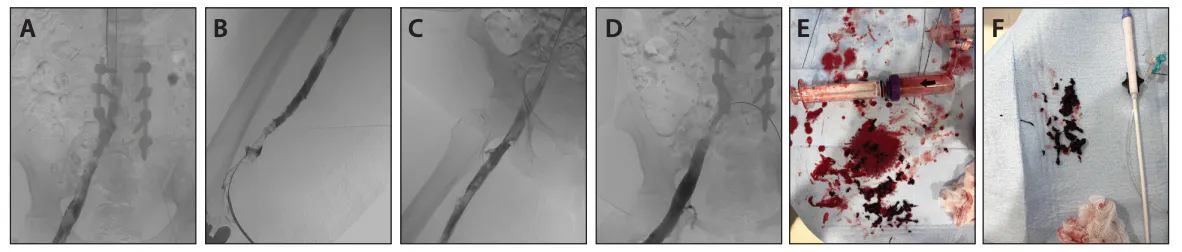
Figure 1. Preprocedure venography demonstrating extensive DVT (A). Thrombectomy with the ClotTriever System of the right popliteal, femoropopliteal, and right common and external iliac veins (B, C). Completion venography demonstrating restored inline venous flow following mechanical thrombectomy (D). Clot material extracted (E, F).
PROCEDURAL OVERVIEW
Catheter-directed thrombolysis was performed with the Ekos system (Boston Scientific Corporation) for presumed acute DVT; however, the procedure was not successful. It was suspected that the age of the DVT was longer than the 3-day symptom onset and chronic material was present. The patient was transferred to our referral center for evaluation, and the decision was made to proceed with mechanical thrombectomy.
Thrombectomy was performed with the ClotTriever System (Inari Medical, now part of Stryker) in the right popliteal, femoropopliteal, and right common and external iliac veins (Figure 1B and 1C). A 24-F Intri24 sheath (Inari Medical, now part of Stryker) was then introduced in the left common femoral vein, and thrombectomy was performed. Completion venography showed restored inline flow (Figure 1D).
Dr. Dexter is a paid consultant of Inari, now part of Stryker. Dr. Dexter is sharing his views, opinions, and experience with Inari Medical devices. His opinions and experiences using these devices were formed independently of Inari Medical and may not represent every experience or outcome with the devices. The information is not a promise or guarantee by Inari Medical regarding a particular treatment, therapy, medication, device, diagnosis, action, recommendation, strategy, or outcome with the product or the information contained in these materials and presentations.
Indications For Use:
The ClotTriever Thrombectomy System is indicated for: (1) The non-surgical removal of thrombi and emboli from blood vessels. (2) Injection, infusion, and/or aspiration of contrast media and other fluids into or from a blood vessel. The ClotTriever Thrombectomy System is intended for use in the peripheral vasculature including deep vein thrombosis (DVT).
The ClotTriever Sheaths are indicated for use as a conduit for the insertion of endovascular devices into the vasculature while minimizing blood loss associated with such insertions.
Review complete Instructions for Use, Indications for Use, Warnings, Precautions, Possible Adverse Effects and contraindications prior to use of the product.
For all non-Stryker products, please refer to manufacturer Instructions for Use/Intended Purpose for complete indications for use, contraindications, warnings and precautions.
Caution: Federal (USA) law restricts this device to sale by or on the order of a physician. PRO-3859-USA-EN-v1
Advertisement
Advertisement