Advertisement
Advertisement
April 2021
Sponsored by Medtronic
An Overview of Endovascular Treatment for Hemorrhoidal Bleeding
Hemorrhoids represent a unique pathology of arteriovenous communication where inflammatory, degenerative, and vascular abnormalities lead to symptomatic congestion of the anorectal vascular plexus within the anal cushions.1 This congestion gives rise to the classic distended and often prolapsed appearance of hemorrhoids and the well-known complications of thrombosis and hemorrhoidal bleeding.
After failure of conservative medical management, rubber band ligation (RBL) is the most commonly used minimally invasive technique for treating symptomatic internal hemorrhoids, with Doppler-guided transanal hemorrhoidal artery ligation (DGHAL) gaining popularity. A recent randomized controlled trial comparing DGHAL versus RBL for grade II/III internal hemorrhoids demonstrated a recurrence rate of 30% in the DGHAL group compared to 49% with RBL, with similarly low complication rates between the two groups.2 However, DGHAL is associated with more postprocedural pain than RBL, albeit significantly less compared with stapled hemorrhoidopexy.3 Both procedures demonstrate low complication rates, with 5% to 15% for DGHAL4 and 4% for RBL.5
When minimally invasive management fails, hemorrhoidectomy and stapled hemorrhoidopexy have been the mainstays of surgical treatment for internal and external hemorrhoids. Stapled hemorrhoidopexy results in less postoperative pain and a more rapid return to normal activity but has slightly greater recurrence rates compared with hemorrhoidectomy.6-8 However, both techniques cause significant postoperative pain and have similarly high complication rates, including postoperative hemorrhage, urinary retention, fecal incontinence and impaction, wound complications, and anal strictures.8,9 In a large comparative meta-analysis of techniques, Simillis et al summarize it as the following: RBL and DGHAL have the least postoperative pain and complications but the greatest rates of recurrence; hemorrhoidectomy is the most definitive treatment but has the greatest associated pain and complication rates, while stapled hemorrhoidopexy demonstrates less pain, greater recurrence, and similar complication rates.10
Because significant pain is associated with these techniques, the administration of a perianal block is common practice. Perianal block administration is a primary contributor to urinary retention rates of up to 69% after proctologic procedures.11 Consideration is warranted in patients at high risk for urinary retention and urinary tract infection. Additionally, patients with a known history of fecal impaction may be at greater risk of symptom exacerbation due to postprocedural tenesmus and pain with defecation.
Hemorrhoidal embolization (emborrhoid) is a nascent technique with promising early results. The earliest report of rectal artery embolization was in 1977 for the treatment of postsurgical hemorrhage after rectal polypectomy.12 Subsequent decades included descriptions in the setting of trauma, aneurysm, and rectal malignancy. However, since 2014, numerous retrospective investigations of hemorrhoidal embolization have been published, with a landmark prospective study by Tradi et al evaluating superior rectal artery embolization of grade II/III hemorrhoids. This trial demonstrated a 72% clinical success rate,13 defined as a two-point decrease on the visual analog scale and the French bleeding score, a prospectively validated scoring system to assess the severity of hemorrhoidal bleeding.14 Additionally, patients experienced a significant decrease in hemorrhoidal prolapse and improvement in quality of life. Notably, no early or late complications were encountered in this 25-patient cohort, and not a single patient endorsed postprocedural pain. This safety profile is consistent with several published case series, which, in summation, reflect several hundred emborrhoid procedures.15 Efficacy and low complication rates in early data signal that this technique has the potential for widespread application in the management of hemorrhoids.
CASE STUDY
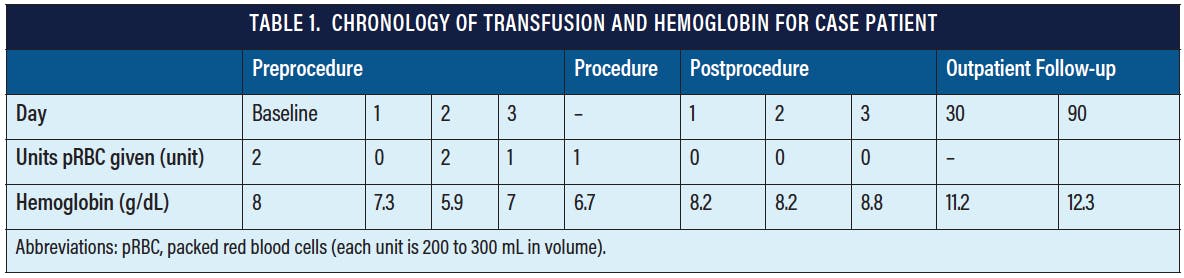
A man in his early 30s with a history of an alcohol use disorder presented to the emergency department with acute-onset abdominal pain and vomiting. Initial workup revealed acute necrotizing pancreatitis, for which he was admitted for treatment. The patient also attested to intermittent bloody bowel movements consisting of bright-red blood for several years. Over the previous 2 months, he experienced significant bleeding multiple times a day. During his hospital course, persistent and worsening episodes of bright-red blood per rectum contributed to anemia that was unresponsive to multiple transfusions. A subsequent CTA demonstrated no active extravasation but prominent enhancement along the anterior rectal wall, which was suspicious for hemorrhoids. A colonoscopy subsequently demonstrated multiple large prolapsed internal and external hemorrhoids not amenable to endoscopic therapy. Surgery was consulted, and surgical management was discussed and ultimately deferred by the patient due to concerns of further pain and medical complexity in the setting of pancreatitis. The interventional radiology (IR) department was consulted for further management, and the patient was deemed a candidate for hemorrhoid embolization.
With the patient in the supine position, right common femoral access was achieved, and the proximal inferior mesenteric artery was accessed using a Sos Omni™* 2 catheter (AngioDynamics) and a Bentson™* wire (Cook Medical). Initial digital subtraction angiography (DSA) and cone-beam CT imaging were performed through the Sos Omni 2 catheter. A combination of a 2-F Progreat™* microcatheter (Terumo Interventional Systems), 0.016-inch Fathom™* microwire (Boston Scientific Corporation), and 0.014-inch Synchro™* microwire (Stryker) was used to further investigate and access the superior rectal artery branch vessels. Superselective injections of all superior rectal artery branches were performed with several vessels, demonstrating the classic appearance of prominent corpus cavernosum vessels supplying hemorrhoids (Figure 1). The microcatheter was tracked as far distally as possible in all superior rectal artery branches with hemorrhoidal supply. These branches were embolized to stasis using 2-, 3-, and 4-mm helical Concerto™ coils (Concerto detachable coil system, Medtronic) (Figure 2). In addition, injection of a right-sided superior rectal artery demonstrated competitive inflow. An even more distal superselective DSA demonstrated a prominent right middle superior rectal anastomosis with significant hemorrhoidal supply from the middle rectal artery as well as inflow from the left middle rectal artery. The microcatheter was then advanced from the superior rectal artery across the anastomosis into the middle rectal artery; the middle rectal artery and superior rectal artery were embolized using helical Concerto coils. Angiography of the left internal iliac artery demonstrated middle rectal hemorrhoidal supply, and this vessel was embolized with helical Concerto coils as well (Figure 3 and Figure 4).
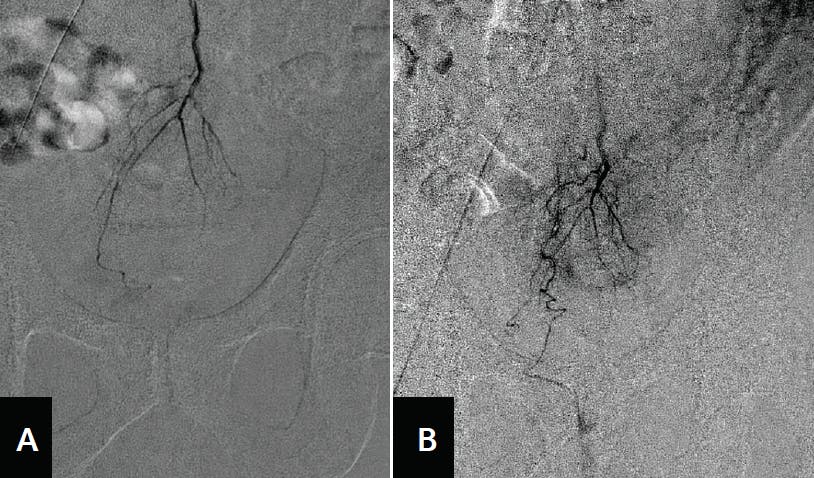
Figure 1. Initial superior rectal angiogram demonstrated prominent branch with hemorrhoid supply (A). Delayed superior rectal angiogram showed hemorrhoidal hypervascularity (B).
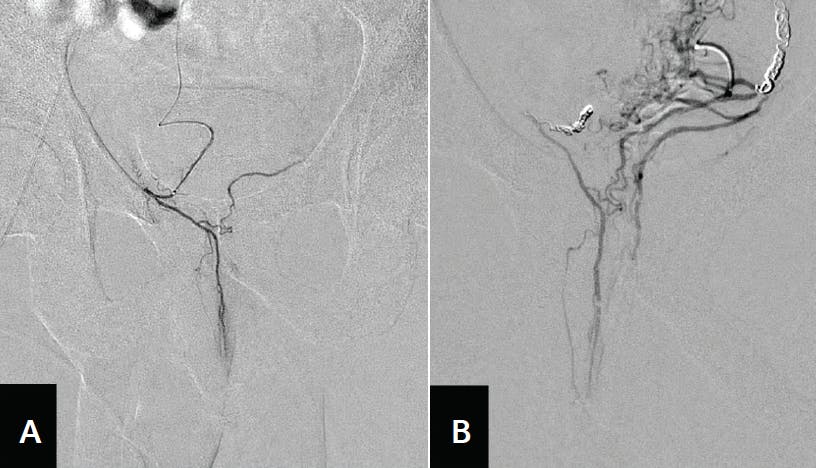
Figure 2. Subselective angiogram of superior rectal artery branch demonstrated hemorrhoidal hypervascularity with observed competitive inflow from the bilateral middle rectal arteries (A). Subselective angiogram of a left superior rectal artery branch with complex hemorrhoidal inflow and hypervascularity with competitive inflow from the right middle rectal artery (B).
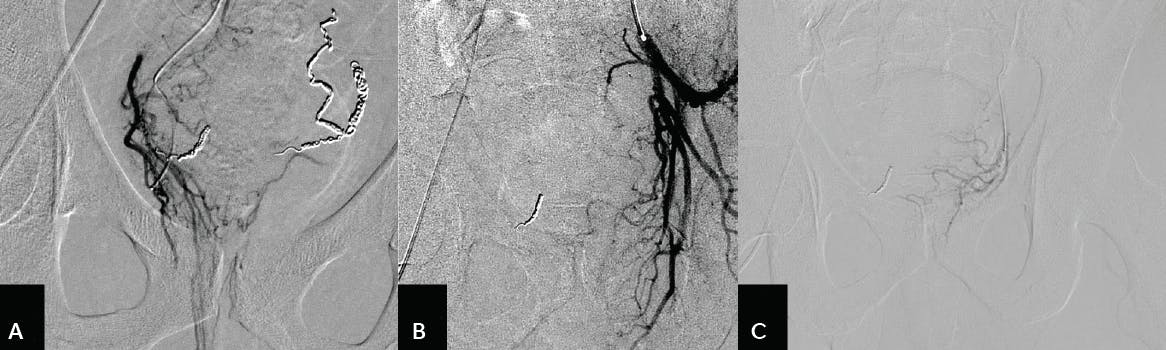
Figure 3. DSA with the microcatheter past the right middle rectal artery via a right superior rectal artery demonstrated hemorrhoidal inflow (A). Left internal iliac angiogram showed the left middle rectal artery with hemorrhoidal inflow (B). Subselective left middle rectal artery angiogram (C).
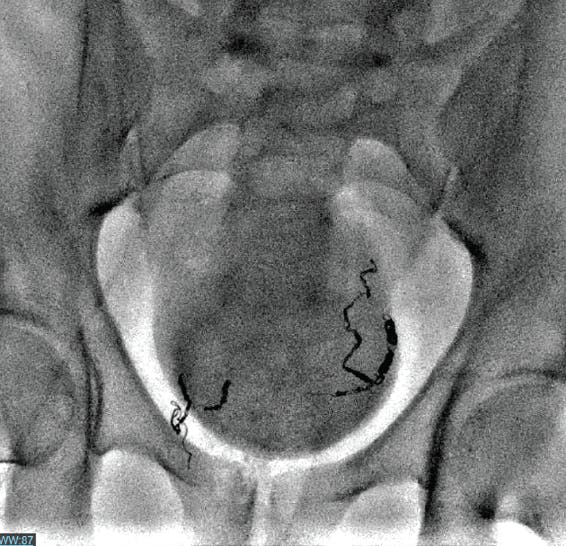
Figure 4. Image of detached 2-, 3-, and 4-mm Concerto coils after embolization of three superior rectal arteries and both middle rectal arteries.
The patient did not require additional transfusions after hemorrhoidal artery embolization. No further episodes of bright blood per rectum were noted during the remainder of his admission for ongoing pancreatitis management. He was discharged and seen in an outpatient clinic for 2 months postprocedure and endorsed significant improvement of bleeding symptoms, with only two bloody bowel movements after discharge (Table 1). The patient also attested to significantly less blood in the toilet and markedly decreased discomfort associated with the bloody bowel movements.
DISCUSSION
Although the early experience is promising, there is an increasing number of questions regarding the role of emborrhoid in the overall treatment paradigm of hemorrhoid treatment, patient selection, patient referral pathways, and embolization technique. With an overall paucity of high-quality data, it is extremely difficult to ascertain which patient population is best served with embolotherapy versus more established standard-of-care therapies. Even though it is relatively conservative, our practice applies the 72% clinical success rate quoted by Tradi’s group when comparing the efficacy of different treatment options because it is derived from prospective data and incorporates validated bleeding scores. Even in its infancy, it is very encouraging to see that the clinical success rate of embolotherapy is already comparable to more established minimally invasive techniques, with a significantly favorable complication rate of zero reported adverse events.
Due to a limited body of evidence, our practice offers hemorrhoidal embolization to two subsets of patients: (1) nonsurgical candidates who have tried all minimally invasive therapies, and (2) patients who cannot receive alternative minimally invasive therapies. In our experience, many more patients qualify for the latter than originally anticipated. For example, there is a population of patients with significant hemorrhoidal bleeding in whom endoscopic therapies are contraindicated because they must remain on dual antiplatelet agents due to cardiovascular comorbidities. These patients are in a precarious situation because dual antiplatelet therapy not only worsens their bleeding but also limits their treatment options. By focusing on a subset of patients that the current treatment paradigm cannot address, our practice has been able to synergistically work in a multidisciplinary fashion and address an unmet need with our colleagues. This has lent itself to a patient-centric organic referral pathway as well as overall institutional buy-in.
Through our initial experience, our pre- and intraprocedural imaging protocol has drastically evolved. Although preprocedural imaging is helpful to identify superior and middle rectal anatomy, its role has strictly evolved in our practice to determine whether or not the inferior mesenteric artery is patent and decide whether or not femoral access is appropriate for a case. Whenever possible, our practice now bases all additional procedural planning—including identification of the superior and middle rectal arteries, identification of anatomic variants, and embolization targets—on intraprocedural three-dimensional (3D) rotational angiography with a 5-F catheter engaged in the inferior mesenteric artery. Incorporating rotational angiography has allowed us to reliably visualize any significant middle rectal supply that, if missed, may result in potential treatment failure.
When performing hemorrhoid embolotherapy, it is best to think of the hemorrhoid vasculature as an arteriovenous malformation. As a low-pressure system that recruits arterialized flow, it is imperative to embolize the “nidus” or as close to the “nidus” as possible to ensure durable embolization. In other words, it is extremely important to track a microcatheter system as distal as possible to prevent treatment relapse given the complex/robust collateral pathways of the superior and middle rectal arteries. Distal catheterization involves navigating through the extremely tortuous corpus cavernosum recti and can be challenging. Therefore, we prefer to use a 2-F microcatheter system for all emborrhoid cases.
Although there is some degree of variation in the choice of embolic agents amongst the published literature, a commonality among all techniques is the predominance of relying on coil embolization. In our opinion, 2-F compatibility and soft coils that can track through the extreme tortuosity of the superior and middle rectal arteries as well as the corpus cavernosum recti are an absolute requirement. For this reason, our practice strictly uses the Concerto Helix or 3D coils for this application. The soft, packable, fibered Concerto coils can navigate through the hemorrhoidal vasculature with ease, allowing for reliable distal delivery of a tight coil pack without any significant catheter kickback. The ability of the coil to track further past the tip of the microcatheter (allowing for an even more distal embolization) and the thrombogenic fibers in conjunction with a reliable and truly detachable platform are additive bonuses and secondary reasons why we prefer this coil for this particular application.
Hemorrhoidal embolization is an exciting, relatively new frontier in vascular and IR. Even in its infancy, its clinical efficacy is in line with preexisting, standard-of-care, minimally invasive therapies, with the added advantage of a very favorable adverse event profile. However, what is most exciting is that this advancement in medicine has the potential to help an unmet need for patients with significant hemorrhoidal bleeding who are not candidates for or have exhausted preexisting treatment options. As interventional radiologists, this exciting intersect also conveys a responsibility to further add to the body of literature to help validate and expand on what has the potential to be a cornerstone of every IR practice.
1. Thomson WH. The nature of haemorrhoids. Br J Surg. 1975;62:542-552. doi: 10.1002/bjs.1800620710
2. Brown SR, Tiernan JP, Watson AJM, et al; HubBLe Study team. Haemorrhoidal artery ligation versus rubber band ligation for the management of symptomatic second-degree and third-degree haemorrhoids (HubBLe): a multicentre, open-label, randomised controlled trial [published erratum appears in Lancet. 2016;388:342]. Lancet. 2016;388:356-364. doi: 10.1016/S0140-6736(16)30584-0
3. Emile SH, Elfeki H, Sakr A, Shalaby M. Transanal hemorrhoidal dearterialization (THD) versus stapled hemorrhoidopexy (SH) in treatment of internal hemorrhoids: a systematic review and meta-analysis of randomized clinical trials. Int J Colorectal Dis. 2019;34:1-11. doi: 10.1007/s00384-018-3187-3
4. Pucher PH, Sodergren MH, Lord AC, et al. Clinical outcome following Doppler-guided haemorrhoidal artery ligation: a systematic review. Colorectal Dis. 2013;15:e284-294. doi: 10.1111/codi.12205
5. Iyer VS, Shrier I, Gordon PH. Long-term outcome of rubber band ligation for symptomatic primary and recurrent internal hemorrhoids. Dis Colon Rectum. 2004;47:1364-1370. doi: 10.1007/s10350-004-0591-2
6. Racalbuto A, Aliotta I, Corsaro G, et al. Hemorrhoidal stapler prolapsectomy vs. Milligan-Morgan hemorrhoidectomy: a long-term randomized trial. Int J Colorectal Dis. 2004;19:239-244. doi: 10.1007/s00384-003-0547-3
7. Gravié JF, Lehur PA, Huten N, et al. Stapled hemorrhoidopexy versus milligan-morgan hemorrhoidectomy: a prospective, randomized, multicenter trial with 2-year postoperative follow up. Ann Surg. 2005;242:29-35. doi: 10.1097/01.sla.0000169570.64579.31
8. Senagore AJ, Singer M, Abcarian H, et al; Procedure for Prolapse and Hemmorrhoids (PPH) Multicenter Study Group. A prospective, randomized, controlled multicenter trial comparing stapled hemorrhoidopexy and Ferguson hemorrhoidectomy: perioperative and one-year results [published errata appears in Dis Colon Rectum. 2005;48:400 and 2005;48:1099]. Dis Colon Rectum. 2004;47:1824-1836. doi: 10.1007/s10350-004-0694-9
9. Nisar PJ, Acheson AG, Neal KR, Scholefield JH. Stapled hemorrhoidopexy compared with conventional hemorrhoidectomy: systematic review of randomized, controlled trials. Dis Colon Rectum. 2004;47:1837-1845. doi: 10.1007/s10350-004-0679-8
10. Simillis C, Thoukididou SN, Slesser AAP, et al. Systematic review and network meta-analysis comparing clinical outcomes and effectiveness of surgical treatments for haemorrhoids. Br J Surg. 2015;102:1603-1618. doi: 10.1002/bjs.9913
11. Falco N, Tutino R, Fontana T, et al. Outpatient management of proctologic disease. Which techniques for local anesthesia? The experience of a single center. G Chir. 2019;40:182-187.
12. Frank P, Tongio J, Wenger JJ, et al. L’embolisation artérielle dans le traitement des hémorragies digestives massives. Son application à un cas de rectorragies incoercibles consécutives à une polypectomie rectale [Arterial embolization in the treatment of massive digestive hemorrhages. Its application to a case of intractable rectorrhagia following a rectal polypectomy]. Chirurgie. 1977;103:45-50.
13. Tradi F, Louis G, Giorgi R, et al. Embolization of the superior rectal arteries for hemorrhoidal disease: prospective results in 25 patients. J Vasc Interv Radiol. 2018;29:884-892.e1. doi: 10.1016/j.jvir.2018.01.778
14. Fathallah N, Beaussier H, Chatellier G, et al. Proposal for a new score: hemorrhoidal bleeding score (HBS). Ann Coloproctol. Published September 18, 2020. doi: 10.3393/ac.2020.08.19
15. Vidal V, Louis G, Bartoli JM, Sielezneff I. Embolization of the hemorrhoidal arteries (the emborrhoid technique): a new concept and challenge for interventional radiology. Diagn Interv Imaging. 2014;95:307-15. doi: 10.1016/j.diii.2014.01.016


Concerto™ detachable coil system Reference Statement
Important Information: Indications, contraindications, warnings and instructions for use can be found in the product labeling supplied with each device.
Indications for Use: The Concerto™ detachable coil system is indicated for arterial and venous embolizations in the peripheral vasculature.
Results may vary. Not all patients achieve the same results.
CAUTION: Federal (USA) law restricts these devices to sale, distribution and use by or on the order of a physician. Indications, contraindications, warnings and instructions for use can be found in the product labeling supplied with each device.
500643 IE ©2021 Medtronic. Medtronic, Medtronic logo and Further, Together are trademarks of Medtronic. TM* third party brands are trademarks of their respective owner. All other brands are trademarks of a Medtronic company. For global distribution.
Advertisement
Advertisement