Advertisement
Advertisement
July 2021
Sponsored by Inari Medical
Building a VTE Center of Excellence
How one institution introduced dedicated care coordinators to identify, triage, and follow patients with venous thromboembolic disease.
With Michael Knox, MD, FACR; Trevor Cummings, MD, FACEP; and Erin VanDyke, MPAS, PA-C



When an ST-segment elevation myocardial infarction (STEMI) or stroke patient presents to the emergency department (ED) at any hospital in the United States, their care pathway is largely predetermined. For these patients, care has become standardized over time, with programs that have evolved to ensure they will be appropriately identified, triaged, and treated in short order and with minimal variance. The same is not true for patients who present with high-acuity venous thromboembolism (VTE) disease, where systematic and coordinated care is lacking and variability common.
Based on years of research on risk stratification and recent developments in mechanical thrombectomy, an enthusiastic team of providers at Spectrum Health in Grand Rapids, Michigan, set out to change that, developing an advanced VTE program similar to what has become familiar in STEMI and stroke care. They created a paradigm shift in care at their institution with a groundbreaking program that introduced a vital new role: a dedicated VTE care coordinator. Their program has changed practice and allowed them to more aggressively treat more VTE patients, leading to improved outcomes. We interviewed Dr. Michael Knox, Dr. Trevor Cummings, and advanced practice provider (APP) Erin VanDyke to learn how their program came to be, how patient pathways emerged, and how they plan to take their successes to the next level to become a VTE Center of Excellence, sharing data, best practices, and providing leadership to other institutions.
There’s no better example of a successful VTE program than what you have developed at Spectrum Health. When did your interest begin, and what was it like before you launched this program?
Dr. Cummings: About 10 years ago, there was a big paradigm shift for those of us trying to move the needle on VTE treatment. Direct oral anticoagulants (DOACs) came out, giving us an oral medication that was instantly therapeutic for a patient. DOACs allowed us to treat some VTE patients as outpatients rather than placing them on a heparin drip, admitting them, and having them spend days in the hospital. Around that time, there was also a lot of work on risk stratification for VTE and trying to find optimal treatment options for different patient populations.
Dr. Knox: We became interested in treating submassive pulmonary embolism (PE) about 12 years ago when catheter-directed thrombolytic therapy was becoming more accepted at some of the more progressive institutions. We started with ultrasound-facilitated thrombolysis, and through that experience, our clinicians saw the clinical benefits and became very supportive of treating submassive (intermediate-risk) patients more aggressively than with anticoagulation alone. We tried some mechanical devices but never latched on to one that was effective and safe until the FlowTriever System (Inari Medical) came along.
Erin VanDyke: PE intervention was driven by a single question during risk assessment: “Can this patient have thrombolytics, and if so, does the benefit outweigh the risk?” When you’ve seen life-altering complications from the use of lytics, it’s very difficult to assess a clinically stable patient and recommend exposing them to thrombolysis. As we started to see a paradigm shift and introduced FlowTriever as a reliable and safe intervention, the risk profile during clinical assessment for PE intervention dropped to nearly zero at our institution. This shift promoted changes to the clinical assessment of PE patients, as well as recommendations for intervention. Patients who previously would not have been considered candidates due to contraindications for thrombolysis could now be considered for intervention.
Many VTE patients come in through the ED. Who diagnosed and followed these patients back then, and how did communication happen?
Dr. Cummings: Without the current standards in place, there was a lot of variation—in evaluation, diagnostic testing, and treatment. I would still risk stratify but mostly to identify low-risk patients. I would also look to identify massive and submassive PE but only to determine where to put them. A massive PE would clearly go to the intensive care unit (ICU), but a submassive PE was more challenging. I would call the hospitalist for these “in betweener” patients, and they were at risk for being moved through the system with wide variations in management and varying follow-up that could put them at risk. They could be lost in the system easily with past approaches.
Before we set up our VTE program, we wouldn’t call interventional radiology (IR) or other proceduralists on our patients. We would admit them and leave that to the inpatient side of things. Some IR operators were interested; however, because what they could do was not universally accepted and thought to involve some risk, they left it to the inpatient service to decide which patients got a consult.
Erin VanDyke: Prior to current standards, we didn’t have algorithms in place for VTE. The ED had variable direction for who and when to contact and no criteria to follow for VTE diagnosis from an interventional service. If IR was not consulted from the ED, the patient would be admitted and depend on the inpatient teams to guide additional consults. Often, these consults were based on clinical stability alone. There was a silo effect where our communication wasn’t congruent. As we worked to decide on the best intervention, communication could be separated by hours or days, depending on the patient’s status and what services were involved.
Dr. Knox: Similarly, posttreatment follow-up for these patients was very inconsistent. Nurses would perform clinical follow-up from our IR outpatient office on those patients who had catheter-based intervention. Most PE patients would be called on the phone; occasionally they would be seen in the office, but not often. They were frequently seen in follow-up by their primary care doctor and infrequently by a pulmonologist. PE patients who were treated with anticoagulation alone received limited and inconsistent follow-up for VTE sequelae.
What was your motivation for setting up a dedicated VTE program, and how long did it take to develop it?
Dr. Cummings: We recognized that there wasn’t standardized care around this patient population, best practice wasn’t defined, and there were barriers for admitted patients. Our hospital services commonly operate in silos. When a service comes by to see a patient, they write notes and move on. That service doesn’t call anybody or talk to other services. We wanted to do better for these patients.
Dr. Knox: Our VTE program took time to develop, including finding the right people to bring to the table, so we were a small group at first: physician champions from IR, pulmonary/critical care, cardiothoracic surgery, hospitalist medicine, and the ED. We put our heads together and realized we needed to do a better job at risk stratifying these patients and deciding how best to treat them. At about that time, Massachusetts General Hospital developed the concept of a pulmonary embolism response team (PERT). We jumped on board to develop a program where we could take care of these patients more consistently.
It took over a year to birth the PERT team, but we brought together people from all walks of our institution, from nursing leaders to pharmacy and informatics, information technology, research, and all the clinician groups. We had many meetings to put all the pieces together and went live with our PERT process in November 2019. Since then, we have seen steady growth in terms of referrals, and today we have had more than 300 PERT activations (ie, approximately four or five per week). This all came as a result of engagement by a core of interested physicians who demonstrated the value to others in our institution and generated widespread support.
What was the rationale for creating the VTE coordinator role?
Erin VanDyke: The birth of the VTE program originated with physician champions who had an interest in VTE work. They first modeled the program on pathways such as acute coronary syndrome or stroke, which were already highly used and functional in the system. VTE algorithms, including PERT, were designed to offer a similar service that would identify candidates for intervention based on specific criteria and clinical presentation and then trigger a multidisciplinary conversation to determine next steps. The VTE coordinator role evolved to bring the entire picture together—building workflows, creating algorithms and order sets, training and supporting other APPs on the IR team to assist with specialized evaluation of VTE patients, and coordinating care. It allows IR to collaborate with other services such as the hospitalist, ED, pulmonary, critical care, oncology, and primary services.
Dr. Cummings: We recognized that smooth transitions and handoffs are really important. The VTE coordinator role creates eyes and ears on the floor for the operators. They are the boots on the ground, relaying information back to the proceduralist and creating a seamless, efficient, and safe system.
What challenges did you need to overcome when developing your VTE program?
Dr. Knox: There were certainly challenges in setting it up. For example, depending on where and when they trained, some clinicians were more resistant than others to treating submassive PE aggressively. We also encountered concerns from nursing education because these interventions were new, and managing these patients postprocedure was not something nurses were used to (eg, care of a larger sheath site).
The other significant hurdle was the perceived cost of intervention. Our hospital’s value analysis team had reservations initially given that some of the mechanical thrombectomy devices we use are expensive. However, they hadn’t factored in the cost-avoidance benefits. Irrespective of the clinical and patient risk-benefit ratio of mechanical intervention over lytic therapy, there are cost-avoidance benefits related to decreased length of hospital stay, no ICU stay, and no cost of tissue plasminogen activator.
Further, what are the cost savings of having preserved cardiopulmonary function and avoiding chronic congestive heart failure, chronic thromboembolic disease, or pulmonary hypertension? We have to consider not only the clinical benefit to each patient but also the costs to the system for taking care of those who develop sequelae of PE, as well as the impact on population health. There’s a much bigger picture to consider than simply device cost. Well-designed studies of long-term clinical benefit from early intervention are critically important, and some are currently in progress.
How did you develop the IR care pathways, and what are their key features?
Dr. Cummings: The ED physician must operate on several levels, focusing on patients, volume and capacity, and throughput. This program makes it easier for me because I can take a systematic approach to an individual patient. I know where I’m going and what I’m doing with them pretty early into their stay. Having standardized what we do when we find these patients takes a lot of the pressure off. As with STEMI, it’s easier because everything is now hardwired. You don’t have as much variance or the mental gymnastics of figuring out what to do with them because we’ve standardized our process.
Erin VanDyke: We decided to tackle the PE care pathways first. Due to the clinical presentation for PE, our care pathways originate in the ED. Dr. Cummings was a valuable asset in streamlining processes between the ED and IR. Together, we created comprehensive and directive workflows for each of our teams, identifying clinically pertinent data points in the ED, such as elevated biomarkers, large-volume PE on CTA with associated right ventricular strain, ultrasound, echo, and clinical history. Each of these points was found to be very effective for supporting PERT activation and multidisciplinary guidance and in providing a seamless transition to the IR team.
We also collaborated with diagnostic physicians to ensure that dictation on CTA would include the presence of right heart strain to assist in initiating the correct algorithm in the ED.
The IR algorithm we developed directs ED providers to initiate a screening call to decide whether the case warrants a multidisciplinary PERT conversation. Based on the screening call, the IR APP is included in the care pathway to further assess clinical status and indications for intervention. The APP assessment will often occur before or at the same time as PERT activation. The primary service caring for the patient will present the case to the IR attending, the IR APP, or both, as well as pulmonary and critical care. The multidisciplinary discussion includes recommendations for catheter intervention, inferior vena cava (IVC) filter placement, and any support the patient may require based on clinical status. If intervention is recommended by the PERT, the interventional team is activated, and the IR algorithm is initiated.
Each pathway has separate, customized order sets, notes, and data points that help navigate the patient to and from the IR department. The type of intervention the patient received and their postprocedure clinical status determine the floor they go to for recovery, how they are monitored, and their nursing assessment needs. Each pathway has a designated order set that the physicians can choose.
When Dr. Knox performs a preprocedure assessment or documents a postprocedure note, he uses customized notes and lists that are easily navigated and specific to each type of intervention. These order sets default to IR current practice standards for specific interventions and can be modified for unique clinical circumstances per the provider’s discretion. The order sets are also based on system standard policies and protocols for nursing assessments and monitoring.
We are very fortunate in that we can keep most of our mechanical thrombectomy patients out of the ICU. We currently use a cardiac step-down unit where the staff have received dedicated training on closure device removal and postvenous intervention assessment.
Dr. Knox: Front-end triage by the ED staff gets the patient to evaluation by the PERT, and then it’s up to the interventionalist to determine what intervention would be most effective. A lot of that may be based on the clot burden, clot anatomy, location, and degree of right ventricular dilatation. Our experience has been that mechanical embolectomy works well, safely, and with very low risk in terms of clinical deterioration or bleeding. We’ve had very few complications, and these patients almost universally improve significantly on the table. They can be quickly transitioned to oral anticoagulants, and we are finding their length of stay is decreased significantly.
You mentioned prepopulated forms. How were these developed, and how do you keep them updated?
Erin VanDyke: When our health care system went on board with Epic electronic medical record (EMR; Epic Systems), the IR team decided to standardize IR workflows into customized notes and order sets for use by the providers in our department. Any updates to workflows, best practices, notes, and order sets are entered into the system by me and shared with the IR APPs and physicians. These changes are universal, meaning clinicians are always working from the same customized forms, and updates are automatic once placed into the EMR. My fellow APPs provide significant support as well, creating new notes and documentation and sharing with the IR provider team. This helps maintain group standardization as opposed to having multiple varying order sets and different note structures coming through from the same department.
Dr. Knox: The benefit to these prepopulated forms is consistency. For everyone receiving patients, there is a uniform set of orders and expectations. It makes my world much easier because we’ve already decided how to monitor these patients and all the details. Erin builds the order sets, and most orders are prechecked, but I can easily make modifications as appropriate to each case. It certainly makes me more efficient.
How would an IR APP follow one of the predetermined pathways?
Erin VanDyke: The IR APP team is the glue that holds these processes together. Dr. Knox and the physician team are in the IR department performing life-saving procedures. They rely on the APP team to assess VTE patients, relay any concerns or challenges, and make sure they get to IR safely and ready for intervention. IR APPs see patients after a PERT call or sometimes even initiate the PERT based on a screening call and clinical assessment. The IR APP team has been trained in VTE assessment and algorithms, can expedite clinically declining patients to intervention, and provides ongoing communication and reassessment.
If the patient meets the criteria for a PERT, even if intervention is not pursued, the IR APPs are automatically sent to assess and follow-up to make sure all points along the established workflows and algorithms are followed for each patient. This ensures the patient will have appropriate follow-up from our pulmonary clinic, as well as recommendations for follow-up imaging.
Dr. Knox: Our IR APP service owns some of the inpatient clinical follow-up as well, even with patients who don’t undergo intervention. If we do a PERT call and the patient is seen by the IR APP, but we decide to anticoagulate without advanced intervention, we follow the patient to see if they trend better over time on anticoagulation. If they’re not improving and show signs of deterioration, we need to reassess and consider intervention. That’s a decision we don’t necessarily want to leave in the hands of a busy hospitalist who may not have time to re-evaluate frequently or be as familiar with subtle clinical changes. We have a low threshold to have another PERT call to discuss change of treatment strategy.
How does change happen in the VTE program, with day-to-day processes and in the bigger picture?
Erin VanDyke: When we develop care flows, we anticipate pinch points and alternate tracks that may need to be addressed. When we discover a need for additional coverage, standardization, or optimization to an existing algorithm, as the VTE coordinator, I’m there to close the gap. I start by collaborating with Dr. Cummings in the ED, the support staff or providers on the floors, or in the IR department and attempt to standardize and create additional algorithms that may streamline the workflows for all involved. This can be as simple as offering additional education or as challenging as recommending a new system policy or designing a new order set.
We also have to consider how our teams are communicating nonverbally through notes, order sets, and transitions of care. This includes our physicians, APPs, residents, and other more transient practitioners we interact with to ensure everyone has the resources and information they need to take the best care of the patients we serve. Typically, orders flow through Epic, and there is a standard expectation of care in our system. However, in medicine, nothing is black and white. When an atypical case arises, we have to be flexible and communicative with the teams that help support the transition of patients through the IR department. This allows for smooth and seamless care, even in unique situations. We also can be advocates for VTE patients on the inpatient floors and with services who may be new to this paradigm shift.
Dr. Cummings: Dr. Knox, Erin, and I are continuously invested in this program, and we meet much more often than the larger group to plan and collaborate. When we went live, the larger group would meet every few weeks, and because the issues weren’t as great and we reached a steady state, we were able to back off. At this point, we touch base quarterly, but the frequency will soon pick up as we pursue becoming a VTE Center of Excellence.
Do you see a difference between where you were before you put this program in place and where you are now?
Dr. Knox: We performed our first FlowTriever case in July 2019, and the PERT process went live in November 2019. The timing was great. Our experience has been driven by the synergism between a very effective device that is low risk and dramatically improves patients immediately and a robust process for identifying patients who can benefit from intervention. Multidisciplinary communication and consideration of best practices, as well as our own experience, are key in deciding optimal treatment for each patient.
One indicator of programmatic success is the volume of patients who are evaluated by our PERT and considered for intervention, which has increased dramatically over the last few years. This is a result of a more comprehensive process to identify these patients and get them to evaluation, leading to intervention when appropriate.
We have done a lot of education with our ED physicians and hospitalists, but we still have some room to grow because we are a system with 11 or 12 hospitals, and we do not have the capability to do advanced intervention at the smaller regional facilities. Patients are transferred to the central hospital for treatment when appropriate, and we need to make sure that the education is available to the physicians and APPs at those hospitals so they know when to reach out to our PERT.
Erin VanDyke: Prior to the availability of an effective mechanical device for PE intervention, the decision to expose an otherwise clinically stable patient to thrombolytic medications weighed heavily on providers. The FlowTriever System supported the growth of this program by giving us a completely different, more inclusive clinical approach to offer patients. Patients who might have been excluded from intervention in the past are now candidates for mechanical treatment and often have clinical improvement of their PE symptoms on the IR table.
How do you market the program, and what sort of outreach are you doing at the more remote hospitals?
Dr. Knox: Dr. Cummings’ group of emergency medicine physicians covers most hospitals within the system, so by communicating the algorithms through champions at Spectrum Health Butterworth Hospital, we have been able to deliver education throughout the network. Even so, many physician groups whose patients could benefit (eg, obstetrics/gynecology, oncology, pediatrics) still have relatively little knowledge about what we can offer their patients. It will take time and effort, but we recognize that it needs to be done to deliver the best care to as many patients as we can.
What advice do you have for those interested in setting up a program like this?
Dr. Knox: To roll out a robust program and help drive it forward, assemble a group of collaborative physicians from different specialties who are passionate about treating VTE. Erin’s role as VTE coordinator has helped with the logistics of moving these patients through the system and dealing with order sets and workflows: the things that make my job easier. These types of up-front efforts make a tremendous difference in terms of acceptance and success of the VTE program.
Dr. Cummings: If an institution is just getting started, the process may be shorter than it was for us because there are now models that work well. So, find a model that works for your institution. Invite key players and leaders to group meetings to decide logistics and work out the process, then integrate that knowledge with the leaders of the facility. Once you go live, track your outcomes. Follow-up to see what you can improve, and keep moving forward because a program like this is a garden you need to tend.
Erin VanDyke: My advice is simply to invite those who doubt the effectiveness of this intervention to watch a case. We’ve found the most compelling thing you can do to spread word quickly is to experience the pre- and postclinical presentations of PE patients and see the physical evidence produced during the case. Post the clot pictures in the patient’s chart. It’s a great way to get your hospital—and any other practitioner—to understand. They pull up the patient chart and see these huge clots and the reaction is, “Wow! No wonder that patient feels better.” It offers a point of conversation and an introduction to the paradigm shift that is occurring for VTE treatment.
What’s next for the program? How do you plan to develop into a VTE Center of Excellence?
Dr. Knox: We’re excited about smartphone applications that may allow the PERT call to be facilitated with fingertip access to images and clinical data needed to make informed decisions about how to treat patients. We’re also planning to establish a multidisciplinary follow-up clinic with dedicated space and time to see patients postdischarge. We have assembled a group of physicians, APPs, nurses, research personnel, and administration to drive this forward because follow-up care is a significant problem for many patients. We can have a major impact on their quality of life by developing a robust and consistent follow-up process. This will also allow the gathering of important long-term clinical outcomes data, supporting our research initiatives.
Dr. Cummings: Regarding the VTE Center of Excellence, we already have a process in place, but next is the research arm and tracking to truly define best practice. Once we have that, we’ll begin to report out, and the world can benefit from what we learn. That’s really exciting because it’s the work that will get VTE care to where we are with STEMI and stroke.
Erin VanDyke: We’ve worked hard to develop algorithms and a robust pathway for PE patients, and we are now working on developing a similar deep vein thrombosis (DVT) pathway. One other area we need to target now that we have things more streamlined is the population of patients who are diagnosed with PE while they are inpatient. We need to introduce those patients into the algorithm by meeting with our colleagues who provide primary inpatient services.
Any closing thoughts on the advantages of a dedicated VTE program?
Dr. Cummings: We are changing the outcomes for these patients and saving their lives. That’s why it’s exciting—we’re doing something that helps people instantly and with on-the-table changes. It’s as gratifying as STEMI care. I had a thrombectomy patient return to the ED postintervention during the pandemic when our hospitals were full and there were no ICU beds. She was a different person pre- versus postprocedure. I received all the “thank you”s I need for 3 years! It was moving to see we are truly making a difference in people’s lives.
Because we haven’t had great therapies for most higher-risk VTE patients, standards similar to STEMI and stroke have not come into play yet. Well, here it is. It’s coming, and I think it is the Inari devices and mechanical thrombectomy. It will take time because of the nature of what VTE care has been, but in my mind, VTE will be just like STEMI care in the future.
Postpartum Patient Rescued From the PE Death Spiral With FlowTriever Mechanical Thrombectomy
By Michael Knox, MD, FACR, and Erin VanDyke, MPAS, PA-C
An otherwise healthy 40-year-old multiparous woman had three syncopal episodes the day after an uncomplicated vaginal delivery. At 4 days postpartum, she presented to the ED at a small community hospital with shortness of breath, chest discomfort, and presyncope. Her symptoms had worsened over the previous 24 hours. The patient was diagnosed with a large PE with evidence of right heart strain based on a CT scan. She reported no history of DVT or PE.
The patient’s clinical presentation and available clinical information were presented by the community hospital ED provider to the interventional radiologist at Spectrum Health during a screening call—the first step to engage the interventional team and determine candidacy for PERT initiation. Based on the screening call, a decision was made to transfer the patient to Spectrum Health Butterworth. The IR department’s PE algorithm and workflow were set in motion, and the IR team’s APP was notified of the patient’s arrival at Spectrum’s ED.
A PERT call was initiated, and a multidisciplinary conversation occurred between the ED physician, pulmonologist/critical care physician, IR attending physician, and IR APP. A decision was made to perform mechanical embolectomy with the FlowTriever System.
Acting as a clinical extension of the IR attending physician and specifically trained in PE assessment, the IR APP identified a decline in the patient’s clinical status since the time of the screening call. The patient was noted to have very elevated brain natriuretic peptide (4736 ng/L) and high-sensitivity cardiac troponin T levels (63 ng/L) with increasing tachypnea, tachycardia, and increased oxygen demand requiring a nonrebreather. Her clinical decline prompted the IR APP to initiate the IR care flow for PE, which included placing orders and communicating with the IR charge nurse to expedite transition to the IR department for immediate intervention. An echocardiogram was not completed prior to intervention due to the patient’s declining clinical status, but a limited lower extremity ultrasound demonstrated acute left iliofemoral vein thrombosis.
Within 30 minutes of the IR APP assessment, the patient had been moved from the ED to the IR prep and recovery area to be seen and consented by the IR attending. While the IR team was diligent to prepare for the procedure and provide expedited care, the patient’s condition continued to deteriorate. She was becoming more hemodynamically unstable and declining, appearing pale and ashen, with conversational dyspnea. It was very apparent to the IR attending and IR APP that her appearance indicated a progressive failing right ventricle.
PROCEDURAL OVERVIEW
Due to the patient’s instability, minimal sedation was used. Access to the right common femoral vein was achieved using ultrasound guidance. After access, a quick contrast injection in the iliac vein and IVC detected no thrombus but very stagnant venous flow (Figure 1A). Right pulmonary angiography revealed a large volume of thrombus, with near-complete occlusion of the truncus anterior and limited flow to the interlobar artery, with minimal right lung perfusion (Figure 1B). A saddle embolus was seen extending from the right main pulmonary artery (PA) into the main PA and left PA.
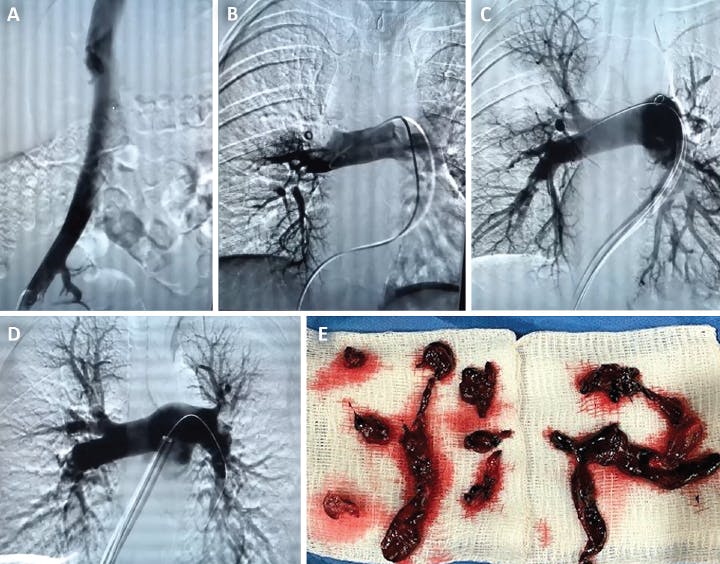
Figure 1. Intraprocedural angiography before thrombectomy showed very sluggish venous flow in the iliac vein and IVC but no thrombus (A). Right pulmonary angiography revealed a large volume of thrombus, with complete occlusion of the truncus anterior and limited flow to the interlobar artery and minimal right lung perfusion (B). The FlowTriever aspiration catheter was advanced to the right PA, and after a single aspiration, marked improvement in right lung perfusion was demonstrated, as well as clearance of the saddle embolus (C). The FlowTriever aspiration catheter was advanced to the left lower lobe, and aspiration was performed, with final main PA injection demonstrating markedly improved perfusion in right and left PAs (D). Extracted thrombus (E).
The access site was dilated, and a 24-F sheath was placed. The 24-F Triever24 aspiration catheter (Inari Medical) was introduced and advanced over a guidewire to the target thrombus in the right PA (Figure 1C). FlowTriever mechanical thrombectomy was initiated, and a large volume of thrombus was removed after the first aspiration. The patient’s skin color immediately improved, the tachycardia lessened, and her oxygen saturation levels increased.
An additional aspiration in the right PA cleared further thrombus in the right lung, and follow-up angiography showed clearance of the saddle embolus and central left PA thrombus. The Triever24 catheter was advanced to the left PA, and additional aspirations were performed to extract residual, smaller-volume thrombus. Completion arteriography in the main PA demonstrated marked improvement in perfusion bilaterally (Figure 1D).
After removal of the majority of thrombus (Figure 1E) and the patient’s dramatic clinical improvement, it was decided to place a retrievable IVC filter in the infrarenal vena cava to address the residual large-volume left leg DVT.
The access site was closed with a cerclage technique, and manual pressure was held for 10 minutes to achieve hemostasis.
From in-suite, preprocedure presentation to postprocedure, the patient’s blood pressure improved from 79/39 to 111/69 mm Hg, her respiratory rate dropped from 40 to 28 breaths/minute, and her pulse dropped from 137 to 101 bpm. Her main PA pressure was 45/22 mm Hg with a mean of 31 mm Hg prior to intervention. Postbilateral thrombectomy, her main PA pressure was 24/9 mm Hg with a mean PA pressure of 16 mm Hg. The total length of time from patient sedation to departure from the IR suite was 55 minutes.
POSTPROCEDURE course
Using the postprocedure IR algorithms, the patient was assigned a non-ICU bed and transferred to the cardiac step-down unit. There, the care team followed the standardized postprocedure orders developed by the IR team. A few hours later, the IR APP went to evaluate the patient at her bedside and found her sitting up, eating lunch, and talking with her husband while he held their newborn baby. She was off oxygen, had no conversational dyspnea, and her vitals had returned to normal. She had no left lower extremity pain or groin pain and informed the IR APP that although she had noticed significant leg swelling in the waning days of her pregnancy, she no longer had pain or other DVT symptoms.
The patient was seen by the IR APP again the next day to ensure that the cerclage suture had been removed appropriately by the trained nursing staff. There were no complications with the puncture site, and the patient continued to tolerate intravenous anticoagulation.
The patient was followed by the hospitalists, and after discussion and assessment, an appropriate oral anticoagulant was chosen. The patient was discharged after one overnight stay and no time in the ICU.
At her 3-month follow-up with the pulmonologist, the patient was doing well and had complete resolution of PE-associated symptoms. She was followed by the IR team for her IVC filter, and an ultrasound verified that there was no residual DVT. The patient underwent uncomplicated, successful IVC filter removal 11 weeks after her intervention. She was taken off anticoagulation by the pulmonologist at 6 months postprocedure.
Advertisement
Advertisement