Advertisement
Advertisement

“No endovascular repair is an island.”
The last 12 months have brought the question of examining and adjudicating evidence to the forefront of the global discourse. Never before has truth, and the search for it, consumed such a large swath of the population’s political and health-related interest. Thus, it is appropriate that we as aortic interventionalists follow suit with a similar period of reflection into our own corner of the universe. It is an opportunity to take stock of the direction we should be pointing our focus and our ever-diminishing surgical resources. We have assembled this edition of Endovascular Today to do just that: explore the new technology in aortic surgery, stimulate discussion about current trends in practice, and, almost as an antidote to the pessimism that has accompanied the medical profession for the last 12 months, asked our younger colleagues to dream big about the future.
In addition to giving us the opportunity truly explore the new and wonderful tools at our disposal as aortic surgeons in the 21st century, this period in time also gives us space to pause. The medical-industrial complex has become very effective at running trials that meet regulatory standards and expeditiously approve devices. However, the experience within the clinical side of the profession in 2019 and 2020—especially in the United Kingdom where the National Institute for Health and Care Excellence guidelines have called into question the very foundation of our rationale for aneurysm repair—is that when creating devices of the future, we need to hold ourselves to higher standards than safety on implantation. We need to start thinking about the longer-term durability of these devices when developing trials and strive to perform procedures that alter the natural history of disease. Certainly, a very interesting place to explore our ability to do this is by studying case studies of the newly emerging endovascular thoracoabdominal device trials.
Currently, there are several different endovascular solutions for thoracoabdominal repair being tested through clinical trials and used in different jurisdictions. Some have been used for years but are finally seeking the necessary regulatory approval, some are variations on familiar themes, and some are truly novel concepts.
Although it is a very small niche in the overall medical landscape, the lowly complex endovascular thoracoabdominal trial has a multitude of masters to whom it must report. All will be implanted by physicians who believe that their intervention will benefit patients, and it is likely safe to say that all will be implanted into patients hoping for a life free from rupture. Most will be implanted in institutions that will frown upon a need for further intervention and in medical systems that will hope for a cost-effective solution that maximizes patient benefit while minimizing cost. Last but not least, all will be manufactured by industry partners convinced they have engineered the answer to this problem and hoping to expand market share. The responsibility for ensuring that all these stakeholders’ needs are met lies not just with the trialists designing the trials but arguably with us, the profession, who can join together with a consensus on where our priorities lie.
Focusing on durability and the creation of a lower-radiation work environment are two obvious targets to evolve our profession to the next stage. Designing trials that target long-term outcomes that are important to healthy patients (follow-up for 15 years) would be a large step toward durability, but that is unfortunately impractical from the standpoint of device approval. The return on investment for trials starting today may be too late. What is needed are larger pragmatic databases that follow patients with existing devices and take advantage of outcomes that will be harvested outside of the trial environment. Real-time registries will both complement regulatory trials and provide patients and caregivers with a reassurance that trends in failure will be captured in a standardized, protocolized way. It will be equally important that regulatory agencies are accepting of the concept of registries to validate these devices.
Considering the radiation dose required for device implantation and surveillance is also an easy target. Lower occupational radiation dose will ensure a long-lived, healthy workforce, and converting our surveillance to use as little nonionizing radiation as possible will also decrease costs, put less pressure on cross-sectional imaging resources that are in high demand, and possibly subvert complications that can come from lifelong radiation exposure. Another less likely target for our prioritization, however, is considering the impact of training and work environment on the life of the implant. Developing complex procedures in the context of the implanting surgeon and the institution that is responsible for care will also help us build a health care system that responsibly deploys devices in a durable way.
Certainly, there are a number of other even more lofty targets on which we could set our sights: greener packaging, supply chain management, remote monitoring, and genetic assessment and linkage. However, the common theme is the beginning of a discussion, and this discussion is the responsibility of us all.
Don’t ask for whom the bell tolls. It tolls for thee.
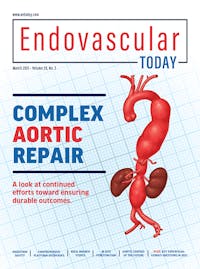
The articles comprising this edition of Endovascular Today explore these themes in modern complex aortic repair, ranging from the ongoing development and clinical study of new options, to the safety of the practitioner, and ultimately, the ideal setting for these procedures to take place. To start, we asked a panel—comprising Matthew J. Eagleton, MD; Sanghyun Ahn, MD; Javairiah Fatima, MD; Stephen W.K. Cheng, MS; Martin J. Austermann MD; Nuno V. Dias, MD; and Björn Sonesson, MD—to consider the ideal branch stent, including stent characteristics, challenges with design, and how to achieve it. Thomas Le Houérou, MD; Dominique Fabre, MD; Justine Mougin, MD; Mark R. Tyrrell, PhD; and Stéphan Haulon, MD, then walked us through techniques, applications, and limitations of laser fenestration, an off-label, emergency technique for complex aortic aneurysms.
In another discussion of stent grafts, authors closely examined current branch and fenestrated concepts, applications, and trial statuses for modern complex stent grafts, including the Zenith fenestrated graft (ZFEN; Cook Medical) by Dr. Oderich, Guilherme Baumgardt Barbosa Lima, MD; Andres Schanzer, MD; Cherrie Abraham, MD; Stéphan Haulon, MD; and Bijan Modarai, PhD; device designs with inner branches by Marcelo Ferreira, MD; Matheus Mannarino, MD; Luis Fernando Capotorto, MD; Diego Ferreira, MD; and Rodrigo Cunha, MD; the Excluder thoracoabdominal branch endoprosthesis (TAMBE; Gore & Associates) by Mark Farber, MD, and F. Ezequiel Parodi, MD; the E-nside system (Jotec GmbH, a fully owned subsidiary of CryoLife Inc.) by Nilo J. Mosquera, MD; the mobile limb thoracoabdominal stent graft system by Patrick Kelly, MD; and the fenestrated Anaconda (Terumo Aortic) by Louise Hill, Jamie McCarte, Patrick Bohan, and Scott Rush.
In a look toward the future, Bernardo C. Mendes, MD; Miranda Witheford, MD; Fiona Rohlffs, MD; and Salma El Batti, MD, reflected on what will define aortic care centers in years to come. Next, Ottavia Borghese, MD, and Blandine Maurel, MD, shared how to protect yourself from radiation, including practical tips related to imaging system settings, protective equipment, and measures to reduce scatter radiation. Then, Adrien Hertault, MD; Gilles Soenens, MD; and Isabelle Van Herzeele, MD, provide some strategies for teaching and maintaining radiation safety practices for endovascular trainees.
Outside of our feature stories on complex aortic repair, Endovascular Today has assembled a two-article series on superficial venous disease, discussing how to navigate patient questions and concerns related to varicose veins as well as predicting the next breakthrough in superficial venous disease care. To close the issue, we spoke with Sonia Ronchey, MD, on her work related to complex aortic pathologies, management of thoracoabdominal aneurysms, her perspective of the value of live versus virtual meetings, and more.
We hope this edition is informative and thought-provoking, and we look forward to continued progress in this field.
Tara M. Mastracci, MD, FRCSC
Gustavo S. Oderich, MD
Guest Chief Medical Editors
Advertisement
Advertisement