Advertisement
Advertisement
April 2022
Advances in Plug Technology
A review of the plug embolization devices, recent studies reporting data on new plug platforms, and evaluation of innovations in plug technology.
By Suraj Prakash, MD, MBA, and Sarah B. White, MD, MS, FSIR, FCIRSE
Current coil embolization platforms come with limitations, including the inability to deploy with exact precision, sizing, potential to prolapse out of intended vessels, variable rates of recanalization, inadvertent detachment in tortuous anatomy, imaging artifacts, and cost. Plug technology can address many of these limitations, both when used alone or in combination with other embolization platforms. Vascular plugs are commonly used today and were originally inspired by the design of cardiac septal occluder devices. They are thrombogenic disc-shaped devices that can be composed of braided nitinol mesh. Some have an additional polytetrafluoroethylene coating, such as the MVP micro vascular plug (Medtronic) and Caterpillar arterial embolization (BD Interventional) devices. Technologic advancements have allowed for the production of vascular plugs in varying configurations and dimensions, each with their own thrombogenic properties and suitability in various anatomic locations; devices with additional braid layers and smaller openings between wire struts can be more thrombogenic.
PLUGS VERSUS COILS
One advantage conferred by vascular plugs is a lower risk of migration after placement, particularly in large and high-flow vessels. In this regard, appropriate size selection is imperative. Although recommendations vary by specific device, the unconstrained device diameter usually exceeds the target vessel lumen diameter by 20% to 50%. As with detachable coils, plugs are detachable and can be retrieved and readjusted when necessary to ensure precise deployment. Unlike coils, deployment of a plug does not require it to “break” and form loops; therefore, a plug can be placed precisely within a vessel, even in a straight vascular segment.
Number of Devices Used
With plugs, adequate vessel occlusion can often be achieved with a single device rather than multiple coils. Figure 1 illustrates the use of a single 16-mm Amplatzer vascular plug (AVP; Abbott) in a patient with an aortic dissection extending to the level of the left subclavian artery (LSA). The patient underwent thoracic endovascular aortic repair (TEVAR), where the LSA was covered. A subsequent carotid-subclavian bypass was performed, but retrograde flow into the false lumen via the LSA remained. The artery was embolized with a single 16-mm AVP, and follow-up imaging demonstrated no further filling of the false lumen with the plug in situ.
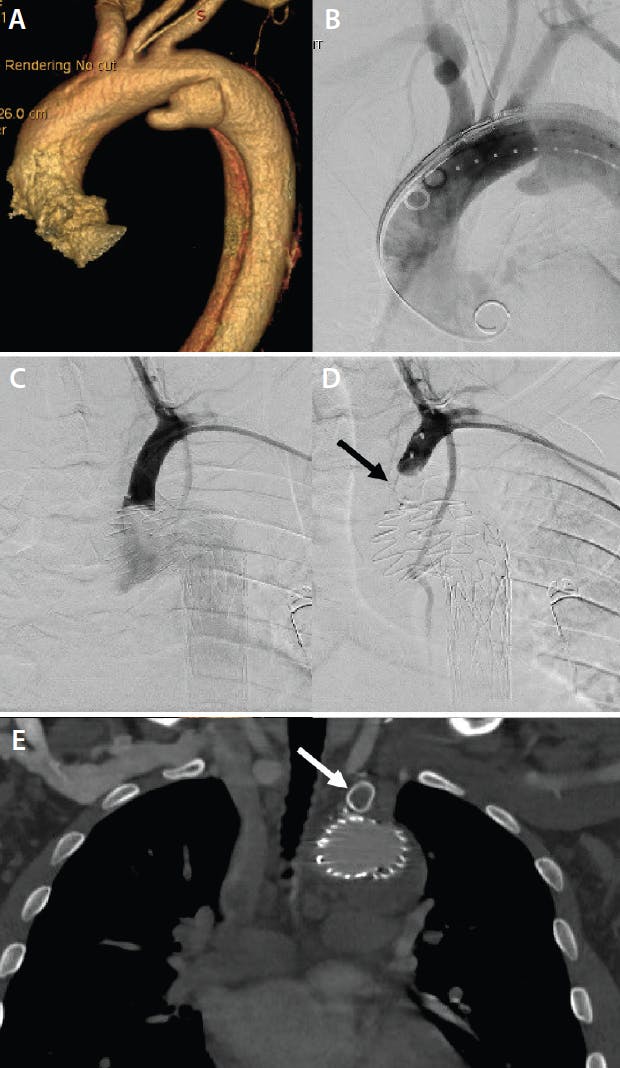
Figure 1. LSA embolization. Three-dimensional reconstruction (A) and angiography (B) showed an aortic dissection extending to the LSA. Retrograde flow into the false lumen via the LSA remained (C) and was embolized with a single 16-mm AVP (black arrow) (D). Follow-up CT demonstrated no further filling of the false lumen, with the plug in situ (white arrow) and the absence of imaging artifact resulting from the plug (E).
Use of a single AVP has also been demonstrated to be effective in embolizing arteries prior to endovascular aneurysm repair (EVAR) to prevent formation of type II endoleaks, and results demonstrate 100% technical success rates with no demonstrable endoleaks on follow-up imaging.1 A recent study evaluating the occlusion rates for MVP demonstrated 75% technical success, as defined by vessel occlusion with only the MVP, without adjunct embolization materials.2 Additionally, technical success significantly improved in straight vascular segments with precise deployment (P < .001), and there was no difference in technical success whether patients were or were not receiving concurrent anticoagulation (P = .6). This indicates that plugs do not rely solely on a patient’s intrinsic clotting factors to achieve vessel occlusion.
In another study, 120 pulmonary arteriovenous malformations (PAVMs) were treated in 69 patients. Seventy-five percent of the PAVMs required a single AVP 1 for vessel occlusion, and follow-up revealed no recanalization in the cohort treated with the plug alone.3 Figure 2 shows the use of a single 14-mm AVP for PAVM occlusion in a patient with a family history of hereditary hemorrhagic telangiectasia.
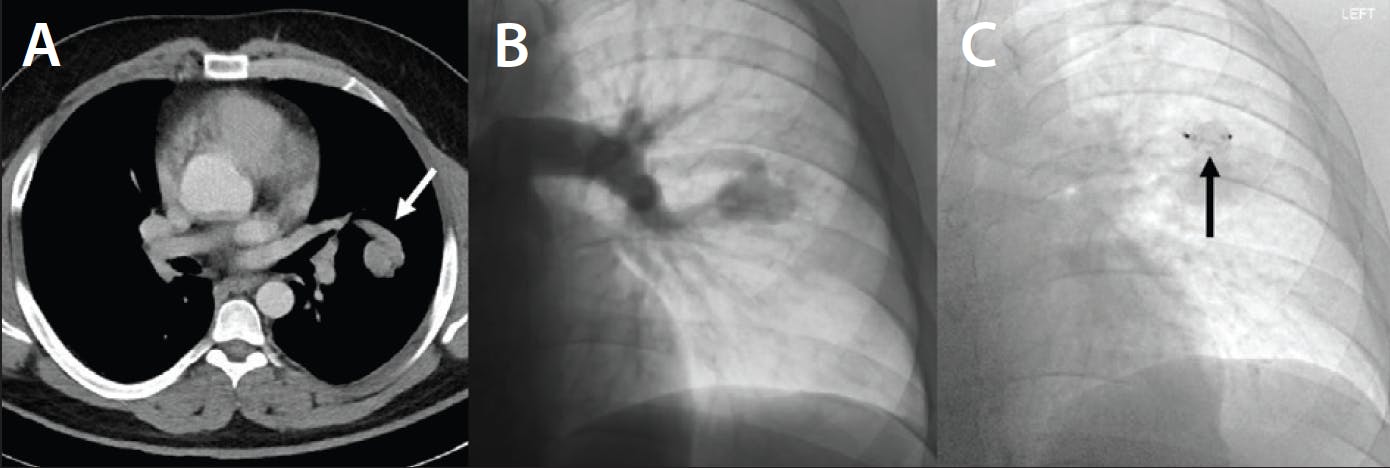
Figure 2. PAVM embolization. CT demonstrated a large PAVM (white arrow) (A). Angiography demonstrated a single feeding vessel (B) that was successfully embolized using a single 14-mm AVP (black arrow) (C).
Radiation Dose, Procedure Time, and Cost
Although the per-unit cost of a vascular plug exceeds that of a single coil, the ability to achieve vessel occlusion with a single plug has the potential to reduce overall cost, radiation dose, procedural time, and, in some instances, streak artifact due to large coil packs (Figure 1E). Reductions in procedural and fluoroscopy time have been validated in some published studies. For example, Sarwar et al performed a retrospective analysis of patients who underwent variceal embolization after transjugular intrahepatic portosystemic shunt (TIPS) creation with either vascular plugs or pushable coils.4 Vascular plugs were associated with a lower fluoroscopy time of 49.05 versus 68 minutes in the coil cohort (P = .006). Total procedural times were also considerably shorter, with a procedure duration of 255 versus 275 minutes for the plug and coil cohorts, respectively (P = .05). However, the cost of vascular plugs in this studied group exceeded that of coils ($1,292 vs $228; P = .0001). Neither differences in administered contrast volume, rebleeding rates, nor mortality were identified. Similar analyses have been performed in other device applications, reaffirming the benefits of reduced procedural and fluoroscopy time. A group of investigators evaluated their experience using AVPs versus coils for splenic artery embolization. They found no difference in procedural times (P = .16) but did find a statistically significant reduction in radiation dose in the AVP group compared to the coil group (842 vs 1,309 mGy; P = .04).5 Another group performed a randomized trial evaluating plugs versus coils for gonadal vein embolization in patients with pelvic venous disease. They found no difference in clinical outcomes between the two groups; however, the plug group had shorter fluoroscopy times (4.68 vs 19.5 min; P < .001) and smaller radiation doses (320.7 vs 948 mGy; P < .001).6
Other studies have validated the potential cost-saving benefits of vascular plugs compared to coils. For example, Wong and colleagues performed a meta-analysis of vascular plugs versus coils in the setting of internal iliac artery embolization prior to EVAR.7 This study demonstrated an estimated total cost savings of $575.45 per patient in the plug cohort. However, it is difficult to make any generalizable conclusions from cost-savings analyses because there can be significant variation in device prices across countries and regions. Benefits conferred in reduced procedural time can also be difficult to valuate monetarily.
POTENTIAL DISADVANTAGES OF VASCULAR PLUGS
The early generation of vascular plugs conferred certain disadvantages, such as the requisite use of larger guiding catheters and delivery sheaths. However, newer devices such as the MVP and Caterpillar plugs are compatible with microcatheter lumens as small as 0.021 inches, although visualization can sometimes be challenging due to their small size. Figure 3 demonstrates a grade IV splenic laceration embolized with a single 1.5–4-mm Caterpillar plug, which resulted in prompt and permanent occlusion of the vessel. Figure 3C demonstrates the challenges of visualizing these small plug platforms.
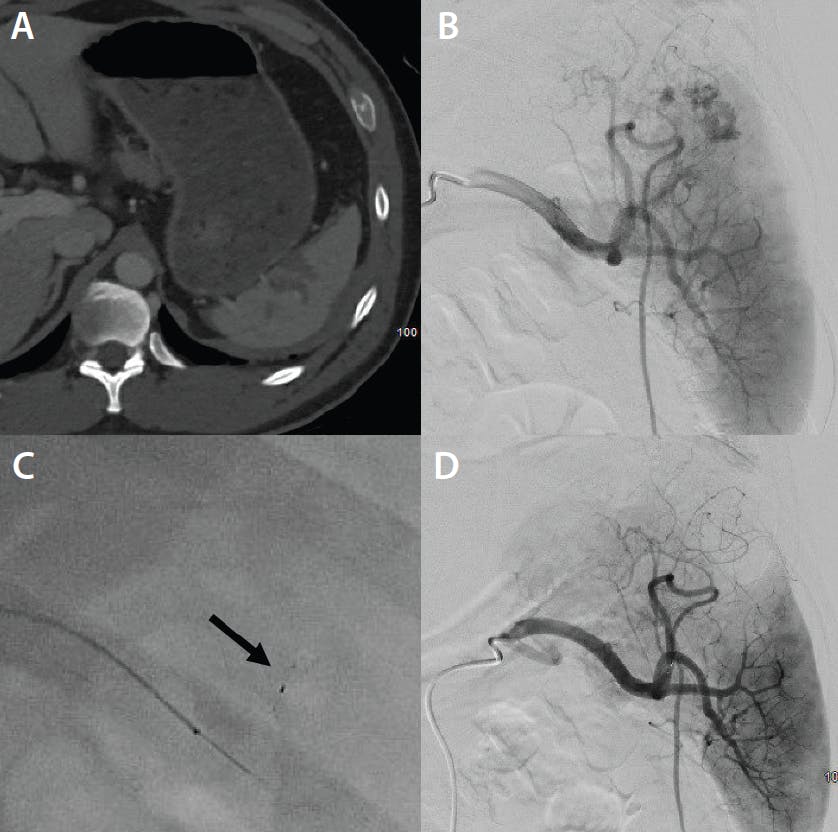
Figure 3. Splenic artery embolization. CT showed a grade IV splenic laceration (A). Angiography demonstrated extravasation in the upper pole of the spleen (B). The feeding vessel was embolized using a single 1.5–4-mm Caterpillar plug (black arrow) (C). Postdeployment angiography demonstrated no flow beyond the plug and no further evidence of extravasation (D).
Additional disadvantages of vascular plugs include variable occlusion times that depend on vessel caliber, blood flow dynamics, plug type, and coagulation status.8,9 However, one group overcame this limitation by using gelatin foam as an adjunct to plug placement to improve vessel occlusion.10 When AVP was used in combination with gelatin foam and compared to historical controls of AVP placement with adjunct placement of additional AVPs or coils, the mean time to occlusion was faster (2.3 vs 25.9 min; P = .029), mean procedural times were reduced (12.8 vs 48.7 min; P < .001), radiation doses were reduced (297.1 vs 744 mGy; P = .04), and mean cost was less ($450 vs $1,524.75; P < .001).
CLINICAL APPLICATION
There are various clinical applications for which vascular plug deployment is suitable. These include embolization of the proximal splenic artery in both traumatic and nontraumatic settings; internal iliac artery and/or visceral arteries prior to EVAR; subclavian artery prior to or after TEVAR; arteriovenous fistulas; PAVMs; the gonadal vein in the setting of pelvic venous insufficiency, portal vein, varices, and portosystemic shunts (often in conjunction with sclerosants such as in plug-assisted retrograde transvenous obliteration); and TIPS closure.3,6,7,11-13 Additional nonvascular applications have been described, such as permanent ureteral occlusion, thoracic duct embolization, occlusion of nonvascular fistulas, and tract embolization.14,15
Figure 4 illustrates the use of a Caterpillar plug in a patient who experienced shortness of breath and inadvertent transgression of the pleura by the right biliary drain that was placed for cholangiocarcinoma. A pullback sheath cholangiogram demonstrated contrast spilling into the pleural cavity (Figure 4B). After placement of a right chest tube and an internal bare-metal stent across the biliary stricture, a single 5–7-mm Caterpillar plug was placed across the transhepatic tract to ensure there was no further biliary leakage into the pleural space (Figure 4C).
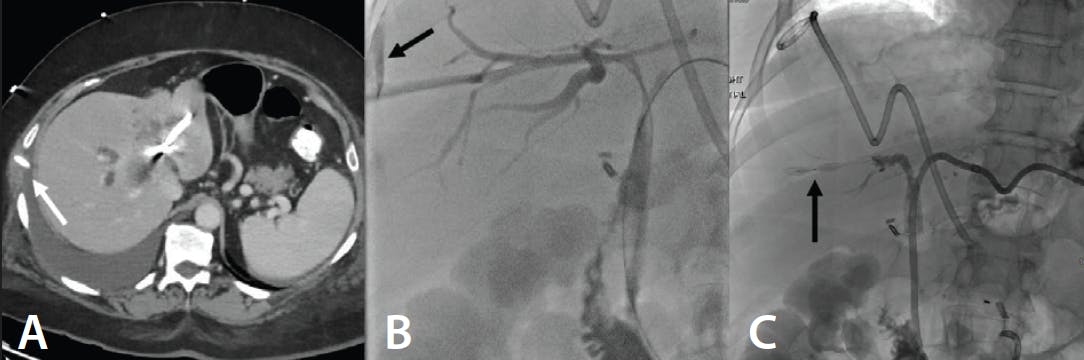
Figure 4. Transhepatic parenchymal tract embolization. CT demonstrated inadvertent transgression of the pleura by the right biliary drain (white arrow) (A). A pullback sheath cholangiogram demonstrated contrast spilling into the pleural space (black arrow) (B). A single 5–7-mm Caterpillar plug was placed across the transhepatic tract to ensure no further biliary leakage into the pleural space (black arrow) (C).
NEW STUDIES
In the next few months, we can expect results demonstrating technical success of the Caterpillar embolization plug. This device has nitinol cross-linking fibers in addition to an occlusion membrane. The CHRYSALIS study in New Zealand is the first-in-human, prospective, multicenter, feasibility study designed to evaluate the device’s performance with peripheral arterial embolization.16 The MONARCH United States study is a real-world study assessing the clinical use of Caterpillar.17 The primary endpoint of both trials is technical success, defined as periprocedural occlusion of the targeted vessel. These studies have completed enrollment, and results are forthcoming.
Another new plug device is the Impede embolization plug family (Shape Memory Medical Inc.), which uses a porous shape memory polymer scaffold that expands on contact with blood. The Impede embolization plug has a short anchor coil that stabilizes the device, followed by a scaffold that conforms to and fills the vessel. Due to the porous design, the surface area is greater than a coil, which leads to prompt occlusion.18 Histopathologic analysis has demonstrated that over time, the scaffold resorbs and leaves behind collagen and a healing response.19 Additionally, this plug has been used to fill aneurysm sacs in animal models, with results demonstrating a remarkable 89% to 93% reduction in aneurysm size after embolization compared to an 18% to 34% reduction with coils.20 The AAA-SHAPE safety study is currently underway to evaluate the Impede-FX RapidFill device (Shape Memory Medical Inc.) when used for abdominal aortic aneurysm sac management during elective EVAR. The Impede and Impede-FX embolization plugs were FDA approved for use in the United States in 2019, and a recent case series demonstrated its unique attributes, including its porosity, healing mechanism, and lack of artifact given its minimal metallic components.21
CONCLUSIONS
Plug embolization devices have many clinical applications, both within and outside of the vasculature, and they address many of the limitations of traditional coil platforms. New technologies are aimed at enhancing the delivery and efficacy of clinical plug platforms, and new devices may allow for innovative approaches to occlusion.
1. Burbelko M, Kalinowski M, Heverhagen JT, et al. Prevention of type II endoleak using the AMPLATZER vascular plug before endovascular aneurysm repair. Eur J Vasc Endovasc Surg. 2014;47:28-36. doi: 10.1016/j.ejvs.2013.10.003
2. Giurazza F, Ierardi AM, Contegiacomo A, et al. Embolization with MVP (Micro Vascular Plug®): experience on 104 patients in emergent and elective scenarios. CVIR Endovasc. 2021;4:59. doi: 10.1186/s42155-021-00246-2
3. Hart JL, Aldin Z, Braude P, et al. Embolization of pulmonary arteriovenous malformations using the Amplatzer vascular plug: successful treatment of 69 consecutive patients. Eur Radiol. 2010;20:2663-2670. doi: 10.1007/s00330-010-1851-2
4. Sarwar A, Esparaz AM, Tapper EB, et al. Comparison of vascular plugs and pushable coils for variceal embolization after TIPS. AJR Am J Roentgenol. 2017;208:650-655. doi: 10.2214/AJR.16.16012
5. Zhu X, Tam MD, Pierce G, et al. Utility of the Amplatzer vascular plug in splenic artery embolization: a comparison study with conventional coil technique. Cardiovasc Intervent Radiol. 2011;34:522-531. doi: 10.1007/s00270-010-9957-0
6. Guirola JA, Sánchez-Ballestin M, Sierre S, et al. A randomized trial of endovascular embolization treatment in pelvic congestion syndrome: fibered platinum coils versus vascular plugs with 1-year clinical outcomes. J Vasc Interv Radiol. 2018;29:45-53. doi: 10.1016/j.jvir.2017.09.011
7. Wong K, Johnson P, Chen Z, et al. A meta-analysis of comparative outcome and cost-effectiveness of internal iliac artery embolization with vascular plug versus coil. Cardiovasc Intervent Radiol. 2020;43:706-713. doi: 10.1007/s00270-020-02425-5
8. Wang W, Li H, Tam MD, et al. The Amplatzer vascular plug: a review of the device and its clinical applications. Cardiovasc Intervent Radiol. 2012;35:725-740. doi: 10.1007/s00270-012-0387-z
9. Maurer MH, Mogl MT, Podrabsky P, et a. Splenic artery syndrome after orthotopic liver transplantation: treatment with the Amplatzer vascular plug. Cardiovasc Intervent Radiol. 2011;34:1208-1213. doi: 10.1007/s00270-010-0083-9
10. Wang W, Tam MD, Spain J, Quintini C. Gelfoam-assisted Amplatzer vascular plug technique for rapid occlusion in proximal splenic artery embolization. AJR Am J Roentgenol. 2013;200:677-681. doi: 10.2214/AJR.12.8949
11. Nagatomi S, Ichihashi S, Kanamori D, Yamamoto H. Successful sac embolization to eliminate a type 2 endoleak after thoracic endovascular aortic repair by penetration of a vascular plug implanted in a left subclavian artery. J Endovasc Ther. Published online December 30, 2021. doi: 10.1177/15266028211067730
12. Matsumoto K, Ohuchi Y, Yata S, et al. Compressed Amplatzer vascular plug ii embolization of the left subclavian artery for thoracic endovascular aortic repair is efficient and safety method comparable to conventional coil embolization. Yonago Acta Med. 2019;62:24-29. doi: 10.33160/yam.2019.03.004
13. Grandi A, Melloni A, Chiesa R, Bertoglio L. Endovascular embolization of a lower limb arteriovenous fistula using a vascular plug deployed with a through-and-through arteriovenous access. Catheter Cardiovasc Interv. 2021;97:E847-E851. doi: 10.1002/ccd.29308
14. Augustin AM, Koneval L, Kalogirou C, et al. Percutaneous transrenal ureteral plug embolization: is there a need for tissue adhesives? Diagn Interv Radiol. 2021;27:762-767. doi: 10.5152/dir.2021.20640
15. Sweigert J, Lee EW. Caterpillar mechanical embolization device: a new vascular plug. J Vasc Interv Radiol. 2021;32:927-929. doi: 10.1016/j.jvir.2021.02.008
16. CATERPILLAR™ arterial embolization device study (CHRYSALIS). Clinicaltrials.gov website. Accessed April 4, 2022. https://clinicaltrials.gov/ct2/show/NCT04090320
17. Caterpillar™ arterial embolization device post-market study (MONARCH). Clinicaltrials.gov website. Accessed April 4, 2022. https://clinicaltrials.gov/ct2/show/NCT04244370
18. Rodriguez JN, Miller MW, Boyle A, et al. Reticulation of low density shape memory polymer foam with an in vivo demonstration of vascular occlusion. J Mech Behav Biomed Mater. 2014;40:102-114. doi: 10.1016/j.jmbbm.2014.07.037
19. Jessen SL, Friedemann MC, Ginn-Hedman AM, et al. Microscopic assessment of healing and effectiveness of a foam-based peripheral occlusion device. ACS Biomater Sci Eng. 2020;6:2588-2599. doi: 10.1021/acsbiomaterials.9b00895
20. Horn J, Hwang W, Jessen SL, et al. Comparison of shape memory polymer foam versus bare metal coil treatments in an in vivo porcine sidewall aneurysm model. J Biomed Mater Res B Appl Biomater. 2017;105:1892-1905. doi: 10.1002/jbm.b.33725
21. Morgan RA, Loftus I, Ratnam L, et al. Clinical experience with a shape memory polymer peripheral vascular embolisation plug: a case series. CVIR Endovasc. 2021;4:29. doi: 10.1186/s42155-021-00214-w
Advertisement
Advertisement