Advertisement
Advertisement
April 2022
Liquid Embolics: Emerging Options and Applications
A review of current liquid embolic agents and future prospects.
By Shyamal Patel, MBBS, BSc, FRCR, and Lakshmi A. Ratnam, MBChB, MRCP, FRCR, EBIR
Over the last century, embolization has grown as a minimally invasive technique to achieve vascular occlusion. Several classes of embolization agent are available, including mechanical (coils or plugs), particles/gelatin, and liquid/gel-based embolics. The choice of agent is dependent on the clinical context, vessel size, durability (temporary vs permanent), and operator preference.1-3
One of the properties specific to liquid embolic agents is their ability to fill the target vessel and induce vascular occlusion by advancing with blood flow and penetrating deeper into the vascular bed to areas where a catheter or coil may not reach. The precise mechanism by which the occlusion occurs varies depending on the type of liquid embolic utilized. They also function independently from the patient’s own coagulation process to induce vascular occlusion.2-4 Commonly used liquid embolic agents include ethanol, N-butyl cyanoacrylate (NBCA) glues, Lipiodol (an ethiodized oil) (Guerbet), and Onyx (Medtronic).2,3
CURRENT AGENTS
Ethanol
One of the most commonly used sclerosants for embolization is absolute ethanol (98%), which can be injected percutaneously or through a catheter into a target vessel. Ethanol induces ablation by causing endothelial injury, vessel wall necrosis, and thrombosis. Irreversible sclerosis of the vessel can result in permanent occlusion. As well as affecting large vessels, ethanol can also penetrate deep into the capillary bed, devascularizing tissues completely.1,3,5
As with many liquid embolics, ethanol has been proven to successfully devascularize arteriovenous malformations (AVMs). It is able to flow through the larger feeding vessels and into the tortuous nidus, which other mechanical agents would be unable to reach.1,5 Similarly, low-flow venous and lymphatic malformations can also be embolized successfully.5
Ethanol can also be used in combination with other liquid agents to perform end-organ embolization of benign and malignant tumors of the liver and kidneys (Figure 1). Selective portal vein embolization is also performed with ethanol prior to hepatic resection to promote blood flow through the remnant liver and induce hypertrophy.5,6
Nontarget embolization is an important consideration when using ethanol, particularly given its ability to devascularize tissues at the capillary level. Often, occlusion balloon catheters are employed to prevent reflux of ethanol into nontarget parenchyma and organs; allowing it to remain in contact with the target vessel and tissues for a longer period promotes its ablative effects (Figure 1B).1,5
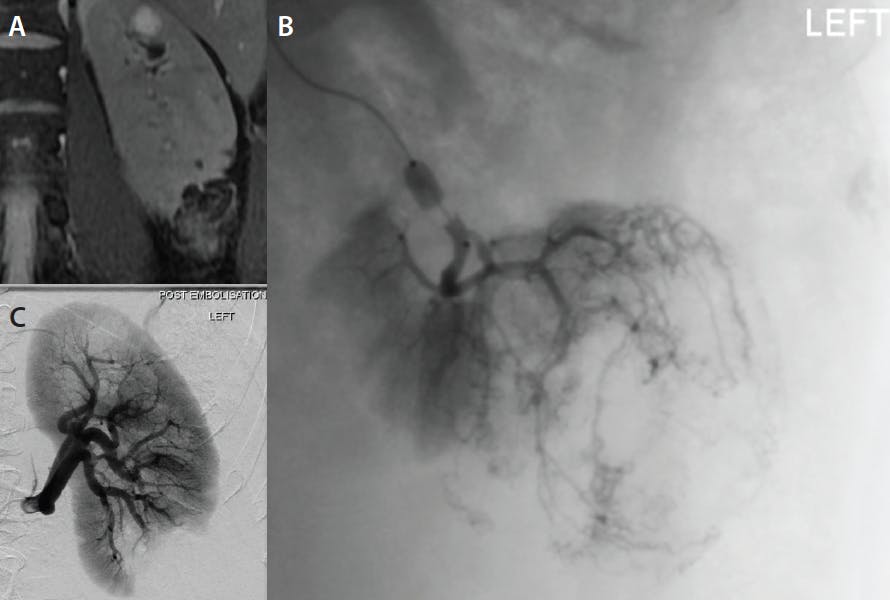
Figure 1. A man in his mid-30s with a 4-cm AML in the left lower pole. The preprocedure MRI (fat-saturated coronal FIESTA) demonstrated the exophytic fat-rich AML (A). Absolute ethanol was injected into the arterial supply of the AML with a temporary occlusion balloon inflated proximally to prevent reflux (B). The postprocedure angiogram demonstrated good embolization of the AML (C).
The use of ethanol can be painful and often requires a general anesthetic. When compared to other liquid agents, ethanol use has the risk of severe systemic complications, which are mainly dose dependent and include seizures, arrythmias, and cardiopulmonary collapse.7,8 Studies suggest the use of ethanol < 0.14 mL/kg of body weight over a 10-minute period to avoid this complication.1,5,9 Due to its toxicity, ethanol should be used with caution and requires sufficient operator experience.8
Lipiodol
Lipiodol is a mixture of iodinated poppy seed ethyl esters, traditionally used as a contrast agent in lymphangiograms (Figure 2A) and to image hepatocellular carcinomas (HCCs). Owing to its elevated viscosity comparative to blood, Lipiodol is difficult to clear from the vasculature and can remain temporarily in the small vessels and at the capillary level.1-3,5 It is often used in combination with chemotherapeutic agents during transarterial chemoembolization (TACE) of HCCs. The disorganized vessels within the tumor are particularly slow to clear the Lipiodol, resulting in a prolonged therapeutic effect. Additionally, because Lipiodol is radiopaque, the distribution of injected drug can be easily assessed radiologically.1-3,5 The main consideration for Lipiodol use in TACE is to ensure there is no arteriovenous fistula, which could allow the mixture to pass into the venous circulation and cause nontargeted tissue injury.1 Lipiodol contains iodine at a high concentration (480 mg/mL), and care should be exercised in those with underlying thyroid disease. Lipiodol can suppress the uptake of radiolabeled iodine but also transiently inhibit the production of thyroid hormones.8
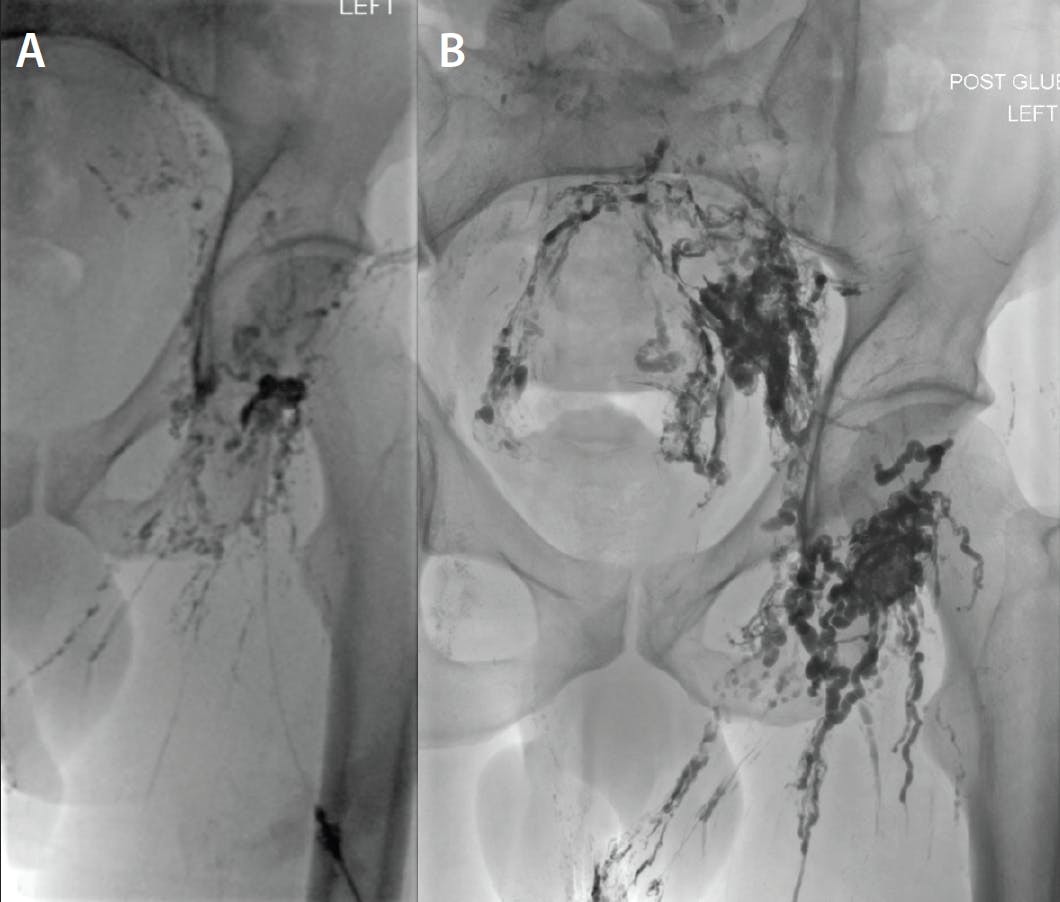
Figure 2. A patient in their mid-30s with a pelvic lymphatic malformation and chylous reflux resulting in lymphedema. The preprocedure lymphagiogram via a left inguinal lymph node demonstrated reflux into the left scrotal and left lower limb lymphatic system (A). Glue and Lipiodol embolization performed via the left inguinal node demonstrated successful reflux of the embolic into these regions (B).
Lipiodol can also be combined with glue or sodium tetradecyl sulfate in the sclerotherapy of low-flow venous and lymphatic malformations.10
NBCA Glue
Cyanoacrylate glues are used as embolics as well as a tissue adhesive.1,3 It takes the form of a clear, radiolucent liquid that can be injected via a catheter into the desired vascular tree. Given its colorless form, syringes filled with NBCA should be clearly labeled and ideally kept separately from saline or contrast syringes to avoid inadvertent injection. The ability of NBCA to travel distally with the flow of blood is advantageous particularly in complex AVMs, where it can penetrate deep into the nidus and draining veins.1-4 NBCA will polymerize and solidify, forming a cast when it contacts ionic fluid (eg, blood, saline). This results in thrombosis, localized endothelial inflammation that leads to an exothermic reaction that forms byproducts such as formaldehyde, and ultimately, local fibrosis, creating permanent vascular occlusion.1-4
Given the affordability and rapid onset of action, NBCA has many applications, including embolization of AVMs, endoleaks after endovascular aneurysm repair (EVAR), acute hemorrhage, selective portal vein embolization, low-flow venous malformations, chyle leak, lymphatic malformations (Figure 2B), and end-organ embolization such as for renal angiomyolipomas (AMLs).4,6,7,10-12
The viscosity of NBCA can be altered for each clinical application with the addition of Lipiodol, giving the added benefit of making the mixture radiopaque. However, NBCA can be difficult to handle and administer, with the possibility of nontarget embolization. Care must be taken to flush the catheter with nonionic dextrose prior to injection to prevent blockage and polymerization within the catheter. If a repeat injection is required, the catheter must be replaced with a new one. The catheter must also be withdrawn when injecting, and reflux of NBCA around the catheter tip should be avoided because this will trap the tip of the catheter within the glue as it solidifies.1-4,7 Hydrophilic-coated microcatheters are less likely to entrap, and catheters with detachable tips have also been developed, which can safely remain in situ.4,7
Ethylene Vinyl Alcohol
Ethylene vinyl alcohol (EVOH) (Onyx) is a copolymer with a dimethyl sulfoxide (DMSO) solvent and a suspension of (radiopaque) micronized tantalum powder. When injected through a catheter and mixed with blood, the solvent is diluted, precipitating the copolymer into a spongy cast with a gel-like consistency. This results in vascular occlusion at a slower rate than glue.1-4 The mixture is manufactured in varying viscosities (Onyx 18/20/34), which can be chosen for the required purpose. For example, Onyx-18 will penetrate deeper into the vascular bed into the nidus of an AVM, while Onyx-34 will precipitate quicker and can be used in aneurysms with a wider neck.1-4,7
Onyx must be agitated to ensure the mixture is uniform and then can be injected via a catheter into the required vascular tree. Specific syringes and catheters are used because the DMSO solvent can degrade equipment. There is much less of an inflammatory response with Onyx when compared with glue, but the polymerization is still uncomfortable, requiring adequate patient sedation. Vascular toxicity and vasospasm can occur in response to the compound, and a slow rate of injection of approximately 1.6 to 4 mL/min peripherally and 0.6 mL/min in the cerebral circulation is recommended.1-4,7
As Onyx is nonadhesive, the risk of blockage and entrapment of the catheter is of much less of a concern compared to the use of glue. Onyx can be injected intermittently using the same catheter to assess the progress fluoroscopically. A small volume of polymer gel forms around the catheter tip, which creates a skin at the interface of the mixture and blood. As more embolic is injected, this expands, forming continuous rupture and reskinning of the embolus, resulting in a lava-like flow of embolic, affording a greater level of control than with glue.1-4,7
Onyx has been utilized for embolization of AVMs. Other applications include embolization of visceral aneurysms/pseudoaneurysms, endoleaks (Figure 3), portal vein embolization, as well as end-organ embolization such as renal AMLs.1,7,10-12
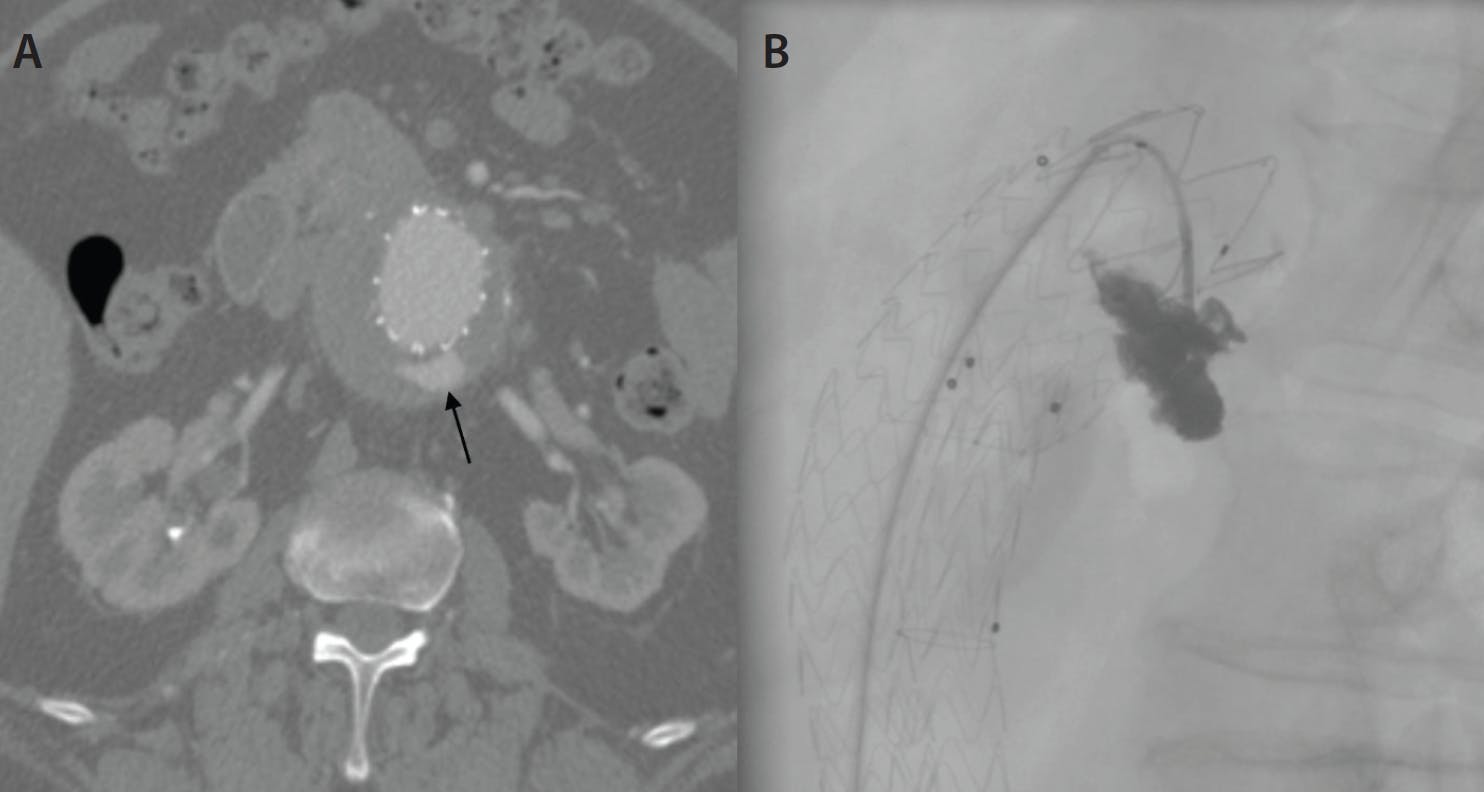
Figure 3. Type Ia endoleak post-EVAR in a patient in their late 70s. Axial image from the post-EVAR CTA demonstrated a type Ia endoleak with contrast filling the superior aspect of the aneurysm sac, external to the stent graft (arrow) (A). Onyx was injected via a catheter at the site of the endoleak, resulting in successful embolization (B).
Onyx has a characteristic black color, and when used on AVMs close to the skin, patients should be counseled regarding discoloration of skin/tissues as well as a characteristic sulfuric smell of DMSO exuded within the first few days of use.1,3,4
Case reports have described combustion of Onyx when it contacts monopolar diathermy during surgical treatment of AVMs previously embolized with the embolic agent. Given the wide applications of Onyx, this could be a potential surgical risk in any region where prior embolization with the agent has occurred. Surgical colleagues should be made aware of this hazard to avoid harm to the patient and operating team.13,14
NEWER AGENTS AND ADVANCEMENTS
Novel agents are under development to overcome the limitations from more established options such as blockage and entrapment of catheters, need for catheter exchanges, and also allowing controlled delivery of embolic, reducing the risk of nontarget embolization. These can be either precipitating, polymerizing, or phase-transitioning agents. Many of these agents are currently in the research and development phase, with in vitro and in vivo studies ongoing to establish efficacy and safety.3,4,7
Precipitating Agents
Precipitating agents are combined with a solvent. Once diluted in blood, the polymer will precipitate, and the mechanism of action is the same as Onyx.3,4
Squid (Balt). Squid is another EVOH/DMSO system with micronized tantalum powder. The tantalum size is smaller and possesses a longer suspension time compared to Onyx, allowing longer working time prior to polymerization. Squid is available in varying viscosities (Squid 14/18), chosen for the application required.2-4,12 The delivery, mechanism, and limitations are identical to Onyx.4,12 Reported applications are also very similar, including embolization of AVMs, visceral aneurysms/pseudoaneurysms, bronchial artery embolization, type II endoleak, and portal vein embolization.12
Precipitating hydrophobic injectable liquid (PHIL) (MicroVention Terumo). PHIL is another liquid embolic polymer that uses DMSO as a solvent. The radiopacity of PHIL is from iodine, which is bound to the polymer rather than tantalum used for Onyx and Squid. This produces less streak artifact on subsequent CT scans.2-4,12 It is prefilled in syringes and has a toothpaste-like consistency of varying viscosities (PHIL 25/30/35). Its embolization applications, characteristics, and capabilities are similar to Onyx, and it is clinically available for the embolization of cerebral AVMs in Europe. As it contains DMSO, it requires special syringes and catheters; however, given the lack of tantalum, does not discolor the skin.2-4,12
Polymerizing Agents
Polymerizing agents are monomers/macromonomers that form a gel when mixed with an initiator. These can be premixed and then injected via a catheter to harden and polymerize within the desired vessels. If using this approach, it must be performed promptly to prevent hardening and blockage of the catheter. An alternative is to inject both separately via a dual-lumen catheter, so mixing occurs within the desired vessel. This approach requires rapid polymerization to avoid nontarget embolization.3,4
Embrace hydrogel embolic system (Instylla). The Embrace hydrogel embolic system is made of polyethylene glycol, which is injected simultaneously via a dual-lumen catheter with its initiator, resulting in rapid solidification via intravascular polymerization. Iodine-based contrast is added to the mixture, making it radiopaque.3,4 The Embrace system demonstrated encouraging results in animal models, with good vascular penetration into the distal circulation due to its low viscosity.4
Phase-Transitioning Agents
Phase-transitioning agents will undergo solute to solid transition depending on factors such as ion concentration, pH, or temperature.3,4
Ionic strength triggered chelation. These agents solidify based on the local ionic concentration, such as calcium alginate. Alginate is a natural polysaccharide derived from brown algae. A dual-lumen catheter is used to inject sodium alginate (combined with iohexol) as well as calcium chloride simultaneously. These mix as they leave the catheter in the desired vessel to form an occlusive gel.3,4,7 When tested in animal models, calcium alginate gel was found to be stable and nontoxic without a significant inflammatory response, producing effective vascular occlusion. There has been the development of an alginate lyase enzyme (found naturally in several marine algae and bacteria), which can be used specifically to dissolve the gel in the case of nontarget embolization—a novel safety feature.3,4,7
Thermoresponsive gels. Temperature-controlled embolic gels take advantage of the transition from a liquid to a solid with increasing temperature (ie, from room to body temperature). Several types are currently being developed, including PNIPAM (poly-N-isopropyl acrylamide) nanogels, poloxamer 407 alginate–based hydrogel, chitosan-based thermosensitive materials, and silk-elastinlike protein polymer. These mixtures do not produce an inflammatory response and demonstrate satisfactory embolization. They are currently being evaluated in in vitro/vivo studies in animals but have been proposed for various applications including aneurysms, AVMs, and end-organ embolization.3,4,7 Because the distal portion of the introducing catheter is within the patient, care must be taken with thermal-responsive embolics to ensure the mixture does not solidify in the lumen of the catheter.3,4
pH-sensitive embolic agents. A variety of sulfamethazine-based, pH-sensitive hydrogels are currently being studied in animals for the applications of vascular embolization as well as chemoembolization. These undergo phase transition from a liquid state prior to injection (pH, 8.5) to a gel with lowering pH (either physiologic [7.4] or relatively acidic pH as with a tumor [6.5-7.2]). This permits mixing with doxorubicin for TACE of hepatic tumors.3,4,7 Because the transition in pH occurs within the vascular tree, they are less likely to block the introducing catheter as compared with thermal-responsive hydrogels.4,7
Shear-thinning hydrogels. Shear-thinning biomaterials are made of gelatin and silicate nanoplatelets. The mixture is a gel prior to injection and transitions to a liquid state when exposed to a pressure of 20 to 25 N (during an injection through a catheter). Once it exits the catheter, the exerted pressure reduces, and it reforms a gel, which occludes the vessel inducing thrombosis. A study in porcine models showed stable and complete occlusion in high-flow targets, without significant nontarget embolization.3,7
SUMMARY
Liquid embolic agents have advantages over other classes, and in specific clinical applications, are the most appropriate option for embolization. The traditional liquid embolics have their own limitations. They can be difficult to handle and require experienced operators to avoid catheter blockage or trapping. These agents also induce vascular injury with varying levels of inflammation.
Several novel agents at various stages of development are aiming to overcome these limitations. Hydrogel-based agents form a gel-like intravascular cast with little vascular irritation or toxicity, which would be better tolerated by patients. Newer phase-transitioning agents can better control the transition from liquid to solid state to allow an easier administration while still achieving an effective embolization. These agents could have applications for peripheral and neurovascular embolization as well as specialized embolization, including TACE. Although these novel agents have exciting properties, there is further work to be done before they can be translated to routine clinical practice.3,4,7
1. Kaufman JA. Vascular interventions. In: Kaufman JA, Lee MJ, editors. Vascular and Interventional Radiology: The Requisites. Elsevier Saunders; 2013:86-95.
2. Wang CY, Hu J, Sheth RA, Oklu R. Emerging embolic agents in endovascular embolization: an overview. Prog Biomed Eng (Bristol). 2020;2:012003. doi: 10.1088/2516-1091/ab6c7d
3. Jiang Y, Zhang Y, Lu Z, et al. Liquid embolic agents for interventional embolization. ChemPhysMater. 2022;1:39-50. doi: 10.1016/j.chphma.2021.09.008
4. Lord J, Britton H, Spain SG, Lewis AL. Advancements in the development on new liquid embolic agents for use in therapeutic embolisation. J Mater Chem B. 2020;8:8207-8218. doi: 10.1039/d0tb01576h
5. Yakes WF. Does material matter? Absolute ethanol. Endovasc Today. 2013;12:71, 75-77. https://evtoday.com/articles/2013-apr/does-material-matter
6. Chansangrat J, Keeratibharat N. Portal vein embolization: rationale, techniques, outcomes and novel strategies. Hepat Oncol. 2021;8:HEP42. doi: 10.2217/hep-2021-0006
7. Hu J, Albadawi H, Chong BW, et al. Advances in biomaterials and technologies for vascular embolization. Adv Mater. 2019;31:e1901071. doi: 10.1002/adma.201901071
8. Roselli A, Khouri C, Roustit M, et al. Safety profile of sclerosing agents: an analysis from the World Health Organization pharmacovigilance database VigiBase. Dermatol Surg. 2019;45:1517-1528. doi: 10.1097/DSS.0000000000001876
9. Shin BS, Do YS, Lee BB, et al. Multistage ethanol sclerotherapy of soft tissue arteriovenous malformations: effect of pulmonary artery pressure. Radiology. 2005;235:1072-1077. doi: 10.1148/radiol.2353040903
10. Tahir M, Mumtaz MA, Sultan A, et al. Role of interventional radiology in the management of peripheral vascular malformations: a tertiary care center experience. Cureus. 2018;10:e2335. doi: 10.7759/cureus.2335
11. Bardin F, Chevallier O, Bertaut A, et al. Selective arterial embolization of symptomatic and asymptomatic renal angiomyolipomas: a retrospective study of safety, outcomes and tumor size reduction. Quant Imaging Med Surg. 2017;7:8-23. doi: 10.21037/qims.2017.01.02
12. Piacentino F, Fontana F, Curti M, et al. Non-adhesive liquid embolic agents in extra-cranial district: state of the art and review of the literature. J Clin Med. 2021;10:4841. doi: 10.3390/jcm10214841
13. Smith SJ, Thomas A, Ashpole RD. Intra-operative combustion of Onyx embolic material. Br J Neurosurg. 2009;23:76-78. doi: 10.1080/02688690802512866
14. Mull A, Marshallek F, Tejada J, Flores RL. A cautionary report: creation of intraoperative sparks and embers from Onyx embolic material during surgical resection of arteriovenous malformations. Plast Reconstr Surg. 2012;129:401e-402e. doi: 10.1097/PRS.0b013e31823af140
Advertisement
Advertisement