Advertisement
Advertisement
April 2022
Coil Technology: Sizes, Shapes, and Capabilities
With the evolution of coil technology, today’s interventional radiologist can embolize vessels in more complex anatomic situations with remarkable precision and therapeutic efficacy.
Transcatheter embolization is one of a multitude of procedure types in the practice of interventional radiology (IR). One of the most frequently used embolization devices is the intravascular coil. Coils are used when one desires permanent vessel occlusion and the option of precise deployment/positioning without causing ischemia to downstream vascular territories. Coils cause vessel occlusion by slowing flow, serving as a thrombogenic surface for clot to form and inducing vessel wall inflammation.1 Since vessel occlusion relies on thrombus formation, achieving occlusion may be difficult in coagulopathic patients. New devices have been developed that allow mechanical occlusion due to tight cross-sectional packing. There are a variety of uses for coils, including the treatment of arterial hemorrhage, portosystemic varices, and pelvic venous congestion—to name only a few. Coils are also suitable in nonvascular interventions, such as ureteral occlusion for the treatment of urinary leak. As coil technology continues to evolve, indications for use expand,2 efficacy improves, and technical limits are pushed further such that the smallest and most distal vessels can be treated with durable results.
HISTORY OF COIL EMBOLIZATION
Coil technology was first developed in the early 1970s. Originally, they consisted of devices such as stripped guidewires that could only treat larger vessels or aneurysms and were a challenge to precisely deploy. One of the first transarterial coil embolizations was performed by Dr. Josef Rosch, who successfully coil embolized a bleeding gastroepiploic artery in a patient with liver failure and severe coagulopathy.3
Pushable Coils
The first commercially developed coils were larger-caliber pushable devices that required the use of larger 7-F sheaths and catheters. Initially, larger-platform 0.035-inch coils were offered that were suitable for large vessels such as the main splenic artery. Long, pushable, stainless steel coils with moveable cores were found to be safe and effective in the treatment of large aneurysms.4 Over time, technologic advancement led to the development of smaller-platform coils that were appropriate for use in smaller vessels. Most of the currently available coils consist of steel or the more malleable platinum.
Many older-generation coils did not achieve tight packing, and thus over time, the thrombus contained in the gaps between coil layers would eventually be resorbed and recanalization would occur (Figure 1). This is particularly problematic in entities such as pulmonary arteriovenous malformations (AVMs) because reestablished flow across the fistula places the patient at risk for paradoxical embolus.
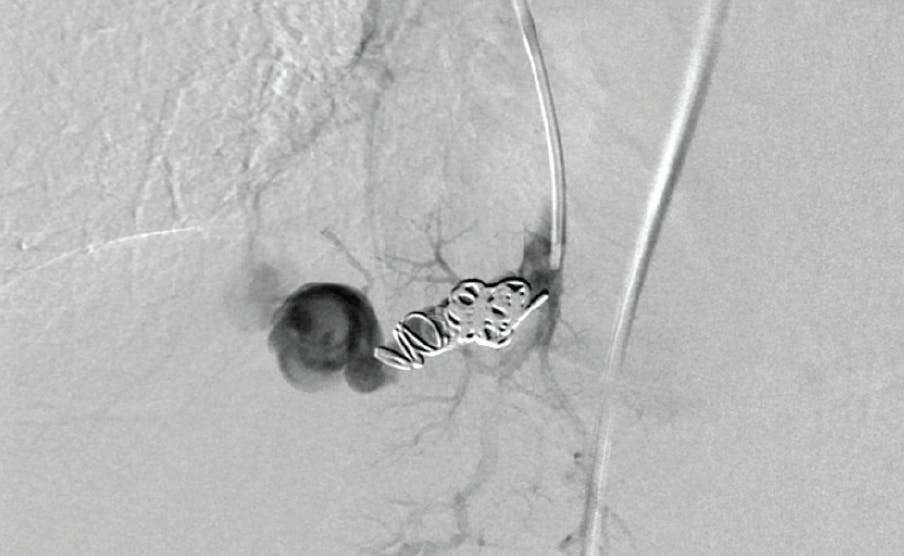
Figure 1. A patient with hereditary hemorrhagic telangiectasia who underwent coil embolization of a right lower-lobe pulmonary AVM 14 years prior presented with recurrent transient ischemic attack symptoms. Selective pulmonary angiography demonstrated a loosely packed coil in the artery supplying a large AVM that had recanalized.
Detachable Coils
Another technologic advancement was the development of detachable coils. This offered more precise deployment, which is critical in the treatment of high-flow lesions. Various deployment mechanisms exist, including mechanical and electrolytic detachment. In 1977, Prof. Cesare Gianturco first described the use of a detachable coil to treat renal artery aneurysms.1 The introduction of detachable coils offered a more controlled deployment, and the technology was refined over the coming years. Dr. Guido Guglielmi developed the Guglielmi detachable coil, which was a softer platinum coil with an electrolytic detachment system, and it revolutionized the treatment of intracranial aneurysms.5 Detachable coils allow the operator to test the stability of the coil before detaching, which is preferred in high-risk situations or when the embolization target is in close proximity to an arterial branch for which patency is desired. However, the price of stability and precision comes at higher cost compared to less expensive pushable coils.
Other Coil Innovations
Liquid coils are a type of pushable coil that can be injected through the delivery catheter. They are nonfibered coils, which are soft enough to track along tight curves and tortuous anatomy and can conform to the target vessel so a tight and compact coil pack can be achieved.6
In addition to smaller platforms and coil sizes, modifications such as surface fibers were introduced to promote thrombogenicity. Early generation fibered coils used wool. Subsequently, Dacron (polyester) fibers were found to be particularly effective in promoting platelet aggregation without causing the high degree of inflammation that was seen with wool fibers. The newest surface technology is hydrogel, which is an expandable polymer that swells to increase the volume of the coil to assist with vessel occlusion.7 Importantly, hydrogel coils do not rely on thrombus formation, thus offering a more effective coil option in coagulopathic patients. Bare platinum coils with no coating are also used with the goal of reaching mechanical occlusion and circumferential packing.
CURRENT TECHNOLOGY AND PRIMARY APPLICATIONS
Current coil technology is available in a wide range of lengths and sizes suitable for 1- through 25-mm-diameter vessels. Various coil shapes are available, including J-shaped, helical, and complex three-dimensional. Coil selection depends on the task at hand, and a comprehensive discussion could culminate in a textbook. This article discusses the newest coil offerings. Over time, we continue to approach the goal of the ideal coil—one that is easy to use and deploy, tracks along tortuous vessels, can be reliably positioned and placed, causes minimal catheter kickback, is available in a variety of sizes and lengths, and provides a durable result with a low rate of recanalization.
The applications for coil use are ever-expanding and include vascular and nonvascular procedures. Typical vascular procedures include treatment of arterial hemorrhage, arterial pseudoaneurysms, and pulmonary AVMs, as well as embolization of portosystemic collaterals, to name a few.
Low-Profile Hydrocoils
One of the most common indications for coil use is treatment of arterial hemorrhage. The challenge of treating a small branch arterial hemorrhage in a coagulopathic patient highlights the utility of the current-generation low-profile hydrocoils.
Case example. A man in his mid 40s with decompensated alcohol-induced cirrhosis presented with large-volume hematochezia. He was coagulopathic at the time of presentation. CTA showed localized active arterial extravasation within the cecum. He was brought to the IR suite for urgent angiography. A 2.8-F Progreat microcatheter (Terumo Interventional Systems) was ultimately used to access the ileocolic artery, and angiography revealed active extravasation from two terminal ileocolic arterial branches (Figure 2). Both the 2.8- and 2.4-F Progreat microcatheters were too large to catheterize the targeted vessels, which are prone to spasm when accessed with a microwire. A 2-F TruSelect microcatheter (Boston Scientific Corporation) was the most suitable microcatheter to access the target vessels given the need for a small-caliber catheter and the ability to advance the microcatheter without leading with a microwire. Both of the targeted branches were successfully accessed.
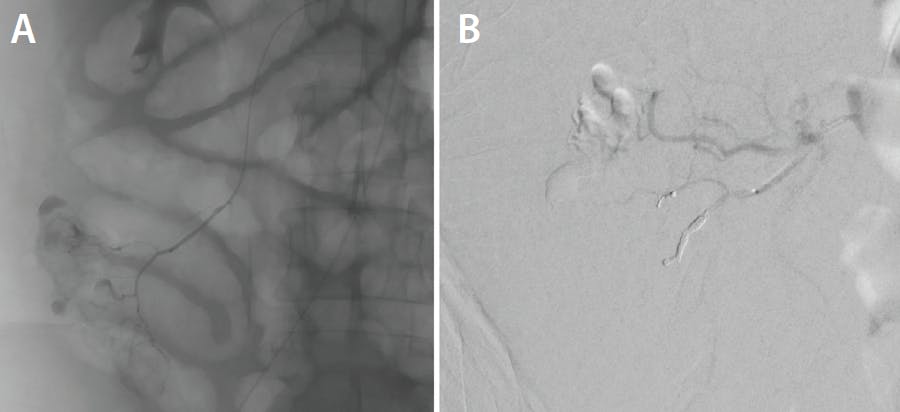
Figure 2. A patient with decompensated alcohol-induced cirrhosis and concurrent coagulopathy presented with massive lower gastrointestinal bleeding. CTA demonstrated arterial extravasation from the ileocolic arterial distribution. Angiography showed localized bleeding from two terminal branches of the ileocolic artery (A). Angiography after embolization with 2-mm low-profile hydrocoils showed dense coil packs with cessation of bleeding (B).
Given the small caliber of the microcatheter and the patient’s coagulopathy, the most suitable coil was a low-profile hydrocoil that could achieve tight packing in the small target vessels. The target vessels were embolized with 2-mm HydroSoft helical coils (MicroVention Terumo). Each helical microcoil was able to be deployed in a precise fashion, and tight coil pack was achieved. The hydrogel contributed to vessel occlusion in this patient because the ability to form clot was compromised in the setting of coagulopathy. Also, as recent literature suggests, hydrogel-coated coils allow for shorter-segment embolization compared to coils without hydrogel.8
Hybrid Detachable Coils
One scenario in which rapid occlusion of a high-flow vessel is desired is the setting of splenic trauma. Today, the preferred management of splenic trauma in the stable patient is splenic artery embolization.9 The surgical literature supports embolization in these patients, and it has been shown to decrease the need for splenectomy compared to conservative management/observation.10 Attractive features of newer-generation coils are those that can offer vessel sacrifice with a single, detachable device. The ideal coil features a leading, anchoring segment that is sized to the target vessel and a trailing component that offers dense packing. Main splenic artery embolization distal to the dorsal pancreatic artery can be achieved quickly with this hybrid-type coil.
Case example. A woman in her early 40s presented with severe pain in the left upper quadrant after a fall from standing. She was hemodynamically stable in the emergency department, and abdominal CT with intravenous contrast revealed a grade IV splenic laceration and a large perisplenic hematoma (Figure 3). She presented to IR for main splenic artery embolization. Radial access was used given the coagulopathy. A 5-F Sarah Optitorque catheter (Terumo Interventional Systems) was advanced into the celiac artery origin, and angiography delineated the splenic artery distal to the dorsal pancreatic artery. A 2.8-F Progreat microcatheter with a Fathom microwire (Boston Scientific Corporation) was advanced to the midsplenic artery, and embolization was performed with a 10-mm POD anchoring coil (Penumbra, Inc.) followed by a 30-mm Packing Coil (Penumbra, Inc.). True to its liquid nature, the Packing Coil formed a dense pack. Coil deployment proved to be efficient and effective, as final angiography showed successful occlusion (Figure 4). Collateral flow to the spleen was observed on completion proximal celiac angiography. The patient recovered without issue, did not require blood transfusion after embolization, and recovered without need for splenectomy.
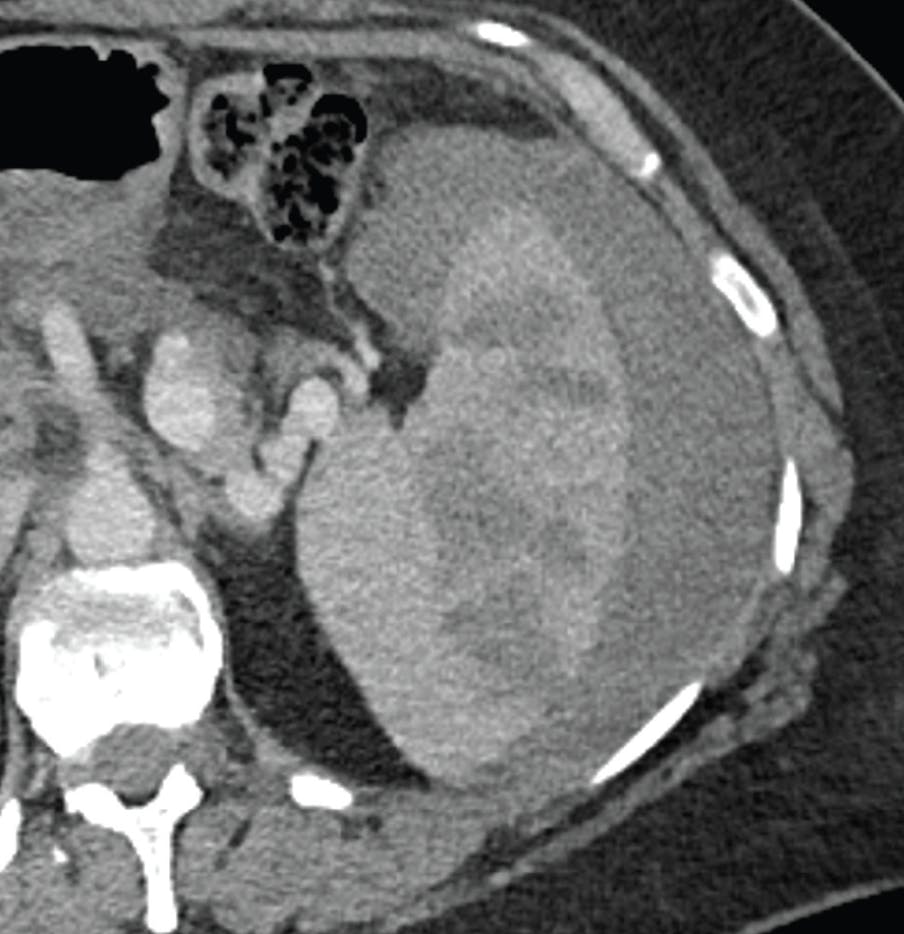
Figure 3. A grade IV splenic laceration and a large perisplenic hematoma.
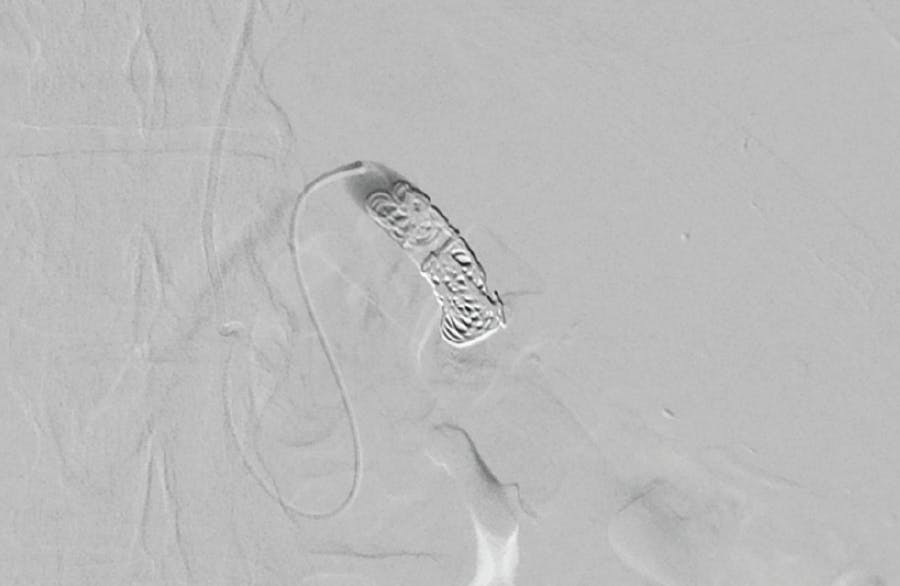
Figure 4. Final angiography after embolization with 10-mm POD and 30-mm Packing Coils demonstrated successful occlusion.
Helical Coils
The newest in small-platform helical coils offers the ability to treat the smallest-caliber target arteries in distal locations. A prime example is embolization for vascular territory protection in prostate artery embolization (PAE).
Case example. A man in his late 70s with a long history of benign prostatic hypertrophy had significant lower urinary tract symptoms of nocturia, frequency, and leakage. His International Prostate Symptom Score at the time of consultation was 23. He presented to IR for PAE. During angiography before left PAE, the origin of the left obturator (corona mortis) and inferior epigastric artery was selected with a 2-F TruSelect microcatheter and a 0.016-inch Fathom wire. A large branch extending medially from the obturator artery appeared to supply the majority of the prostate. There was also a branch that extended inferior to the pubic symphysis, which appeared to supply penile tissue (Figure 5A). This was confirmed with cone-beam CT (Figure 5B).
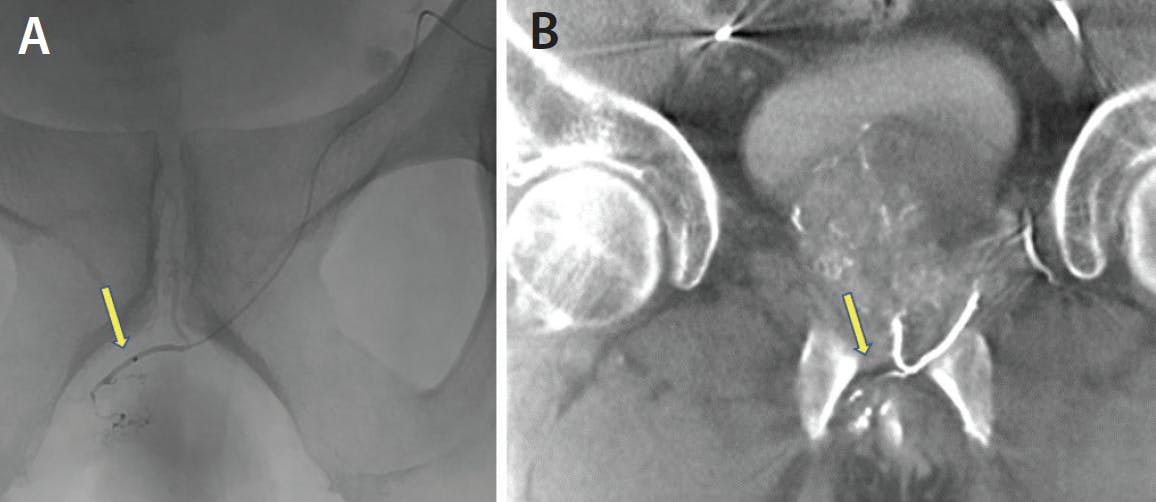
Figure 5. An unsubtracted angiogram (A). Arterial enhanced cone-beam CT demonstrated small collateral branch (yellow arrow) to posterior right corpora and spongiosum (B).
The penile branch was selected and was embolized with two separate 2-mm X 2-cm Concerto coils (Medtronic). The small vessel with short landing zone made the selected coils the obvious best choice for embolization. Complete occlusion was confirmed with postintervention angiography (Figure 6).
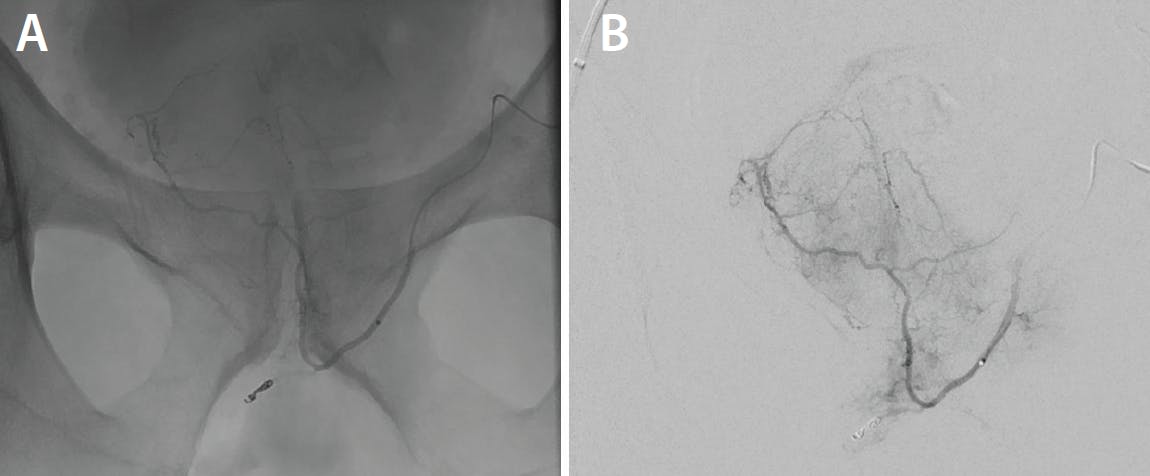
Figure 6. Unsubtracted angiography showed well-positioned coil pack in the penile collateral (A). Digital subtraction angiography confirmed adequate occlusion of the target collateral connection (B).
The ascending artery that supplied the majority of the prostate was selected, and embolization was performed. The well-positioned and tightly packed coils successfully prevented nontarget delivery to the penile artery distribution.
CONCLUSION
Newer coil technology allows embolization of target vessels with precision, without size limitation, and with remarkable results.
1. Vaidya S, Tozer KR, Chen J. An overview of embolic agents. Semin Intervent Radiol. 2008;25:204-215. doi: 10.1055/s-0028-1085930
2. Tang Z, Jia A, Li L, Li C. Brief history of interventional radiology. Article in Chinese. Zhonghua Yi Shi Za Zhi. 2014;44:158-165.
3. Rosch J, Dotter CT, Brown MJ. Selective arterial embolization. A new method for control of acute gastrointestinal bleeding. Radiology. 1972;102:303-306. doi: 10.1148/102.2.303.
4. Golzarian J, Dussaussois L, Ait Said K, et al. Embolization of large aneurysms with long wire coils. Cardiovasc Intervent Radiol. 2002;25:26-29. doi: 10.1007/s00270-001-0046-2
5. Guglielmi G, Viñuela F, Sepetka I, Macellari V. Electrothrombosis of saccular aneurysms via endovascular approach. Part 1: electrochemical basis, technique, and experimental results. J Neurosurg. 1991;75:1-7. doi: 10.3171/jns.1991.75.1.0001
6. Ha-Kawa SK, Kariya H, Murata T, Tanaka Y. Successful transcatheter embolotherapy with a new platinum microcoil: the Berenstein liquid coil. Cardiovasc Intervent Radiol. 1998;21:297-299. doi: 10.1007/s002709900264
7. Kallmes DF, Fujiwara NH. New expandable hydrogel-platinum coil hybrid device for aneurysm embolization. AJNR Am J Neuroradiol. 2002;23:1580-1588
8. Hongo N, Kiyosue H, Ota S, et al. Vessel occlusion using hydrogel-coated versus nonhydrogel embolization coils in peripheral arterial applications: a prospective, multicenter, randomized trial. J Vasc Interv Radiol. 2021;32:602-609.e1. doi: 10.1016/j.jvir.2020.12.001
9. Quencer KB, Smith TA. Review of proximal splenic artery embolization in blunt abdominal trauma. CVIR Endovasc. 2019;2:11. doi: 10.1186/s42155-019-0055-3
10. Coccolini F, Montori G, Catena F, et al. Splenic trauma: WSES classification and guidelines for adult and pediatric patients. World J Emerg Surg. 2017;12:40. doi: 10.1186/s13017-017-0151-4
Advertisement
Advertisement