Advertisement
Advertisement
April 2022
Bead Technology: What’s New, What’s Next?
A review of mechanical properties and a discussion of available embolic particulates, recent advances for benign disease, novel concepts in the tumor microenvironment, and evolving use in liver cancer.
By Srinivasan Narayanan, MD, PhD; Andrea C. Cortes; and Rony Avritscher, MD
Transcatheter arterial embolization (TAE) using calibrated bead technology represents a remarkably successful chapter in the evolution of minimally invasive image-guided therapies. Since their initial introduction in the 2000s, the emergence of embolic particles with uniform and predictable shapes has enabled more distal and complete particle penetration. These new particles of various sizes can be methodically selected and employed to treat various conditions ranging from prostate hyperplasia to hepatocellular carcinoma (HCC). Calibrated beads mechanically block blood flow within a very selective target vasculature. Efforts are now underway to use this precision to deliver novel therapeutic agents more accurately and to develop biodegradable embolic particles. This versatility makes these devices powerful, as their flexible design applies to endless clinical scenarios, such as priming solid tumors to improve clinical response to immunotherapy. The article reviews the most commonly used bead agents and their applications.
MECHANICAL PROPERTIES AND LIMITATIONS
Improvements in bead technologies are enabling ever-expanding applications for catheter-based interventions. Early embolization materials, including autologous blood clots, steel pellets, and gelatin sponge, proved helpful in treating acute hemorrhages.1 However, they lacked the necessary refinement for more distal agent delivery situations. Moreover, due to their unpredictable size and shape, they carried a high risk for nontarget embolization. Gas exchanges occur at the distal microvasculature, where arterioles and capillaries range from 10 to 30 µm. Even optimal embolization technique often leads to occlusion of more proximal vasculature (> 40 µm in diameter). Given this proximal nature of the embolization, tissue perfusion persists via collateral circulation and newly perfused vessels. Johnson et al quantified this residual perfusion in a rabbit tumor model. Embolization of these tumors with 100–300-µm bead particles to angiographic stasis only stopped blood flow in 56% of the tumor microvasculature.2 The main difference between carrying out embolization to stasis versus near stasis rested on the development of newly perfused microvasculature, which was nearly absent in the tumors embolized to angiographic stasis.2 Our recent study confirmed these findings by assessing the degree of hypoxia in tumor microvasculature after embolization with different size beads (40-60 µm vs 70-150 µm). Smaller beads penetrate deeper into the tumor vasculature and reduce the potential for residual perfusion via collaterals, thus leading to more significant necrosis.3 When using beads too large for the targeted vasculature, the residual perfusion allows hypoxic tumor cells to survive. Thus, advances in calibrated agents (ie, particulates) were necessary and have allowed tailoring of embolization for vascular and visceral intervention, including drug and radiation delivery.
ADVANCEMENTS IN EMBOLIC PARTICULATES
Polyvinyl alcohol (PVA) particles have been used for embolization since the 1970s and quickly gained popularity as a reliable and cost-effective embolic agent. PVA is compressible but can expand after catheter delivery.4 Early iterations of PVA lacked homogenous size distribution, with diameters ranging from 100 to 1,100 µm. These embolic agents were refined into small, calibrated PVA (Contour embolization PVA particles, Boston Scientific Corporation).
Another breakthrough in embolic particles came with tris-acryl gelatin microspheres (TAGM) (Embosphere microspheres, Merit Medical Systems). Embospheres are polymers of acrylamide monomer with a gelatin coating. These tightly calibrated particles carry a cationic charge, which allows them to be hydrophilic and resist aggregation. Typically, these particles are suspended in iodinated contrast and saline prior to injection and offered in calibrated sizes ranging from 40 to 1,200 µm.5 Compared to TAGM, nonuniform PVA particles have higher proximal and distal aggregation rates in preclinical models of uterine artery embolization (UAE).6 The use of size-matched spherical PVA particles resulted in similar rates of immediate technical success but demonstrated significantly higher rates of incomplete response on 3-month postprocedure imaging. The suboptimal response resulted from the high compressibility of PVA compared to TAGM, which may result in deformational changes and nontarget redistribution.7
Bead Block (Boston Scientific Corporation) represents another advancement of PVA particles. They are calibrated microspheres consisting of biocompatible PVA hydrogel cross-linked with acrylic polymer. The hygroscopic nature of Bead Block is unique, with water molecules interspersed between the suspension, resulting in a lower rate of catheter occlusion and particle aggregation. However, their hygroscopic nature typically requires longer preparation times.8 Embozene microspheres (Varian Medical) are another variety of tightly calibrated microspheres made of nonresorbable hydrogel coated with Polyzene-F polymer. These are available in 40- to 1,300-µm sizes.
The development of bead technology with drug-eluting capabilities revolutionized catheter-based embolization techniques. There are several devices available, including PVA microspheres containing sulfonate groups (DC Bead, Boston Scientific Corporation), microspheres containing sodium acrylate groups (HepaSpheres, Merit Medical Systems), and a drug-eluting version of Embozene (Oncozene, Varian Medical). DC Beads are copolymerized with 2-acrylamide-2-methylpropane sulfonate salt, allowing binding of low-molecular-weight and positively charged pharmaceuticals via ion exchange. Similarly, HepaSpheres utilizes the polymerization of vinyl acetate and methyl acrylate monomers to bind chemotherapeutic agents. These drug-eluting beads (DEBs) allow loading and release of irinotecan and doxorubicin, agents primarily used for transarterial chemoembolization (TACE) of liver tumors (Figure 1).9
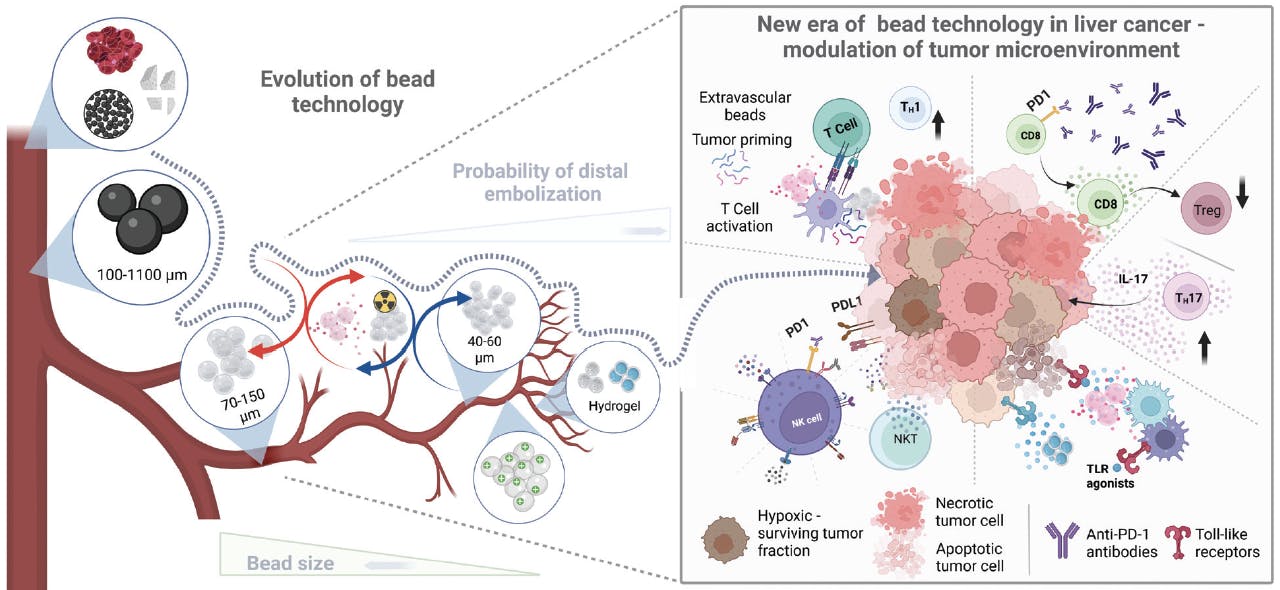
Figure 1. Schematic representation of the history and evolution of bead technology. Left panel: The refinement of particulate materials and diminution of its sizes to attain additional precision and more distal delivery. Evolving materials ranging from autologous blood clots, steel pellets, and gelatin sponge to calibrated beads of various materials and sizes to accommodate more complex therapeutic classes with improved drug release profiles. Right panel: How ever-expanding catheter-based interventions combined with immunotherapy could be tailored to overcome the challenges of an immunosuppressive tumor microenvironment. Clockwise: T cell activation and tumor priming by extravascular beads, increased cytotoxic response, activation of toll-like receptors, and activation of natural killer cells by immune checkpoint inhibition in combination therapies. Image created with Biorender.com.
RECENT DEVELOPMENTS IN BEAD TECHNOLOGY FOR BENIGN DISEASE
The flexibility inherent to calibrated bead technology is particularly well suited for embolization in benign disease, where targeting a specific vascular plexus is desirable. Optimal uterine fibroid embolization (UFE) technique requires occlusion of perifibroidal plexus with vessels typically ranging from 500 to 800 µm in diameter. Calibrated particles of smaller diameter (< 500 µm) can bypass the plexus and lodge in smaller arterioles, potentially leading to myometrial infarction. Thus, typically nonresorbable beads with sizes from 500-700 µm or 700-900 µm are preferred.10 The precise range of embolic beads required for successful treatment led to the FDA approval of several embolic beads for UFE, including PVA and TAGM particles.11 The precise level of embolization afforded by calibrated beads translates into a different angiogram endpoint paradigm. Slowing flow within the uterine artery after embolization with these beads is enough to document sufficient penetration of the embolic agent into the perifibroidal plexus, instead of the typical contrast stasis used as reference with noncalibrated particles. Due to the small potential risk of permanently reduced postprocedural ovarian function, there has been renewed interest in developing a temporary approach to UAE. Hacking et al performed UFE in 23 consecutive patients with a novel bioresorbable 700–1,000-µm gelatin sphere to complete stasis.12 MRI studies performed 3 months after the procedure revealed 100% fibroid infarction in 83% of patients, a rate comparable with embolization performed with permanent embolic agents. Several other temporary beads are currently being investigated in various preclinical settings.
Calibrated beads are also uniquely advantageous for prostate artery embolization (PAE). The UK-ROPE study demonstrated small spherical Embozene particles (< 400 µm) and nonspherical 100–200-µm PVA produced similar clinical outcomes after PAE.13 Similar findings were reported by Bilhim et al, where 300–500-µm spherical Bead Block particles and 100–300-µm nonspherical PVA particles produced equivalent technical and clinical success rates up to 2 years following PAE.14 Another single-center, randomized clinical trial demonstrated no significant difference in PAE outcomes using 100–300-µm versus 300–500-µm Embosphere particles.15 There was a significant difference in mild adverse events (ie, dysuria, increased frequency, hematuria) with a small particle treatment group compared to a larger particle size (86% vs 41%). No significant adverse events were recorded for either group. Wang et al demonstrated that a combination of 50- and 100-µm PVA particles showed improved clinical and imaging outcomes after PAE compared to 100-µm PVA particles alone.16 Bagla et al also reported similar efficacy and safety profile following PAE for patients with benign prostatic hyperplasia using Embozene particles.17 Further prospective multicenter studies are ongoing to delineate the best embolic agent for PAE.
NOVEL CONCEPTS IN THE TUMOR MICROENVIRONMENT
Recent studies are describing the postembolization liver tumor microenvironment in greater detail. The magnitude of the hypoxic insult resulting from abrupt occlusion of the tumor arterial supply is a critical determinant of treatment outcome. When the combination of ischemia and drug cytotoxicity is not enough to eliminate the entirety of the targeted tumor, the surviving but stressed cancer cells are allowed to adapt to the hypoxic and nutrient-starved environment through activation of survival pathways associated with cell migration, angiogenesis, and metastasis.18 Our preclinical studies have shown that hypoxic stress within surviving tumor cell fraction was increased 3 days after treatment with hepatic arterial embolization (HAE) and DEB-TACE and decreased at 7 days. Tumor hypoxic response across treatment arms demonstrated that the size of the beads has a significant influence over the hypoxic stress of the surviving tumor cell fraction with a higher degree of residual tumoral hypoxic stress observed among animals treated with 70–150-µm beads compared with the group of rats treated with 40–60-µm beads.3
Traditionally, experiments dealing with the impact of HAE on the liver parenchyma have focused on circulating peripheral cells in HCC patients. These studies analyzed circulating immune cells subsets including CD4+ cells (Th1, Th17, and Treg cells), CD8+ T cells, NK cells, and NKT cells, as well as plasma cytokines before and after TACE and revealed a significant increase in the frequency of circulating Th17 cells 1 month after TACE.19 Moreover, systemic and hepatic recruitment of Th17 cells and increased expression of their signature cytokine interleukin-17A played a central role in the proinflammatory microenvironment after bland TAE in a rat model of HCC.20 Recent studies focusing on the immune response in HCC after embolization with TAGM beads demonstrated that posttreatment tumors contained a significantly greater number of CD3, CD4, and CD8 tumor-infiltrating lymphocytes and that extravascular location of beads was critical in eliciting greater immune reaction.21 These findings corroborate our recent observation of increased CD8 and FOXP3 T cell within the tumor after embolotherapy, as well as increase peritumoral macrophage population (Figure 2).
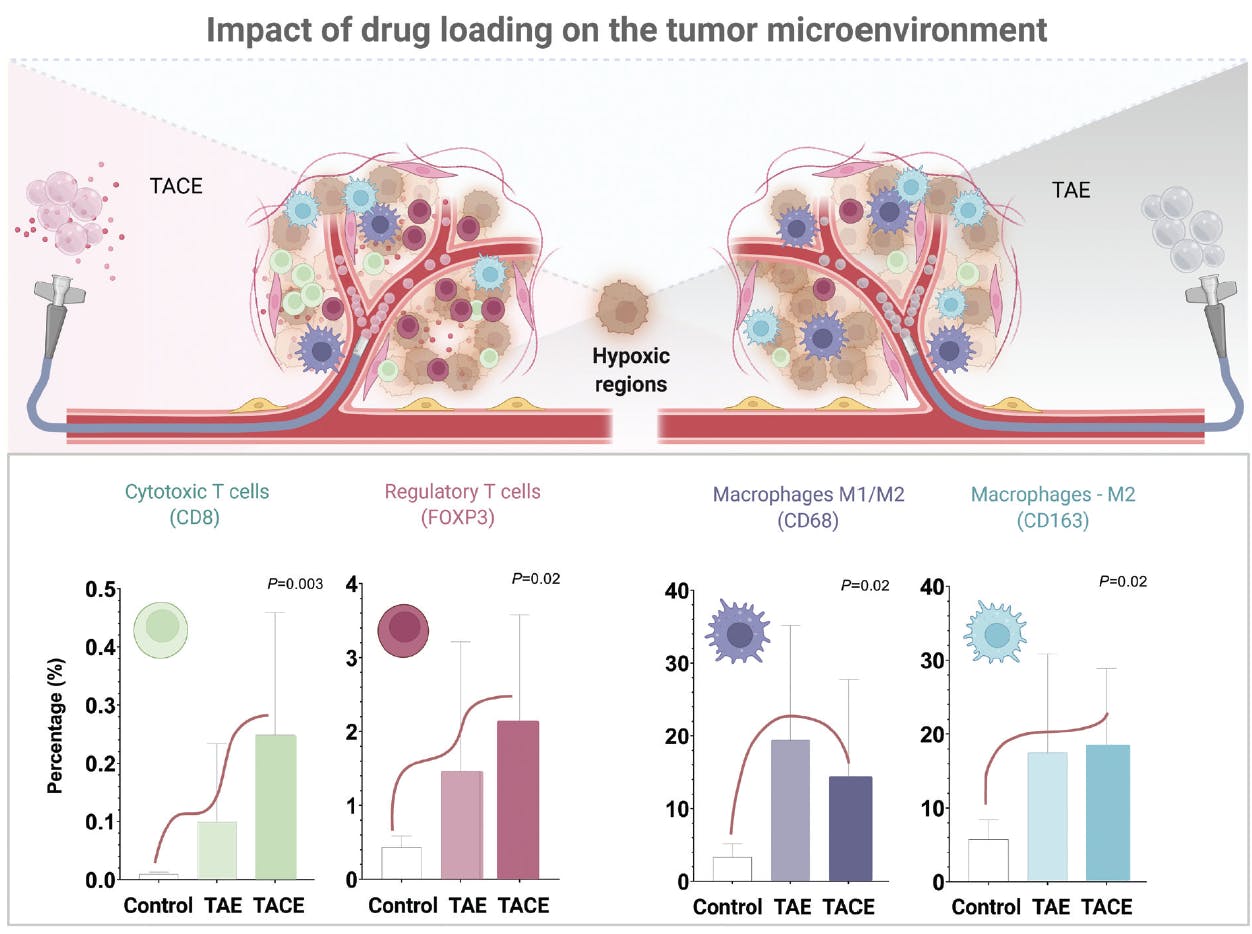
Figure 2. Differential response of tumor microenvironment after TAE using PVA microspheres containing sulfonate groups unloaded or loaded with doxorubicin hydrochloride. Upper panel: Schematic diagram portraying tumor microenvironment response after treatment with the different embolization modalities. Lower panel: Higher infiltration cytotoxic and FOXP3-expressing T cells (CD8+, Tregs) are observed in tumors treated with doxorubicin-eluting beads cells (left). Significant trend indicating tumor macrophage polarization toward a M2 state is observed when the bead-treated groups are compared to the saline control injection group. However, during the time of follow-up (14 days after procedure), a clear differential trend was not observed between DEB- and unloaded microsphere–treated groups (right). Data are expressed as the percentage of positive cells expressing the respective markers (CD8, FOXP3, CD68, and CD163) over the total number of nucleated cells within the tumor boundary. P value derived from Kruskal-Wallis test (unpublished data). Image created with Biorender.com.
EVOLUTION IN LIVER CANCER
Transcatheter hepatic arterial chemoembolization remains the mainstay of minimally invasive treatment for patients with intermediate–advanced-stage HCC and is also commonly used to treat metastatic neuroendocrine and colon cancer to the liver. Concerns regarding systemic toxicity of chemotherapy agents used during conventional TACE have led to the development of DEB-TACE. This approach leverages the powerful combination of ischemia caused by vascular occlusion with drug delivery. Typical microspheres used for TAE and TACE range from 100 to 300 µm.22 The robust hepatic collateral circulation makes complete vascular occlusion of liver tumors challenging and the severity of postembolization intratumoral hypoxia difficult to predict. Unlike the ischemic stress after vascular embolization, tumor effects caused by doxorubicin after DEB-TACE are not immediate, as the drug elutes into the surrounding tissue. Gaba et al demonstrated that loading the microspheres with increasing concentrations of doxorubicin caused more significant necrosis in rabbit VX2 tumors.23 These results highlight that the presence of doxorubicin in the microsphere vicinity affects the surviving stressed cancer cells in the hypoxic postembolization tumor microenvironment and immune landscape, enabling combination strategies with novel immune-modulating agents.3
The emergence of immunotherapy has transformed the field of oncology by producing long-lasting responses in patients with advanced disease. The therapy works by resetting the equilibrium between costimulatory signals and immune checkpoints that regulate the activation and magnitude of cytotoxic T cell response in the tumor immune microenvironment. A large number of patients does not fully benefit from these novel therapies. There are several well-known barriers for adequate response to immunotherapy, including low immunogenicity of tumor antigens, development of antigen tolerance, a limited number of infiltrating cytotoxic T cells, and an immunosuppressive tumor microenvironment.
Hypoxia from complete arterial occlusion secondary to conventional TAE appears to create an immunosuppressive tumor microenvironment.20 Injured hypoxic tumor cells surviving the initial embolization constitute a major determinant of treatment outcome. These surviving tumor cells typically display an increasingly aggressive and invasive phenotype. Another important consideration is that cell populations surviving the initial embolic insult may enter a quiescent state, which affords them protection again cytotoxic agents aimed at the cell cycle.24 The combination of DEB-TACE and immunotherapy can be tailored to overcome these challenges. Studies have established the safety and tolerability of combining local liver therapies and immune checkpoint inhibitors. Wu et al assessed the safety and efficacy of lenvatinib and anti-PD-1 immunotherapy with TACE in a retrospective study, establishing a high rate of tumor response (77.4%), which is superior to previously observed response rates to a systemic combination of vascular endothelial growth factor inhibitor and anti-PD-L1 antibodies.25 DEBs offer great potential to deliver other immune-modulating agents and activate critical immune-stimulatory pathways while reducing systemic toxicity. DEBs can be used to deliver toll-like receptor agonists, which represent a promising class of agents with the potential to initiate an antitumor response, since intravenous administration of these agents is associated with unacceptable systemic toxicity. However, the authors successfully loaded these novel agents on bead platforms with favorable release profiles for local delivery.26
CONCLUSION
Familiarity with the mechanical properties of different beads and their impact on the tissue microenvironment is needed to improve embolization outcomes. Recent studies have established the role of bead size, drug loading, and location on the postembolization inflammatory milieu. Refinement of the changes in the cell landscape will enable the combination of image-guided minimally invasive interventions with immunotherapy.
1. Eckstein MR, Kelemouridis V, Athanasoulis CA, et al. Gastric bleeding: therapy with intraarterial vasopressin and transcatheter embolization. Radiology. 1984;152:643-646. doi: 10.1148/radiology.152.3.6611562
2. Johnson CG, Sharma K, Levy EB, et al. Microvascular perfusion changes following transarterial hepatic tumor embolization. J Vasc Interv Radiol. 2016;27:133-141. doi: 10.1016/j.jvir.2015.06.036
3. Cortes AC, Nishiofuku H, Polak U, et al. Effect of bead size and doxorubicin loading on tumor cellular injury after transarterial embolization and chemoembolization in a rat model of hepatocellular carcinoma. Nanomedicine. 2022;39:102465. doi: 10.1016/j.nano.2021.102465
4. Laurent A. Microspheres and nonspherical particles for embolization. Tech Vasc Interv Radiol. 2007;10:248-256. doi: 10.1053/j.tvir.2008.03.010
5. Derdeyn CP, Graves VB, Salamat MS, Rappe A. Collagen-coated acrylic microspheres for embolotherapy: in vivo and in vitro characteristics. Am J Neuroradiol. 1997;18:647-653.
6. Pelage JP, Laurent A, Wassef M, et al. Uterine artery embolization in sheep: comparison of acute effects with polyvinyl alcohol particles and calibrated microspheres. Radiology. 2002;224:436-445. doi: 10.1148/radiol.2242010847
7. Spies JB, Allison S, Flick P, et al. Spherical polyvinyl alcohol versus tris-acryl gelatin microspheres for uterine artery embolization for leiomyomas: results of a limited randomized comparative study. J Vasc Interv Radiol. 2005;16:1431-1437.doi:10.1097/01.RVI.0000179793.69590.1A
8. Lewis AL, Adams C, Busby W, et al. Comparative in vitro evaluation of microspherical embolisation agents. J Mater Sci Mater Med. 2006;17:1193-1204. doi: 10.1007/s10856-006-0592-x.
9. Jordan O, Denys A, De Baere, et al. Comparative study of chemoembolization loadable beads: in vitro drug release and physical properties of DC bead and hepasphere loaded with doxorubicin and irinotecan. J Vasc Interv Radiol. 2010 Jul;21:1084-1090. doi: 10.1016/j.jvir.2010.02.042
10. Silberzweig JE, Powel DK, Matsumoto AH, Spies JB. Management of uterine fibroids: a focus on uterine-sparing interventional techniques. Radiology. 2016;280:675-692. doi: 10.1148/radiol.2016141693
11. Spies JB, Allison S, Flick P, et al. Polyvinyl alcohol particles and tris-acryl gelatin microspheres for uterine artery embolization for leiomyomas: results of a randomized comparative study. J Vasc Interv Radiol. 2004;15:793-800. doi: 10.1097/01.RVI.0000136982.42548.5D
12. Maclean D, Vigneswaran G, Bryant T, et al. A retrospective cohort study comparing a novel, spherical, resorbable particle against five established embolic agents for uterine fibroid embolization. Clin Radiol. 2021;76:452-457. doi: 10.1016/j.crad.2021.01.012
13. Maclean D, Harris M, Drake T, et al. Factors predicting a good symptomatic outcome after prostate artery embolisation (PAE). Cardiovasc Intervent Radiol. 2018;41:1152-1159. doi: 10.1007/s00270-018-1912-5
14. Bilhim T, Pisco J, Pereira JA, et al. Predictors of clinical outcome after prostate artery embolization with spherical and nonspherical polyvinyl alcohol particles in patients with benign prostatic hyperplasia. Radiology. 2016;281:289-300. doi: 10.1148/radiol.2016152292
15. Goncalves OM, Carnevale FC, Moreira AM, et al. Comparative study using 100-300 versus 300-500 μm microspheres for symptomatic patients due to enlarged-BPH prostates. Cardiovasc Intervent Radiol. 2016;39:1372-1378. doi: 10.1007/s00270-016-1443-x
16. Wang MQ, Zhang JL, Xin HN, et al. Comparison of clinical outcomes of prostatic artery embolization with 50-μm plus 100-μm polyvinyl alcohol (PVA) particles versus 100-μm PVA particles alone: a prospective randomized trial. J Vasc Interv Radiol. 2018;29:1694-1702. doi: 10.1016/j.jvir.2018.06.019
17. Bagla S, Martin CP, van Breda A, et al. Early results from a United States trial of prostatic artery embolization in the treatment of benign prostatic hyperplasia. J Vasc Interv Radiol. 2014;25:47-52. doi: 10.1016/j.jvir.2013.09.010
18. Kim YB, Park YN, Park C. Increased proliferation activities of vascular endothelial cells and tumour cells in residual hepatocellular carcinoma following transcatheter arterial embolization. Histopathology. 2001;38:160-166. doi: 10.1046/j.1365-2559.2001.01064.x
19. Liao Y, Wang B, Huang ZL, et al. Increased circulating Th17 cells after transarterial chemoembolization correlate with improved survival in stage III hepatocellular carcinoma: a prospective study. PLoS One. 2013;8:e60444. doi: 10.1371/journal.pone.0060444
20. Avritscher R, Jo NH, Polak U, et al. Hepatic arterial bland embolization increases Th17 cell infiltration in a syngeneic rat model of hepatocellular carcinoma. Cardiovasc Intervent Radiol. 2020;43:311-321. doi: 10.1007/s00270-019-02343-1
21. Tischfield DJ, Gurevich A, Johnson O, et al. Transarterial embolization modulates the immune response within target and nontarget hepatocellular carcinomas in a rat model. Radiology. 2022;303:215-225. doi: 10.1148/radiol.211028
22. Prajapati HJ, Xing M, Spivey JR, et al. Survival, efficacy, and safety of small versus large doxorubicin drug-eluting beads TACE chemoembolization in patients with unresectable HCC. AJR Am J Roentgenol. 2014;203:W706-14. doi: 10.2214/AJR.13.12308
23. Gaba RC, Emmadi R, Parvinian A, Casadaban LC. Correlation of doxorubicin delivery and tumor necrosis after drug-eluting bead transarterial chemoembolization of rabbit VX2 liver tumors. Radiology. 2016;280:752-761. doi: 10.1148/radiol.2016152099.
24. Gade TPF, Tucker E, Nakazawa MS, et al. Ischemia induces quiescence and autophagy dependence in hepatocellular carcinoma. Radiology. 2017;283:702-710. doi: 10.1148/radiol.2017160728
25. Wu Jy, Yin ZY, Bai Yn, et al. Lenvatinib combined with anti-PD-1 antibodies plus transcatheter arterial chemoembolization for unresectable hepatocellular carcinoma: a multicenter retrospective study. J Hepatocell Carcinoma. 2021;8:1233-1240. doi: 10.2147/JHC.S332420
26. Mikhail AS, Mauda-Havakuk M, Negussie AH, et al. Evaluation of immune-modulating drugs for use in drug-eluting microsphere transarterial embolization. Int J Pharm. 2022;616:121466. doi: 10.1016/j.ijpharm.2022.121466
Advertisement
Advertisement