Advertisement
Advertisement
April 2022
Embolization: Exploring Current and Future Capabilities
By Elika Kashef, MBBS, MRCS, FRCR and Sarah B. White, MD, MS, FSIR, FCIRSE


Progress in the field of embolotherapy can be seen across a diverse array of conditions and pathologies, ranging from oncologic to orthopedic, arterial to venous and even lymphatic, emergent lifesaving settings to simple and elective, and in patients of virtually every demographic. A great diversity of materials are currently in use, with ongoing innovation toward optimizing material composition, sizing, visualization, coatings, loading capabilities, and long-term durability and applications. Additionally, work is underway to understand the effects of embolization on the immune system, hypoxia and inflammatory pathways, and tumor microenvironments. However, along with this progress and the understandable enthusiasm in the field, supporting each agent and application with robust clinical data is paramount, as even well-established procedures face real-world roadblocks outside of the interventional suite.
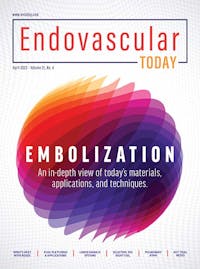
In this edition of Endovascular Today, we focus entirely on embolization and the plethora of innovations in use and in the pipeline. In our planning of this issue, we set out to highlight the current status of key agents and materials, with particular attention on how and why they are in use and what their evolution and next iterations may be. We also look at a few often-overlooked applications for embolics, as well as insights for the next generation of clinical exploration.
Our issue begins with a compelling and scientific review of the mechanical properties of bead technology by Srinivasan Narayanan, MD; Andrea C. Cortes; and Rony Avritscher, MD. They discuss available embolic particulates, recent advances for benign disease, novel concepts in the tumor microenvironment, and their evolving use in liver cancer.
Siobhan Flanagan, MD, and Jafar Golzarian, MD, explore the sizes, shapes, and capabilities of coil technology. Noting the remarkable evolution of this technology, they discuss how the interventional radiologist can now embolize vessels in more complex anatomic situations with remarkable precision and therapeutic efficacy.
Suraj Prakash, MD, and Sarah B. White, MD, give an overview of plug technology and how it can overcome some of the shortfalls of current coil platforms. They describe the benefits of plug technologies and discuss two platforms that are new to the market and report on the animal work and forthcoming data with these devices.
Continuing our discussion, Shyamal Patel, MBBS, and Lakshmi A. Ratnam, MBChB, present a review of the current emerging options and applications of liquid embolic agents—including ethanol, ethiodized oil, N-butyl cyanoacrylate glues, and ethylene vinyl alcohol—as well as newer agents and future prospects.
Zachary Schwartz, MD; Russ M. Guidry Jr, MD; and Theresa M. Caridi, MD, then provide an overview of pulmonary arteriovenous malformations and outline step-by-step management, including tips for treatments and consideration for patients with hemorrhagic hereditary telangiectasia.
Next, we asked experts Bob Abraham, MD; Christoph Binkert, MD; Roberto Iezzi, MD; and Nikki Keefe, MD, what they believe are the most needed data in peripheral embolization to allow more patients access to these minimally invasive, life-changing procedures.
We close this issue with an interview with Maarit Venermo, MD, who shares her insights on projects with the International Consortium of Vascular Registries and VASCUNET, the simulation training program at her center, the upcoming activities of the European Society for Vascular Surgery, her passion for working with young researchers, and more.
We hope this edition helps you stay up to date on one of the most diverse and rapidly evolving arenas in embolization, and we thank our authors for their time and expertise.
Elika Kashef, MBBS, MRCS, FRCR
Sarah B. White, MD, MS, FSIR, FCIRSE
Guest Chief Medical Editors
Advertisement
Advertisement