Advertisement
Advertisement
April 2022
Sponsored by Medtronic
Pulmonary Arteriovenous Malformations: Current Guidelines, Recanalization, and a Case Study
Pulmonary arteriovenous malformations (PAVMs) are abnormal, high-flow, low-pressure shunts between the pulmonary arteries and pulmonary veins.1 The intervening capillary network is absent, which results in decreased capacity for gaseous transfer and capillary filtration. The overall prevalence of PAVMs ranges from 1 in 1,315 to 1 in 5,555, and most (> 65%) are associated with hereditary hemorrhagic telangiectasia (HHT), an angiodysplatic disorder inherited as an autosomal dominant trait.2 Women are more commonly affected (1.5-1.8 times) than men. HHT patients with the ENG mutation (chromosome 9) have the highest incidence of PAVMs. Patients with HHT tend to have a shorter life span (63 vs 70 years) as compared with patients without HHT. Early detection and treatment of arteriovenous malformations (AVMs) would increase the life expectancy in these patients.3
The clinical presentation of PAVMs varies from asymptomatic incidental detection (seen in 13%-55% depending on the series) to severe complications related to hypoxemia (stunted growth, shortness of breath, exercise intolerance, cyanosis, clubbing), size of the shunt (cardiac failure), lack of capillary filtration (paradoxical embolism leading to stroke or transient ischemic attacks [TIAs], brain abscesses, or mesenteric, renal, or lower extremity ischemia), and fragility of the PAVM wall (hemoptysis, hemothorax).2,4 Symptoms also depend on the coexistent HHT and the presence and location of other angiodysplatic abnormalities. These include nose bleeds, gastrointestinal bleeding/melena, and anemia in the presence of nasal or gastrointestinal telangiectasia/AVMs; stroke or seizures in the presence of cerebral AVMs; and portal hypertension, hepatic encephalopathy, biliary ischemia, and cardiac failure in the presence of hepatic AVMs. In addition, nearly 50% of patients can have neurologic symptoms, such as headache, migraine, vertigo, syncope, numbness, paresthesia, or confusion.
UPDATE ON HHT GUIDELINES
The current HHT guidelines5 recommend screening of all suspected and confirmed HHT patients for the presence of PAVMs with transthoracic contrast echocardiography. Symptomatic PAVMs should be treated irrespective of the patient’s age and during the second trimester in pregnant women. In adults, asymptomatic PAVMs should be treated, preferably with transcatheter embolotherapy, to prevent complications associated with paradoxical emboli, such as stroke and brain abscess. Embolotherapy is effective irrespective of the feeding artery size. Patients must be followed long term to detect growth of untreated PAVMs and reperfusion of treated PAVMs.
RECANALIZATION OF PAVMs
Reperfusion of PAVMs can occur due to various reasons, with the most common being recanalization of the treated feeding artery. Recruitment of new feeding arteries from adjacent pulmonary artery branches or systemic arteries (such as the intercostal or bronchial arteries) can lead to reperfusion of the AVM. A retrograde flow into the venous sac of the PAVM from the adjacent pulmonary veins can mimic reperfusion of the AVM; however, it can be accurately diagnosed on angiography and has little clinical relevance.
The rates of PAVM recanalization vary widely based on the embolic material used and the duration of follow-up.6,7 The recanalization rates are higher with coil embolization, with rates ranging from 20% to 45%.8 The use of a single coil, oversizing of coils, lack of dense coil packing, larger size of the feeding artery, and coil placement too far away from the venous sac are associated with a higher frequency of recanalization. Nitinol vascular plugs have a lower recanalization rate of 5% to 10%, and associated use of coils along with the nitinol vascular plug decreases recanalization rates to 1%. MVP™ micro vascular plug system (Medtronic), used alone, has the lowest rates of recanalization, ranging from 0% to 3%.8-10
CASE STUDY WITH MVP MICRO VASCULAR PLUG SYSTEM
A woman in her 50s presented to the hospital with a history of recurrent TIAs and frequent migraines. She had a remote history of epistaxis as a teenager, and her family history was not available. The workup revealed a right-to-left shunt of pulmonary origin on contrast-enhanced echocardiography. A subsequent CT confirmed the presence of a small AVM in the superior segment of the left lingula. The electrocardiogram was normal. Laboratory parameters revealed normal hematology, coagulation parameters, and renal function. Left pulmonary angiography (Figure 1), performed using a 6-F angled pigtail catheter placed through a transfemoral venous access, demonstrated a left lingular PAVM with an associated venous sac and early draining vein. The feeding artery, which measured 3.4 mm, was selectively catheterized using an 8-F Lumax™* guiding catheter (Cook Medical) and a 5-F Kumpe™* catheter (Cook Medical), and angiography was performed (Figure 2). This confirmed the presence of the AVM, venous sac, and early draining vein. The catheter tip was positioned as close as possible to the venous sac, and an MVP-5Q device (Medtronic) was deployed. Postembolization angiography (Figure 3) showed occlusion of the feeding artery, with no filling of the PAVM. Follow-up contrast-enhanced echocardiography at 6 months revealed no more right-to-left shunting, and the patient reported no TIA symptoms. She also reported improvements in her migraine symptoms.
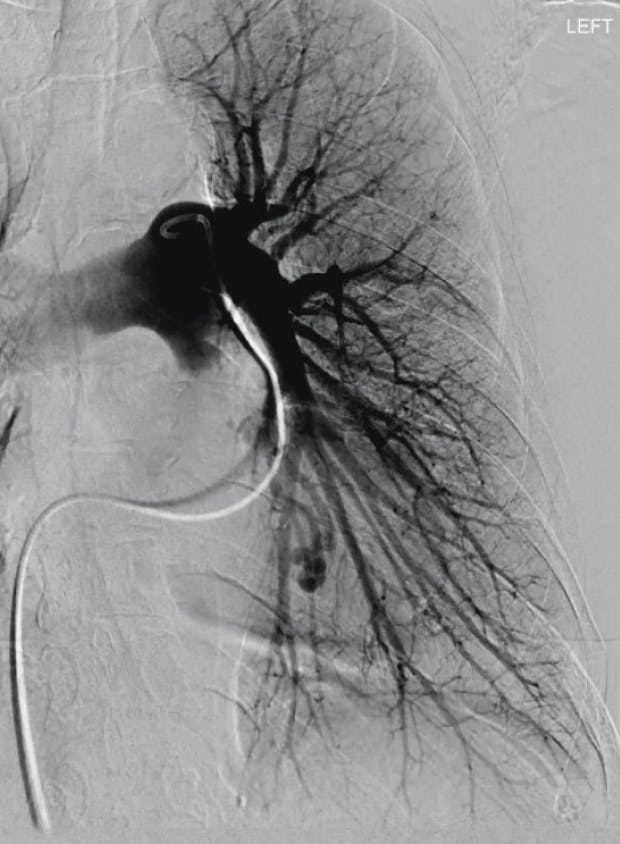
Figure 1. Left pulmonary angiography showed a left lingular PAVM with an associated venous sac and early draining vein.
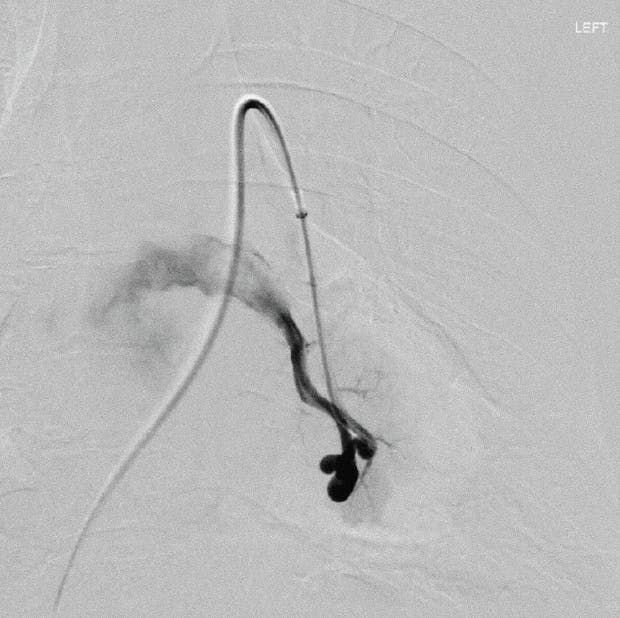
Figure 2. Selective left superior lingular segmental angiography showed the AVM, venous sac, and early draining vein.
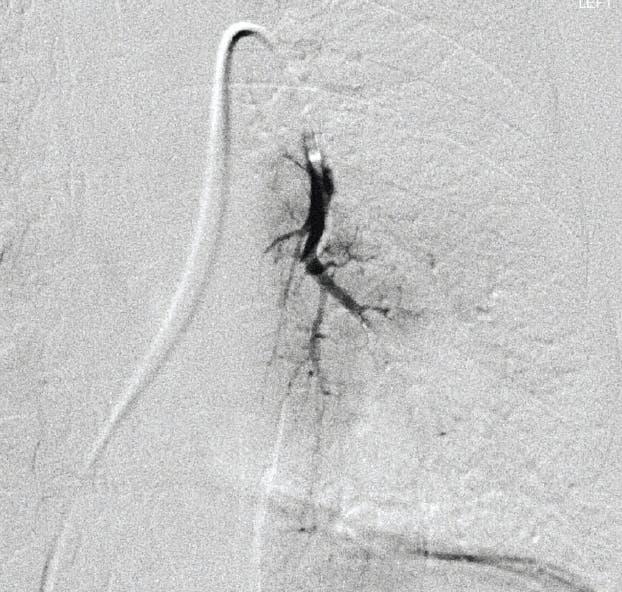
Figure 3. Selective left superior lingular segmental angiography showed the occluded feeding artery, with no opacification of the AVM and the venous sac.
CONCLUSION
The MVP device is the preferred embolic material for treatment of PAVMs due to its high technical success (close to 100%) in occluding the feeding artery, ease of use, and ability to reposition if required before its final detachment. The device results in very minimal artifacts on subsequent CT and allows accurate evaluation of arterial occlusion. In addition, the MVP-3Q device and the MVP-5Q devices can be deployed through 0.021- and 0.027-inch lumen microcatheters, respectively. These can also be deployed through regular 4- and 5-F catheters, thus avoiding the need for a microcatheter if one chooses. The larger MVP-7Q device and MVP-9Q devices can be delivered through 0.041-inch (4-F) and 0.043-inch (5-F) catheters.
This content is intended primarily for United States physicians. Outside of the United States, use of the MVP device in the treatment of PAVMs may be considered off-label.
1. Girerd B, Montani D, Coulet F, et al. Clinical outcomes of pulmonary arterial hypertension in patients carrying an ACVRL1 (ALK1) mutation. Am J Respir Crit Care Med. 2010;181:851-861. doi: 10.1164/rccm.200908-1284OC
2. Shovlin CL. Pulmonary arteriovenous malformations. Am J Respir Crit Care Med. 2014;190:1217-1228. doi: 10.1164/rccm.201407-1254CI.
3. Sabbà C, Pasculli G, Suppressa P, et al. Life expectancy in patients with hereditary haemorrhagic telangiectasia. QJM. 2006;99:327-334. doi: 10.1093/qjmed/hcl037
4. Shovlin CL, Condliffe R, Donaldson JW, et al; British Thoracic Society. British Thoracic Society clinical statement on pulmonary arteriovenous malformations. Thorax. 2017;72:1154-1163. doi: 10.1136/thoraxjnl-2017-210764
5. Faughnan ME, Mager JJ, Hetts SW, et al. Second international guidelines for the diagnosis and management of hereditary hemorrhagic telangiectasia. Ann Intern Med. 2020;173:989-1001. doi: 10.7326/M20-1443
6. Trerotola SO, Pyeritz RE. PAVM embolization: an update. AJR Am J Roentgenol. 2010;195:837-845. doi: 10.2214/AJR.10.5230
7. Wang W, Li H, Tam MD, et al. The amplatzer vascular plug: a review of the device and its clinical applications. Cardiovasc Intervent Radiol. 2012;35:725-740. doi: 10.1007/s00270-012-0387-z
8. Ratnani R, Sutphin PD, Koshti V, et al. Retrospective comparison of pulmonary arteriovenous malformation embolization with the polytetrafluoroethylene-covered nitinol microvascular plug, AMPLATZER plug, and coils in patients with hereditary hemorrhagic telangiectasia. J Vasc Interv Radiol. 2019;30:1089-1097. doi: 10.1016/j.jvir.2019.02.025
9. Mahdjoub E, Tavolaro S, Parrot A, et al. Pulmonary arteriovenous malformations: safety and efficacy of microvascular plugs. AJR Am J Roentgenol. 2018;211:1135-1143. doi: 10.2214/AJR.17.19200
10. Bailey CR, Arun A, Towsley M, et al. MVP™ micro vascular plug systems for the treatment of pulmonary arteriovenous malformations. Cardiovasc Intervent Radiol. 2019;42:389-395. doi: 10.1007/s00270-018-2106-x

MVP™ micro vascular device system Reference Statement
Important Information: Indications, contraindications, warnings and instructions for use can be found in the product labeling supplied with each device.
Indications for Use: The MVP™ micro vascular device system is indicated to obstruct or reduce the rate of blood flow in the peripheral vasculature.
Results may vary. Not all patients achieve the same results.
Potential Complications: Potential adverse events that may occur during or after a procedure placing this device include, but are not limited to:
Air embolus, allergic reaction/toxic effects, bleeding, death, device migration, fever, foreign material embolic event, infection, occlusion of unintended vessel, peripheral embolism, recanalization, residual flow, stroke/TIA, surgical intervention, vascular access site complication, vessel trauma/perforation.
CAUTION: Federal (USA) law restricts these devices to sale, distribution and use by or on the order of a physician. Indications, contraindications, warnings and instructions for use can be found in the product labeling supplied with each device.
501019 ©2022 Medtronic. Medtronic, Medtronic logo are trademarks of Medtronic. TM* third party brands are trademarks of their respective owner. All other brands are trademarks of Medtronic. For global distribution. 04/2022
Advertisement
Advertisement