Advertisement
Advertisement
April 2022
Sponsored by Penumbra, Inc.
The Value of the Penumbra Large-Volume Coils in Vessel Sacrifice
A discussion of the benefits of the Ruby, POD, and Packing Coils and case examples demonstrating their use.
By Romaric Loffroy, MD, PhD, FCIRSE; Nicola Tusini, MD; Moad Alaidroos, MD; Andrea Esposito, MD, PhD; and Danilo Menna, MD, PhD

EMBOLISATION: DECISION-MAKING FACTORS
Which factors are important for you when it comes to considering an embolisation tool?
Prof. Loffroy: In my opinion, the most important factors to consider are the safety and efficacy of embolic devices for the vessel we want to embolise. Other important factors are ease of delivery, range diversity, and cost.
There have been some innovations in coil technology in recent years; which ones would you highlight?
Prof. Loffroy: The shape and softness of coils should be highlighted. Diameter and length range as well as occlusive power are also particularly important in our daily practice. The Penumbra embolisation platform has allowed for improved coil technology through these characteristics over recent years.
VALUE OF THE PENUMBRA EMBOLISATION PLATFORM IN DAILY PRACTICE
Which factors led you to choose the Penumbra embolisation system, and how did it improve your daily practice?
Prof. Loffroy: The Penumbra embolisation platform, which includes Ruby, POD, and Packing Coils (Penumbra, Inc.), has allowed for a large portfolio of coil embolisation interventions (see case example Figure 1, Figure 2, Figure 3, Figure 4, and Figure 5). It makes life easier by choosing the appropriate embolisation device according to the indication, disease, and territory of the lesion being embolised. The Penumbra coils are particularly satisfactory for embolisation of large vessels—both arteries and veins—and are designed for the use of a reduced number of coils. They are similar in size to 0.035-inch coils, are up to 60 cm in length, and can allow for a powerful occlusion. They are also detachable and can be delivered via a microcatheter.
Case Example
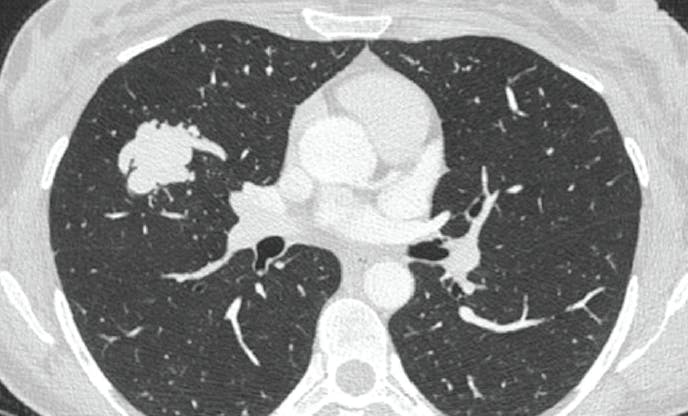
Figure 1. Axial CTA showing complex large pulmonary arteriovenous malformation (PAVM) in the right lung.
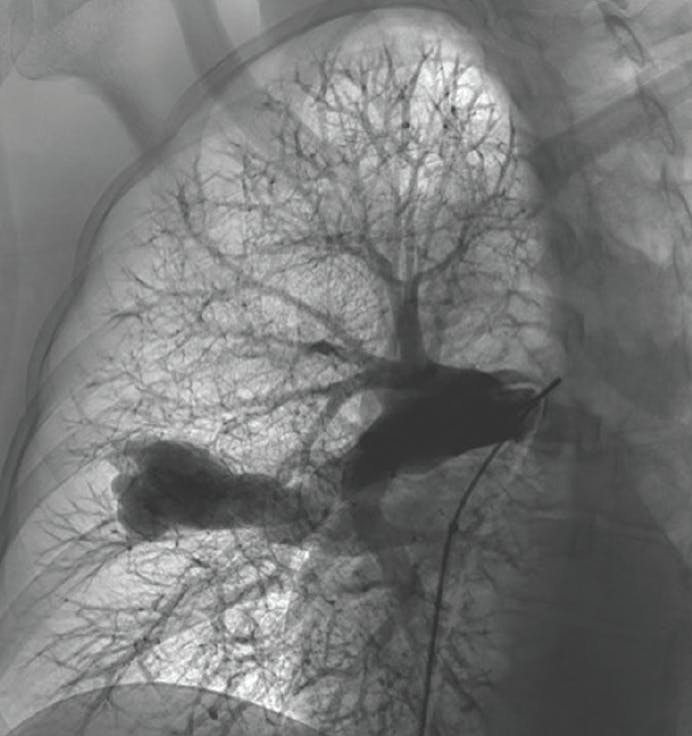
Figure 2. Proximal right pulmonary artery (PA) angiogram showed a giant high-flow complex PAVM in the right lung, with two feeding PAs, a large nidus, and a single draining pulmonary vein.
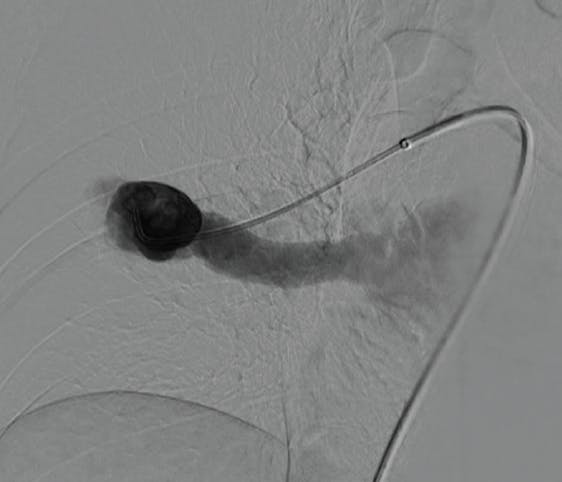
Figure 3. Selective angiogram of the PAVM nidus.
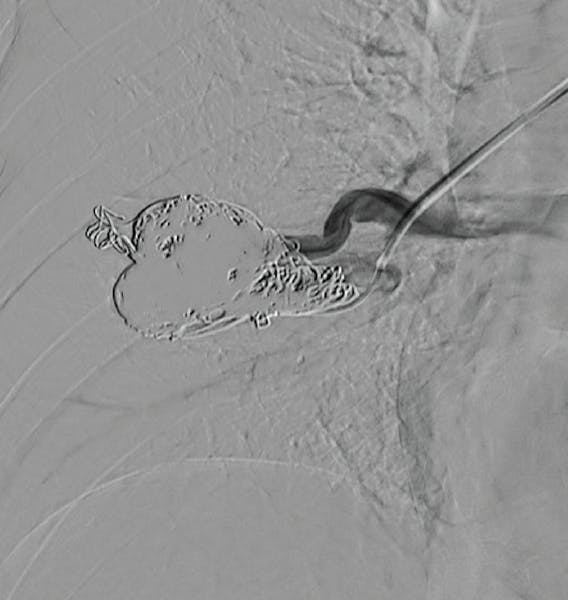
Figure 4. Embolisation of the nidus and feeding vessels with Ruby Coils (a combination of Standard and Soft Ruby Coils decreasing in size from 32 mm X 60 cm to 20 mm X 60 cm for the nidus and smaller Ruby Coils from 12 to 8 mm in diameter for the feeding vessels).
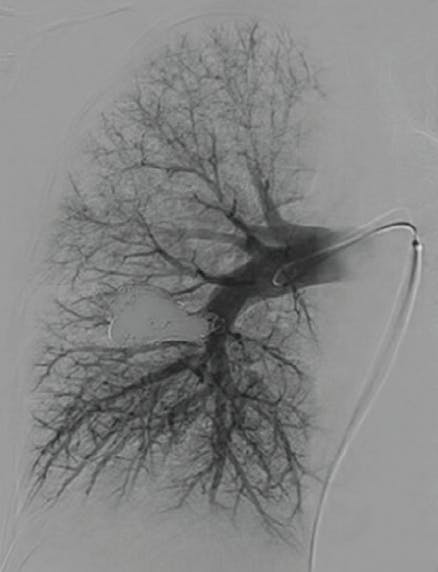
Figure 5. Final angiogram showing complete occlusion of the PAVM with preservation of normal adjacent vessels and lung.
What do you see as some of the biggest advantages and benefits of Ruby, POD, and Packing Coils over conventional coils/plugs?
Prof. Loffroy: Penumbra’s peripheral embolisation platform provides useful tools for durable and efficient vascular occlusion in several applications. All three device technologies are large-volume coils deliverable through high-flow microcatheters, which is really advantageous.
Another major advantage—as compared with other coils—is the softness, which can offer an excellent packing density with durable occlusion. Overall and based on my experience, they have softer coils, longer lengths, and larger volume compared to conventional 18-system coils. The volume advantage and the range of lengths are designed to allow for interventional radiologists to perform embolisation procedures with fewer devices per patient, potentially leading to more cost-effective interventions.
“Recently, Penumbra expanded its coil offering on the same design platform. First, Ruby Coils are now available up to 40 mm in diameter, expanding the product offering to 12 coils in 60-cm length, providing volume advantage for large vessels or lesions. Second, 3- to 14-mm vessels may now be embolised with the new range of PODs. Last, the new Packing Coil, which is like ‘liquid metal’ that can be advanced distally, includes a wave shape made up to pack more densely behind Ruby and POD devices. This line extension allows for expanded accurate and efficient occlusions, which may lead to reduction of intervention times, potentially fewer devices for the feeding target vessel, and possible cost benefits.”
In which indications do you use Penumbra Coils, and why?
Prof. Loffroy: Penumbra Coils may be used in numerous peripheral indications for mechanical occlusion of visceral artery aneurysms and other vessels. Arteriovenous fistulas, esophageal varices, arterial gastrointestinal bleedings, and gonadal vessels can also be embolised and successfully treated with Penumbra Coils.
They are my first choice given the softness and reliable detachment, which can provide a safety and efficacy profile, even in very challenging cases. They allow for more efficient endovascular interventions with potentially fewer coils needed for each case due to the mechanical occlusion characteristics. Their use can potentially limit costs and may reduce procedural time as well as radiation exposure.
Hypogastric Occlusion


Why I Chose PENUMBRA Coils
- The Ruby Coil stability provided dense packing and filling of the aneurysm sac, delivering an efficient embolisation in this case.
- POD provided accurate embolisation of the feeding artery, with great anchoring and optimal packing in the selected target zone.
- The Packing Coils softness provided precise embolisation.
- Penumbra Coils can be easy to use and can help physicians in complex cases.
PATIENT PRESENTATION
A man in his mid 70s previously underwent endovascular aneurysm repair (EVAR) for an abdominal aortic aneurysm (AAA) with a “bell-bottom” stent graft (BBSG) for the left common iliac artery (CIA; Figure 1A). On his third annual follow-up, duplex ultrasound demonstrated a complete exclusion of the AAA with aneurysmal sac shrinkage (from 57 to 49 mm); however, the left limb demonstrated poor distal sealing as well as progressive dilatation of the CIA. A CTA was obtained and confirmed these findings (Figure 1B).
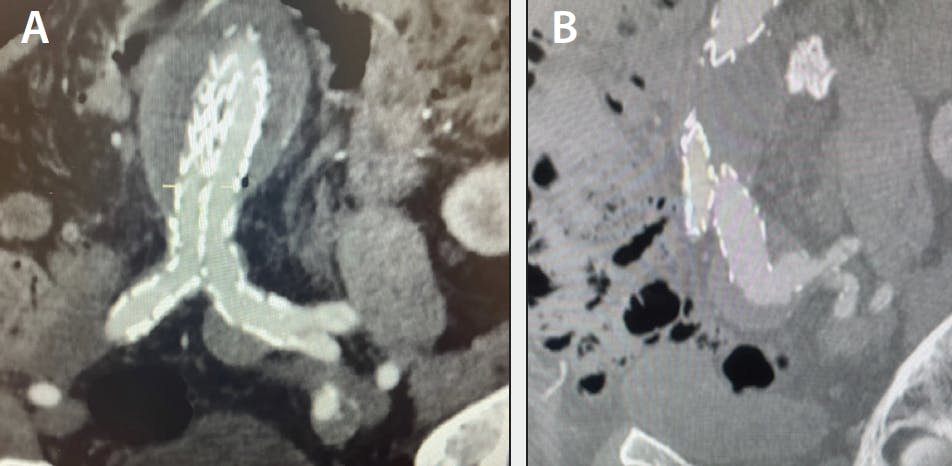
Figure 1. Post-EVAR CTA showed successful exclusion of the common iliac dilatation with BBSG (A). CTA demonstrated failure of the left limb distal seal (B). Note the dilated left hypogastric artery and the tortuous iliac access.
INTERVENTION
The option of placing a branched iliac device was omitted due to the tortuous iliac anatomy and dilated internal iliac artery (IIA). Therefore, it was planned to proceed with embolisation of the hypogastric artery and the iliac aneurysmal sac using a combination of the Penumbra Ruby Coils, POD, and Packing Coils for the hypogastric artery aneurysm and its feeding branches, respectively.
An ipsilateral percutaneous common femoral artery access was used to access the aneurysmal sac through an 11-F sheath, and a 5-F rim diagnostic catheter was used to cannulate the ostium of the hypogastric artery. A 2.7-F microcatheter was then used to navigate into the superior and inferior gluteal arteries (Figure 2A), followed by embolisation using the POD6 (Penumbra, Inc.) and 4-mm X 15-cm and 2-mm X 4-cm Penumbra Soft Ruby Coil, followed by 15-cm Packing Coil in each of the two feeding branches. In addition, the aneurysmal sac was successfully embolised using 12-mm X 60-cm and 4-mm X 20-cm Standard Ruby Coils as a preventive measure for filling the spaces not occupied by thrombus in the aneurysmal sac (Figure 2B). Angiography demonstrated the successful exclusion.
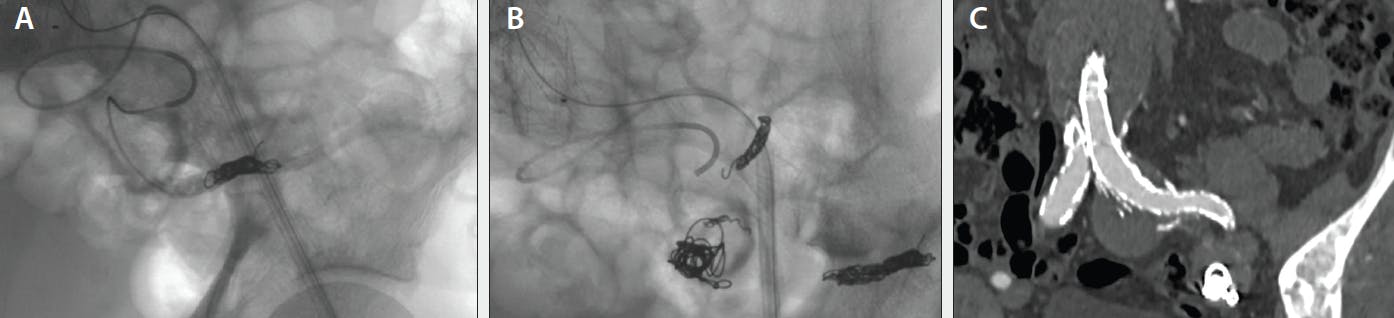
Figure 2. Inferior gluteal branch embolisation (A). Final result showed inferior and superior gluteal artery embolisation and aneurysm sac (B). CTA demonstrated complete exclusion of the iliac aneurysmal sac with no endoleak (C).
Finally, the left limb was further extended into the external iliac artery. The postoperative angiogram and CT scan revealed complete exclusion of the iliac aneurysmal sac, with the absence of endoleak (Figure 2C).
DISCUSSION
CIA dilatations are frequently present in AAA, thus compromising a safe distal landing zone. Extension of the iliac limb into a healthy zone with the preservation of the hypogastric artery is the preferred option.1 Nevertheless, this might not always be feasible due to the anatomy of the iliac artery. The vessel tortuosity in addition to distal hypogastric dilatation in this case has limited our revascularization options. If the conditions to preserve the hypogastric artery are not met and in the presence of a patent contralateral hypogastric artery, one must highly consider excluding the hypogastric artery to avoid the risk of jeopardizing the whole aortic endograft.2
The reliable POD and soft Packing Coils allowed a controlled deployment and stable packing of arterial branches, providing accurate arterial branch occlusion. On the other hand, the Ruby Coil was the optimal option for aneurysmal sac embolisation given its stability and volume-filling abilities. In this case, the combination of the different types of Penumbra coils resulted in optimal exclusion and provided the ideal distal landing zone.
1. Giosdekos A, Antonopoulos CN, Sfyroeras GS, et al. The use of iliac branch devices for preservation of flow in internal iliac artery during endovascular aortic aneurysm repair. J Vasc Surg. 2020;71:2133-2144. doi: 10.1016/j.jvs.2019.10.087
2. Lee C, Dougherty M, Calligaro K. Concomitant unilateral internal iliac artery embolisation and endovascular infrarenal aortic aneurysm repair. J Vasc Surg. 2006;43:903-907. doi: 10.1016/j.jvs.2005.12.063
Treating a Type Ib Endoleak Post-EVAR


Why I Chose PENUMBRA Coils
- POD is engineered for an easy and controlled deployment in tortuous anatomy, with an ipsilateral approach to avoid nontarget embolisation.
- Ruby Coils can provide an efficient solution to frame and fill the aneurysm sac.
- Ruby, POD, and Packing Coils are large-volume coils deliverable through a microcatheter, allowing efficient and long-term embolisation.
Ib endoleak after EVAR is a potentially dangerous condition leading to an increased risk of aneurysm rupture.1 Use of flared limbs during the index procedure (“bell-bottom” technique) represents a risk factor for a late type Ib endoleak.2 It should be treated promptly and with the aim of excluding the aneurysm from pressurized circulation. Endovascular is the treatment of choice, and the most common and straightforward technique is limb extension with or without embolisation of the IIA.3
PATIENT PRESENTATION
A woman in her mid 80s underwent urgent EVAR for a symptomatic 8-cm large aortoiliac aneurysm in 2015. A 5-year follow-up CT scan revealed left CIA dilatation, with a consequent type Ib endoleak and aneurysm sac expansion (Figure 1A and 1B). The patient was scheduled for left IIA embolisation and endograft limb extension into the external iliac artery.
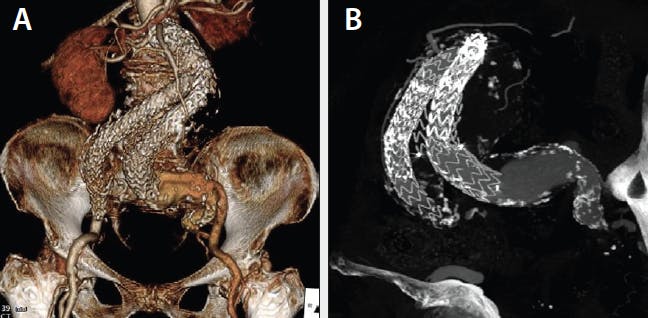
Figure 1. CT scan revealed CIA dilatation (A) with a type Ib endoleak and aneurysm sac expansion (B).
INTERVENTION
Left common femoral artery access was achieved using a percutaneous preclosure technique with ultrasound guidance. The left IIA was cannulated with a Sim2 diagnostic catheter and was embolised using POD14 (Penumbra, Inc.) to anchor the efferent vessel, three Soft Ruby Coils (20 mm X 60 cm), one 60-cm Packing Coil, and one 30-cm Packing Coil to fill the aneurysm sac (Figure 2A and 2B). Then, two Endurant 16-13-156 iliac limb extensions (Medtronic) were inserted.
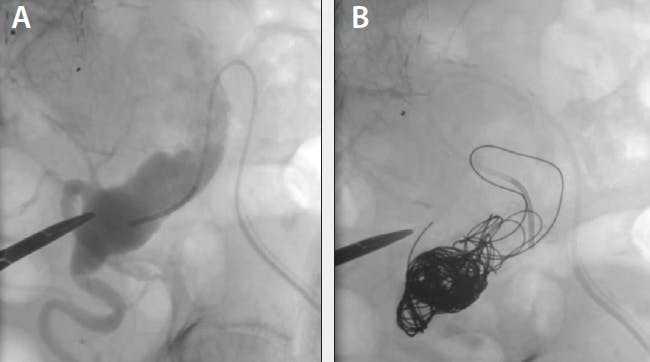
Figure 2. Catheterization of the left IIA (A) and embolisation with POD, Ruby, and Packing Coils (B).
Completion angiography showed patency of the iliac extension (Figure 3A) and occlusion of the left IIA with stasis of the contrast medium in the left CIA, indicating the absence of any residual endoleak (Figure 3B).
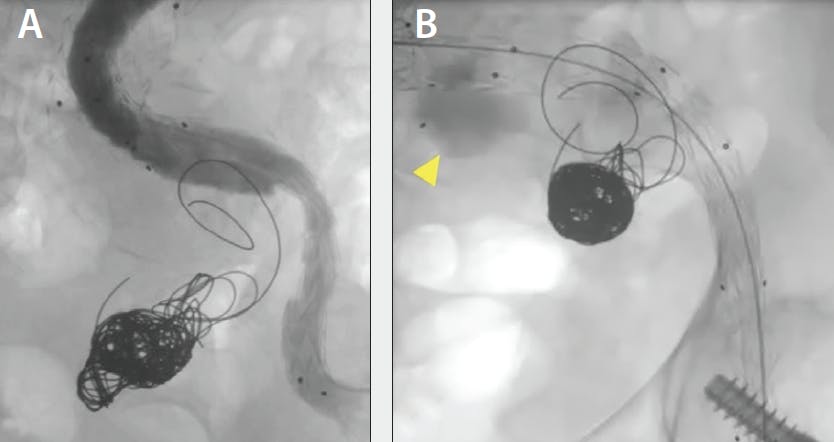
Figure 3. Final angiogram showed patency of the iliac extension (A) and complete exclusion of the type Ib endoleak, indicated by the stasis of the contrast medium in the left CIA (arrow) (B).
DISCUSSION
Embolisation of the IIA before iliac limb extension to treat a type Ib endoleak is essential to avoid a type II endoleak. Generally, vascular plugs are preferred over coils as they are associated with fewer ischemic complications. However, the deployment of large vascular plugs requires the positioning of a large guide catheter or sheath inside the IIA. This maneuver can be very difficult in cases like this (previous EVAR) where contralateral access cannot be used, and ipsilateral axis is so tortuous.
The ideal product for a specialist in these cases is an effective device that has a controlled release to avoid ischemic complications and is deliverable through a microcatheter to be deployed through a tortuous axis. The combination of POD, Ruby, and Packing Coil meets all these needs.
1. Bianchini Massoni C, Mascoli C, Perini P, et al. Endovascular treatments for type Ib endoleaks after aorto-iliac aneurysms exclusion: mid-term results. Int Angiol. 2018;37:384-389. doi: 10.23736/S0392-9590.18.04024-5.
2. Gray D, Shahverdyan R, Reifferscheid V, et al. EVAR with flared iliac limbs has a high risk of late type 1b endoleak. Eur J Vasc Endovasc Surg. 2017;54:170-176. doi: 10.1016/j.ejvs.2017.05.008
3. Gaffey AC, Damrauer SM. Evolving concepts, management, and treatment of type 1 endoleaks after endovascular aneurysm repair. Semin Intervent Radiol. 2020;37:395-404. doi: 10.1055/s-0040-1715883
Prof. Romaric Loffroy and Drs. Andrea Esposito and Nicola Tusini were compensated in association with this article. Prof. Loffroy and Dr. Tusini are consultants to Penumbra.
Disclaimer: The opinions and clinical experiences presented herein are for informational purposes only. The results may not be predictive of all patients. Individual results may vary depending on a variety of patient-specific attributes.
Advertisement
Advertisement