Advertisement
Advertisement
August 2022
Lower Extremity PAD Utilizing a Radial Approach
Moderator: Meryl Simon Logan, MD;
Panelists: Sarah J. Carlson, MD, MSc; Sabeen Dhand, MD; and Dejah R. Judelson, MD
CASE PRESENTATION
A female patient in her mid-60s presented to the emergency department with dry gangrene of her left third and fourth digits. She had chronic obstructive pulmonary disease, hypertension, diabetes, and hyperlipidemia, and she was morbidly obese. She had a myocardial infarction 6 months previously and was on aspirin and clopidogrel. Additionally, she had a history of kissing iliac stents placed for a prior right foot wound a decade ago, which healed. On examination, her femoral pulses were difficult to feel given the body habitus but were palpable. On the left, she had nonpalpable popliteal and pedal pulses. The left ankle-brachial index (ABI) was 0.6 and toe pressure was 33 mm Hg. Results of laboratory testing were unremarkable.
What would be your initial imaging modality of choice?
Dr. Carlson: Given the history of kissing iliac stents and difficult-to-palpate femoral pulses, I would favor CTA of the aorta/lower extremity runoff in this patient prior to planning an intervention. However, I would consider going straight to angiography if there are other factors to consider, such as the recent worldwide shortage of iodinated contrast.
Dr. Judelson: In this case, I would first obtain a CTA of the abdomen/pelvis and the bilateral lower extremity runoffs. I prefer to start with CTA when femoral pulses are difficult to appreciate. Additionally, because the patient had an inflow procedure previously (kissing iliac stents), I could assess the patency of the stents as well as their location relative to the aortic bifurcation.
Dr. Dhand: Given the presence of previous iliac intervention, I would first review previous angiograms and any other vascular imaging if possible. In addition to previous imaging and because this patient’s kidneys are normal, I would obtain a CTA to determine the current extent of disease and access options. MRA is also an excellent option, and although it would be hindered by artifact at the level of the iliacs, it would still give excellent detail of the patient’s infrainguinal (and especially infrapopliteal) disease and can be used regardless of renal function with newer gadolinium-based agents.
CASE CONTINUED
CTA was performed, showing widely patent kissing iliac stents. The bilateral external iliac artery (EIA), common femoral artery (CFA), and profunda femoris arteries were also patent. On the left, the superficial femoral artery (SFA) was patent but had diffuse disease, the popliteal artery appeared patent, and the tibial arteries were calcified and patency could not be determined.
Given these findings, how would you approach revascularization, and where would you access? Do you need any additional information prior to this?
Dr. Judelson: Because the patient had kissing iliac stents that extended into the aorta and SFA disease, I think she would be an excellent candidate for a left radial approach for intervention. I try to avoid brachial approaches due to access site complications. Body habitus does not routinely sway me away from a femoral approach, but it does make a radial approach more attractive in this scenario. Before proceeding with a radial approach, I would want to make sure that she is ulnar dominant to the left hand and perform an Allen test.
Dr. Dhand: In my practice, we strongly prefer antegrade access to treat infrainguinal disease. This type of access depends on the patency of the CFA and SFA and can be more difficult in obese patients. Although this patient is morbidly obese, safe antegrade access is still feasible with adequate preparation (taping or retraction devices). Antegrade access to the left CFA would obviate the problems with the raised iliac bifurcation and allow treatment of the entire extent of the diffuse SFA disease, in addition to tibial disease. I would not access the proximal SFA in this patient because the CTA shows diffuse disease to its origin.
However, if the body habitus was too large and left CFA access was still not possible or safe, I would consider alternative access with primary pedal access, radial access, or a combination of both. In this patient, we are unsure of the patency of the distal tibial vessels due to calcification on the CTA. MRA would actually be more beneficial in this regard to evaluate tibiopedal patency. That said, I would review the prior angiogram to see if there were any runoffs at that time, and I would personally perform an ultrasound of the patient’s foot and calf at bedside. If the distal tibiopedal vasculature is patent, I would consider primary pedal access to treat both the diseased tibial and femoropopliteal segments. Otherwise, another option would be the left radial artery, as long as the artery is suitable for access and there is access to devices with longer shaft lengths due to the distance from the wrist to the foot. Because this patient has gangrene and advanced disease of the tibial vasculature, combined radial and pedal access would likely be necessary for the most favorable recanalization and outcome.
Dr. Carlson: In general, I favor a traditional “up-and-over” angiogram via contralateral femoral access, especially when tibial intervention is possible, unless certain factors make this approach less favorable. For this patient, obesity and kissing iliac stents are reasons I might favor a left radial approach. However, I would not consider either of these factors an absolute contraindication to a traditional “up-and-over” approach. When situated well into the iliacs and not extending cephalad into the aorta, kissing iliac stents can still be navigated with a traditional contralateral femoral approach in certain cases. If using a radial approach, I would take into consideration the patient’s height, expecting that a very tall person might pose a challenge to intervening in the tibial arteries with standard-length radial-to-peripheral catheters and balloons. I would also perform an Allen test in clinic and a Barbeau test at the time of angiography to confirm patency of the ulnar artery and palmar arch, with ultrasound measurement to confirm the radial artery access site is > 2 mm in diameter and free of circumferential calcium.
CASE CONTINUED
Given the patient’s body habitus and presence of iliac stents, which raised the aortic bifurcation, the decision was made to pursue angiography from a radial approach. Unfortunately, previous angiographic images were not available for review. Pedal access was also considered, and the foot prepped into the field as a secondary option. A Barbeau test was completed and showed ulnar-dominant flow to the left hand, and an ultrasound showed a noncalcified radial artery measuring > 2 mm in diameter.
When performing angiography via the radial artery, what tools/ medications do you routinely use? If you use a cocktail, please specify the mixture and when it is given.
Dr. Dhand: When planning radial access, I will always palpate for a pulse and obtain an ultrasound of the wrist to confirm that the artery is of adequate course and size (> 2 mm). Depending on the type of case, I will even place my access higher up into the forearm, anatomy permitting. Additional tests that I use in patients who do not have a straightforward exam are the Allen test and/or modified Barbeau test to assess collateral circulation to the hand in the case of access complications, which are fortunately rare.
When achieving access, I always use ultrasound guidance and perform a single wall stick with micropuncture access. I feed the microwire very gently and feel for any wire resistance after several centimeters (most commonly due to a radial loop). Once the wire is inserted, I place a hydrophilic, thin-walled sheath and administer a “radial artery cocktail” consisting of 200 µg of nitroglycerin, 2.5 mg of verapamil, and 3,000 IU of heparin. This is hemodiluted to 20 mL and administered slowly through the sheath sidearm, as adopted from the interventional team at Mount Sinai Hospital in New York, New York.
In cases of wire resistance, I obtain an angiogram of the radial artery to define a radial loop or any other reason for the resistance. If no resistance, I often skip the angiogram and feed a catheter over a soft 0.035-inch wire, usually performing fluoroscopy in the upper arm/axillary region. I am always gently pushing the system, being very cautious and aware of any resistance.
Dr. Carlson: I typically administer systemic intravenous heparin when initial access is achieved and 200 μg of nitroglycerin intra-arterially through the initial access sheath, allowing at least 3 minutes for the heparin to circulate before passing a wire into the aorta. I also administer 200 μg of nitroglycerin through the sheath on the way out once the sheath is pulled back into the arm, allowing 2 to 3 minutes to circulate before removing the sheath.
Dr. Judelson: For radial access, I like to use a 4-F micropuncture kit for access. When I have confirmed access, the patient is systemically heparinized for a goal activated clotting time (ACT) of approximately 250 seconds. I also administer at least 100 μg of nitroglycerin through my micropuncture sheath, and I chase it with an additional 20 mL of heparinized saline. This reduces vasospasm when I upsize and advance my larger sheath. Additionally, at the end of the case, I give an additional 100 to 200 μg of nitroglycerin before the sheath is removed to reduce radial artery spasm in the forearm, as this is often where sheaths get stuck and avulsion/hematomas can occur.
CASE CONTINUED
The left radial artery was accessed just proximal to the wrist under ultrasound guidance. We routinely watch the wire traverse the artery for the first several centimeters under ultrasound. A 6-F Glidesheath Slender (Terumo Interventional Systems) was then placed and radial cocktail given. Our cocktail consists of 200 µg of nitroglycerin, 2.5 mg of verapamil, and 3,000 IU of heparin in a 10-mL syringe. Simultaneously, 3,000 IU of heparin is given intravenously.
A Glidewire (Terumo Interventional Systems) and a 150-cm angled Glidecath (Terumo Interventional Systems) were used to select the left distal EIA, and lower extremity angiography was performed. The SFA was patent but diffuse disease was present throughout (Figure 1 and Figure 2). The popliteal artery was patent with a 50% stenosis at the level of the knee joint, and the below-knee popliteal artery was patent. The anterior tibial artery was occluded with no reconstitution, the tibioperoneal trunk (TPT) was patent with a 60% stenosis, the peroneal artery was patent with filling into the foot, and the posterior tibial artery was occluded with no distal reconstitution.
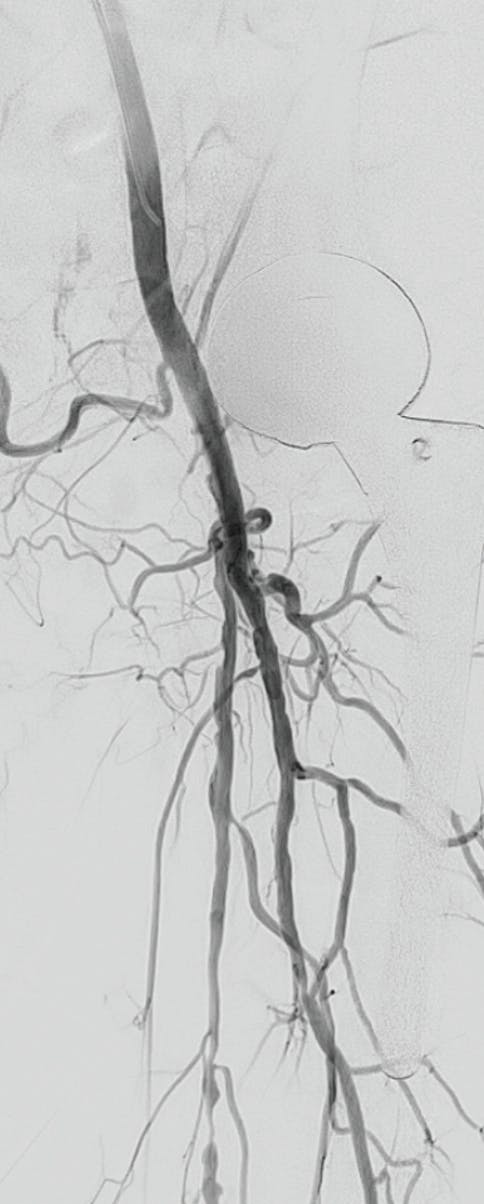
Figure 1. An angiogram of the catheter in the proximal CFA shows a patent CFA and profunda femoris artery, with a patent but diffusely diseased proximal SFA.
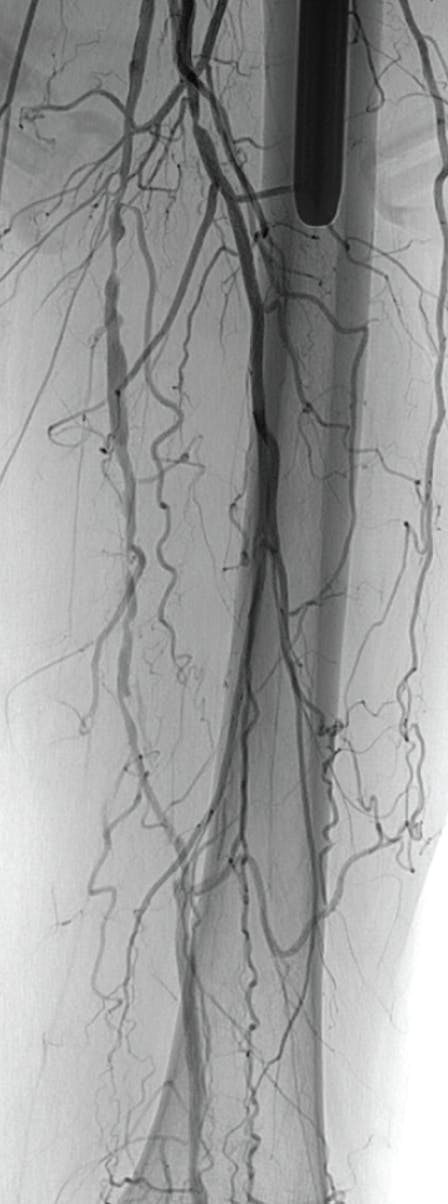
Figure 2. This image shows the distal SFA and proximal popliteal artery, again showing the patent but diffusely diseased vessels.
How would you treat this patient?
Dr. Judelson: Given the location of the lesion (localized to the SFA) and the patient’s body habitus in the setting of critical limb ischemia, I would proceed with endovascular intervention. After confirming a therapeutic ACT, I would advance a wire into the left CFA and then advance a 6-F, 119-cm Destination Slender sheath (Terumo Interventional Systems) into the left EIA. Using a combination of a long, angled Glidewire and Glidecath, I would cross the lesion and select the popliteal artery. If I had difficulties in the distal SFA, I might use a long CXI catheter (Cook Medical) for support. Once crossed, I would balloon angioplasty the SFA and place a self-expanding stent to cover the lesion and postdilate. After completion angiography to confirm outflow, I would carefully remove my sheath after giving an additional 100 to 200 μg of nitroglycerin and use a TR Band (Terumo Interventional Systems) for hemostasis. Given the gangrene, the patient would need to be evaluated for possible toe amputations. I would see her in clinic for a 1-week postprocedure check and then again at 1 month for arterial duplex ultrasound and ABIs. She would continue lifelong surveillance for her stents.
Dr. Carlson: I would advance a radial-to-peripheral sheath (R2P sheath, Terumo Interventional Systems) to the level of the EIA, select the SFA, obtain wire access to the peroneal artery with an 0.035-inch Glidewire, and exchange for a 0.014-inch wire. I would then treat the popliteal artery and TPT stenoses with appropriately sized balloon angioplasty and treat the more severe areas of SFA stenosis using a self-expanding stent such as R2P Misago (Terumo Interventional Systems). Prior to stenting, I would predilate with a balloon 1 to 2 mm smaller than the stent and then treat the stent with a size-matched balloon. Finally, I would consider amputation of the toes in the same setting.
Dr. Dhand: At this point, I would exchange the existing system for a longer, thin-walled, hydrophilic sheath to the level of the distal left EIA or CFA. Then, I would carefully advance a 0.014- or 0.018-inch wire through the diseased femoropopliteal segment into the peroneal artery runoff.
After wiring and stable access, I would perform intravascular ultrasound (IVUS) from the CFA to the proximal peroneal artery to accurately measure the vessels and better delineate the plaque (soft, calcified, medial, etc). Based on IVUS, I may perform atherectomy of the femoropopliteal segment, with the device tailored to the sonographic findings. Given the single-vessel runoff, I would avoid aggressive atherectomy below the knee because embolization would be disastrous in this case.
After atherectomy, I would perform a combination of plain old balloon and drug-coated balloon angioplasty of the diseased infrainguinal arteries, again with sizing determined based on IVUS findings. Stenting would then be performed at any site of significant residual disease or dissection.
Once those vessels are treated and optimized, I would focus my attention on the occluded anterior tibial and posterior tibial arteries. After a more robust flow to the foot, I would attempt to identify reconstituted pedal targets that would facilitate pedal access and allow for advanced recanalization techniques to aid in healing digital amputation.
CASE SUMMARY
A 6-F, 119-cm Glidesheath Slender was placed in the CFA, and the SFA was crossed with an angled Glidewire and a 200-cm ViperCath XC catheter (Cardiovascular Systems, Inc.). The wire was advanced to the patent peroneal artery, then exchanged for a ViperWire (Cardiovascular Systems, Inc.). The SFA and above-knee popliteal segment were treated with orbital atherectomy (Diamondback 360, Cardiovascular Systems, Inc.), followed by angioplasty with a 5-mm balloon. Dissection points of the proximal SFA were then stented with 6- and 7-mm R2P Misago self-expanding peripheral stents. Lastly, the TPT was treated with angioplasty with a 4-mm balloon. Upon procedure completion, the sheath was removed and a TR Band was placed. The radial pulse remained palpable at case conclusion.
The patient underwent digit amputations with podiatry the next day, which went on to heal. Surveillance arterial duplex imaging at 1 month postprocedure showed patency of the SFA and popliteal artery without significant stenosis.
MODERATOR’S SUMMARY
This case exemplifies the challenges we face with endovascular therapy in regard to access. Radial access is a good option in the appropriately selected patient. Limitations to standard femoral access include past open and endovascular surgery, as well as body habitus. Radial access allows for an alternative location, with benefits including the ability to treat multiple vascular beds and ease of closure and postoperative care.
Advertisement
Advertisement