Advertisement
Advertisement
August 2022
Sponsored by Medtronic
Utility of the FlowMet™ Peripheral Blood Flow Monitoring System for Lower Extremity Revascularization

The FlowMet™ monitoring system (Medtronic) is a simple-to-use, noninvasive device that measures peripheral blood flow (see instructions for use1). The sensor is placed around a toe, and then the FlowMet device uses laser speckle imaging to provide a real-time, continuous measure of blood flow in the digit in the form of a recordable waveform, as well as a quantitative measurement calculated as a flow value. The sensor can be affixed noninvasively to any digit, is painless, and can be used as an intraprocedural monitor during peripheral endovascular procedures.
The FlowMet device received 510(k) clearance from the FDA in 2019,2 and clinical data surrounding its use continue to accrue.3-5 As an investigator of the device, I have found this monitoring system to be the most sensitive measure of digital blood flow of any device I have used. In healthy patients with no arterial disease, the digital waveform is brisk, with a rapid upstroke and downstroke followed by a distinct dicrotic notch. This waveform has proven consistent, regardless of digit temperature and room temperature.
In contrast, patients with increasing arterial disease and arterial insufficiency consistently demonstrate broadening and flattening of the blood flow waveform, which is reflective of slowing acceleration and deceleration times as the arterial insufficiency worsens. The flow value is a distinct clinical metric that is provided in real time as well. In my experience, flow values are typically in the range of 3 to 30 in healthy patients and exhibit considerable heterogeneity, while patients with chronic limb-threatening ischemia often have values of 0 to 5. The FlowMet device allows operators to easily record and store key values and waveforms throughout the case and provides concise pre- and postprocedural comparisons of these data.
The use of the FlowMet device as an intraprocedural monitoring device has proven to be extremely valuable in my experience. During peripheral cases, we routinely monitor heart rate, blood pressure, and pulse oximetry, yet only now does the FlowMet device provide a means of monitoring blood flow to the limb we’re actually treating in real time. This can serve as important initial information if blood flow is unsuspectingly compromised during a procedure. Blood flow compromise can occur when a sheath is nearly or fully occlusive of the artery in which it is positioned, when a filter is overfilled, when an angioplasty-induced severe dissection occurs, and in certain instances of distal embolization. In these examples, the FlowMet device can inform the operator immediately of a flow-limiting situation, thus allowing for immediate corrective action.
However, equally valuable is the ability of the FlowMet device to provide real-time procedural insights at the digital level. Hemodynamically significant improvements in blood flow reliably translate to visual improvement in the flow waveform and an increase in the flow value. This information can provide objective corroboration of successful revascularization, although it should be noted that at this time, there are no data available that correlate positive changes in the FlowMet device values with wound healing or limb salvage. These studies are presently underway. However, the absence of flow improvement detected by the FlowMet device may be taken as a reliable indicator of ongoing flow restriction, undetected complication, or significant small vessel occlusive disease.
The following case example illustrates how the FlowMet monitoring system can provide real-time blood flow monitoring during an endovascular procedure.
CASE PRESENTATION
A diabetic man in his 50s with a history of tobacco use and hypertension presented with ischemic rest pain of his right foot with evolving gangrene of the second toe (Figure 1).

Figure 1. A patient with ischemic rest pain of his right foot with gangrene of the second toe.
He had undergone no prior arterial intervention in either lower extremity. An arterial duplex ultrasound revealed evidence of significant superficial femoral artery (SFA) occlusive disease, and an arteriogram was performed. This demonstrated mild stenosis at the right iliac bifurcation, severe stenosis in the proximal to mid SFA, and preserved posterior tibial/peroneal runoff to his foot (Figure 2A-2D). A FlowMet sensor was placed on the right great toe before beginning the procedure, and his initial flow value was 2.8 with a heavily dampened waveform (Figure 2E).
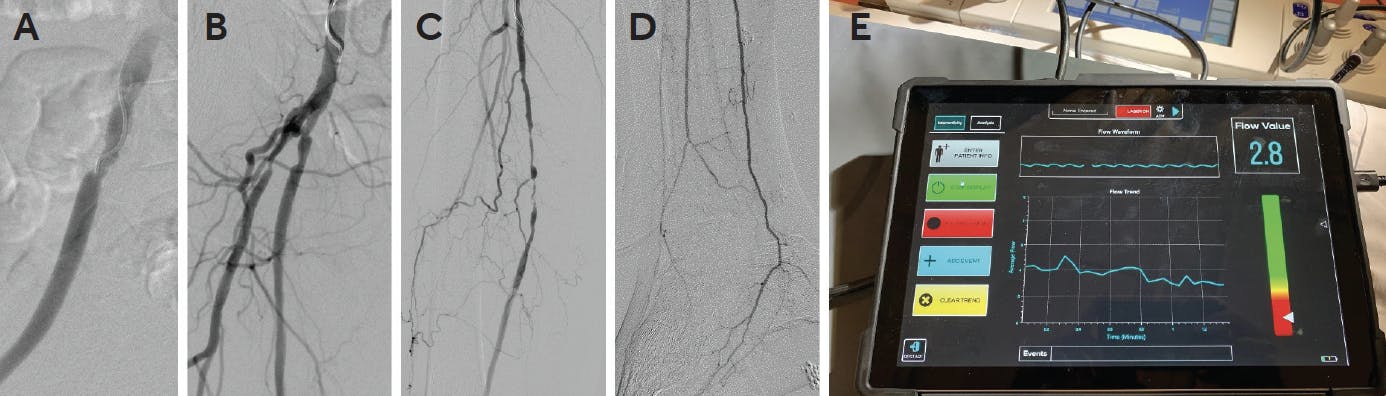
Figure 2. Initial angiograms showing mild stenosis at the right iliac bifurcation (A), severe stenosis of the proximal and mid SFA (B, C), preserved posterior tibial/peroneal runoff to the foot (D), and initial flow value with dampened waveform (E).
A 7-F sheath was placed into the right common femoral artery, and a 7-mm SpiderFX™ embolic protection device (Medtronic) was deployed in the popliteal artery. Directional atherectomy with the HawkOne LX system (Medtronic) was performed; there were 10 to 12 directed passes at the mid-SFA plaque, with interval imaging to guide the location of passes (Figure 3B). With < 30% residual stenosis remaining, DCB angioplasty was performed with a long balloon (6- X 200-mm IN.PACT Admiral DCB, Medtronic) (Figure 3C). The final angiogram showed unrestricted flow (Figure 3D) compared to the initial angiogram (Figure 3A). The FlowMet device value increased to 6.7 immediately after treatment of the mid-SFA stenoses (Figure 3E).
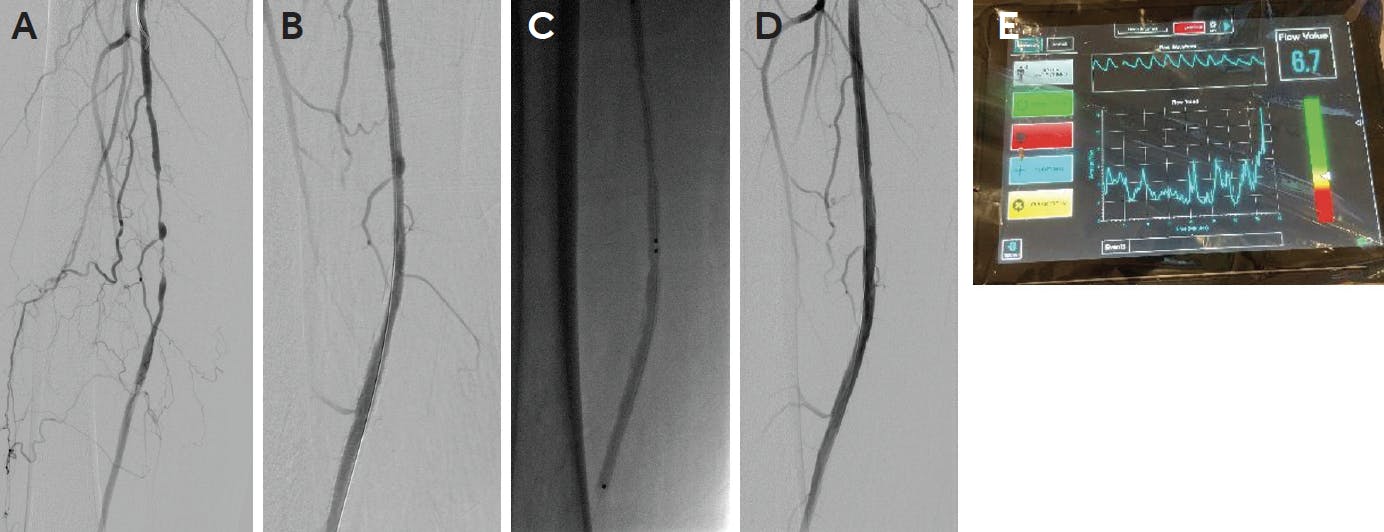
Figure 3. Initial angiogram of the mid SFA (A), directional atherectomy with the HawkOne™ LX directional atherectomy system (B), angioplasty with the IN.PACT™ Admiral™ drug-coated balloon (DCB) (C), postprocedure angiogram (D), and the FlowMet device display after the directional atherectomy and angioplasty procedure (E).
The proximal SFA stenosis was then treated in a similar fashion, with directional atherectomy and a 6- X 40-mm IN.PACT Admiral DCB (Figure 4A-4D). The FlowMet device value increased further to 7.3, with a notable increase in waveform upstroke and amplitude (Figure 4E). No further intervention was performed, and after filter and sheath removal, the FlowMet device value increased further to 8.7. This increase was perhaps due to flow restriction from our 7-F sheath being placed across the mild right iliac stenosis (Figure 5). The patient was placed on dual antiplatelet therapy and subsequently healed after amputation of his necrotic second toe.
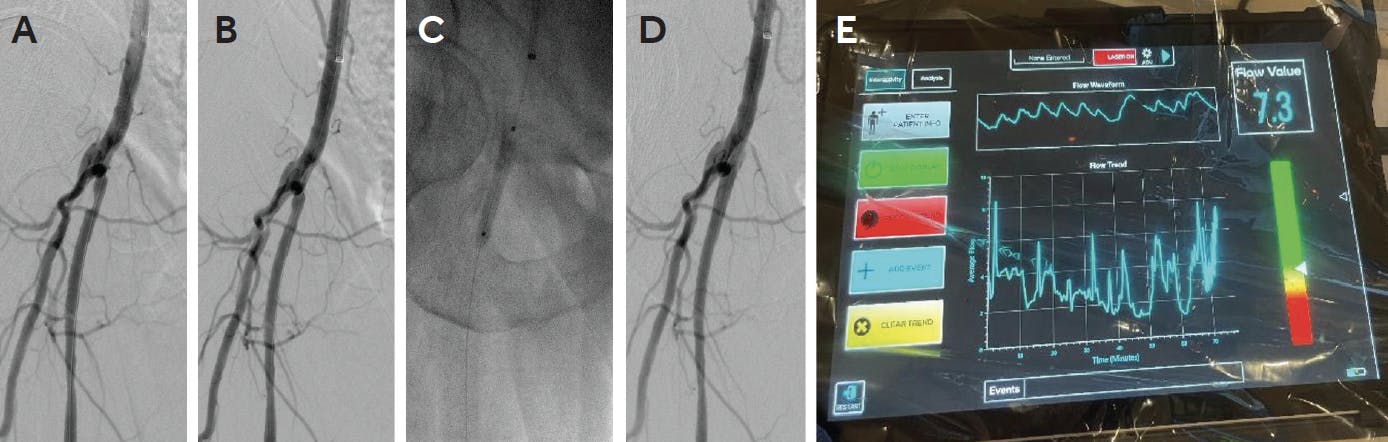
Figure 4. Initial angiogram of the proximal SFA (A), directional atherectomy with the HawkOne LX system (B), angioplasty with the IN.PACT Admiral DCB (C), postprocedure angiogram (D), and the FlowMet device reading after the directional atherectomy and angioplasty procedures (E).
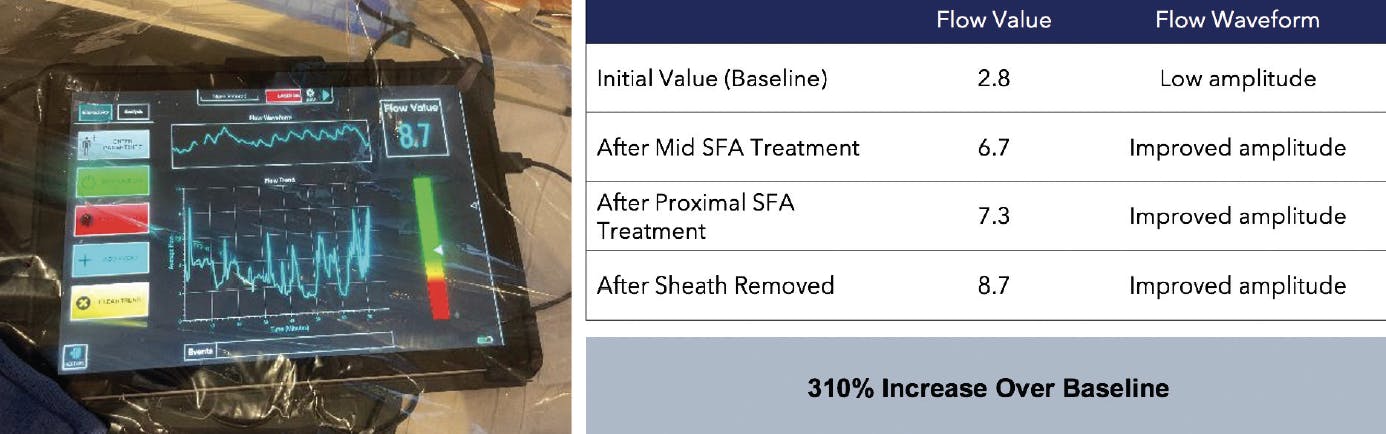
Figure 5. The final FlowMet system reading shows a further improvement in the flow waveform amplitude and an increase of the flow value to 8.7 (a 310% increase over the baseline value).
In this particular example, the performed interventions provided sufficient blood flow or circulation to heal the wound, and this correlated to an increase in the flow value of 310% over baseline.
CONCLUSION
The FlowMet blood flow monitoring system is a highly sensitive measure of digital blood flow that can provide immediate, reliable data regarding intraprocedural changes in flow. In my experience with the monitor, its real-time data reduce procedural uncertainty by its ability to detect unexpected reductions in flow and improve our confidence in satisfactory angiographic results by confirming actual increases in digital blood flow. This device can be a simple yet valuable blood flow monitoring tool in our offices and clinics. We all are eagerly awaiting important clinical data to further evaluate the benefits of monitoring flow values and waveforms and any associated changes after successful revascularization.
Disclosures
Dr. Scott: Received honoraria from Boston Scientific and Medtronic; received research grants from Bard, Boston Scientific, Endologix, and Medtronic.
1. FlowMet™ Peripheral Blood Flow Monitoring System [instructions for use]. Minneapolis (MN): Medtronic, Inc.: 2021. https://manuals.medtronic.com/content/dam/emanuals/cardio/M006465C001_A_EN_view.pdf. Accessed July 26, 2022.
2. US Food and Drug Administration. 510(k) premarket notification. Accessed July 26, 2022. https://www.accessdata.fda.gov/scripts/cdrh/cfdocs/cfpmn/pmn.cfm?ID=K192966.
3. Razavi MK, Flanigan DPT, White SM, Rice TB. A real-time blood flow measurement device for patients with peripheral artery disease. J Vasc Interv Radiol. 2021;32:453-458. doi: 10.1016/j.jvir.2020.09.006
4. Rice TB, Yang B, White S. Effect of skin optical absorption on speckleplethysmographic (SPG) signals. Biomed Opt Express. 2020;11:5352-5361. doi: 10.1364/BOE.403501
5. Stanley GA. Time to stop doing angiography in the dark: the FlowMet™ peripheral blood flow monitoring system. Endovasc Today. 2021;20.
FlowMet™ peripheral blood flow monitoring system
Important Information: Indications, contraindications, warnings and instructions for use can be found in the product labeling supplied with each device.
Indications for Use: The FlowMet is a non-invasive probe that is affixed to the fingers or toes and intended to quantify tissue blood flow rate.
CAUTION: Federal (USA) law restricts this product for sale by or on the order of a physician
IN.PACT™ Admiral™ Paclitaxel-coated PTA balloon catheter Brief Statement
Indications for Use:
The IN.PACT™ Admiral™ Paclitaxel-coated PTA Balloon Catheter is indicated for percutaneous transluminal angioplasty, after appropriate vessel preparation, of de novo, restenotic, or in-stent restenotic lesions with lengths up to 360 mm in superficial femoral or popliteal arteries with reference vessel diameters of 4-7 mm.
Contraindications
- The IN.PACT Admiral DCB is contraindicated for use in:
- Coronary arteries, renal arteries, and supra-aortic/cerebrovascular arteries
- Patients who cannot receive recommended antiplatelet and/or anticoagulant therapy
- Patients judged to have a lesion that prevents complete inflation of an angioplasty balloon or proper placement of the delivery system
- Patients with known allergies or sensitivities to paclitaxel
- Women who are breastfeeding, pregnant or are intending to become pregnant or men intending to father children. It is unknown whether paclitaxel will be excreted in human milk and whether there is a potential for adverse reaction in nursing infants from paclitaxel exposure.
Warnings
- A signal for increased risk of late mortality has been identified following the use of paclitaxel-coated balloons and paclitaxel-eluting stents for femoropopliteal arterial disease beginning approximately 2-3 years post-treatment compared with the use of non-drug coated devices. There is uncertainty regarding the magnitude and mechanism for the increased late mortality risk, including the impact of repeat paclitaxel-coated device exposure. Physicians should discuss this late mortality signal and the benefits and risks of available treatment options with their patients.
- Use the product prior to the Use-by Date specified on the package.
- Contents are supplied sterile. Do not use the product if the inner packaging is damaged or opened.
- Do not use air or any gaseous medium to inflate the balloon. Use only the recommended inflation medium (equal parts contrast medium and saline solution).
- Do not move the guidewire during inflation of the IN.PACT Admiral DCB.
- Do not exceed the rated burst pressure (RBP). The RBP is 14 atm (1419 kPa) for all balloons except the 200 and 250 mm balloons. For the 200 and 250 mm balloons the RBP is 11 atm (1115 kPa). The RBP is based on the results of in vitro testing. Use of pressures higher than RBP may result in a ruptured balloon with possible intimal damage and dissection.
- The safety and effectiveness of using multiple IN.PACT Admiral DCBs with a total drug dosage exceeding 34,854 µg of paclitaxel in a patient has not been clinically evaluated.
Precautions
- This product should only be used by physicians trained in percutaneous transluminal angioplasty (PTA).
- This product is designed for single patient use only. Do not reuse, reprocess, or resterilize this product. Reuse, reprocessing, or resterilization may compromise the structural integrity of the device and/or create a risk of contamination of the device, which could result in patient injury, illness, or death.
- Assess risks and benefits before treating patients with a history of severe reaction to contrast agents.
- The safety and effectiveness of the IN.PACT Admiral DCB used in conjunction with other drug-eluting stents or drug-coated balloons in the same procedure or following treatment failure has not been evaluated.
- The extent of the patient’s exposure to the drug coating is directly related to the number of balloons used. Refer to the Instructions for Use (IFU) for details regarding the use of multiple balloons and paclitaxel content.
- The use of this product carries the risks associated with percutaneous transluminal angioplasty, including thrombosis, vascular complications, and/or bleeding events
- Vessel preparation using only pre-dilatation was studied in the clinical study. Other methods of vessel preparation, such as atherectomy, have not been studied clinically with IN.PACT Admiral DCB.
- This product is not intended for the expansion or delivery of a stent.
Potential Adverse Effects
- The potential adverse effects (e.g. complications) associated with the use of the device are: abrupt vessel closure; access site pain; allergic reaction to contrast medium, antiplatelet therapy, or catheter system components (materials, drugs, and excipients); amputation/loss of limb; arrhythmias; arterial aneurysm; arterial thrombosis; arteriovenous (AV) fistula; death; dissection; embolization; fever; hematoma; hemorrhage; hypotension/hypertension; inflammation; ischemia or infarction of tissue/organ; local infection at access site; local or distal embolic events; perforation or rupture of the artery; pseudoaneurysm; renal insufficiency or failure; restenosis of the dilated artery; sepsis or systemic infection; shock; stroke; systemic embolization; vessel spasms or recoil; vessel trauma which requires surgical repair.
- Potential complications of peripheral balloon catheterization include, but are not limited to the following: balloon rupture; detachment of a component of the balloon and/or catheter system; failure of the balloon to perform as intended; failure to cross the lesion.
- Although systemic effects are not anticipated, potential adverse events that may be unique to the paclitaxel drug coating include, but are not limited to: allergic/immunologic reaction; alopecia; anemia; gastrointestinal symptoms; hematologic dyscrasia (including leucopenia, neutropenia, thrombocytopenia); hepatic enzyme changes; histologic changes in vessel wall, including inflammation, cellular damage, or necrosis; myalgia/arthralgia; myelosuppression; peripheral neuropathy.
- Refer to the Physician’s Desk Reference for more information on the potential adverse effects observed with paclitaxel. There may be other potential adverse effects that are unforeseen at this time.
- Please reference appropriate product Instructions for Use for a detailed list of indications, warnings, precautions and potential adverse effects. This content is available electronically at www.manuals.medtronic.com.
CAUTION: Federal (USA) law restricts this device to sale by or on the order of a physician.
HawkOne™ directional atherectomy system Reference Statement
Important Information: Indications, contraindications, warnings and instructions for use can be found in the product labeling supplied with each device.
Indications for Use: The HawkOne™ directional atherectomy system is intended for use in atherectomy of the peripheral vasculature. The HawkOne catheter is indicated for use in conjunction with the SpiderFX™ embolic protection device in the treatment of severely calcified lesions. The HawkOne catheter is NOT intended for use in the coronary, carotid, iliac or renal vasculature.
CAUTION: Federal (USA) law restricts this product for sale by or on the order of a physician.
SpiderFX™ embolic protection device Reference Statement
Important Information: Indications, contraindications, warnings and instructions for use can be found in the product labeling supplied with each device.
Indications for Use:
Lower Extremity (LE) Interventions
The SpiderFX™ embolic protection device is indicated for use as a guidewire and embolic protection system to contain and remove embolic material in conjunction with the TurboHawk™ Peripheral Plaque Excision System, either during standalone procedures or together with PTA and/or stenting, in the treatment of severely calcified lesions in arteries of the lower extremities. The vessel diameter at the filter basket placement site should be between 3.0 mm and 6.0 mm.
Carotid Interventions
The SpiderFX embolic protection device is indicated for use as a guidewire and embolic protection system to contain and remove embolic material (thrombus/debris) while performing angioplasty and stenting procedures in carotid arteries. The diameter of the artery at the site of filter basket placement should be between 3.0mm and 7.0mm.
Saphenous Vein Graft (SVG) Interventions
The SpiderFX embolic protection device is indicated for use as an embolic protection system to contain and remove embolic material (thrombus/debris). The device also acts as the guidewire while performing percutaneous transluminal coronary angioplasty or stenting procedures in coronary saphenous vein bypass grafts with reference vessel diameters of 3.0 mm to 6.0mm. The safety and effectiveness of this device as an embolic protection system has not been established in the cerebral vasculature.
CAUTION: Federal (USA) law restricts this product for sale by or on the order of a physician.
501122 ©2022 Medtronic. Medtronic, Medtronic logo are trademarks of Medtronic
All other brands are trademarks of Medtronic. For global distribution. 08/2022
Advertisement
Advertisement