Advertisement
Advertisement
February 2022
Sponsored by AngioDynamics, Inc.
Use of a Novel Mechanical Aspiration System for the Removal of Venous Thrombus
The first case report on the AlphaVac system.
By Jaafer Golzar, MD; Marlon Everett, MD; and Mark Thompson, MD
Minimally invasive technologies for the removal of undesirable intravascular materials such as deep vein thrombus (DVT), caval thrombus, and clot in transit have undergone a significant improvement in the last decade.1,2 Several catheter-based techniques have utilized aspiration and extraction thrombectomy to remove thrombi from the venous system. Multiple published articles have outlined the treatment algorithm for clot removal from the veins and the right heart, but anticoagulation and/or surgical thrombectomy remain the current norm.3,4 However, the modalities currently available pose limitations given the considerable thrombus burden and the risk of blood loss. In this case report, we report one of the successful utilization of the AlphaVac F2220 system (AngioDynamics, Inc.) for the removal of a right atrial and inferior vena cava (IVC) thrombus.
The AlphaVac System (Figure 1), recently cleared by the FDA, is a percutaneous, multipurpose mechanical aspiration device indicated for the removal of thromboemboli from the venous system. The system consists of a handle that acts as the engine and the vacuum source, a 22-F cannula with two angled funnel tip options (20° or 180°), an obturator, and a waste bag that can hold up to 250 cc of blood.

Figure 1. The AlphaVac system with the handle, cannula, and waste bag.
CASE PRESENTATION
The patient was an 80-year-old male presenting with gastrointestinal bleeding and acute dyspnea. He was found to have bilateral saddle pulmonary embolism with right ventricular strain. During his workup he was found to have a large colon mass requiring surgical hemi-colectomy. He subsequently underwent mechanical thrombectomy to remove the bilateral pulmonary emboli with IVC filter implantation.
After the pulmonary thrombectomy, an echocardiogram revealed a large mobile mass in the right atrium, which was likely present prior to IVC filter implantation. Under general anesthesia, transesophageal echocardiography (TEE) was performed that confirmed a highly mobile, serpentine, echogenic structure in the right atrium measuring 2.9 X 2.9 cm. The plan was to perform mechanical thrombectomy using the AlphaVac System.
Right internal jugular access was achieved using a 26-F DrySeal sheath (Gore & Associates). Three 10-cc pulls of the AlphaVac handle were completed under TEE guidance resulting in complete removal of the thrombus. Estimated blood loss was 40 cc (Figure 2) and the total procedure time was 29 minutes.
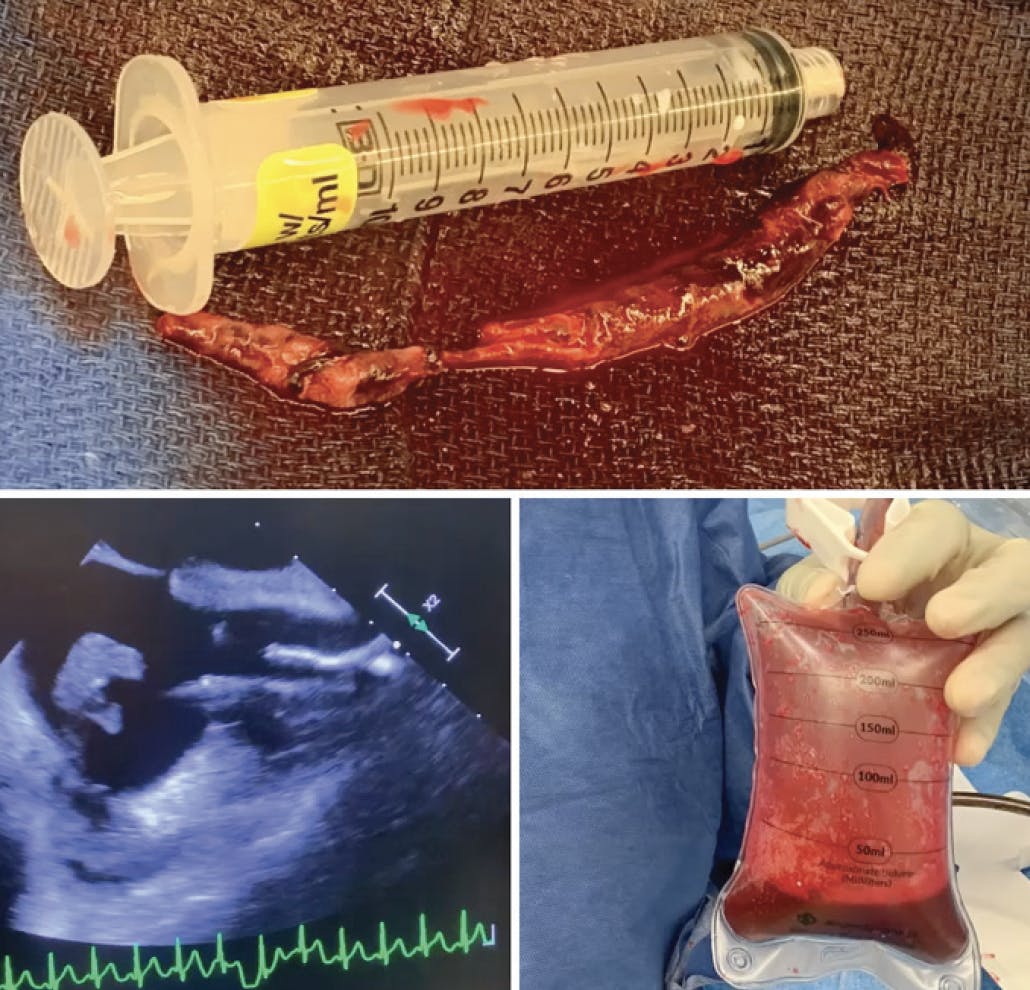
Figure 2. Clot removed from the right atrium and the waste bag with the volume of blood lost.
The patient underwent successful surgical removal of the colon mass; however, the following day the patient developed pain and edema in bilateral lower extremities. Venous duplex demonstrated extensive bilateral DVTs. A CT venogram showed extensive iliofemoral DVT with thrombus noted in the IVC filter. Mechanical thrombectomy was performed in prone position via bilateral popliteal venous access for bilateral iliofemoral DVTs. We decided to remove the extensive large thrombus burden from the IVC filter using the AlphaVac system.
The patient was placed in the supine position and bilateral femoral venous access was achieved. The right femoral vein was used for angiography and the AlphaVac F2220 was inserted into the left common femoral vein to remove the IVC filter thrombus and residual thrombus of the left common iliac vein. Five consecutive pulls were made with the AlphaVac handle on the 30-cc setting. The AlphaVac cannula was tracked up and down from the confluence to right below the IVC filter. Complete removal of thrombus was achieved with only 150 cc of blood loss. The patient did well postoperatively without any perioperative complications. Since hospitalization, the patient had complete resolution of lower extremity edema, dyspnea, and is now cancer free.
CONCLUSION
This case report demonstrates that the AlphaVac System with a 22-F cannula for IVC and right atrial thrombus removal was performed safely and efficiently. The AlphaVac System is a safe and effective procedure to remove large thrombus burden from IVC and right atrium as demonstrated in this case report. Since this case, our center has used the AlphaVac System with a very high success rate without any periprocedural complications. Additional case reports and larger clinical trials are needed to support the role of the AlphaVac System in clinical practice.
1. Vedantham S, Goldhaber SZ, Julian JA, et al. Pharmacomechanical catheter-directed thrombolysis for deep-vein thrombosis. N Engl J Med. 2017;377:2240-2252. doi: 10.1056/NEJMoa1615066
2. George B, Voelkel A, Kotter J, et al. A novel approach to percutaneous removal of large tricuspid valve vegetations using suction filtration and veno-venous bypass: a single-center experience. Catheter Cardiovasc Interv. 2017;90:1009-1015. doi: 10.1002/ccd.27097
3. Liu D, Peterson E, Dooner J, et al. Diagnosis and management of iliofemoral deep vein thrombosis: clinical practice guideline. CMAJ. 2015;187:1288-1296. doi: 10.1503/cmaj.141614
4. Goktay AY, Senturk C. Endovascular treatment of thrombosis and embolism. Adv Exp Med Biol. 2017;906:195-213. doi: 10.1007/5584_2016_116
The Cannula is indicated for:
- The non-surgical removal of thrombi or emboli from the vasculature
- Aspiration of contrast media and other fluids from the vasculature
The Cannula is intended for use in the venous system.
The Handle is indicated as a vacuum source for the AlphaVac Multipurpose Mechanical Aspiration System.
Refer to Directions for Use provided with the product for complete Instructions, Warnings, Precautions, Possible Adverse Effects and Contraindications. Observe all instructions for use prior to use. Failure to do so may result in patient complications.
CAUTION: Federal law (USA) restricts this device to sale by or on the order of a physician.
AngioDynamics and AlphaVac are trademarks and/or registered trademarks of AngioDynamics, Inc., an affiliate or subsidiary.
Advertisement
Advertisement