Advertisement
Advertisement
June 2022
Sponsored by Medtronic
The SLF™* AV Graft: Physician Perspectives
Experience-based insight on the benefits of a novel AV graft technology.
With Hosam F. El Sayed, MBBCh, PhD, FACS, RVT; Charmaine E. Lok, MD, MSc, FRCPC; and Nicholas G. Inston, MD, PhD


Hemodialysis (HD) vascular access dysfunction is widely considered the single most frequent cause of hospitalization in the HD population within the United States at an estimated cost of roughly $1 billion annually.1 Venous neointimal hyperplasia (NIH) characterized by stenosis and subsequent thrombosis accounts for the overwhelming majority of polytetrafluoroethylene (PTFE) dialysis graft failure.2 Likewise, PTFE grafts are associated with less than favorable patency rates. A systematic review published in 2020 analyzed 3,381 arteriovenous (AV) grafts placed, representing an average 1-year primary patency rate of 41% and a 2-year primary patency rate of 28%.3 Despite the magnitude of the problem and the enormous cost burden, successful innovation focused on preventing NIH and improving patency rates in PTFE dialysis grafts has been limited. The SLF™* AV graft (Medtronic) is the first HD graft of its kind focused on remodeling blood flow to reduce the burden associated with venous NIH. The SLF™* AV graft is an expanded PTFE (ePTFE) HD graft featuring a unique injection mold located on the venous end of the graft, which remodels the blood flow in a spiral laminar fashion, decreasing turbulence and matching the natural pattern of blood flow found within native veins (Figure 1 and Figure 2). Initial clinical results have been encouraging and show significant improvement in patency compared to standard PTFE HD grafts.4
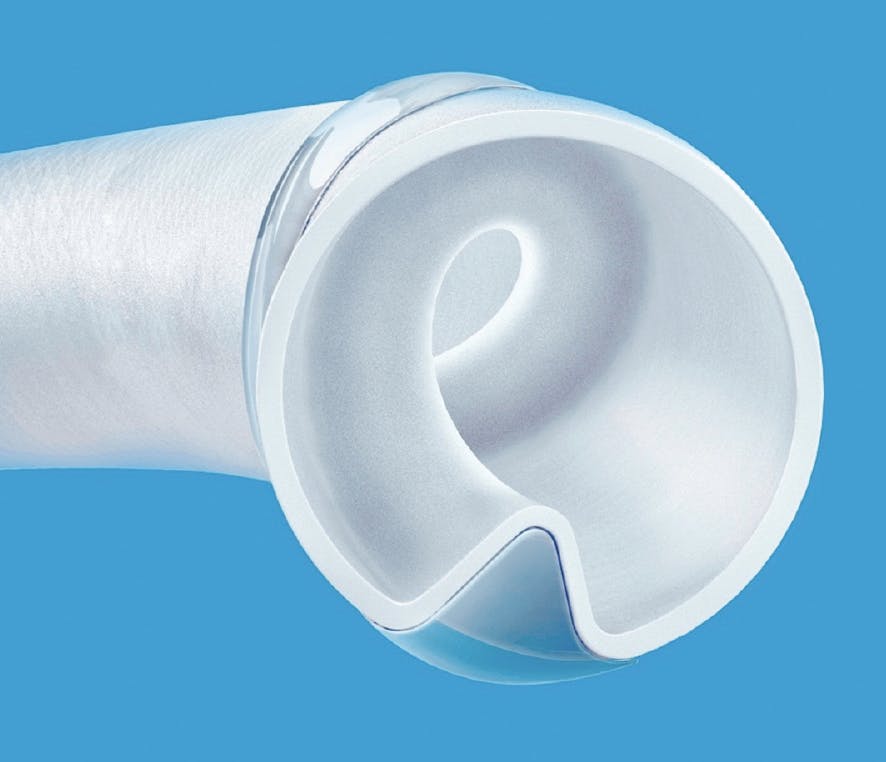
Figure 1. The SLF™* AV graft features a unique injection mold located on the venous end of the graft.
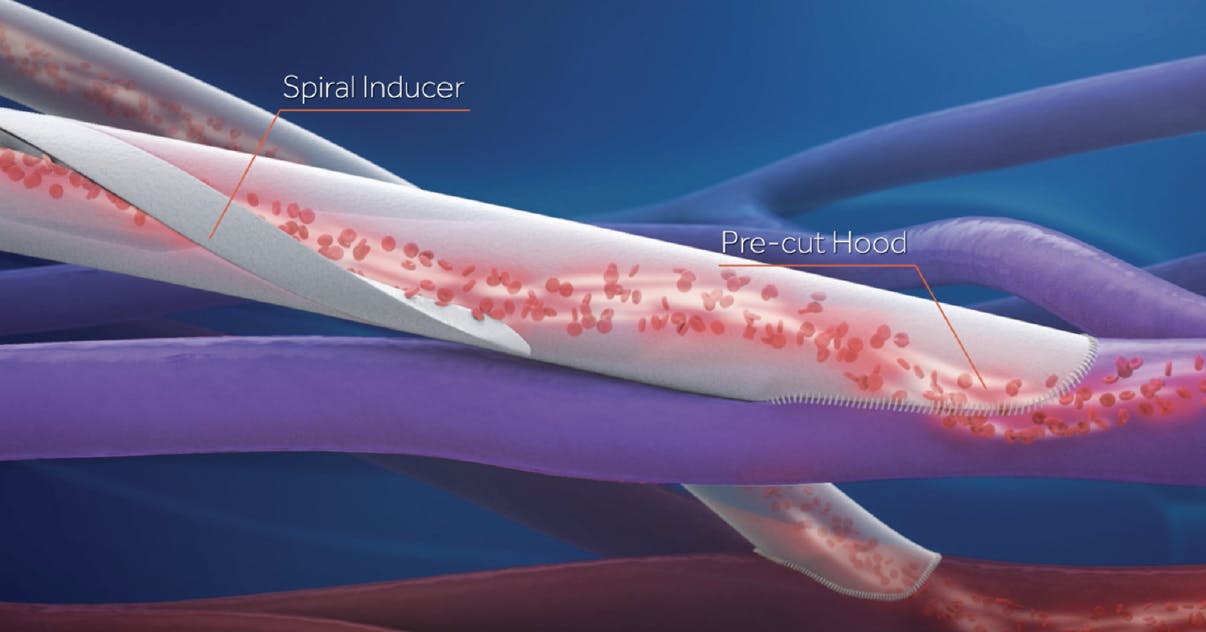
Figure 2. The pre-cut hood and spiral inducer segment remodel blood flow in a spiral laminar fashion, decreasing turbulence and matching the natural blood flow pattern found within native veins.
If the SLF™* AV graft can reduce NIH, what impact can that have on your patients? Your practice?
Dr. El Sayed: Reducing NIH would translate into improved graft patency, reducing the number of interventions on the graft and allowing longer use for dialysis. This has significant convenience and improved quality of life for patients who spend a significant time of their lives revolving around dialysis. It also has significant economic advantage both for the patient and society because of the cost associated with maintaining AV grafts.
Dr. Inston: In the last 10 years, the negative attitudes that were associated with AV grafts have changed. Data have shown that grafts have similar survival to AV fistulas when comparing primary failure and functional patency, and infection concerns appear overstated.5,6 Graft outflow stenosis is a big problem for clinicians but even more so for patients who require interventions. Unlike fistulas where stenosis often manifests as an issue during dialysis, there is often little warning when grafts develop an outflow stenosis and the patient presents with an occluded graft.7 Without a reactive thrombectomy service readily available, these patients may need admission and insertion of a bridging central venous catheter to allow dialysis. Subsequently, treatment with angioplasty and/or stents predisposes the patients to further stenosis and procedural burden. The impact of this on a patient’s quality of life is certainly underestimated.
The SLF™* AV graft design restores spiral blood flow at the venous outflow portion of the graft. Have you collected any initial clinical data that suggest improved long-term patency?†
Dr. El Sayed: I have collected clinical data using the graft for upper extremity AV access. I used the graft in 38 patients, and the patency was significantly better than historical cases I performed using other PTFE grafts. The 12-month patency of the SLF™* AV graft was 73% primary patency and 79% secondary patency compared with 34% primary patency and 62% secondary patency using other standard PTFE grafts.
Dr. Inston: When we used the SLF™* AV graft previously, our indications for graft use were for challenging patients who were exhausting other access options. The outcomes of the SLF™* AV grafts were favorable with no outflow stenosis or thrombosis in this group.
Which patient groups do you think would benefit most from the SLF™* AV graft?
Dr. El Sayed: I think this graft would benefit any patient who is not amenable to AV fistula creation. I have used the SLF™* AV graft as my primary AV graft for dialysis patients. I do not see any added advantage for using any other ePTFE graft compared with the SLF™* AV graft, other than if an early access graft is needed in patients with limited access options, as this graft needs at least a couple of weeks before it can be used. The only place where I do not see this graft used is in patients with potentially infected fields, in which case a biologic graft would be the choice.
Dr. Inston: Using grafts as a first-line option is unusual, but data support that in some groups—for example, patients at a higher risk of nonmaturation or those where access is needed more urgently than a standard PTFE graft—their use can result in less primary failure, a lower intervention rate to achieve maturation, better access survival up to 2 years, and less overall exposure to central venous catheters when compared to AV fistulas. The main aversion to using a graft is the requirement for interventions for outflow stenosis. If this can be avoided, then the indications for using a graft are likely to increase. In the United States, 80% of patients start dialysis on a central venous catheter and avoiding or at least minimizing the overall catheter time is essential. In these patients, prolonging catheter time by attempting to achieve a mature fistula is likely misguided. Although the SLF™* AV graft is not an early cannulation graft, the actual time to cannulation of many early cannulation grafts is delayed to allow the swelling and pain around the tunneling site to dissipate.
Did you need to work with your nephrology partners when adopting the SLF™* AV graft? If so, what was their experience with the technology?
Dr. El Sayed: I really did not have to do anything special. I did communicate with them that we are using a new graft and the advantage of using it compared to other ePTFE AV grafts, primarily for informational purposes, as well as to let them know to avoid sticking the graft in the juxta-anastomotic venous end. However, other than that, they would not have noticed any difference in this graft compared to other types of grafts used for AV access. I did get a couple of positive comments that these grafts tend to have fewer problems compared to other grafts.
Dr. Inston: In my experience, most nephrologists want their patients to have an easily cannulatable, nonproblematic vascular access that provides effective and reliable dialysis at each session. They want this to be performed in a timely fashion after the patient is referred and for it to be suitable for cannulation soon after creation.
Maintaining dialysis access over the long term without the requirement for interventions is critical. When the properties of the SLF™* AV graft were highlighted, my colleagues were all supportive and interested, and the grafts performed like we had expected.
Did you need to train your auxiliary staff (nurses, techs, etc) to successfully use the SLF™* AV graft?
Dr. El Sayed: Not really. It is essentially a regular ePTFE graft that has a physical modification on the venous end. I only told them not to modify the venous end when creating the anastomosis, and this entails always creating the venous anastomosis first. As far as accessing the graft, again, it is like any other graft apart from avoiding the juxta-anastomotic venous end of the graft where the spiral flow inducer is present. This area is not a common area to access a graft anyway.
Dr. Inston: Beyond our standard training for graft cannulation, nothing further was required. The way the graft is inserted, particularly if used as a brachioaxillary graft, the spiral inducer is not an impediment to cannulation and lies away from the cannulation zone. The concept of spiral flow did raise a lot of interest and discussion, particularly for those performing ultrasound assessments, with operators looking for spiral flow elsewhere, such as AV fistulas where it was seen as a predictor of maturation.
Dr. Lok, from a nephrologist’s perspective, what are your thoughts on Dr. El Sayed and Dr. Inston’s experience and clinical outcomes with the SLF™* AV graft?
Dr. Lok: The primary and secondary patency rates are impressive. Of course, these outcomes are obtained by talented surgeons dedicated to the care and creation of HD vascular access, so it is a little difficult to compare these outcomes with historical data from a heterogeneous mix of surgeons of variable experience. Nevertheless, they do highlight that excellent patency rates can be achieved with AV grafts; this is particularly encouraging as nephrologists face a progressively aging HD population burdened with many comorbidities that make successful fistula creation and function challenging. Having an AV access option that does not require the nephrologist to “do anything special” to maintain AV graft patency with low intervention rates is a win-win for both patient and providers.
Please reach out with any questions or inquiries to: DLSLFAVGraft@medtronic.com.
Note: The SLF™* AV graft is currently awaiting FDA approval.
†Based on individual physician experiences, individual results may vary.
1. Yevzlin A, Asif A, Agarwal AK. Dialysis access dysfunction. Int J Nephrol. 2012;2012:612025. doi: 10.1155/2012/612025
2. Roy-Chaudhury P, Kelly BS, Miller MA, et al. Venous neointimal hyperplasia in polytetrafluoroethylene dialysis grafts. Kidney Int. 2001;59:2325-2334. doi: 10.1046/j.1523-1755.2001.00750.x
3. Halbert RJ, Nicholson G, Nordyke RJ, et al. Patency of ePTFE arteriovenous graft placements in hemodialysis patients: systematic literature review and meta-analysis. Kidney360. 2020;1:1437-1446. doi: 10.34067/KID.0003502020
4. El Sayed HF, Anaya-Ayala JE, Davies M. Early results of using Spiral Flow AV Graft: is it a breakthrough solution to a difficult problem? Poster presented at: Society for Clinical Vascular Surgery (SCVS) symposium; March 2014; Carlsbad, California.
5. Allon M. Vascular access for hemodialysis patients: new data should guide decision making. Clin J Am Soc Nephrol. 2019;14:954-961. doi: 10.2215/CJN.00490119
6. Kingsmore D, Stevenson K, Jackson A, et al. Application and implications of a standardised reporting system for arteriovenous access graft infection. J Vasc Access. Published online February 10, 2021. doi: 10.1177/1129729820987382
7. Quencer KB, Oklu R. Hemodialysis access thrombosis. Cardiovasc Diagn Ther. 2017;7(suppl 3):S299-S308. doi: 10.21037/cdt.2017.09.08
ISI Information:
SLF™* Spiral Laminar Flow AV Graft
Indications for use: The SLF™* Vascular Arteriovenous Graft is a vascular prosthesis, which is intended for use as a subcutaneous arteriovenous conduit for vascular access during hemodialysis. ONLY trained and qualified physicians and/or surgeons, under the controlled conditions of a hospital operating theater environment are indicated for use of this device for implantation.
Contraindications
The SLF™* Arteriovenous Graft should not be used to perform Extra Anatomic Bypass Procedures (e.g., Axillofemoral, Femoral Femoral, and Axillobifemoral). These prostheses should not be implanted in patients who exhibit sensitivity to ePTFE. These prostheses should not be implanted in the Central Circulatory System.
Adverse Reactions
Potential complications which may occur with any surgical procedure involving a vascular prosthesis include, but are not limited to: bleeding; thrombosis; stenosis; infection, steal syndrome; hemorrhage and/or skin erosion.
For complete details of the SLF™* Graft, including product and important safety information such as indications, contraindications, warnings and precautions associated with the device and its components, refer to the Medtronic SLF™* Spiral Laminar Flow AV Graft IFU (Instructions for Use No. PT00127804).
©2022 Medtronic. Medtronic, Medtronic logo, and Engineering the extraordinary are trademarks of Medtronic. ™*Third-party brands are trademarks of their respective owners. All other brands are trademarks of a Medtronic company. 04/2022 – US-RC-2200030
Advertisement
Advertisement