Advertisement
Advertisement

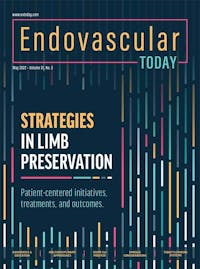
Spring in the Northern hemisphere has been associated over the last decade with the special critical limb ischemia (CLI) issue of Endovascular Today. CLI (or chronic limb-threatening ischemia, CLTI) remains an area of interest but also concern, with a growing number of patients affected by this condition and the presence of gender, racial, economic, and other disparities. However, there is also hope for patients with CLI/CLTI, with more and more societies considering amputation prevention as one of their major goals. Recent examples of the global expansion of focus on this disease state include the founding of a European office of the CLI Global Society in Brussels, Belgium, and the American Heart Association’s policy statement aiming to lower nontraumatic lower extremity amputations by 20% by 2030,1 just to name a few.
The special issue on CLI/CLTI in Endovascular Today has been at the forefront of developments over the last decade, and the current issue is no exception.
Costantino Del Giudice, MD, provides an overview of emerging extra-anatomic interventions for chronic CLI/CLTI and techniques to manage challenging superficial femoral artery occlusions where conventional techniques have failed or are impossible.
A panel discussion moderated by Anahita Dua, MD, discusses the makeup of the panelists’ care teams for patients at risk for amputation, optimal medical and wound care management, follow-up protocols, and how to improve communication with patients to ensure outcomes that fit their needs. Participants in this discussion on multidisciplinary limb salvage approaches are Laura Drudi, MD; Luis Mariano Palena, MD; Elisa Piccolo, MD; Gaurav Parmar, MD; Sara Rose-Sauld, DPM; and Mehdi H. Shishehbor, DO.
Our first “Ask the Experts” article answers the question, “What are three keys to meaningful improvement in amputation prevention?” Panelists Naseer Ahmad, MD; Foluso Fakorede, MD; Sonya Noor, MD; and Mark J. Portou, PhD, share their ideas on what they consider necessary changes for achieving amputation prevention. This includes efforts related to patient awareness, education, care models, and more.
The SCOPE-CLI registry will explore patient-centered outcomes in CLI/CLTI, and the rationale, goals, and status of this registry are described by Kim G. Smolderen, PhD; Lindsey E. Scierka, MD; and Carlos Mena-Hurtado, MD, on behalf of the SCOPE-CLI Consortium.
A common problem during endovascular procedures is the occurrence of embolization of particulate matter. John H. Rundback, MD; Peter A. Schneider, MD; and Richard E. Fulton, MD, elaborate in their article on embolization during popliteal and tibial interventions for CLI/CLTI and whether embolization may prevent optimal outcomes.
To allow comparison of outcomes and make a well-pondered choice of treatment strategies, various grading systems are available. In order to provide guidance in choosing a grading system, Shipra Arya, MD; Michael S. Conte, MD; Vickie Driver, DPM; and Thomas Zeller, MD, answer the question, “Which CLI/CLTI grading systems are you using when, and why?” This discussion provides the panelists’ perspectives on classification and grading systems, their strengths and limitations, and how they are used in current practice.
The field of CLI/CLTI treatment has been evolving over the last decade and will probably continue to do so in the future. The second “Ask the Experts” panel includes Andrew Holden, MBChB; Leigh Ann O’Banion, MD; and August Ysa, MD, and discusses the promise of new and existing technologies for the treatment of CLI/CLTI patients.
Concluding this issue is an interview with Mohamad Hamady, MBChB, in which he discusses his work in robotic intervention, plans for the upcoming IDEAS meeting, the fight for recognition of interventional radiology as a specialty in the United Kingdom, and more.
I want to thank all the contributors for their efforts in making another CLI issue of Endovascular Today a very worthwhile read. With life slowly getting back to “normal,” I hope that you will be able to continue fighting CLI/CLTI and meet in person with your peers.
Jos C. van den Berg, MD, PhD
Guest Chief Medical Editor
1. Creager MA, Matsushita K, Arya S, et al. Reducing nontraumatic lower-extremity amputations by 20% by 2030: time to get to our feet: a policy statement from the American Heart Association. Circulation. 2021;143:e875-e891. doi: 10.1161/CIR.0000000000000967
Advertisement
Advertisement