Advertisement
Advertisement
November 2022 Supplement
Sponsored by Surmodics, Inc.
Practice Profile: At ECCO Medical, Radial-to-Peripheral Is Driving Practice Growth
A conversation with Aaron Kovaleski, MD.
Dr. Aaron Kovaleski, physician-owner at ECCO Medical in Denver, Colorado, received his formal training in interventional radiology but learned business on the job. After joining a large radiology practice early in his career, he took on business development of the group’s office-based lab (OBL), from evaluating the financial health of the OBL to procedural selection for optimizing revenue generation.
He has put that experience to good use. In 2020, Dr. Kovaleski opened his own endovascular OBL in Denver, ECCO Medical, with partner Dr. Charles Nutting. Their practice has thrived on an intense dedication to patient satisfaction, disciplined business management, and energetic marketing. From humble beginnings, the practice now employs 11 full-time staff, with a focus on minimally invasive, image-guided treatment of arterial and venous disease, cancer, pelvic conditions, and much more. This fall, they will build out another procedure room with a fixed C-arm. We spoke with Dr. Kovaleski about the lessons he’s learned along the way.
What’s the first thing you’d say to a physician looking to open an OBL?
You don’t need the Taj Mahal. Procedures pay the same in a 2,200 sq ft space with a mobile C-arm as they do in a 20,000 sq ft palace with a $2 million C-arm. You need to manage your overhead. We opened with a small place and a small staff, and we were profitable within 5 months, without taking out a loan. Later, we built out the Taj Mahal (laughs).
Your practice does a lot of marketing. What works best?
Securing referrals. This begins in the clinic. Many patients have had procedures before, and if you can provide patients with a superior experience, they will tell their referring doctors. However, you also have to go out and generate referrals, especially when you’re starting out. When we opened, if things were slow, we would drive around visiting clinics. After the pandemic hit, we cold-called clinics to set up online appointments and sent in lunch. This type of marketing never ends.
Your practice began doing radial-to-peripheral procedures in January 2022. Do you promote this capability with your referral base?
Absolutely. We live in a world where referring physicians really don’t know the nuances of what my field does. I’ll take the time to tell them about access points and explain why this is so important for patients. It looks bad for them if they refer their patients to someone who doesn’t deliver a positive experience. Radial access is a lower-risk access site, which is priceless. And it’s much easier on patients—they can move around in recovery without any worries about popping a femoral stick. If they feel good 30 minutes after the procedure, they can get up and go. That really resonates with referring physicians.
Why did you wait until this year to begin doing radial-to-peripheral procedures?
I’d known about radial access for years, but until recently, I just didn’t think we had the right equipment. That changed last January when I was able to try out the Sublime™ Radial Access Guide Sheath and the Sublime™ Radial Access .014 and .018 RX PTA Balloon Catheters.
What do you like about the Sublime™ Radial Access Guide Sheath?
The sheath is very hydrophilic. Whenever you have something that long that also has good support, you’re going to be concerned about it making that turn into the aorta. That has not been a problem. The sheath tracks very well, especially when making that difficult turn. Once you place the guide sheath, it doesn’t back out. As far as patients are concerned, I haven’t had any complaints of pain when I have put this guide sheath through the wrist. I think that speaks to the coating. It’s just able to sail through.
What are your impressions of the Sublime™ Radial Access .014 and .018 Balloon Catheters?
The shaft construction on those balloons—there’s so much support, it’s nice and steady, and it gets through lesions very well. With that nice, tapered tip, I’m able to sail through a lot of lesions I would otherwise be struggling with if I were using other balloons. Even coming from a femoral approach, those balloons have become a real asset in the procedure room, especially with the more complex patients.
How about the level of pushability, given these balloons are rapid exchange (RX) and not over the wire?
The company did a lot of things right with the design of the RX balloons. Even though they’re RX, the RX portion is quite long and provides over-the-wire support, which gives you a lot more pushability and torqueability to get through lesions or around turns. In my opinion, the push on the catheter itself has a lot of support, certainly more than anything else on the market. There’s nothing even close. With other balloon catheters, when you’re pushing through a lesion or through the iliac bifurcation, you often end up prolapsing the push portion of the catheter where it connects to the over-the-wire portion; you’re having to push so hard that it will bend. You just don’t have that sort of issue with the Sublime™ balloons.
What kinds of cases do you perform using the Sublime™ Radial Access devices?
In addition to treating peripheral artery disease (PAD), I use these products for pelvic angiograms, prostate interventions, and some iliac interventions. For example, if you’re going to do prostate artery embolization, some of these patients are going to have very tortuous aortas and iliac arteries. You need a support sheath to get down deep to relieve the tension on your microcatheter through all those turns. The support we get from Sublime™ products enables us to get through challenging cases that would be nearly impossible using a femoral stick.
We also do pelvic artery revascularization for erectile dysfunction. In these cases, we’re probably using atherectomy devices and we’re certainly using balloons, so it’s essentially a PAD case, just in the pelvis. So, a good support sheath is very useful for the same reasons it’s useful in PAD. Some of these patients are also very tall. If you’re treating a man who is 6 ft, 6 inches from the radial approach, you’re almost using the whole of length of the sheath just to get into the pelvis. In any case, angles are so much easier from the radial approach, because vessels come off their origins in the direction of blood flow. Coming in from above makes it easier to direct the wire to the appropriate vessel.
How has the ability to perform radial-to-peripheral procedures impacted your bottom line?
It has a substantial impact, because your two premiums in an OBL are space and time. If you have two recovery bays and you’ve done two procedures, you can’t do another procedure until those people are out. We all know how long femoral access patients can take in recovery, especially if the closure doesn’t take. With radial access, with a typical 30-minute recovery time, even a small practice can probably add an extra procedure per day. Between that and the nursing time you save in recovery, you more than make up for any marginal added expense from using purpose-built radial access devices. Add to that the money you save on femoral closure devices, which cost us around $150 compared with the $10 we spend for radial bands. With radial access, you’re coming out quite a bit ahead given the way these procedures are reimbursed.
Caution: Federal (US) law restricts the Sublime™ Radial Access Guide Sheath and the Sublime™ Radial Access .014 and .018 RX PTA Dilatation Catheters to sale by or on the order of a physician. Please refer to each product’s Instructions for Use for indications, contraindications, warnings, and precautions.
Case Report: Treatment of the Dorsal Penile and Pudendal Arteries Using the Sublime™ Radial Access Platform
By Aaron Kovaleski, MD
Patient Presentation/Baseline
A 57-year-old male presented to the clinic with longstanding erectile dysfunction and was unresponsive to prescription medications. The patient also had a past medical history of diabetes, hyperlipidemia, hypertension, and atrial fibrillation.
Treatment
Access was obtained via the radial artery using ultrasound guidance and an introducer sheath was exchanged for a 6 Fr Sublime™ Radial Access Guide Sheath, which was advanced and delivered to the common iliac artery. A 3.0 X 100 mm Sublime™ Radial Access RX PTA Dilatation Catheter was inserted and advanced to the dorsal penile artery where prolonged balloon angioplasty was performed. The balloon was then advanced to the internal pudendal artery where prolonged balloon angioplasty was once again performed before the balloon was removed (Figure 1).
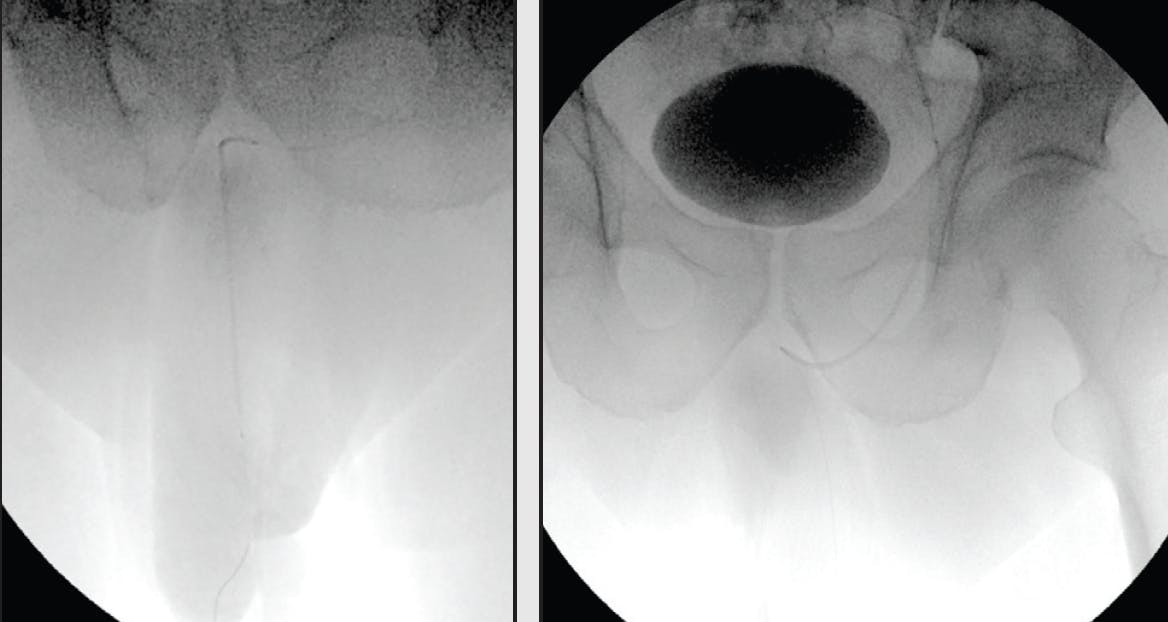
Figure 1. A 3.0 X 100 mm Sublime™ Radial Access RX PTA Dilatation Catheter was used to treat the stenoses.
Post Procedure Outcome
The procedure was technically successful with improved flow through the dorsal penile artery and increased blush of the spongiosum (Figure 2). The Sublime™ Radial Access Guide Sheath and Sublime™ Radial Access RX PTA Dilatation Catheter provided the deliverability required to successfully reduce erectile dysfunction symptoms and improve erectile function for this patient, thereby improving his quality of life.
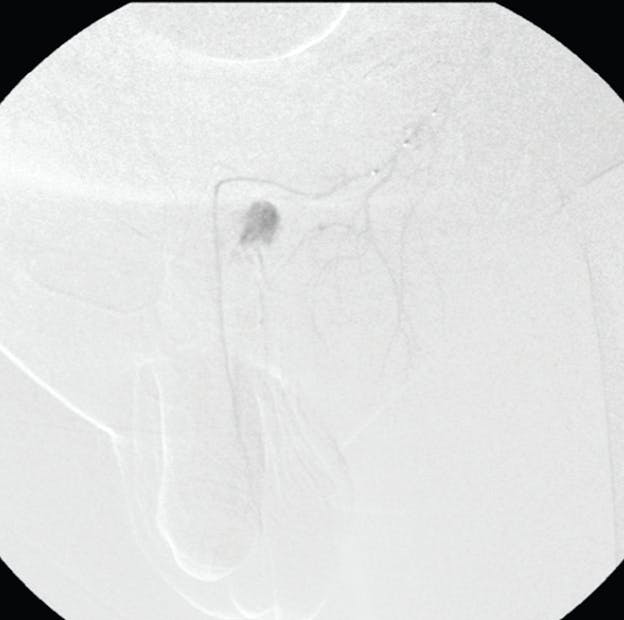
Figure 2. Completion arteriogram.
Caution: Federal (US) law restricts the Sublime™ Radial Access Guide Sheath and the Sublime™ Radial Access .014 and .018 RX PTA Dilatation Catheters to sale by or on the order of a physician. Please refer to each product’s Instructions for Use for indications, contraindications, warnings, and precautions.

Advertisement
Advertisement