Advertisement
Advertisement
November 2022
Embolization Techniques for False Lumen Treatment
Use of the balloon fracture fenestration technique or direct embolization of the false lumen to obtain adequate seal and false lumen obliteration during TEVAR.
By Patrick R. Vargo, MD; Adam Daly, MD; and Eric E. Roselli, MD
Endovascular surgery has evolved and is now an integral consideration in the management of patients with thoracoabdominal aortic dissection. Thoracic endovascular aortic repair (TEVAR) is less morbid than open repair and has become the standard of care for complicated acute type B aortic dissection. Increasingly, TEVAR and other endovascular adjuncts are employed in the management of chronic thoracoabdominal aortic (TAA) dissections as well. The goal of TEVAR in aortic dissection is to cover entry tears and increase true lumen (TL) flow while depressurizing the false lumen (FL) to promote positive aortic remodeling.
Complete thrombosis of the FL results in positive remodeling of the aorta but is only achieved in approximately 40% of patients with TEVAR alone.1-3 Continued FL perfusion is an independent predictor of poor long-term survival and risk of reoperation or rupture (Figure 1).4-7 A pressurized FL from distal reentry tears and persistent FL flow can lead to aneurysm degeneration and subsequent catastrophic aortic events.8,9 In young, healthy patients, those diagnosed with connective tissue disorders, or those with distal descending aortic diameters > 42 mm, we pursue open TAA repair. However, in higher-risk patients with suitable descending thoracic aortic diameters, we commonly treat with TEVAR and FL obliteration adjuncts.6,7,10,11 The treatment algorithm for treating this complex condition is shown in Figure 2.
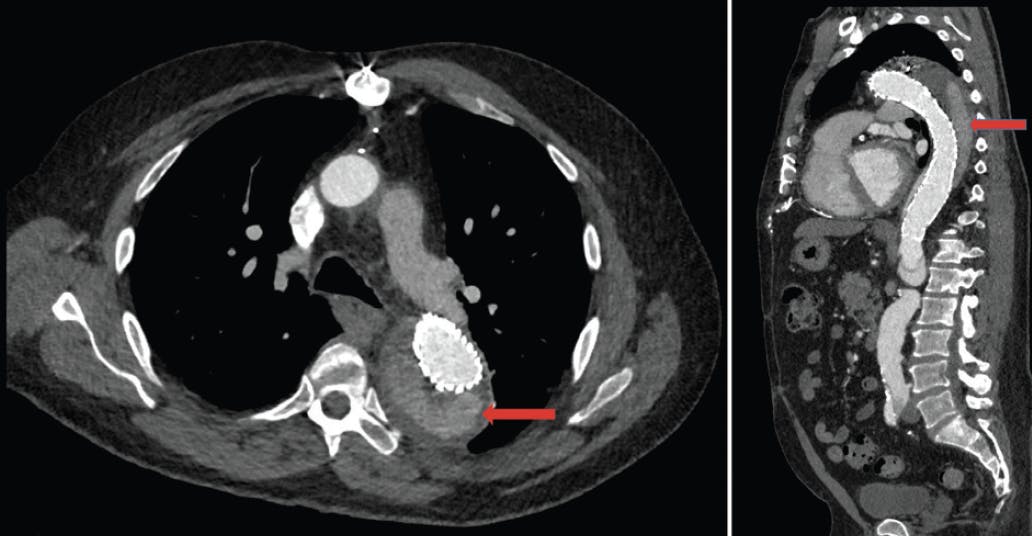
Figure 1. CTA demonstrating retrograde FL perfusion after TEVAR (red arrows).
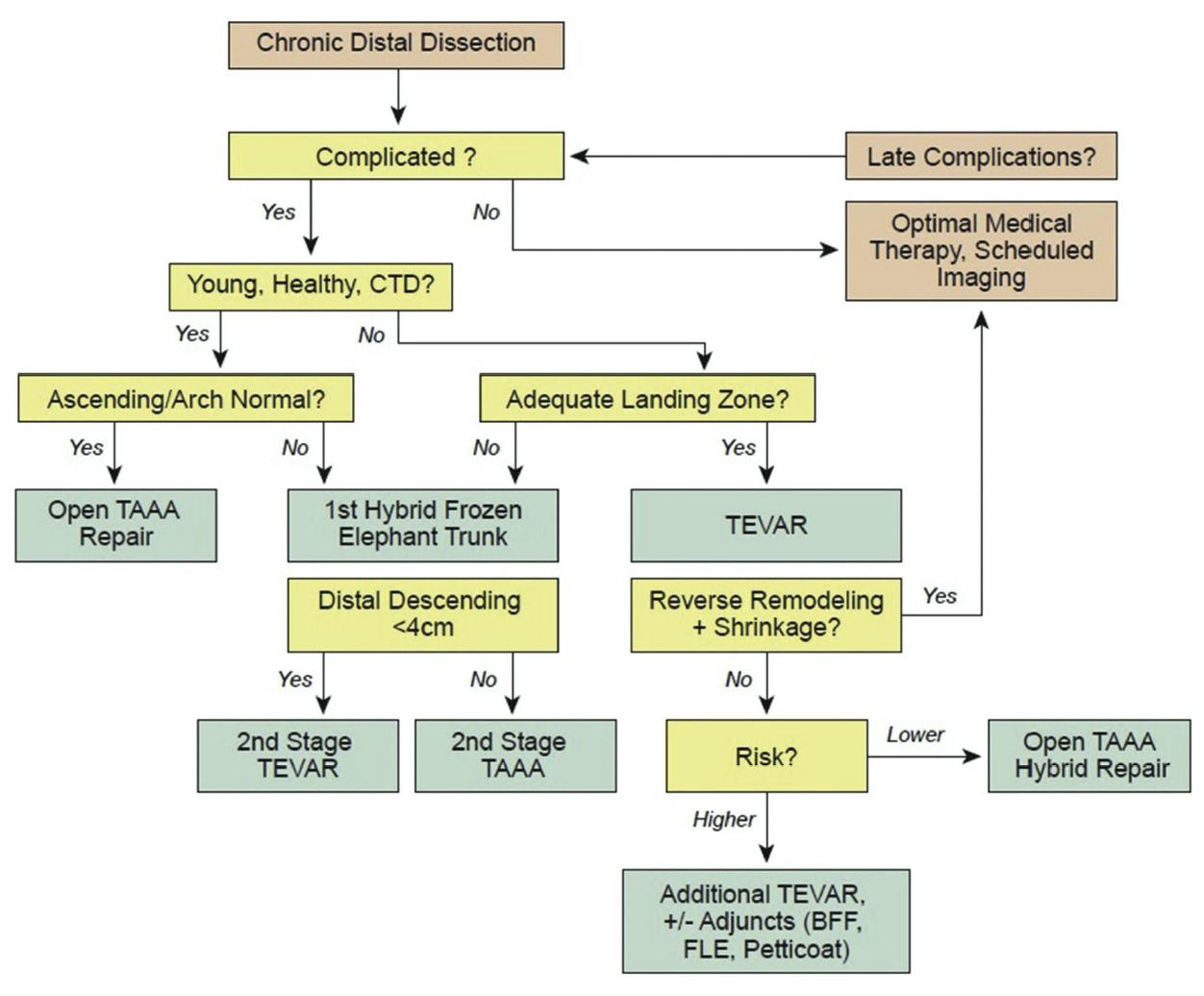
Figure 2. Treatment algorithm for chronic distal aortic dissection at Cleveland Clinic. BFF, endovascular balloon fracture fenestration; CTD, connective tissue disease; FLE, false lumen embolization; TAAA, thoracoabdominal aortic aneurysm; TEVAR, thoracic endovascular aortic repair. Reprinted with permission from Miletic KG, Kindzelski BA, Hodges KE, et al. Impact of endovascular false lumen embolization on thoracic aortic remodeling in chronic dissection. Ann Thorac Surg. 2021;111:495-501.
ENDOVASCULAR TECHNIQUES TO TREAT THE FL
At our institution, TEVAR is performed under general anesthesia with either open or percutaneous common femoral access, which is largely dependent on the size and quality of the femoral and iliac vasculature. The use of and familiarity with intravascular ultrasound is critical in cases of dissection to identify and map entry tears and the lumina. Cerebrospinal fluid drains are placed preoperatively in patients with chronic dissection undergoing TEVAR since they typically require extensive coverage, and delayed FL thrombosis that occurs posttreatment can obliterate additional segmental vessels postoperatively, increasing the risk for delayed spinal cord injury. Completion angiography is performed at the end of the procedure, and contrast-enhanced CT is performed prior to discharge to evaluate technical success.
Balloon Fracture Fenestration and Aortic Bare-Metal Stenting
In the setting of chronic dissection, the fibrotic dissection flap limits stent expansion necessary for an adequate seal and FL obliteration. Our institute previously described the balloon fracture fenestration (BFF) technique whereby a covered endograft is deployed in the TL of the thoracic aorta, and a compliant balloon (Coda, Cook Medical) is used to fully expand the constrained stent and fenestrate the intimal flap.10 Using this technique, 74% of patients achieved complete FL thrombosis and a mean total aortic diameter shrinkage of 11 mm.10 This is analogous to the knickerbocker technique described by Kölbel and colleagues.
We have modified our strategy with the availability of bare-metal dissection stents, which we now deploy through the abdominal aorta (zones 6-9) prior to BFF of the thoracic endografts (Figure 3). Early results of bare-metal stenting suggest positive aortic remodeling in both acute and chronic dissection.7 We have seen that the preemptive placement of this TL bare-metal stent optimizes TL flow beyond the TEVAR and may prevent malperfusion secondary to stent-induced new entry tears after intimal flap fenestration of chronic dissections. Balloon fracturing of the abdominal aorta with the bare-metal stent in place has been described but was associated with renal or iliac malperfusion requiring additional branch artery stenting in about 25% of patients.12
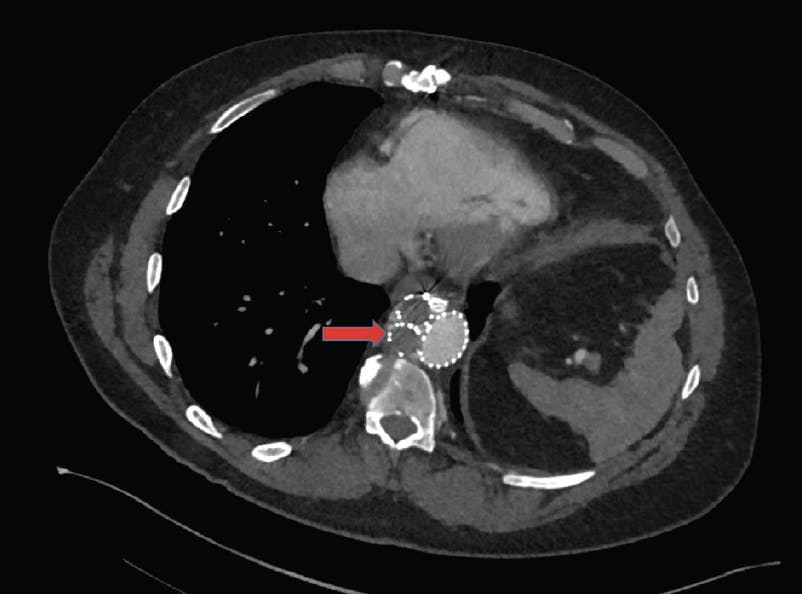
Figure 3. Iliac occluder plugs in the FL of the thoracic aorta (red arrow).
FL Embolization
In addition to the previously described techniques, the FL may be directly accessed for the delivery of commercially available embolization devices such as iliac occluder plugs, nitinol plugs, and embolization coils (Figure 3 and Figure 4) or the so-called candy-plug devices described by Kölbel and colleagues, which are not currently available in the United States. We have found this strategy particularly effective to treat retrograde perfusion from entry tears in the abdominal aorta pressurizing a thoracic aneurysm. We have reported positive aortic remodeling defined as aortic size reduction in 31% with complete FL thrombosis and aneurysm stabilization in another 51% of patients.6 This technique can be done safely with low mortality and morbidity, although these patients may require subsequent endovascular interventions.6,11
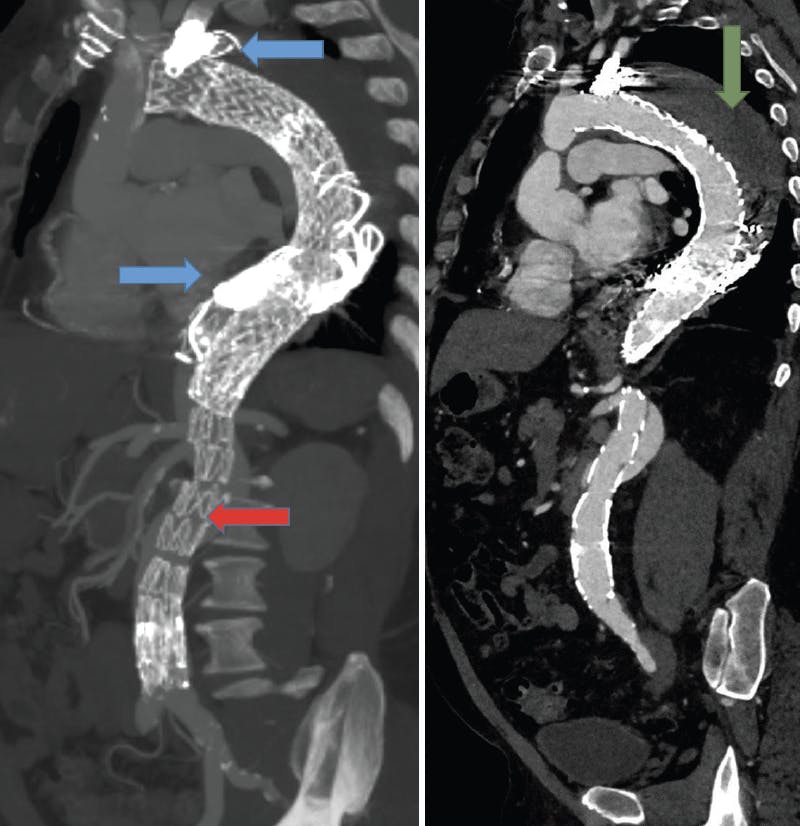
Figure 4. CTA demonstrating repair of chronic TAA dissection with embolization coils (blue arrows) and bare-metal stent (red arrow). Note the thrombosis of the FL (green arrow).
SUMMARY
Lifelong care for chronic aortic dissection often requires multiple staged segmental repairs. Open and endovascular approaches to repair are complementary in achieving the goals of avoiding aortic rupture and end-organ malperfusion. TEVAR and branch grafting to cover entry tears and replace aneurysmal segments of the aorta can be augmented with the adjuncts of balloon expansion of the stent graft devices and fracture of the dissection flap, bare-metal stenting of the TL to address dynamic obstruction, and embolization of the FL to promote positive aortic remodeling. With further refinement of patient selection and development of novel devices and techniques, outcomes have improved and will continue to do so.
1. Kamman AV, Jonker FHW, Sechtem U, et al. Predictors of stable aortic dimensions in medically managed acute aortic syndromes. Ann Vasc Surg. 2017;42:143-149. doi: 10.1016/j.avsg.2017.01.012
2. Li D, Ye L, He Y, et al. False lumen status in patients with acute aortic dissection: a systematic review and meta‐analysis. J Am Heart Assoc. 2016;5:e003172. doi: 10.1161/JAHA.115.003172
3. Kang WC, Greenberg RK, Mastracci TM, et al. Endovascular repair of complicated chronic distal aortic dissections: intermediate outcomes and complications. J Thorac Cardiovasc Surg. 2011;142:1074-1083. doi: 10.1016/j.jtcvs.2011.03.008
4. Spanos K, Kölbel T, Rohlffs F, et al. Intentional targeted false lumen occlusion after aortic dissection: a systematic review of the literature. Ann Vasc Surg. 2019;56:317-329. doi: 10.1016/j.avsg.2018.08.086
5. Roselli EE. Thoracic endovascular aortic repair versus open surgery for type-B chronic dissection. J Thorac Cardiovasc Surg. 2015;149(2 suppl):S163-S167. doi: 10.1016/j.jtcvs.2014.11.028
6. Miletic KG, Kindzelski BA, Hodges KE, et al. Impact of endovascular false lumen embolization on thoracic aortic remodeling in chronic dissection. Ann Thorac Surg. 2021;111:495-501. doi: 10.1016/j.athoracsur.2020.04.093
7. Vargo PR, Tarola CL, Durbak E, et al. Early results of bare metal extension stent for thoracoabdominal aortic dissection. JTCVS Tech. 2022;14:1-8. doi: 10.1016/j.xjtc.2022.04.011
8. Nienaber CA, Rousseau H, Eggebrecht H, et al. Randomized comparison of strategies for type B aortic dissection: the INvestigation of STEnt Grafts in Aortic Dissection (INSTEAD) trial. Circulation. 2009;120:2519-2528. doi: 10.1161/CIRCULATIONAHA.109.886408
9. Tanaka A, Sakakibara M, Ishii H, et al. Influence of the false lumen status on clinical outcomes in patients with acute type B aortic dissection. J Vasc Surg. 2014;59:321-326. doi: 10.1016/j.jvs.2013.08.031
10. Levack MM, Kindzelski BA, Miletic KG, et al. Adjunctive endovascular balloon fracture fenestration for chronic aortic dissection. J Thorac Cardiovasc Surg. 2022;164:2-10.e5. doi: 10.1016/j.jtcvs.2020.09.106
11. Vargo PR, Maigrot JL, Roselli EE. Chronic thoracoabdominal aortic dissection: endovascular options to obliterate the false lumen. Ann Cardiothorac Surg. 2021;10:778-783. doi: 10.21037/acs-2021-taes-23
12. Faure EM, El Batti S, Sutter W, et al. Stent-assisted balloon-induced intimal disruption and relamination of distal remaining aortic dissection after acute DeBakey type I repair. J Thorac Cardiovasc Surg. 2019;157:2159-2165. doi: 10.1016/j.jtcvs.2018.10.031
Advertisement
Advertisement