Advertisement
Advertisement
April 2023
Sponsored by Shape Memory Medical
Smart Polymer: Embolization Plus
The versatility of Smart Polymer devices, including the IMPEDE and IMPEDE-FX Embolization Plugs, are highlighted in case examples depicting pulmonary arteriovenous malformation embolization, ovarian and testicular vein embolization, and internal iliac artery embolization as part of iliac artery aneurysm treatment.
With Daniel A.F. van den Heuvel, MD; Sjors Klompmaker, MD, MSc, PhD; Andreas Hadjipolycarpou, MD, MSc; Patrick Knüsel, MD; and Edvard Skripochnik, MD
Evolution and intelligence go hand in hand, and Smart Polymer (Shape Memory Medical) has the potential to advance the field of embolization with macro- and micro-level material properties that translate into unique device features and expand the interventionalist’s toolbox.
On a macro level, a Smart Polymer device expands in a vessel and is hemostatic. On a micro level, Smart Polymer supports rapid conversion to thrombus formation throughout its porous structure, which is the first step toward new tissue formation (Figure 1). The supported thrombus converts to collagen, and collagen formation across the entire cross-sectional area of the embolus limits the potential for recanalization. Furthermore, Smart Polymer is bioabsorbable at a slow, steady rate (without chronic inflammation) as native tissue takes its place. Preclinical studies have shown Smart Polymer supports cellular growth, new tissue formation, and tissue remodeling.1,2
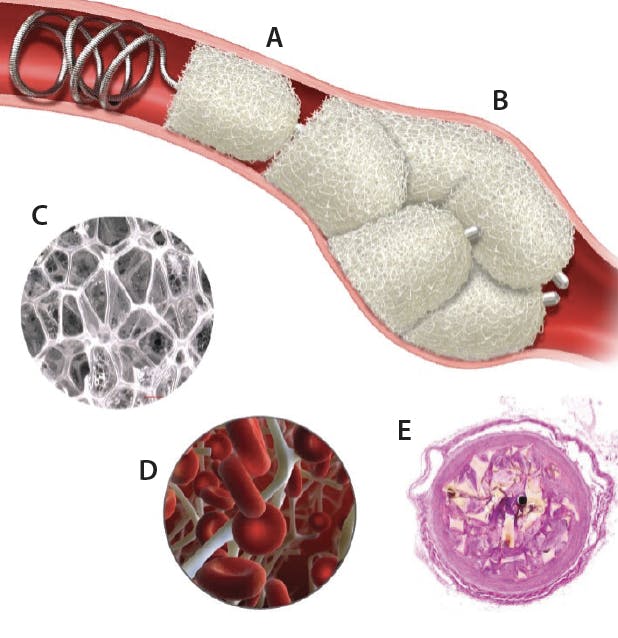
Figure 1. Smart Polymer has a porous structure when expanded in a vessel, allowing thrombus formation throughout its structure. The IMPEDE Embolization Plug (A) and IMPEDE-FX Embolization Plug (B). The expanded Smart Polymer is a porous scaffold (C) with low radial force, which supports thrombus formation throughout its structure (D) and then converts to collagen as the polymer bioabsorbs over time, without chronic inflammation (E).
On a macro level, expanded Smart Polymer devices occupy a large volume, making them ideal for filling large endovascular spaces (Figure 1). On a micro level, the Smart Polymer is mostly an open cell structure, which contributes to its low radial force and conformability. The open cell structure also contributes to Smart Polymer radiolucency, which facilitates intraprocedural and follow-up imaging, particularly when treating complex anatomy.
In this article, we review case examples in which interventionalists took advantage of the unique features of the Smart Polymer devices in their toolbox: treatment of pulmonary arteriovenous malformations (PAVMs) in an ongoing study, ovarian and testicular vein embolization, and internal iliac artery embolization as part of iliac artery aneurysm treatment.
1. Jessen SL, Friedemann MC, Ginn-Hedman AM, et al. Microscopic assessment of healing and effectiveness of a foam-based peripheral occlusion device. ACS Biomater Sci Eng. 2020;6:2588-2599. doi: 10.1021/acsbiomaterials.9b00895
2. Chau SM, Herting SM, Noltensmeyer DA, et al. Macrophage activation in response to shape memory polymer foam-coated aneurysm occlusion devices. J Biomed Mater Res B Appl Biomater. 2022;110:1535-1544. doi: 10.1002/jbm.b.35015
PAVM EMBOLIZATION


Patients with hemorrhagic hereditary telangiectasia (HHT) often present with PAVMs, and embolotherapy is indicated to prevent paradoxical emboli or brain abscesses and treat hypoxemia in case of a severe right-to-left shunt. PAVM persistence secondary to feeding artery recanalization puts these patients at continued risk of developing PAVM-related complications. We are studying the performance of Smart Polymer plugs and coils in treating PAVMs in a prospective study of approximately 75 HHT patients. We are about halfway through enrollment and will follow patients through to 3 years, per a standard of care imaging schedule. To date, we have treated 105 PAVMs (122 arteries) with Smart Polymer devices in the study.
By way of example, a woman in her early 30s in our study presented with two PAVMs requiring treatment, and a total of three arteries were treated in a single procedure (Figure 1). In this case, arteries were treated with the IMPEDE Embolization Plug (Shape Memory Medical) and TrelliX Embolic Coils (Shape Memory Medical).
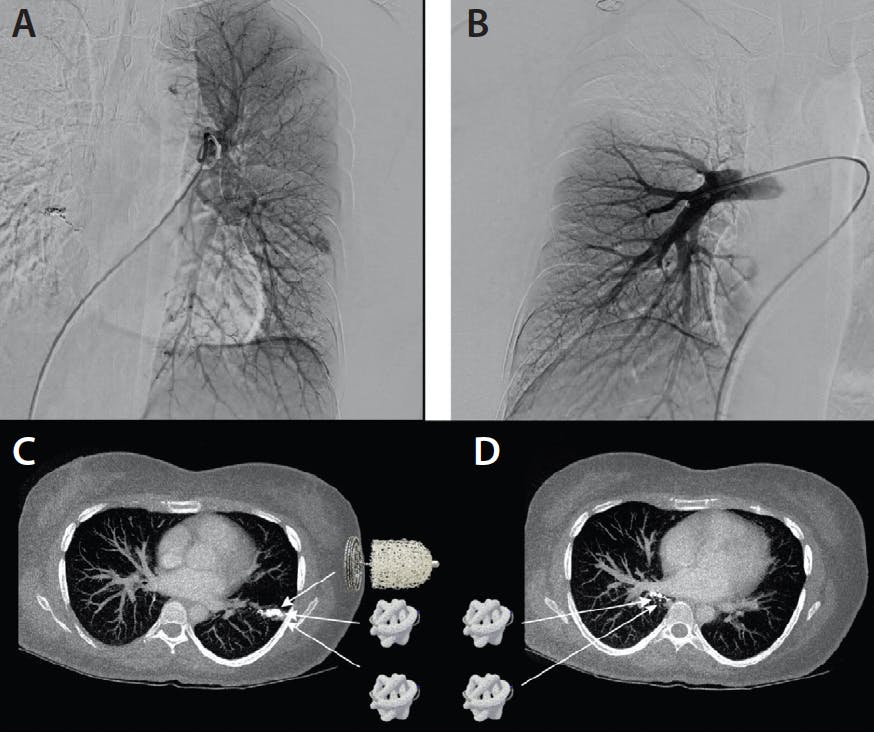
Figure 1. Preprocedural catheter angiography shows a single PAVM with two feeding arteries in the left lower lobe lateral segment (A) and a PAVM with one feeding artery in the right lower lobe posterior segment (B). Contrast-enhanced chest CT scan at 6-month follow-up shows a single PAVM treated with a 7-mm-diameter IMPEDE Embolization Plug and 4-mm X 10-cm TrelliX Embolic Coil in a 2.3-mm-diameter feeding artery and a 2-mm X 8-cm TrelliX Embolic Coil in a 1.7-mm-diameter feeding artery (C), as well as two TrelliX Embolic Coils (3 mm X 8 cm and 3 mm X 10 cm) placed in a single PAVM with a 1.6-mm-diameter feeding artery (D).
Many HHT patients face a lifetime of interventional treatment and follow-up imaging, as successfully treated PAVMs may reperfuse as a result of recanalization of the treated arteries, recruitment of new feeding arteries, and incidental systemic feeding arteries. The radiolucency of Smart Polymer facilitates accurate interpretation of repeated imaging, and the use of Smart Polymer devices minimizes the amount of permanent metal implant in who are often relatively young patients at first presentation.
OVARIAN VEIN EMBOLIZATION

Bilateral embolization of the ovarian veins using different embolization devices highlights the minimal artifact of Smart Polymer devices. A woman in her early 30s presented with pelvic pain, and bilateral ovarian vein embolization was indicated to treat reflux.
Ovarian vein embolization techniques vary widely, and here at Apollonion hospital, we generally try to embolize the entire vein length to minimize the likelihood of subsequent collateral formation and recanalization, especially in young patients.
The 12-mm-diameter left ovarian vein was accessed from a transfemoral approach with a 7-F sheath (Launcher guiding catheter, Medtronic). Because sclerosant foam is not commercially available in Cyprus at a high enough concentration (3%), no sclerosant was used. The deployment of the first Smart Polymer device (IMPEDE-FX Embolization Plug, Shape Memory Medical) was performed as distally as possible. With stasis, additional Smart Polymer devices were deployed more proximally (Figure 1A). The acute angle of the right ovarian vein ostium precluded access with a sheath large enough to deliver Smart Polymer devices, and therefore bare-metal embolization coils were then delivered into the entire length of the right side. Intraprocedural angiography (Figure 1B) shows the notable difference in metal content in each vein when the entire length of the vein is treated. We then implanted more Smart Polymer devices in the left side, which resulted in embolic material in the entire length of the vein, up to approximately 4 cm of the renal vein junction. With experience and on reflection, we would recommend using an IMPEDE Embolization Plug (with an anchor coil) proximally to minimize any risk of proximal migration and also recommend minimal flushing after delivery of IMPEDE-FX Embolization Plugs for the same reason. Postembolization venography of the internal iliac veins with eclectic catheterization of various distal branches confirmed the absence of any remaining insufficiency.
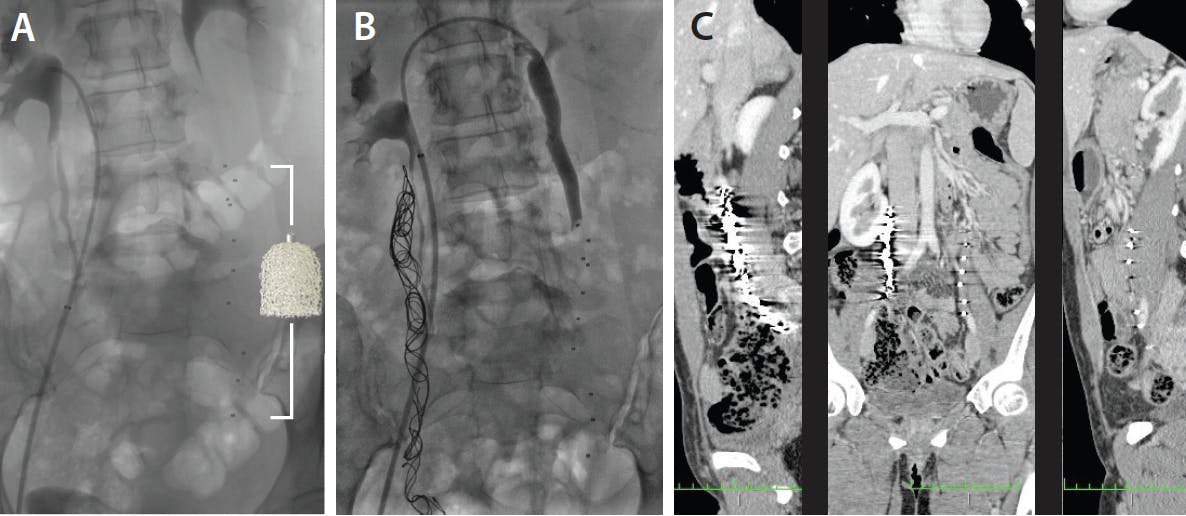
Figure 1. Ovarian vein embolization using Smart Polymer devices. Ten IMPEDE-FX Embolization Plugs were first deployed into the left ovarian vein (A). Then, the right ovarian vein was treated with bare-metal embolization coils before treating the remaining left ovarian vein length (B) with additional IMPEDE-FX Embolization Plugs until approximately 4 cm of the renal vein junction. Follow-up CT imaging shows the minimal artifact of Smart Polymer devices in the left ovarian vein (C).
Clinical follow-up, ultrasound imaging, and CT venography at 3 and 10 months have not shown any evidence of symptom recurrence or recanalization. The patient underwent radiofrequency ablation of the remaining varices in the lower limbs (which gradually shrunk after the ovarian vein embolization) at 1 year postprocedure.
Patients indicated for ovarian vein embolization are usually young; therefore, we consider the low metal content of the Smart Polymer devices a significant advantage in treating these women (Figure 1C).
TESTICULAR VEIN EMBOLIZATION

We have seen good clinical results using Smart Polymer devices in combination with sclerosant via a transjugular approach for gonadal vein embolization of men and women to treat symptomatic varicocele and pelvic congestion syndrome. In 15 cases over the last 14 months, we experienced straightforward and reliable treatment for our patients with a device that has minimal metal implant combined with excellent thrombogenic characteristics. We additionally appreciate the bioabsorbable aspect of Smart Polymer.
We treated a man in his early 20s who had painful grade 4 varicocele, especially during his physical job. Left testicular vein reflux was confirmed (Figure 1A and 1B, transjugular approach). After intubation of this testicular vein, we advanced a long 6-F sheath (Ansel Flexor, Cook Medical) and then deployed an 8-mm-diameter IMPEDE Embolization Plug at the level of the lower iliosacral joint (Figure 1C). The pushable device can be deployed using standard J-wire or the dilatator of the sheath. To prevent potential parallel vein recanalization, a sandwich technique was used with a sclerosant (2 mL Aethoxysklerol 3% [Kreussler Pharma] in a 1:4 foam formulation). After half of the sclerosing foam volume was administered, two 12-mm-diameter IMPEDE-FX Embolization Plugs were deployed in the middle part of the vein, followed by the remaining sclerosing foam volume. The intervention was completed by placing a second 8-mm-diameter IMPEDE Embolization Plug just below the left renal vein junction. After 5 minutes for full device expansion and thrombotic occlusion, reflux was no longer observed (Figure 1D). We recently saw the patient in a scheduled clinical follow-up, and he was very satisfied; his previous scrotal pain and varices had disappeared.
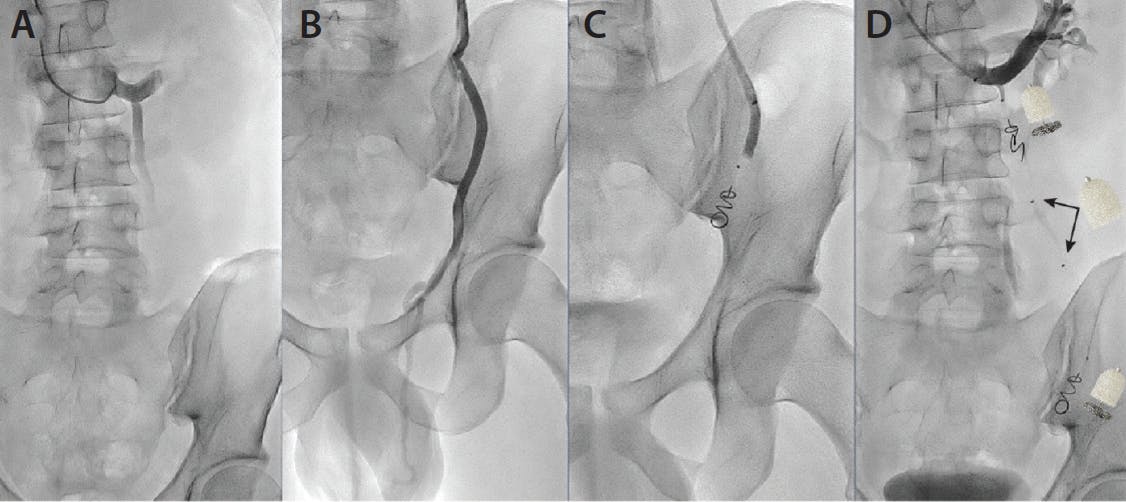
Figure 1. Pulsed fluoroscopy image hold of left testicular vein embolization using Smart Polymer devices. Reflux in the left testicular vein (A, B). An 8-mm-diameter IMPEDE Embolization Plug was placed at the level of the lower iliosacral joint (C). Two IMPEDE-FX Embolization Plugs in combination with sclerosant were used along the vein length, with an 8-mm-diameter IMPEDE Embolization Plug near the renal vein junction (D).
Given the young age of the typical patient undergoing gonadal vein embolization, we only use pulsed fluoroscopy sequences, and we favor these bioabsorbable Smart Polymer implants with low metal content.
INTERNAL ILIAC ARTERY EMBOLIZATION

We used Smart Polymer among a number of devices to perform endovascular aneurysm repair (EVAR) of a large iliac artery aneurysm. A man in his mid 70s was found on a screening ultrasound to have a left iliac artery aneurysm that was 2.5 cm in diameter. A surveillance ultrasound 1 year later showed > 1 cm of growth in the aneurysm to 3.5 cm (Figure 1A). Based on anatomic criteria, EVAR with a bifurcated device was required, with embolization of the ipsilateral internal iliac artery. After percutaneous bilateral femoral access, a 5-F sheath was advanced up and over to the 8-mm-diameter left internal iliac artery. A 12-mm-diameter IMPEDE Embolization Plug was deployed into the internal iliac artery followed by a single coil (Figure 1B). Standard EVAR was then performed with a bifurcated device that was extended into the external iliac artery for coverage. Completion aortography showed occlusion of the internal iliac artery and an excluded aneurysm (Figure 1C). The patient was followed with postoperative ultrasound due to chronic renal insufficiency, which confirmed occlusion of the internal iliac artery. Smart Polymer has minimal artifact that allows us to better evaluate vessels on postoperative scans.
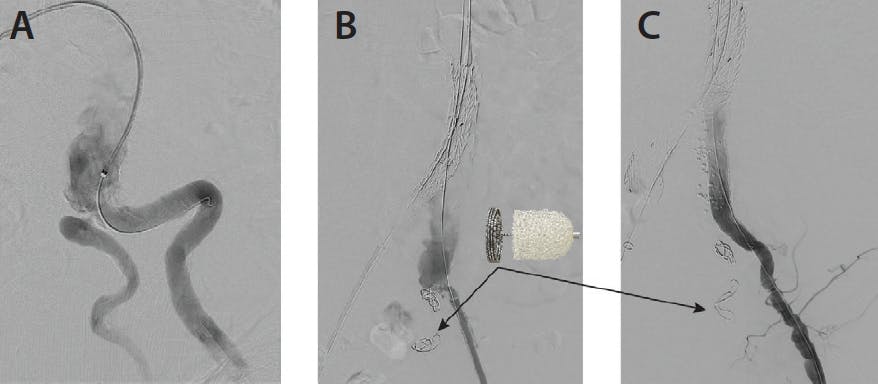
Figure 1. Smart Polymer was used among several devices to treat a large common iliac artery aneurysm. Preprocedural angiography of the left iliac artery aneurysm that was 3.5 mm in diameter (A). Embolization of the left internal iliac artery with an IMPEDE Embolization Plug and a coil (B). Case completion angiography after EVAR of the large iliac artery aneurysm (C).
In countries recognizing CE Marking, the IMPEDE Embolization Plug and the IMPEDE-FX Embolization Plug are indicated to obstruct or reduce the rate of blood flow in the peripheral vasculature.
In the United States, the IMPEDE Embolization Plug is indicated to obstruct or reduce the rate of blood flow in the peripheral vasculature and the IMPEDE-FX Embolization Plug is indicated for use with the IMPEDE Embolization Plug to obstruct or reduce the rate of blood flow in the peripheral vasculature.
In countries recognizing CE Marking, the TrelliX Embolic Coil System is intended to obstruct or occlude blood flow in vascular abnormalities of the neurovascular and peripheral vessels. Indications include intracranial aneurysms, other neurovascular abnormalities such as arteriovenous malformations and arteriovenous fistulae, and arterial and venous embolizations in the peripheral vasculature.
The TrelliX Embolic Coil System is not available for sale in the United States or Japan.
Refer to the IFU – supplied with each device – for a complete statement of the indications, contraindications, warnings, and instructions for use.
Advertisement
Advertisement