Advertisement
Advertisement
January 2023
Coding Updates for 2023
An overview of endovascular and interventional CPT coding updates for your practice.
There are numerous changes to CPT that may pertain to the practice of endovascular and/or interventional procedures. The most significant changes are the creation of category I codes for percutaneous arteriovenous fistula (pAVF) creation for dialysis patients and the changes in coding of many evaluation and management (E/M) services provided for inpatient and observation patients. Because of the large number of changes, this article will address the main points of the new codes, but the reader will need to also review the CPT Manual 2023 to understand the nuances and rules that apply to any of these codes. These coding changes took effect January 1, 2023.
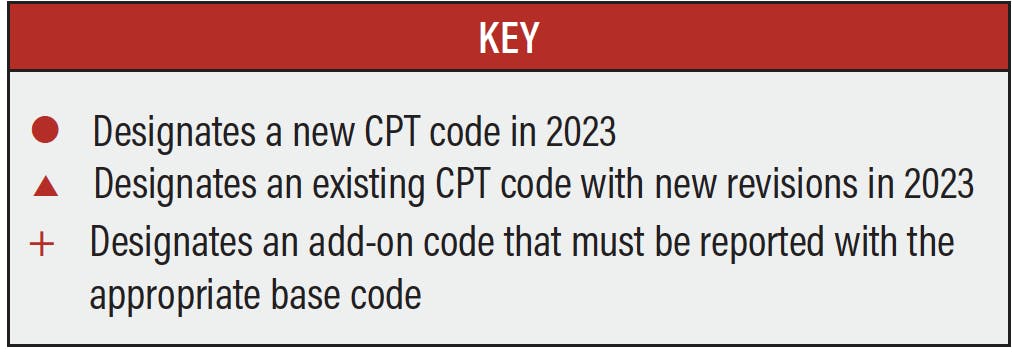
NEW CODES
pAVF Creation
Two new codes (36836, 36837) were created to describe pAVF creation in the upper extremity for hemodialysis access. Both codes are bundled, and each includes all aspects of the procedure that creates the fistula. Specifically, imaging guidance of vascular access(es), vascular access, angiography, imaging guidance, and (when performed) blood flow redirection or maturation techniques (eg, transluminal balloon angioplasty, coil embolization), radiologic supervision, and interpretation performed for fistula creation are included in each code. Both codes describe the procedure of percutaneously accessing an artery and a vein, which are then directly connected using energy (eg, thermal energy), creating the AVF. Balloon angioplasty may be performed to treat any areas of stenosis or to dilate/enlarge the vessel(s). Coil embolization may be performed to direct flow into the intended outflow vein to maximize flow through the desired channel. All of these elements are included in codes 36836 and 36837 and are not separately reportable.
Code choice is dependent on the number of access sites used to perform the pAVF creation. If a single access site is utilized to access both the artery and the vein, code 36836 is reported. If two or more access sites are utilized to access the vessels, 36837 is reported.
These codes are specific to fistula creation in the upper extremities. If pAVF creation is performed in a lower extremity, these codes do not apply. Instead, unlisted code 37999 should be reported.
●36836 pAVF creation, upper extremity, single access of both the peripheral artery and peripheral vein, including fistula maturation procedures (eg, transluminal balloon angioplasty, coil embolization) when performed, including all vascular access, imaging guidance, and radiologic supervision and interpretation
●36837 pAVF creation, upper extremity, separate access sites of the peripheral artery and peripheral vein, including fistula maturation procedures (eg, transluminal balloon angioplasty, coil embolization) when performed, including all vascular access, imaging guidance, and radiologic supervision and interpretation
E/M Coding Revisions: Hospital Inpatient and Observation Care Services, Inpatient and Outpatient Consultations, Prolonged Services
Significant changes have been made to update and streamline the inpatient and observation E/M codes for 2023. The codes have been consolidated, combining inpatient visits and observation care and both new and established patients into the same codes, allowing deletion of seven codes. Eleven codes have been revised, as shown here. The consolidations include inpatient and observation daily visit services as well as discharge services. Each of the codes may be reported using time spent in the care of that patient on the date of service, and the times for each code have been updated for 2023.
The coding changes for E/M reporting are extensive and are not fully covered in this article. The changes are intended to decrease administrative burden for providers and allow the provision of care that is pertinent and necessary for each patient.
Providers may choose from two methods of determining level of coding and can select the method that results in the higher level if the methods result in different levels. Codes may be reported based on time spent, which includes all time spent on that patient’s care that day (except time spent for procedures). The times for each code also have been updated for 2023, which should be noted for your practice. Alternatively, level of medical decision-making (MDM) may be used to determine the level of coding. Documentation that supports the method of code determination is required. Small changes were made to the CPT table showing examples for determining level of MDM in 2023.
Codes 99221-99223 are reported for the first hospital inpatient or observation status encounter with the patient. These codes are used when the initial visit is the first visit during this hospital/observation stay by the physician or qualified health care provider (QHP) or by another physician/QHP of the exact same specialty or subspecialty belonging to the same group practice. For all subsequent E/M visits during the hospital stay by the same physician/QHP/same specialist in the same practice, codes 99231-99233 are reported. Even if it is the first time an individual provider is seeing that patient in the hospital, it would be reported as a subsequent visit if the patient had previously been seen by a provider in the same group practice.
Initial Hospital Inpatient or Observation Care, New or Established Patient
▲99221 Initial hospital inpatient or observation care, per day, for E/M of a patient, which requires a medically appropriate history and/or examination and straightforward or low level of MDM
When using total time on the date of the encounter for code selection, 40 minutes must be met or exceeded
▲99222 Initial hospital inpatient or observation care, per day, for E/M of a patient, which requires a medically appropriate history and/or examination and straightforward or moderate level of MDM
When using total time on the date of the encounter for code selection, 55 minutes must be met or exceeded
▲99223 Initial hospital inpatient or observation care, per day, for E/M of a patient, which requires a medically appropriate history and/or examination and straightforward or high level of MDM
When using total time on the date of the encounter for code selection, 75 minutes must be met or exceeded
Subsequent Hospital Inpatient or Observation Care
▲99231 Subsequent hospital inpatient or observation care, per day, for E/M of a patient, which requires a medically appropriate history and/or examination and straightforward or low level of MDM
When using total time on the date of the encounter for code selection, 25 minutes must be met or exceeded
▲99232 Subsequent hospital inpatient or observation care, per day, for E/M of a patient, which requires a medically appropriate history and/or examination and moderate level of MDM
When using total time on the date of the encounter for code selection, 35 minutes must be met or exceeded
▲99233 Subsequent hospital inpatient or observation care, per day, for E/M of a patient, which requires a medically appropriate history and/or examination and high level of MDM
When using total time on the date of the encounter for code selection, 50 minutes must be met or exceeded
Hospital Inpatient or Observation Care Services (Including Admission and Discharge Services)
The codes for management of a patient admitted and discharged on the same date of service (either as an inpatient or observation status) have been revised. Billing codes 99234-99236 require two separate encounters on the same date and are billed on either time spent or level of MDM documented.
▲99234 Hospital inpatient or observation care, for E/M of a patient including admission and discharge on the same date, which requires a medically appropriate history and/or examination and straightforward or low level of MDM
When using total time on the date of the encounter for code selection, 45 minutes must be met or exceeded
▲99235 Hospital inpatient or observation care, for E/M of a patient including admission and discharge on the same date, which requires a medically appropriate history and/or examination and moderate level of MDM
When using total time on the date of the encounter for code selection, 70 minutes must be met or exceeded
▲99236 Hospital inpatient or observation care, for E/M of a patient including admission and discharge on the same date, which requires a medically appropriate history and/or examination and high level of MDM
When using total time on the date of the encounter for code selection, 85 minutes must be met or exceeded
Hospital Inpatient or Observation Discharge Services
The codes for discharge-day management of patients have been updated for 2023, combining services for both hospital inpatient discharge with observation discharge and eliminating codes that were specific for observation discharge. These codes are reported solely on time spent.
▲99238 Hospital inpatient or observation discharge-day management; 30 minutes or less on the date of the encounter
▲99239 Hospital inpatient or observation discharge day management; more than 30 minutes on the date of the encounter
Consultations (Office and other Outpatient/Inpatient or Observation)
The consultation codes have been updated for 2023, with significant changes. Consultations are typically complex, require significant time, and are provided for a patient new to the provider. These services may be provided in any setting and are distinguished by a set of codes for either office or other outpatient consultations (99242-99245) and a separate set of codes for inpatient or observation consultations (99252-99255). Consultations are defined in CPT as “a type of E/M service provided at the request of another physician, other QHP, or appropriate source to recommend care for a specific condition or problem.” The Centers for Medicare & Medicaid Services (CMS) does not cover these codes, but other carriers may allow providers to bill these codes. CMS directs providers to use office or inpatient/observation E/M codes to report consultation services. Consultation codes may be reported using either level of MDM or time spent. The times assigned to these codes have not changed in 2023.
Prolonged Service on the Date of an E/M Service
CPT has added a new code (99418) and revised an existing code (99417) used to report E/M services that require more time than the maximum time in the highest level of code. Code 99417 is used for outpatient services (eg, outpatient new patient visit 99205, established patient visit 99215, outpatient consultation 99245). Code 99418 is specific for inpatient/observation E/M services (eg, inpatient/observation care initial visit 99223 or subsequent visit 99233, inpatient/observation admission/discharge same day 99236, inpatient/observation consult 99255). Codes 99417 and 99418 are only reported when the total time spent is at least 15 minutes more than the minimum time specified for the E/M code that describes the base service. The codes may be reported for each additional increment of at least 15 minutes that is spent providing the E/M services. CPT Manual 2023 has included a table showing times required to report these codes.
+▲99417 Prolonged outpatient E/M service(s) time with or without direct patient contact beyond the required time of the primary service when the primary service level has been selected using total time, each 15 minutes of total time
+●99418 Prolonged inpatient or observation E/M service(s) time with or without direct patient contact beyond the required time of the primary service when the primary service level has been selected using total time, each 15 minutes of total time
CMS is again not covering codes 99417 and 99418 but has created G codes that may be reported. The G code for prolonged E/M services provided in inpatient/observation sites may be billed to CMS. Note that CMS previously created code G2212 for prolonged services for outpatient E/M visits.
●G0316 Prolonged hospital inpatient and observation care E/M service(s) beyond the total time for the primary service; each additional 15 minutes
Pulmonary Angiography (Performed With Cardiac Services)
New codes have been added to the cardiac section of CPT to describe selective pulmonary artery and venous angiography. These are add-on codes that are reported with cardiac catheterization procedures (eg, transcatheter aortic valve replacement, transcatheter mitral valve replacement, coronary angiography). These do not replace the codes for pulmonary angiography or pulmonary artery catheterizations performed to evaluate the pulmonary arteries without performing any cardiac services. See the CPT Manual 2023 for specific lists of base codes applicable to this set of codes.
+▲93568 Injection procedure during cardiac catheterization including imaging supervision, interpretation, and report; for nonselective pulmonary arterial angiography
+●93569 for selective pulmonary arterial angiography, unilateral
+●93573 for selective pulmonary arterial angiography, bilateral
+●93574 for selective pulmonary venous angiography of each distinct pulmonary vein during cardiac catheterization
+●93575 for selective pulmonary angiography of major aortopulmonary collateral arteries arising off the aorta or its systemic branches, during cardiac catheterization for congenital heart defects, each distinct vessel
Percutaneous Pulmonary Artery Revascularization
A new set of codes has been added for pulmonary artery stent revascularization procedures. These codes include all vascular access, catheterizations, fluoroscopic guidance, angiography that confirms known diagnosis, angiography that guides the procedure (including confirmation of completion of procedure), and radiologic supervision and interpretation for the procedure. Angiography that is included in these codes may not also be reported separately as diagnostic angiography. Diagnostic angiography may be reported separately when it is providing diagnostic information that is essential for the patient and that is documented to meet the criteria described in the introductory section of the CPT Manual 2023 for this set of codes.
●33900 Percutaneous pulmonary artery revascularization by stent placement, initial; normal native connections, unilateral
●33901 normal native connections, bilateral
●33902 abnormal connections, unilateral
●33903 abnormal connections, bilateral
+●33904 Percutaneous pulmonary artery revascularization by stent placement, each additional vessel or separate lesion, normal or abnormal connections
REVISED CODES
Percutaneous Nephrolithotomy
Codes 50080 and 50081 have been revised to include antegrade stent placement and nephrostomy tube placement, when performed. When tract placement/dilation/nephrostomy tube placement is performed separately from the nephrolithotomy, these may be reported with existing codes 50436 and 50437.
▲50080 Percutaneous nephrolithotomy or pyelolithotomy, lithotripsy, stone extraction, antegrade ureteroscopy, antegrade stent placement and nephrostomy tube placement, when performed, including imaging guidance; simple
▲50081 complex
Nerve Blocks
Several codes for nerve blocks have been revised to now include any imaging guidance when used. The revised codes are for nerve block injections and continuous infusions for brachial plexus (64415, 64416), axillary nerve (64417), sciatic nerve (64445, 64446), and femoral nerve (64447, 64448).
Single-Photon Emission CT (SPECT)
Codes 78803, 78830, 78831 and 78832 have been updated to be in line with how imaging is performed for these studies. Changes for 2023 are outlined in the following descriptors.
▲78803 Radiopharmaceutical localization of tumor, inflammatory process, or distribution of pharmaceutical agent(s) (includes vascular flow and blood pool imaging, when performed); tomographic (SPECT), single area (eg, head, neck, chest, pelvis) or acquisition, single-day imaging
▲78830 tomographic (SPECT) with concurrently acquired CT transmission scan for anatomic review, localization and/or determination/detection of pathology, single area (eg, head, neck, chest, pelvis) or acquisition, single-day imaging
▲78831 tomographic (SPECT), minimum two areas (eg, pelvis and knees, chest and abdomen) or separate acquisitions (eg, lung ventilation and perfusion), single-day imaging, or single area or acquisition over 2 or more days
▲78803 tomographic (SPECT) with concurrently acquired CT transmission scan for anatomic review, localization and determination/detection of pathology, minimum two areas (eg, pelvis and knees, chest and abdomen) or separate acquisitions (eg, lung ventilation and perfusion), single-day imaging, or single area or acquisition over 2 or more days
NEW CATEGORY III CODES
Virtual Reality Patient Procedural Dissociation
Four new category III codes were created to describe the use of virtual reality (VR) to alter a patient’s consciousness level and facilitate performance of a procedure/service by decreasing the patient’s pain and/or by increasing the patient’s ability to tolerate the procedure. These services may be used in place of moderate sedation for some patients/services. The codes are structured with a parent code for VR dissociation provided by the same physician or QHP who is performing the diagnostic or therapeutic service (0771T, 0772T) and a parent code for VR dissociation provided by a separate provider (0773T, 0774T). These codes are not to be reported for administration of drugs (eg, pain control, anxiolysis, moderate sedation) and may not be reported for patients younger than age 5 years. An independent trained observer is required to be present with no other duties and providing continuous monitoring of the patient’s condition/comfort, and the physician/QHP providing the service must be continuously face-to-face with the patient throughout the service. The codes are reported on intraservice time only. Although the codes also include preservice work of evaluating and managing the patient for suitability for VR dissociation, describing the service to the patient/family, and applying the device, the time spent in these activities cannot be counted toward time that determines which code(s) to report. Postservice work time is also not separately reportable and is not included in the time used to determine reported code(s). See the CPT Manual for further details and descriptions, as well as a chart for determining the appropriate code(s) to report. Moderate sedation codes may be also reported if VR dissociation is not or cannot be used for the entire procedure, but the time for moderate sedation is separately counted, and no time may be counted toward both VR dissociation and moderate sedation.
Dorsal Sacroiliac Arthrodesis
Code 0775T describes placement of an intra-articular stabilization device into the sacroiliac (SI) joint that does not transfix the SI joint. If placing a device that does transfix the SI joint (ie, the device passes through the ilium, across the SI joint, and into the sacrum), use code 27279.
●0775T Arthrodesis, SI joint, percutaneous, with image guidance, includes placement of intra-articular implant(s) (eg, bone allograft[s], synthetic devices)
Coronary Artery Lithotripsy
A new category III add-on code for coronary artery lithotripsy was added.
+●0715 Percutaneous transluminal coronary lithotripsy
DELETED CODES FOR 2023
Several codes have been deleted in 2023: 99217-99226 (E/M codes specific for observation care, replaced with codes including both inpatient hospital care and observation care, see previous E/M section) and 99241 and 99251 (office and inpatient consultations). The lowest-level codes have been deleted.
Advertisement
Advertisement