Advertisement
Advertisement
January 2023
How to Denervate With Current Renal Denervation Device Iterations
A step-by-step guide to renal denervation for the treatment of hypertension.
By Brian Fulton, MD; Jay Giri, MD, MPH; Debbie L. Cohen, MD; Herbert D. Aronow, MD, MPH; and Taisei Kobayashi, MD
Half of adult Americans have hypertension (HTN), and < 25% have optimally controlled blood pressure.1 Uncontrolled HTN increases the risk for adverse outcomes such as ischemic heart disease, stroke, and chronic kidney disease and is the most prevalent risk factor contributing to cardiovascular mortality in the United States.2 Additionally, rates of nonadherence to medical therapy for HTN are as high as 44% in randomized studies.3 Renal denervation (RDN) therapy is a nonpharmacologic treatment modality that, in early studies, significantly reduced blood pressure in patients both on and off medical therapy for HTN.4-7 Currently, this modality is only available in the United States in the context of investigational trials, with ongoing studies evaluating its efficacy, safety, and durability for the treatment of HTN. This article reviews the step-by-step procedural approach for the two most well-studied RDN platforms: radiofrequency (RF) RDN (rRDN) and ultrasound RDN (uRDN). The rRDN system (Symplicity Spyral, Medtronic) relies on the application of RF waves across the renal arterial wall and into the surrounding sympathetic nerve bed to selectively destroy the nerves by application of heat. The uRDN system (Paradise system, ReCor Medical) uses ultrasound waves to accomplish similar targeted denervation.
rRDN
The Symplicity Spyral system (Figure 1) uses a 6-F sheath inserted via the common femoral artery. First, a nonselective aortogram is obtained detailing the location and anatomy of the main and accessory renal arteries that will require treatment. Care is taken to exclude patients with significant renal artery stenosis, fibromuscular dysplasia, renal artery aneurysms, or prior stenting that would preclude optimal denervation. Targets for RDN are in renal arteries ranging from 3 to 8 mm in diameter, including accessory renal arteries.
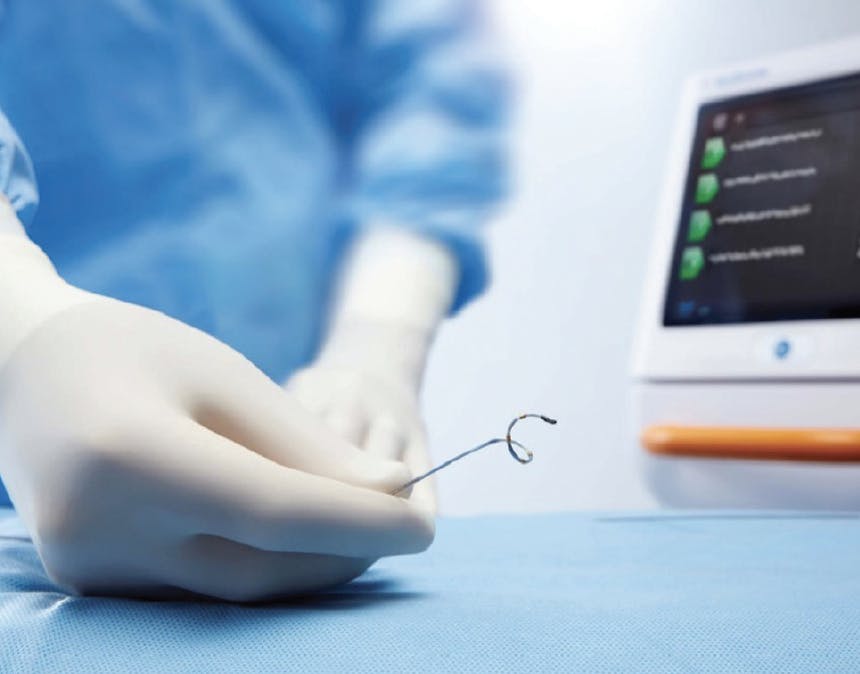
Figure 1. The Symplicity Spyral rRDN catheter and console. The Spyral catheter has four gold electrodes that deliver RF energy. The console shows individual readings of resistance and temperature for each of the four electrodes.
(Courtesy of Medtronic.)
Second, selective angiography of the renal arteries is performed utilizing a 55-cm guide catheter. Note the length of the guide catheter must be shorter than standard guide catheters used for coronary intervention given the shaft length of current-generation RDN catheters. We favor the IMA (internal mammary artery) guide catheter shape, but Amplatz, multipurpose, RDN-1, and RDC shapes may be used as well. RDN-1 shapes may work better for down-sloping takeoffs for the left renal arteries to provide better backup against the aorta. Multipurpose catheters are more advantageous when approaching the renal arteries from above (not yet possible with existing RDN system iterations). Selective renal angiography should be carefully reviewed to rule out routine exclusionary criteria as outlined previously. Ongoing research is examining the optimal location to apply RDN (ie, distal branches vs main renal artery vs both). Current study designs dictate that renal RF ablation treatment begins in the distal renal arteries, when of appropriate diameter, adjacent to but not beyond the renal parenchyma. Treatments are performed sequentially, moving distal to proximal. The rRDN catheter is advanced over a 0.014-inch standard workhorse guidewire that is placed into the distal branches of the target renal artery. Stiffer wires may provide greater support, and hydrophilic wires should be avoided.
The Symplicity Spyral catheter has a rapid-exchange design with the intention to treat all vessels between 3 and 8 mm, and a single catheter can accommodate any diameter within that range (ie, one catheter for one patient). The catheter contains four radiopaque electrodes at its distal tip spaced 5 mm apart that emit RF waves and measure impedance to energy conduction and arterial wall temperature. The catheter’s distal end is attached to the console, which allows the operator to review the impedance and temperature of each of the four electrodes on the catheter and determine whether there is adequate vessel wall apposition during respiration. By convention, the most distal electrode is numbered 1 and the most proximal electrode is numbered 4. The system comes with a remote that controls each individual electrode to provide ultimate control of which electrode(s) will deliver treatment. Once satisfied with positioning, the guidewire is retracted proximal to the most proximal RF ablation electrode prior to delivering treatment. Once the guidewire is retracted, the catheter assumes a helical shape, allowing each of the four electrodes to abut the arterial wall. Additional sedatives should be given prior to treatment to minimize associated pain and the likelihood of resultant patient movement that could lead to loss of contact between electrodes and the arterial wall. After adequate sedation, each treatment run is delivered over a 60-second interval. During each treatment, the electrodes monitor for abnormal increase in temperature of the vessel wall suggesting vessel spasm or a change in impedance to suggest loss of contact. The system automatically stops delivering treatment to an electrode if either of these conditions is met. It is possible to reposition, reactivate, and retreat a site if vasospasm or loss of contact occurs. Vasospasm that does not resolve spontaneously can be treated with intra-arterial nitroglycerin; poor vessel contact can usually be addressed by torquing the catheter. For instance, if electrode 3 suggests loss of contact, it is possible to turn off electrodes 1, 2, and 4 via the remote, adjust the catheter by turning it in a clockwise motion, and then retreat using electrode 3 in isolated fashion.
Although it is possible to pull the catheter more proximally toward the aorta, most repositioning should be performed by readvancing the guidewire through the Spyral catheter. Ideal treatment should be evenly spaced by 5 mm (because each of the four electrodes is spaced by 5 mm, the catheter can be used as a guide). Once the catheter is repositioned, additional treatments are delivered where appropriate in a distal to proximal pattern, with care not to treat within 5 mm of an ostium or bifurcation. Overall, most operators will treat branch vessels from distal to proximal, leaving the main renal artery last, given the current investigational trial’s requirement that four simultaneous treatments be delivered within the main renal artery. A final selective renal angiogram is taken to ensure no perforation, dissection, or other vessel trauma has occurred, although it is common to see mild luminal irregularities within the vessel at points of treatment. These steps are then repeated in the contralateral renal artery.
uRDN
The Paradise system (Figure 2) uses a 7-F sheath inserted via the common femoral artery, and an aortogram should be obtained to define the anatomy using a standard pigtail catheter as detailed previously. One key difference in trial design between rRDN and uRDN trials was the use of preprocedural CTA to rule out patients with renal artery stenosis, fibromuscular dysplasia, or renal aneurysms. This also allowed preprocedural measurements of the renal arteries and screening for presence of accessory renal arteries, which becomes important for the procedure as described herein.
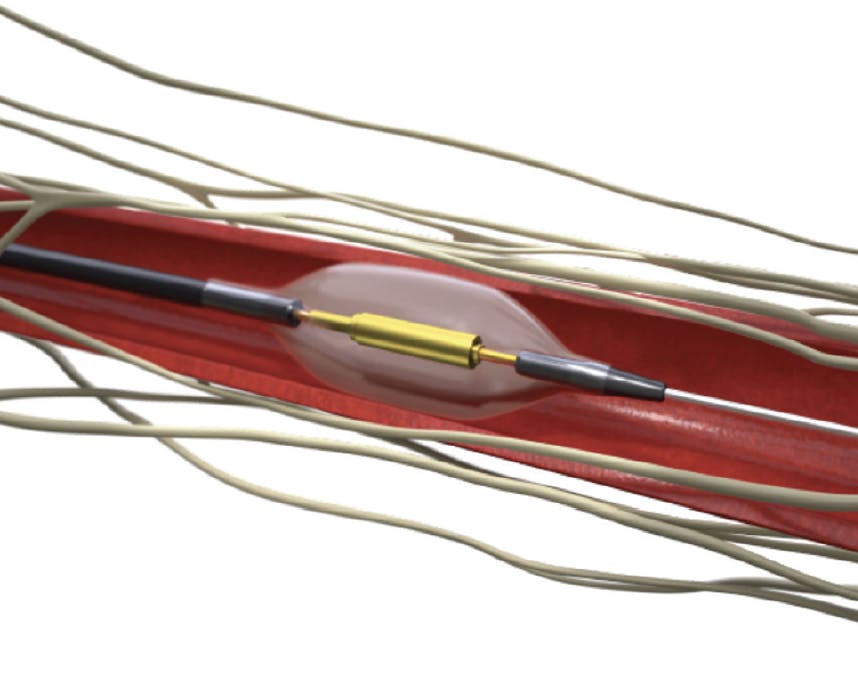
Figure 2. The Paradise uRDN catheter inflated with the target renal nerves surrounding the main renal artery.
(Courtesy of ReCor Medical.)
Similar to rRDN, a 55-cm guiding catheter is advanced to the ostium of the renal artery; similar guide catheter shapes may be used. However, a key differentiating factor is that in uRDN, treatment to the main and accessory renal arteries bilaterally has been equally efficacious to rRDN in the distal, main, and accessory arteries, and thus treatment is focused only on the main renal arteries for uRDN.8 Similar to rRDN, target arteries for uRDN are 3 to 8 mm in diameter. Even if CTA was performed prior to the procedure, selective renal angiography should be performed to confirm results as well as remeasure the main renal arteries utilizing quantitative analytic tools. Intravascular ultrasound may also be used to obtain or confirm accurate sizing.
A guidewire, similar to that used for rRDN, is advanced into the renal artery branch. The Paradise catheter is an over-the-wire system with a balloon at its distal tip that surrounds an ultrasound emitter at its core. The Paradise catheter balloon sizes are 3.5, 4.2, 5, 6, 7, and 8 mm and should be sized in a 1:1 fashion (eg, a 3.5-mm balloon should be used for a 3-3.5–mm target artery). The catheter connects to an ultrasound generator that adjusts the energy output according to the balloon size chosen. A standard hemostatic valve must be attached to the guide catheter to accommodate the larger ReCor device profile (eg, Honor hemostasis valve, Merit Medical).
Targets for the Paradise catheter begin 5 mm proximal to the main renal artery branch, followed more proximally in 5-mm increments moving toward the aorto-ostium, with care not to treat within 5 mm of the ostium itself. The catheter has a 5-mm radiopaque marker in the middle of the balloon-tipped shaft for reference. A preprocedure CTA or MRA may help the operator to determine treatment strategy (eg, number and location of treatments as well as optimal fluoroscopic/angiographic views). Prior to treatment, several ports must be attached to the Paradise system console. There are two ports at the distal end of the Paradise catheter that are connected via a larger pump that is attached to the console. This serves as an inflow/outflow of continuous sterile water that will cool the arterial wall before, during, and after the treatments are delivered. The most proximal end of the catheter must be plugged into the console to allow for energy delivery to the ultrasound emitter in the catheter.
Once the catheter is in appropriate position, the interventionalist initiates an automatic low-pressure inflation that is controlled by the console. When the balloon is inflated, the operator must inject contrast into the renal artery to confirm complete renal artery occlusion and balloon apposition. The balloon then precools the arterial wall via flow of sterile water through the balloon and continues to cool the arterial wall while the ultrasound waves are emitted. The cooling protects the arterial wall from the heat of the ultrasound waves and reduces risk of damage to the wall while allowing the ultrasound waves to pass through the wall and apply heat to the target nerve bed. Each treatment lasts for 7 seconds. Typically, two to three treatments are delivered per main renal artery. After procedure completion, a renal angiogram is obtained to rule out vessel trauma. The same approach is applied for any large accessory renal arteries and/or proximal side branches of at least 3 mm in diameter and the contralateral renal artery. Of note, a different balloon size or multiple balloon sizes may be required for each target vessel depending on variation in arterial anatomy.
SIMILARITIES AND DIFFERENCES
Despite using different technology, both the rRDN and uRDN systems accomplish the same end goal of selectively damaging sympathetic nerve fibers along the renal arteries. Both systems require femoral access and can be used with standard 55-cm guiding catheters and 0.014-inch guidewires. Renal arteries that are within 3 to 8 mm are typical targets for intervention with either modality. The approach to sedation and pain control as well as the use of angiography before and after treatment are similar.
However, there are several differences between the two systems. The Symplicity Spyral is a one-size-fits-all catheter, can treat more distal branches, employs longer treatment times, and allows for distal flow during treatment. The Paradise catheter must be sized according to vessel diameter, is designed to treat the main renal artery and accessory arteries, and involves shorter treatment times. The cooling system is also unique to the Paradise catheter and not required for the Spyral catheter. Despite these differences, both systems appear to have similar safety and efficacy in contemporary studies, providing a viable and valuable adjunct to medical therapy in the treatment of HTN.
CONCLUSION
Although there are distinct procedural differences in how to perform rRDN and uRDN, there are many similarities in terms of access approach, target artery size for intervention, and approach to sedation and pain control. Contemporary data have revealed no safety concerns for both rRDN and uRDN.
1. Virani SS, Alonso A, Benjamin EJ, et al. Heart disease and stroke statistics—2020 update: a report from the American Heart Association. Circulation. 2020;141:e139-e596. doi: 10.1161/cir.0000000000000757
2. Mills KT, Stefanescu A, He J. The global epidemiology of hypertension. Nat Rev Nephrol. 2020;16:223-237. doi: 10.1038/s41581-019-0244-2
3. Berra E, Azizi M, Capron A, et al. Evaluation of adherence should become an integral part of assessment of patients with apparently treatment-resistant hypertension. Hypertension. 2016;68:297-306. doi: 10.1161/hypertensionaha.116.07464
4. Böhm M, Kario K, Kandzari DE, et al. Efficacy of catheter-based renal denervation in the absence of antihypertensive medications (SPYRAL HTN-OFF MED pivotal): a multicentre, randomised, sham-controlled trial. Lancet. 2020;395:1444-1451. doi: 10.1016/S0140-6736(20)30554-7
5. Kandzari DE, Böhm M, Mahfoud F, et al. Effect of renal denervation on blood pressure in the presence of antihypertensive drugs: 6-month efficacy and safety results from the SPYRAL HTN-ON MED proof-of-concept randomised trial. Lancet. 2018;391:2346-2355. doi: 10.1016/S0140-6736(18)30951-6
6. Azizi M, Daemen J, Lobo MD, et al. 12-month results from the unblinded phase of the RADIANCE-HTN SOLO trial of ultrasound renal denervation. JACC: Cardiovascular Interventions. 2020;13:2922-2933. doi: 10.1016/j.jcin.2020.09.054
7. Azizi M, Sanghvi K, Saxena M, et al. Ultrasound renal denervation for hypertension resistant to a triple medication pill (RADIANCE-HTN TRIO): a randomised, multicentre, single-blind, sham-controlled trial. Lancet. 2021;397:2476-2486. doi: 10.1016/S0140-6736(21)00788-1
8. Fengler K, Rommel KP, Blazek S, et al. A three-arm randomized trial of different renal denervation devices and techniques in patients with resistant hypertension (RADIOSOUND-HTN). Circulation. 2019;139:590-600. doi: 10.1161/CIRCULATIONAHA.118.037654
Advertisement
Advertisement