Advertisement
Advertisement
June 2023
Sponsored by Medtronic
Drug-Coated Balloon Angioplasty in Failing AVFs: Where Are We?
With Andrew Holden, MBChB, FRANZCR, EBIR, ONZM, and Vincent Gallo, MD


In this article, Drs. Holden and Gallo discuss current clinical evidence on drug-coated balloons (DCBs) for treatment of dysfunctional dialysis arteriovenous fistulas (AVFs) and improving outcomes for end-stage kidney disease (ESKD) patients. Dr. Gallo shares a case example of how he used IN.PACT™ AV drug-coated balloon (Medtronic) to treat a high-grade cephalic stenosis.
DISCUSSION WITH DRS. HOLDEN AND GALLO
IN.PACT AV Access trial data have been reported through 3 years, with mortality reported through 4 years. What are the most clinically meaningful outcomes from this data set?
Dr. Holden: There are four key parts of this study that I keep returning to as an interventionalist treating ESKD patients. The first is safety in terms of mortality—after the paclitaxel safety concerns, it’s important to note that through 4 years, there is no difference in mortality between DCB and percutaneous transluminal angioplasty (PTA) arms in this trial. The second is the sustained superior patency through 3 years that you see when a participant was treated with DCB: 52.1% compared to 36.7% with PTA.1 Third, beyond the raw patency data is the median time to reintervention between the DCB group and the PTA group; there was a 14.7-month delay if a participant was treated with DCB. When I think of my patients, this increase in time spent without a reintervention is critical. It’s one less interruption in dialysis, one less intervention. That matters.
Finally, especially long term, AV access thrombosis is an important factor. Thrombosis significantly impacts a patient’s ability to undergo timely and adequate hemodialysis and puts the access at risk for failure and abandonment. Through 3 years, AV circuit thrombosis was significantly lower with DCB (8.2%) compared to plain balloon (18.3%).
Does this mean we have sufficient evidence to support DCBs as the standard of care for ESKD patients?
Dr. Holden: Let’s start with what guidelines say are standard of care. Per the Kidney Disease Outcomes Quality Initiative, a given AVF should have ≤ 3 interventions per year.2 Plain balloon, with high pressure as needed, is considered the “reasonable” primary treatment for dysfunction. Expectations here are set: We know that it’s not if an AVF will experience dysfunction, it’s when. Because frequent short-term interventions are required to maintain AV access patency, there aren’t much long-term data. The IN.PACT AV Access study is the first of its kind—large, prospective, multicenter, randomized, and adjudicated to report outcomes through 3 years in patients with dysfunctional access. The primary effectiveness endpoint was target lesion primary patency through 6 months and adverse events involving the access circuit through 30 days. Both outcomes were met, as reported in the New England Journal of Medicine publication.3
Twelve-month outcomes further demonstrated safety, with statistically significant improved outcomes in target lesion primary patency and access circuit primary patency.4,5 Now, we have data that demonstrate durability through 24 and 36 months, with no difference in mortality through 48 months and sustained benefit seen in several subgroups.1 Furthermore, there was a statistically significant advantage of DCB over plain balloon through 3 years, whether the fistula was located in the forearm or upper arm, was a de novo or restenotic lesion, and/or the lesion was located in the perianastomotic location, with other subgroups showing directionality supporting the use of DCB.
Looking at this recent evidence, it is reasonable to suggest that IN.PACT AV DCB should be incorporated as part of our standard of care. We also have information that indicates this would be a highly cost-effective approach. It’s important to note that there were differences between this trial and both the Lutonix AV6 and PAVE7 randomized controlled trials, which used a different DCB technology and had some differences in enrollment criteria and geographies. These trials have not demonstrated superior effectiveness of DCB compared to plain balloon as that seen in the IN.PACT AV Access trial.
If someone was new to using DCBs to treat AVF lesions, where would you recommend they begin?
Dr. Gallo: I would recommend that the endovascular specialist use the DCB in a very similar fashion to how it was studied in IN.PACT AV Access trial, which included de novo or restenotic lesions up to 100 mm in length in autogenous AVFs. Adequate vessel prep is also very important. I use high-pressure balloons covering the entirety of the lesion, with 1-cm extension on each side. If successful, I then treat it with a DCB of the same diameter.
Any practical considerations and technical tips?
Dr. Gallo: Vessel preparation is imperative to having the best results. Predilate with a high-pressure balloon for > 90 seconds. If there is an adequate treatment response (< 30% residual stenosis) on repeat AV fistulography, without evidence of flow-limiting dissection (grade > B) or perforation, consider using the DCB. The DCB should also cover the entirety of the lesion, with 1-cm extension on each side and inflation maintained for at least 180 seconds.
Dr. Holden: For de novo or restenotic access circuit stenosis, we now use the term “optimized vessel preparation,” which includes using a high-pressure balloon to treat the entire stenotic lesion and appropriate balloon sizing for the target lesion. We use a combination of transcutaneous ultrasound, angiography, intravascular ultrasound, and image overlay of the fistula at the time of intervention for real-time balloon sizing, and then we predilate with a high-pressure balloon for at least 2 minutes. After the optimal vessel preparation, we continue with a DCB. The preferred DCB is the IN.PACT AV DCB because it’s the only DCB that has shown long-term efficacy.*
DR. GALLO’S PATIENT CASE
A man in his late 70s with a history of ESKD on maintenance hemodialysis had a right upper extremity, percutaneous, endovascular, proximal radial artery–to–antecubital perforator vein fistula, with cephalic dominant outflow. He presented with low venous flow volumes within the targeted cannulation vein. Duplex ultrasound flow volume measurement demonstrated inadequate flow volumes within the cephalic vein (Figure 1A). A transradial right upper extremity AV fistulogram demonstrated a patent proximal radial artery–to–antecubital vein fistula with a high-grade, short-segment stenosis (92% stenosis, 2-cm lesion length) involving the juxta-anastomotic segment (Figure 1B and 1C). The reference vessel diameter of the target fistula was approximately 6 mm. The cephalic vein was otherwise unremarkable.
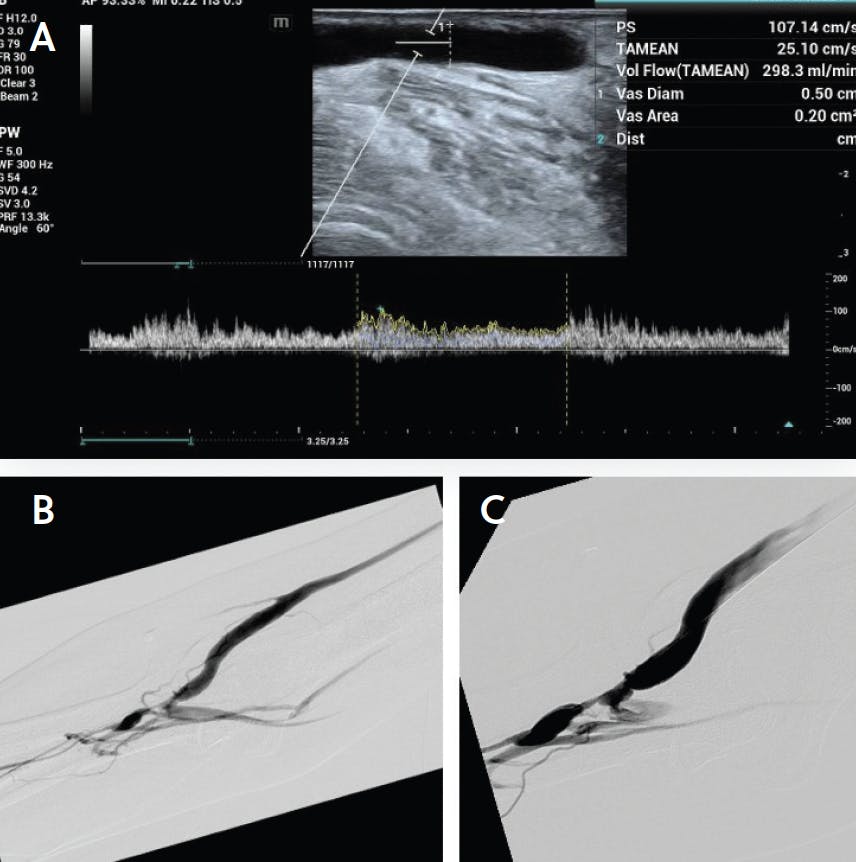
Figure 1. Duplex ultrasound flow volume measurement of the cephalic vein (A). A transradial AV fistulogram showed a high-grade, short-segment stenosis (B, C)
The vessel preparation was performed with high-pressure balloon angioplasty inflated for 2 minutes. There was no angiographic evidence of perforation or flow-limiting dissection at this point. I proceeded to treat the patient with a 6- X 40-mm IN.PACT AV DCB (Figure 2A). The final angiogram after DCB angioplasty demonstrated a patent right cephalic vein (Figure 2B) with adequate flow volume. At the time of this article, it has been > 3 months since his last intervention and no clinically significant issues with hemodialysis have been reported.
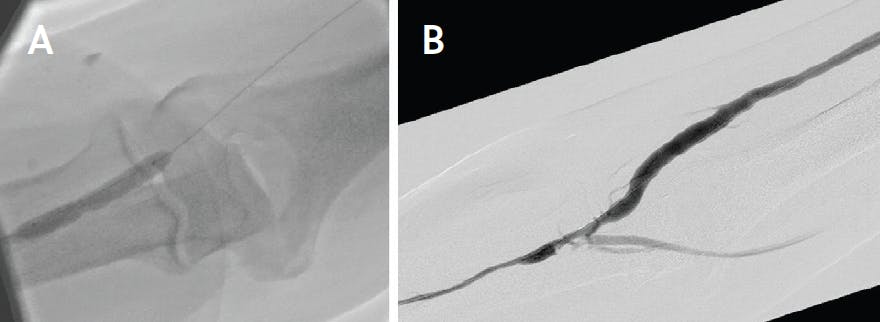
Figure 2. IN.PACT AV DCB angioplasty (A) and the final angiogram (B).
Disclosures
Dr. Holden: Medical advisory board member for Boston Scientific Corporation, Gore & Associates, Medtronic, and Phillips; clinical investigator for Abbott, Bard/BD, Boston Scientific Corporation, Biotronik, Cagent Medical, Cook Medical, Efemoral, Endologix, Endospan, Gore Medical, Intact Vascular, Medtronic, Nectero, Reflow Medical, Philips, Reflow Medical, Shape Memory, Shockwave Medical, Terumo, and TriReme Medical.
Dr. Gallo: Consultant to Medtronic.
*IN.PACT AV DCB is available for sales in US, Canada and Japan
1. Holden A. IN.PACT AV Access trial new data release: 3-year sub-analysis data. Presented at: CX Symposium 2023; April 25-27, 2023; London, United Kingdom.
2. Lok CE, Huber TS, Lee T, et al. KDOQI clinical practice guideline for vascular access: 2019 update. Am J Kidney Dis. 2020;75(4 suppl 2):S1-S164. doi: 10.1053/j.ajkd.2019.12.001
3. Lookstein RA, Haruguchi H, Ouriel K, et al. Drug-coated balloons for dysfunctional dialysis arteriovenous fistulas. N Engl J Med. 2020;383:733-742. doi: 10.1056/NEJMoa1914617
4. Holden A, Haruguchi H, Suemitsu K, et al. IN.PACT AV Access randomized trial: 12-month clinical results demonstrating the sustained treatment effect of drug-coated balloons. J Vasc Interv Radiol. 2022;33:884-894.e7. doi: 10.1016/j.jvir.2022.03.606
5. Haruguchi H, Suemitsu K, Isogai N, et al. IN.PACT AV access randomized trial: Japan cohort outcomes through 12 months. Ther Apher Dial. Published online January 6, 2023. doi: 10.1111/1744-9987.13966
6. Trerotola SO, Saad TF, Roy-Chaudhury P, et al. The Lutonix AV randomized trial of paclitaxel-coated balloons in arteriovenous fistula stenosis: 2-year results and subgroup analysis. J Vasc Interv Radiol. 2020;31:1-14.e5. doi: 10.1016/j.jvir.2019.08.035
7. Karunanithy N, Robinson EJ, Ahmad F, et al. A multicenter randomized controlled trial indicates that paclitaxel-coated balloons provide no benefit for arteriovenous fistulas. Kidney Int. 2021;100:447-456. doi: 10.1016/j.kint.2021.02.040
IN.PACT™ AV Paclitaxel-coated PTA balloon catheter
Brief Statement
Indications for Use:
The IN.PACT™ AV Paclitaxel-coated PTA balloon catheter is indicated for percutaneous transluminal angioplasty, after appropriate vessel preparation, for the treatment of obstructive lesions up to 100 mm in length in the native arteriovenous dialysis fistulae with reference vessel diameters of 4 to 12 mm.
Contraindications
The IN.PACT AV DCB is contraindicated for use in the following anatomy and patient types:
- Coronary arteries, renal arteries, and supra-aortic/cerebrovascular arteries
- Patients who cannot receive recommended antiplatelet and/or anticoagulant therapy
- Patients judged to have a lesion that prevents complete inflation of an angioplasty balloon or proper placement of the delivery system
- Patients with known allergies or sensitivities to paclitaxel
- Women who are breastfeeding, pregnant, or are intending to become pregnant, or men intending to father children. It is unknown whether paclitaxel will be excreted in human milk and whether there is a potential for adverse reaction in nursing infants from paclitaxel exposure
Warnings
- A signal for increased risk of late mortality has been identified following the use of paclitaxel-coated balloons and paclitaxel-eluting stents for femoropopliteal arterial disease beginning approximately 2-3 years post-treatment compared with the use of non-drug coated devices. There is uncertainty regarding the magnitude and mechanism for the increased late mortality risk, including the impact of repeat paclitaxel-coated device exposure. Inadequate information is available to evaluate the potential mortality risk associated with the use of paclitaxel-coated devices for the treatment of other diseases/conditions, including this device indicated for use in arteriovenous dialysis fistulae. Physicians should discuss this late mortality signal and the benefits and risks of available treatment options for their specific disease/condition with their patients.
- Use the product prior to the Use-by date specified on the package.
- Contents are supplied sterile. Do not use the product if the inner packaging is damaged or opened.
- Do not use air or any gaseous medium to inflate the balloon. Use only the recommended inflation medium (equal parts contrast medium and saline solution).
- Do not move the guidewire during inflation of the IN.PACT AV DCB.
- Do not exceed the rated burst pressure (RBP). The RBP is based on the results of in vitro testing. Use of pressures higher than RBP may result in a ruptured balloon with possible intimal damage and dissection.
- The safety of using multiple IN.PACT AV DCBs with a total drug dosage exceeding 15,105 μg paclitaxel has not been evaluated clinically.
Precautions
- This product should only be used by physicians trained in percutaneous transluminal angioplasty (PTA).
- Assess risks and benefits before treating patients with a history of severe reaction to contrast agents. Identify allergic reactions to contrast media and antiplatelet therapy before treatment and consider alternatives for appropriate management prior to the procedure.
- This product is not intended for the expansion or delivery of a stent.
- Do not use the IN.PACT AV DCB for pre-dilatation or for post-dilatation.
- This product is designed for single patient use only. Do not reuse, reprocess, or resterilize this product. Reuse, reprocessing, or resterilization may compromise the structural integrity of the device and/or create a risk of contamination of the device, which could result in patient injury, illness, or death.
- The use of this product carries the risks associated with percutaneous transluminal angioplasty, including thrombosis, vascular complications, and/or bleeding events
- The safety and effectiveness of the IN.PACT AV DCB used in conjunction with other drug-eluting stents or drug-coated balloons in the same procedure has not been evaluated.
- The extent of the patient’s exposure to the drug coating is directly related to the number of balloons used. Refer to the Instructions for Use (IFU) for details regarding the use of multiple balloons and paclitaxel content.
- Appropriate vessel preparation, as determined by the physician to achieve residual stenosis of ≤ 30%, is required prior to use of the IN.PACT AV DCB. Vessel preparation of the target lesion using high-pressure PTA for pre-dilatation was studied in the IN.PACT AV Access clinical study. Other methods of vessel preparation, such as atherectomy, have not been studied clinically with IN.PACT AV DCB.
Potential Adverse Effects
Potential adverse effects which may be associated with balloon catheterization may include, but are not limited to, the following: abrupt vessel closure, allergic reaction, arrhythmias, arterial or venous aneurysm, arterial or venous thrombosis, death, dissection, embolization, hematoma, hemorrhage, hypotension/hypertension, infection, ischemia or infarction of tissue/organ, loss of permanent access, pain, perforation or rupture of the artery or vein, pseudoaneurysm, restenosis of the dilated vessel, shock, stroke, vessel spasms or recoil.
Potential complications of peripheral balloon catheterization include, but are not limited to, the following: balloon rupture, detachment of a component of the balloon and/or catheter system, failure of the balloon to perform as intended, failure to cross the lesion. These complications may result in adverse effects.
Although systemic effects are not anticipated, potential adverse effects not captured above that may be unique to the paclitaxel drug coating include, but are not limited to, the following: allergic/immunologic reaction, alopecia, anemia, gastrointestinal symptoms, hematologic dyscrasia (including leucopenia, neutropenia, thrombocytopenia), hepatic enzyme changes, histologic changes in vessel wall, including inflammation, cellular damage, or necrosis, myalgia/arthralgia, myelosuppression, peripheral neuropathy.
Refer to the Physician’s Desk Reference for more information on the potential adverse effects observed with paclitaxel. There may be other potential adverse effects that are unforeseen at this time.
Please reference appropriate product Instructions for Use for a detailed list of indications, warnings, precautions and potential adverse effects. This content is available electronically at www.manuals.medtronic.com.
CAUTION: Federal law (USA) restricts this device to sale by or on the order of a physician.
501298 ©2023 Medtronic. Medtronic, Medtronic logo are trademarks of Medtronic. TM* third party brands are trademarks of their respective owner. All other brands are trademarks of Medtronic. For global distribution. 06/2023
Advertisement
Advertisement