Advertisement
Advertisement
September 2023
Sponsored by Veryan Medical
MIMICS-3D: Latest Data Show Consistency of Performance of the BioMimics 3D Stent in Smaller Femoropopliteal Vessels
Reference vessel diameter subgroup analysis provides additional compelling data that demonstrate consistent, durable results through 3-year follow-up, irrespective of vessel diameter.
The BioMimics 3D stent is a true biomimetic stent that, by design, imparts curvature to the vessel. This curvature is intended to generate swirling flow, leading to elevated wall shear stress, which has been shown to be vasoprotective.1 The self-expanding stent is laser cut from a nitinol tube and has three-dimensional helical centerline geometry set into the nitinol shape memory (Figure 1), which facilitates artery shortening during knee flexion and promotes swirling flow.
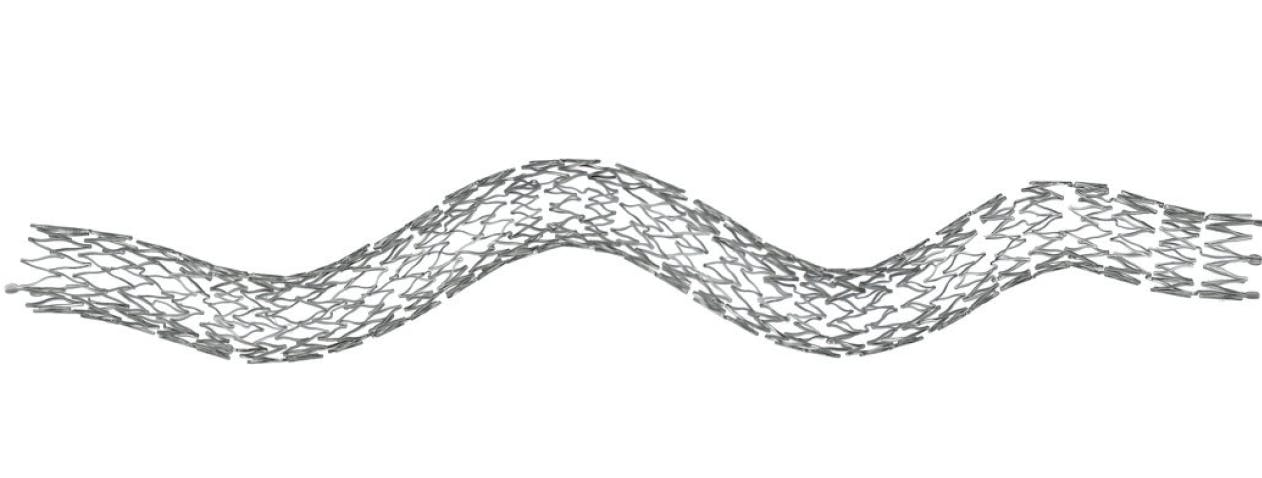
Figure 1. BioMimics 3D helical centerline.
MIMICS-3D is the third study in a series sponsored by Veryan Medical in which the performance of the BioMimics 3D stent (Veryan Medical) has been studied in increasingly more complex patients and lesions. The 3-year data from MIMICS-3D were published earlier this year and showed satisfying outcomes in patients treated with BioMimics 3D that are comparable to those of drug-eluting stents (DESs).2 The study has provided a wealth of data showing the benefits of using BioMimics 3D in a range of challenging lesions. This article reports results of the latest subgroup analysis.
BACKGROUND
Chang et al identified a total of 7,912 patients from the Society for Vascular Surgery Vascular Quality Initiative (VQI) who had undergone endovascular treatment (angioplasty, atherectomy, or stent placement) for isolated de novo occlusive superficial femoral artery (SFA) disease.3 Patients were stratified into three groups: group 1, < 4 mm (911 patients); group 2, 4.0 to 5.9 mm (2,206 patients); and group 3, ≥ 6 mm (4,795 patients). Median follow-up was 13 months (IQR, 8-18 months).
Their analysis showed that the overall patency rate was lower in group 1 as compared with groups 2 and 3 (50% vs 62% and 77%, respectively; log-rank P < .001). The outcome among patients with small vessels was significantly worse in those undergoing atherectomy with or without balloon angioplasty compared to the stent group.
They concluded that in patients undergoing endovascular intervention for isolated de novo SFA stenosis, a smaller-diameter SFA (especially < 4 mm) was associated with the worst patency rates, and although stenting did improve patency in this cohort, overall outcomes remained poor.
MIMICS-3D REFERENCE VESSEL DIAMETER SUBGROUP ANALYSIS
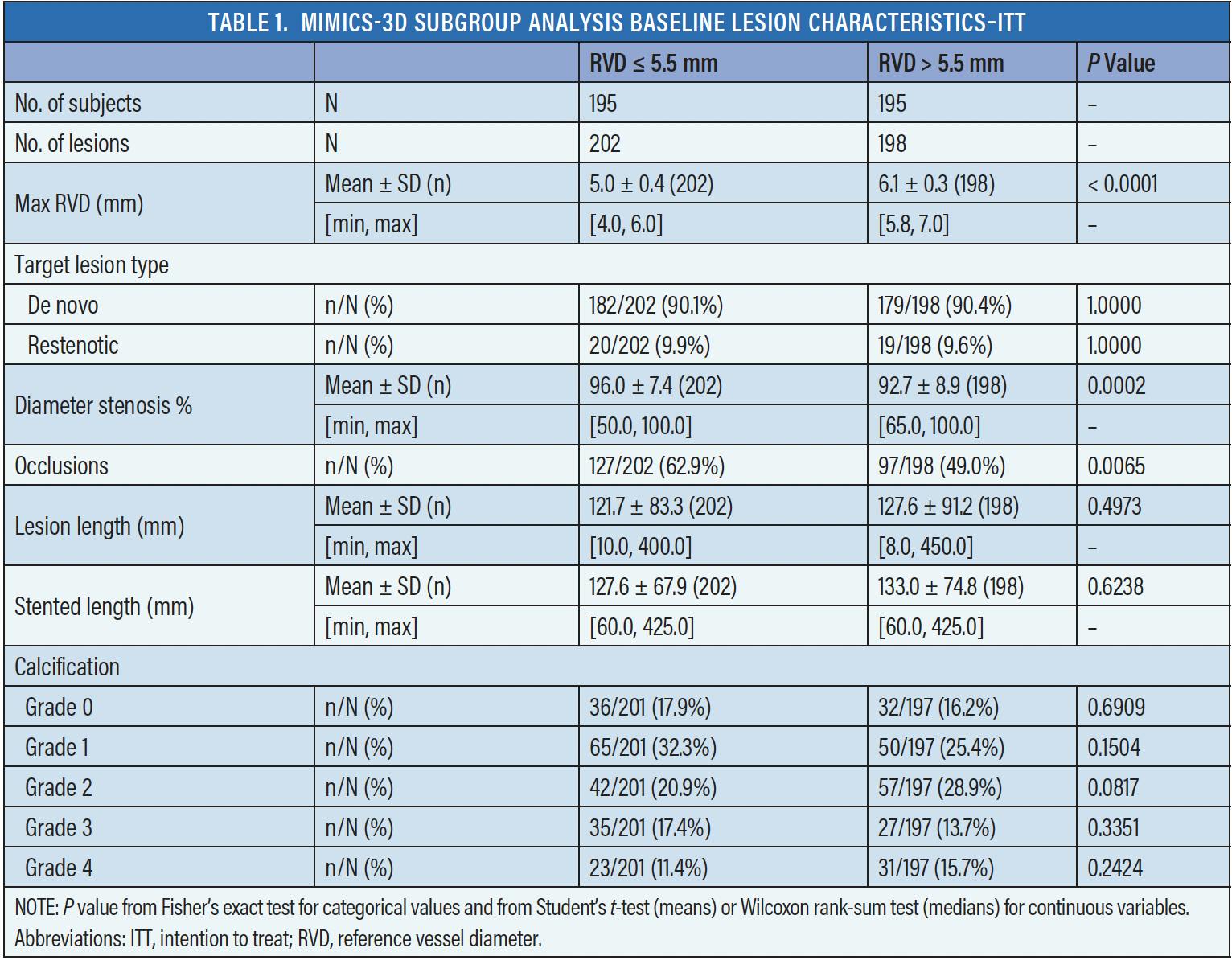
Considering Chang et al’s findings, a subgroup analysis of data from the MIMICS-3D study was conducted to compare outcomes based on reference vessel diameter.4 A propensity-matched analysis was conducted across 390 patients to assess primary patency and freedom from clinically driven target lesion revascularization (CD-TLR) in small-diameter vessel (< 5.5 mm; mean, 5.0 mm) and large-diameter vessel (> 5.5 mm; mean, 6.1 mm) groups.
Each group included 195 patients, with 202 treated lesions in the small-diameter vessel group and 198 treated lesions in the large-diameter vessel group. Lesion length and calcification were comparable between the two groups, but there was a significantly higher presence of chronic total occlusions in the small-diameter vessel group (127/202 [62.9%] vs 97/198 [49.0%]; log-rank P < .0065) (Table 1).
Subgroup Analysis Results
The mean reference vessel diameters of the MIMICS-3D small-diameter group (mean, 5.5 mm) and large-diameter groups (mean, 6.1 mm) were comparable to VQI groups 2 and 3. Unlike the significant difference in primary patency between VQI group 2 and VQI group 3 at 1 year (62% vs 77%), there was no difference between the MIMICS 3D small-diameter group and large-diameter group at 3 years (74% vs 76%) (Figure 2).
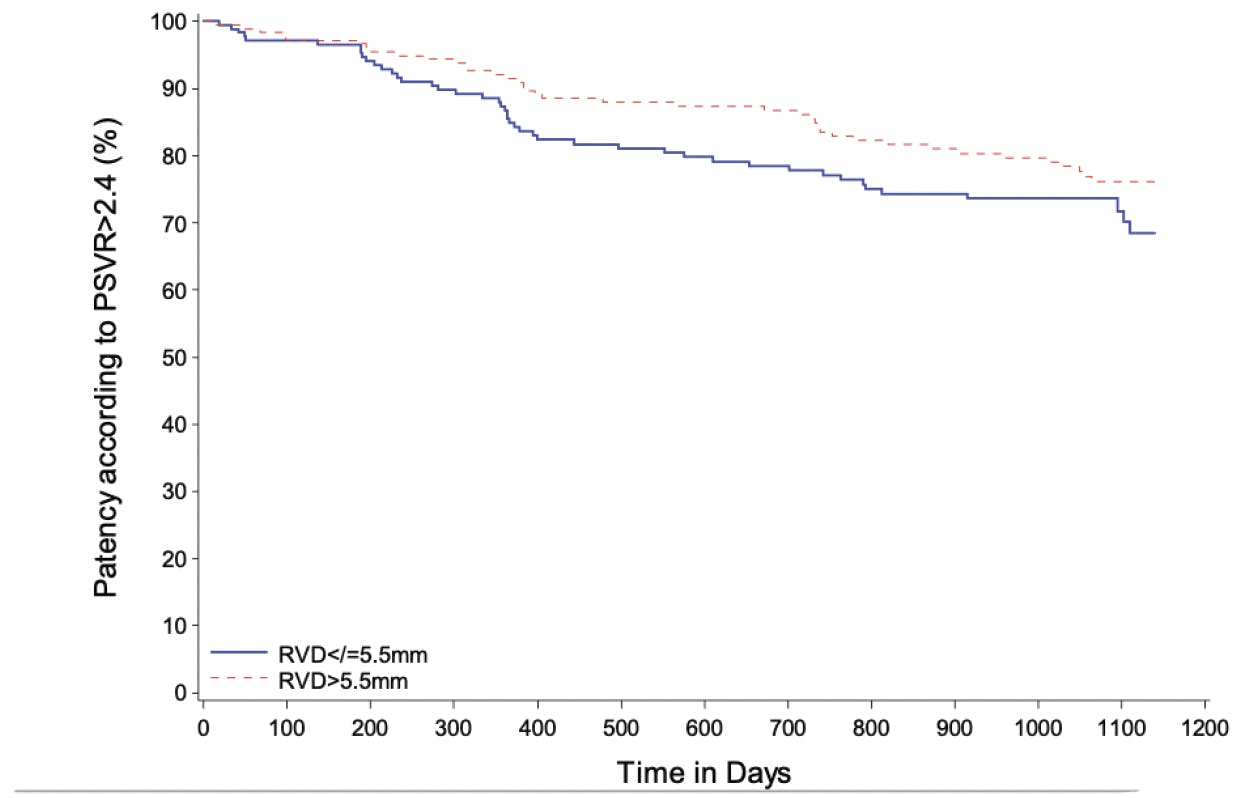
Figure 2. MIMICS-3D 3-year freedom from loss of primary patency. PSVR, peak systolic velocity ratio.
Similarly, there was no significant difference in 3-year freedom from CD-TLR, which was 79% in the small-vessel group and 82% in the large-vessel group (Figure 3).
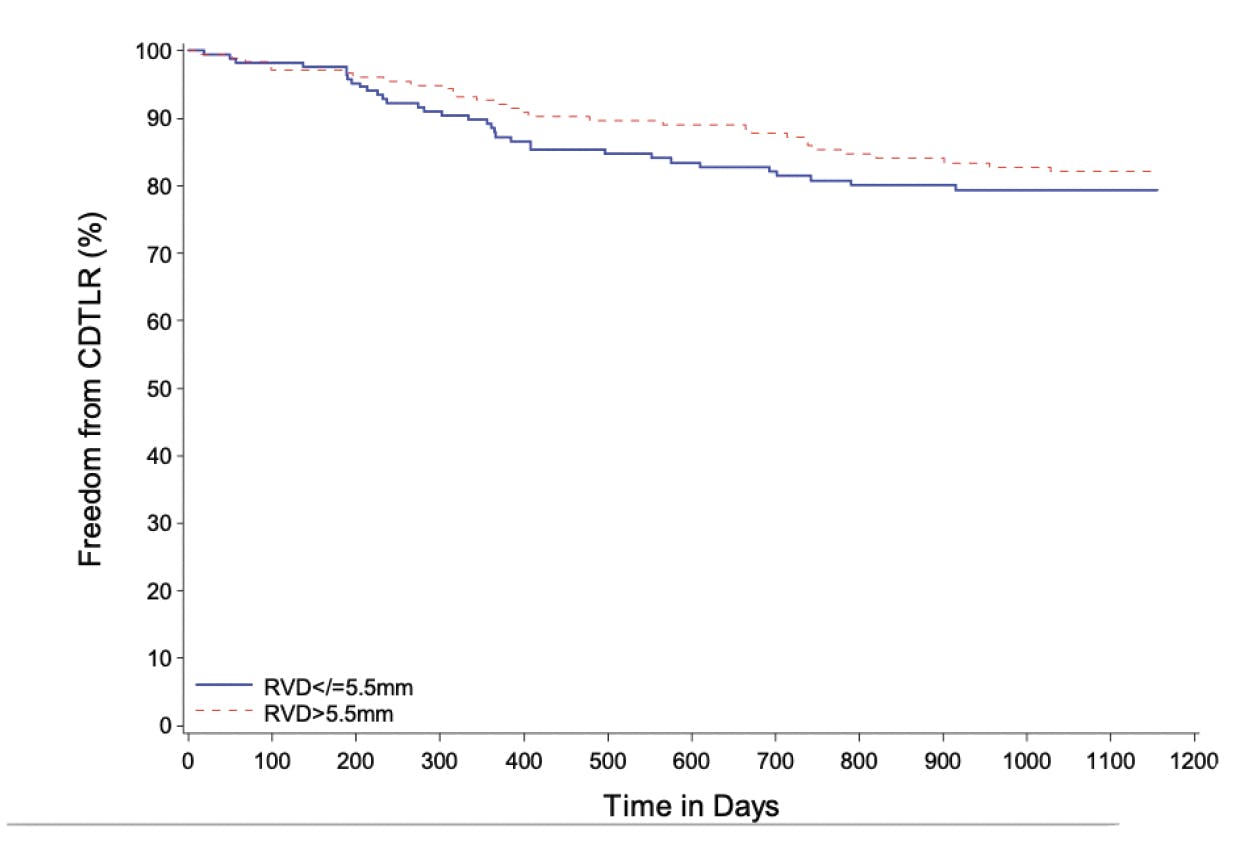
Figure 3. MIMICS-3D 3-year freedom from CD-TLR.
This reference vessel diameter subgroup analysis is the latest data release from the MIMICS-3D study, which has demonstrated consistent performance of BioMimics 3D regardless of vessel length, location, or morphology, and vessel diameter can now be added to that list.
CONCLUSION
In three clinical studies of increasing complexity, BioMimics 3D continues to show durable results that are comparable to DESs. Although small-diameter vessels typically have poorer outcomes than larger-diameter vessels after endovascular treatment, the MIMICS-3D reference vessel diameter subgroup analysis demonstrated consistent, durable results through 3-year follow-up, irrespective of vessel diameter.
BioMimics 3D offers a simple, durable and cost-effective platform for patients with complex femoropopliteal disease and challenging anatomy.
1. Caro CG, Seneviratne A, Heraty KB, et al. Intimal hyperplasia following implantation of helical-centreline and straight-centreline stents in common carotid arteries in healthy pigs: influence of intraluminal flow. J R Soc Interface. 2013;10:20130578. doi: 10.1098/rsif.2013.0578
2. Piorkowski M, Zeller T, Rammos C, et al. BioMimics 3D stent in femoropopliteal lesions: 3-year outcomes with propensity matching for drug-coated balloons. J Cardiovasc Dev Dis. 2023;10:126. doi: 10.3390/jcdd10030126
3. Chang H, Jacobowitz G, Rockman C, et al. Small superficial femoral artery has worse outcomes after endovascular interventions for isolated de novo stenosis. J Vasc Surg. 2020;72:E158-E159. doi: 10.1016/j.jvs.2020.04.274
4. Data on file at Veryan Medical.
PAM 343 Version 1.0
BioMimics 3D and Swirling Flow are registered trademarks of Veryan Medical Ltd.
BioMimics 3D is FDA approved, PMDA approved, and CE Marked.
CAUTION: Federal law restricts this device to sale by or on the order of a physician.

Bret N. Wiechmann, MD
Medical Director at Vascular & Interventional Physicians
Gainesville, Florida
Disclosures: Chief Medical Officer, Veryan Medical.
Advertisement
Advertisement