Advertisement
Advertisement
September 2023
Navigating Complex Femoropopliteal Atherosclerosis: A Surgeon’s Perspective on Directional Atherectomy and Drug-Coated Balloon Angioplasty
Directional atherectomy in combination with drug-coated balloon angioplasty is safe and effective in treating complex, long-segment, heavily calcified femoropopliteal lesions in patients with intermittent claudication and chronic limb-threatening ischemia.
The field of vascular surgery has witnessed remarkable advancements in recent years, revolutionizing the treatment of complex femoropopliteal atherosclerotic disease. I have witnessed firsthand the transformative impact of directional atherectomy (DA) and drug-coated balloon (DCB) angioplasty on complex femoropopliteal atherosclerotic disease in my patients with both intermittent claudication and chronic limb-threatening ischemia (CLTI). Traditional treatment options for complex femoropopliteal lesions such as balloon angioplasty and stent placement have limitations, including the risk of restenosis and suboptimal long-term outcomes. Extensive stenting can result in stent fracture and occlusion, which can be more challenging to treat than native arteries.1,2 I was a late adopter of atherectomy in my practice, but after seeing the results of DA with DCB angioplasty and how it reduced the need for stenting in some of my most difficult patients, it has become the primary treatment modality for the majority of my complex femoropopliteal lesions.
CLINICAL DATA
Several studies have shown DA to be safe and effective in a wide range of patients. The DEFINITIVE LE and DEFINITIVE AR studies have played a pivotal role in elucidating the benefits of DA in treating femoropopliteal disease. The DEFINITIVE LE study showed that DA resulted in a 12-month primary patency of 78% in claudicants and a 95% limb salvage rate in CLTI patients, and it was equally effective in patients with diabetes. The risk of adverse events including embolization (3.8%), perforation (5.3%), and abrupt closure (2%) was low and the bailout stent rate was only 3%.3
The DEFINITIVE AR study compared DA before DCB angioplasty to DCB angioplasty alone for femoropopliteal lesions in patients with claudication or rest pain. These results were not powered to show a significant difference between groups at 1 year, but the primary patency rates and freedom from major adverse events were similar, further illustrating that DA with DCB is both safe and effective.4
The REALITY study is a prospective multicenter study sponsored by VIVA Foundation that aimed to assess the safety and effectiveness of the HawkOne DA system (Medtronic) followed by DCB angioplasty with In.Pact (Medtronic) in complex, long-length femoropopliteal lesions with heavy calcification. The results showed that despite the lesion complexity, 12-month primary patency was 76.7% and freedom from target limb revascularization was 92%. Adverse events included perforation (3.1%) and significant dissection (14.3%), with provisional stenting required in 8.8% of patients.5
PATIENT SELECTION
Armed with these data, I began incorporating DA with DCB angioplasty into my treatment algorithm and have been impressed with the results. I have long been interested in treatment options that limit the need for leaving metal behind and have found that with DA and DCB, I am able to avoid stenting in the majority of my patients. I find this combination therapy to be especially appealing in patients with medium- and long-segment femoropopliteal disease, heavily calcified vessels, and popliteal disease.
Our group treats a considerable amount of peripheral artery disease (PAD) and includes a busy limb preservation program for CLTI. Patients presenting with rest pain or nonhealing ischemic ulcerations are managed with early angiography and revascularization. For patients presenting with intermittent claudication, my practice is to obtain a baseline ankle-brachial index (ABI) and pulse-volume recording (PVR) study and initiate a 3- to 6-month trial of guideline-directed medical therapy as recommended by the Society for Vascular Surgery before considering any type of surgical intervention.
Considering recent media attention regarding the overuse of vascular interventions and poor patient outcomes, I would be remiss if I did not emphasize the importance of proper patient selection and consent for any proposed lower extremity interventions. For patients with lifestyle-limiting claudication who do not improve with a trial of conservative treatment, I have a detailed discussion about the natural history of intermittent claudication as well as the risks and benefits of surgical and endovascular intervention. Once the decision is made to proceed with revascularization, I typically obtain an arterial duplex ultrasound of the affected extremity for preoperative planning. If aortoiliac inflow disease is suspected, a CTA is obtained of the abdominal aorta with bilateral lower extremity runoff.
PROCEDURAL APPROACH
Preprocedural Evaluation
In the angio suite, percutaneous contralateral common femoral artery (CFA) access is obtained, and aortography is performed if there has not been recent aortoiliac imaging. A catheter is then directed up and over the aortic bifurcation, and lower extremity angiography is performed from the CFA. The location and severity of the arterial disease is evaluated. For significant CFA disease in a good-surgical-risk patient, I typically terminate the procedure and offer a femoral endarterectomy with or without concomitant distal endovascular revascularization for additional severe distal femoropopliteal disease. The popliteal artery and trifurcation are evaluated as is the tibial runoff. It is important to consider the distal extent of the lesion to be treated to ensure there is adequate landing space for the nose cone of the DA device beyond the lesion.
Most lesions, including long-segment, heavily calcified femoropopliteal vessels, can be successfully treated with DA. However, 100% thrombus is a contraindication for DA, and if this is suspected based on the patient’s history and imaging, my practice is to perform catheter-directed thrombolysis and thrombectomy to clear any loose thrombus prior to intervention.
Intervention
Once the decision is made to treat a femoropopliteal lesion, a 6-F sheath is advanced into the CFA or superficial femoral artery (SFA) and the patient is heparinized. The lesion is crossed with a wire and crossing catheter, being careful to avoid crossing long segments in a subintimal plane. Once successfully crossed, I confirm we are intraluminal and place a 0.014-inch filter wire for embolic protection. It is recommended to perform DA while working over a filter wire when treating plaque with mixed morphology, chronic total occlusions, vessels with severe calcifications, and single-vessel runoff. I treat most lesions while working over a filter wire, as one of my least favorite procedures is chasing embolic debris after successfully treating a proximal vessel.
With the filter wire in place, the DA device is advanced across the entire length of the lesion to ensure easy passage. If the device does not track across the lesion, predilation may be required, which I typically perform with a low-profile, 3-mm balloon.
Once the device is across the lesion, I begin atherectomy at the proximal extent of the segment to be treated. The lesion is treated in 6-cm-long increments, packing the packing device at the end of each segment to capture the removed plaque. The device is then pulled back and rotated 90° and the same segment is treated with the blade oriented in a different direction. The same segment is treated with three to four passes, with each pass having the cutting blade oriented in a different direction to treat the vessel circumferentially. After each pass is made, I monitor the packing device, and once it appears sufficiently full, the entire atherectomy device is removed from the patient to flush and empty the packing device. Treating in short segments and emptying the packing device frequently is important to avoid overfilling the device, which can lead to distal embolization. Once emptied, the device is reinserted into the patient and the remaining lesion is treated by repeating the above steps.
Once the entire lesion has been treated, angiography is performed to assess the luminal gain achieved. Any areas of persistent severe stenosis can be treated again with the blade aimed in the direction of the plaque if eccentric. When satisfied with the debulking, the atherectomized segment is dilated with plain old balloon angioplasty up to the desired vessel diameter. Angiography is then performed to assess the result and ensure there are no flow-limiting dissections or perforations that require stenting. The vessel is then treated with the appropriately sized DCB. Completion angiography confirms adequate treatment of the vessel and assesses the filter for debris. The filter is then carefully removed, and the distal runoff is evaluated with angiography (Figure 1).
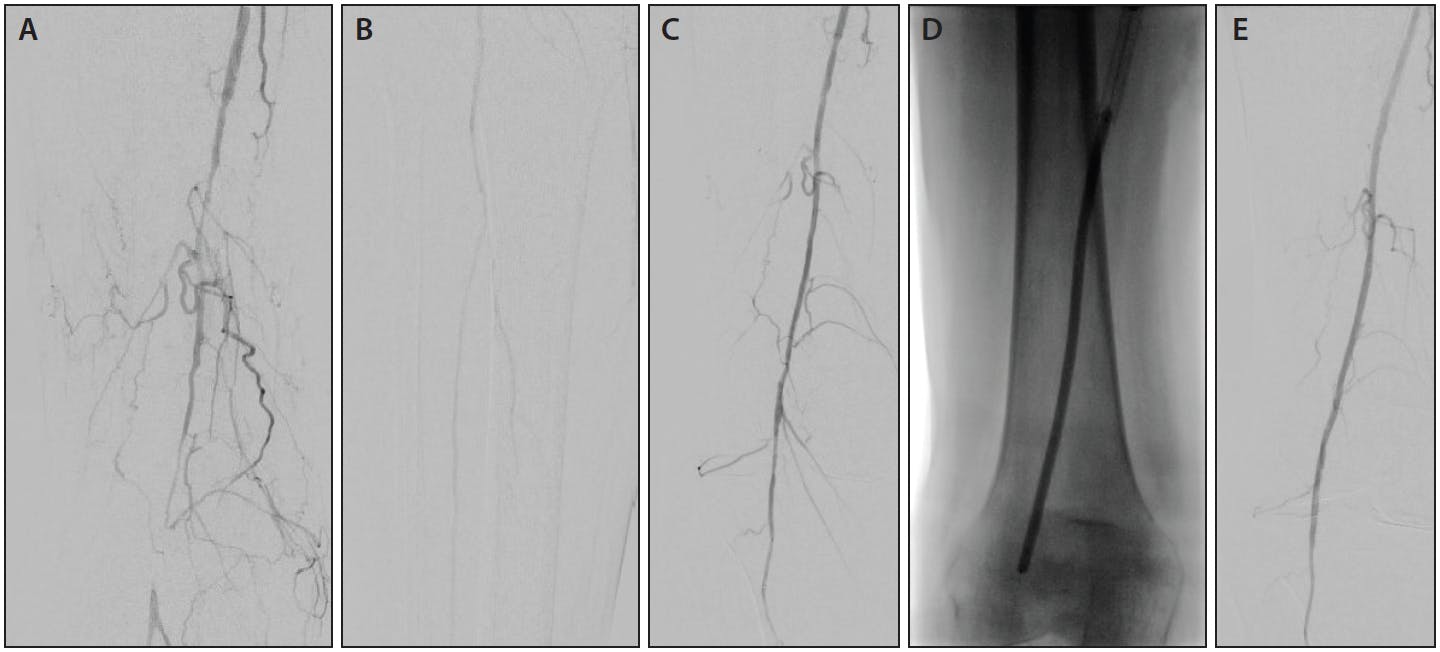
Figure 1. A woman in her early 80s presented with short-distance claudication, nocturnal rest pain, and rubor of her distal right foot. She underwent extensive stenting of her proximal and mid SFA 4 months prior to presentation at an outside institution and experienced recurrence of her symptoms 2 months later. Angiography showed moderate to severe stenosis of the distal SFA with a short-segment occlusion of the P2 segment of the popliteal artery and single-vessel runoff through the peroneal artery (A, B). Inline flow was restored after treatment with DA (C). DCB angioplasty of the treated segment was performed, with restoration of inline flow through the SFA and popliteal artery and preserved distal runoff (D, E).
PITFALLS AND COMPLICATIONS
There are several considerations to keep in mind to perform a safe and successful atherectomy. First, as previously mentioned, any significant acute or subacute thrombus should be cleared prior to performing atherectomy to avoid distal embolization of loose debris. If significant thrombus is suspected, a thrombectomy catheter should be available to clear the thrombus prior to intervening. Second, DA is contraindicated in in-stent restenosis. The cutting blade can catch a stent strut and become lodged in the patient, requiring open exposure for removal. I recommend treating lesions in short, 6-cm intervals and emptying the packing device frequently to reduce the risk of distal embolization. To that end, I also recommend using a filter wire for added embolic protection. Should distal embolization occur, it is important to have a thrombectomy/embolectomy catheter readily available. Finally, avoid overtreating the same wall of a segment of the vessel to prevent perforation. If perforation does occur, placement of a covered stent should be employed. In the event of a flow-limiting dissection after treatment, a bare-metal stent can be placed at the level of the dissection and the remaining vessel can be treated with a DCB.
POSTOPERATIVE FOLLOW-UP
Postoperatively, my patients receive dual antiplatelet therapy or aspirin plus low-dose rivaroxaban, which is maintained for a minimum of 3 months. Patients return for evaluation 3 to 4 weeks postoperatively with repeat ABI/PVR and arterial duplex ultrasound studies and then every 3 months for the first year, with ABI/PVR studies at subsequent visits.
CONCLUSION
Although DA and DCB angioplasty offer revolutionary solutions for complex femoropopliteal atherosclerotic disease, challenges remain. The combined insights from studies such as DEFINITIVE LE, DEFINITIVE AR, and REALITY provide evidence for the efficacy and safety of these interventions, both in controlled setting and real-world clinical scenarios. Amidst these advancements, patient safety must remain paramount, and we must emphasize our commitment as surgeons to mitigating risks and ensuring the well-being of our patients. Patient selection, device availability, and long-term durability are areas that warrant ongoing research and refinement to determine the proper role of this technique in our treatment algorithm for PAD. However, in my practice, combination therapy with DA and DCB angioplasty has resulted in excellent outcomes in many of my most challenging patients with complex femoropopliteal atherosclerotic disease.
1. The SH, Gussenhoven EJ, Zong Y, et al. Effect of balloon angioplasty on femoral artery evaluated with intravascular ultrasound imaging. Circulation. 1992;86:483-493. doi: 10.1161/01.cir.86.2.483
2. Scheinert D, Scheinert S, Sax J, et al. Prevalence and clinical impact of stent fractures after femoropopliteal stenting. J Am Coll Cardiol. 2005;45:312-315. doi: 10.1016/j.jacc.2004.11.026
3. McKinsey JF, Zeller T, Rocha-Singh KJ, et al. Lower extremity revascularization using directional atherectomy: 12-month prospective results of the DEFINITIVE LE study. JACC Cardiovasc Interv. 2014;7:923-933. doi: 10.1016/j.jcin.2014.05.006
4. Zeller T, Langhoff R, Rocha-Singh KJ, et al. Directional atherectomy followed by a paclitaxel-coated balloon to inhibit restenosis and maintain vessel patency: 12-month results of the DEFINITIVE AR study. Circ Cardiovasc Interv. 2017;10:e004848. doi: 10.1161/CIRCINTERVENTIONS.116.004848
5. Rocha-Singh KJ, Sachar R, DeRubertis BG, et al. Directional atherectomy before paclitaxel coated balloon angioplasty in complex femoropopliteal disease: the VIVA REALITY study. Catheter Cardiovasc Interv. 2021;98:549-558. doi: 10.1002/ccd.29777
Advertisement
Advertisement