Advertisement
Advertisement
September 2023
Retrograde Access for Stenting of the SFA Ostium
A guide to performing the PRESTO technique for safe, accurate stent deployment in complex femoropopliteal arterial disease cases.
By Luis Mariano Palena, MD; Larry J. Diaz-Sandoval, MD; Elisa Piccolo, MD; and Marco Manzi, MD
The burden of peripheral artery disease continues to expand, with substantial impact on morbidity, mortality, and use of resources.1,2 Although surgical revascularization by means of bypass remains a good therapeutic option in eligible patients, endovascular therapy (EVT) has improved substantially over the last few decades thanks to many key developments.3 Among these are numerous refinements in techniques and approaches, but perhaps most important has been the ability to select the proper device for the indicated lesion in the appropriate segment. This single (yet complex) step has had an unprecedented impact and has propelled EVT considerably.4,5 Specifically in the femoropopliteal (FP) segment, use of retrograde access combined with intended antegrade subintimal recanalization has yielded substantially improved rates of technical and procedural success.5,6
Multiple studies have already shown the benefits of stenting compared to angioplasty to improve outcomes after EVT in the FP segment.7,8 Within this segment, lesions involving the ostium of the superficial femoral artery (SFA) still represent a challenging subgroup as they often involve the femoral bifurcation and present a high incidence of heavily calcified plaques, which make these lesions prone to recoil and/or plaque shift (“snowplowing”) into the profunda after balloon angioplasty.9
Surgical endarterectomy remains the gold standard to treat the common femoral artery (CFA) and its bifurcation.10 More recently, hybrid procedures (open access + endarterectomy + EVT) have become an attractive option to treat long FP chronic total occlusions (CTOs) involving the ostium of the SFA.
In the "endovascular first" era, guaranteed acceptable long-term patency rates after FP revascularization remain a challenge. Currently, we have at our disposal a plethora of mechanical therapeutic options to treat the ostium of the SFA and the FP segment (drug-coated balloons, standard nitinol stents, drug-eluting stents, atherectomy, and combinations of these modalities). However, lesion morphology remains the most important predictor of long-term outcomes.
Long and calcified CTOs represent the most complex lesion subtype and are associated with the highest incidence of stent fracture.11 Newer-generation stents incorporating biomimicry into their design have shown improved outcomes compared to percutaneous transluminal angioplasty (PTA), with the added benefit of freedom from fractures.8 However, these stents possess one important peculiarity: The deployment of the very first crown is perfectly predictable, but the deployment of the very last crown is less so. These stents are subject to elongation and/or shortening during their deployment, leading operators to avoid their use when there is a need to cover the ostium of the SFA in antegrade fashion (ie, when the very last crown needs to “nail” the ostium).
The PRESTO (precise retrograde stenting of the ostium of the SFA for complex FP occlusions) technique7 was conceived and developed to guarantee accurate and safe deployment of the stent in complex cases of FP arterial disease where there is involvement of the ostium of the SFA.
PREOPERATIVE IMAGING AND PATIENT SELECTION
It is essential to follow the clinical indication related to wound, ischemia, and foot infection (WIfI) and GLASS (Global Limb Anatomic Staging System) classifications to properly evaluate the risks of limb loss and mortality. The balance between each allows proper decision-making for determining when to go for aggressive procedures and when to be more conservative.
A preoperative Doppler ultrasound (DUS) allows for optimal assessment of the CFA and its bifurcation. In our practice, this represents the first step (and perhaps the most important) in the endovascular approach to treating chronic limb-threatening ischemia (CLTI) patients, with use of flow-wave analysis for exclusion of iliac arterial disease and precise access site selection.4 During DUS evaluation, we can clearly identify the proximal SFA/ostial SFA, presence or absence of disease, type of plaque and its extension, risk of plaque shift into the profunda, and lesion length into the distal SFA or popliteal artery.
More specific imaging such as CTA or MRA can further help in planning revascularization procedures but are subject to local expertise and require more contrast volume, posing an increased risk in CLTI patients, who usually also have concomitant poor renal function and multiple other comorbidities.
In our daily practice, we perform ultrasound-guided antegrade access in the CFA and CO2 angiography to assess the vascular disease of the target limb, from the groin to the foot (Figure 1). CLTI patients with ostial/proximal SFA occlusions are considered candidates for retrograde stenting.
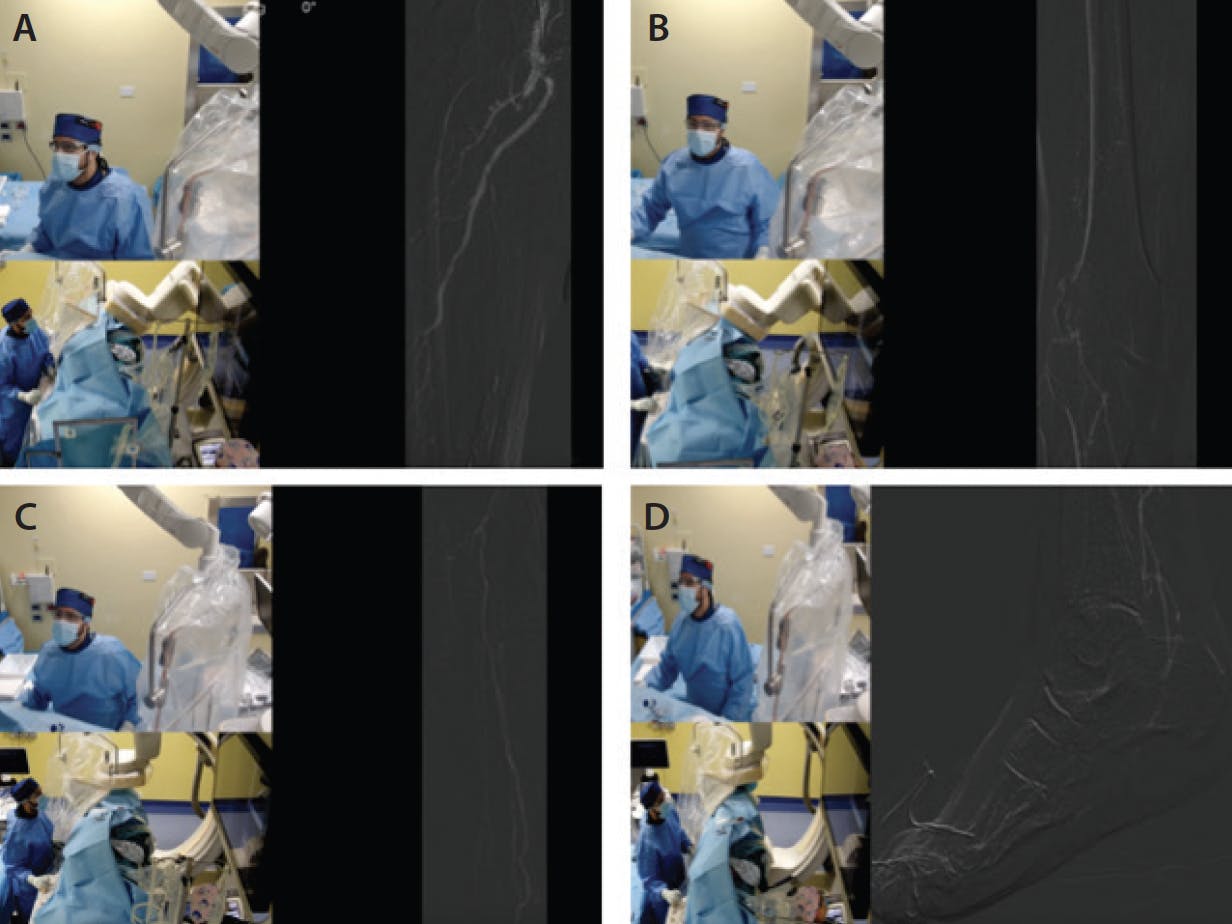
Figure 1. Diagnostic angiography with CO2 showing long, moderate calcified CTO of the SFA and popliteal arteries, with flow through the collaterals at the P3 level (A, B). Below-the-knee angiography showing occluded AT and PT arteries and patent peroneal artery; at the foot level, collaterals give flow for the calcaneal branches (C, D).
PROCEDURE AND DEVICES
Prior to EVT, patients are pretreated with aspirin (81-325 mg) and ticlopidine (500 mg) or clopidogrel (300-600 mg). During the procedure, an intravenous bolus of 50 to 70 IU/kg of unfractionated heparin is administered. Aspirin (81-325 mg/day) and clopidogrel (75 mg/day) (or ticlopidine 500 mg/day) are then continued for 3 to 6 months.
After local anesthesia, antegrade or contralateral/crossover access in the CFA is achieved under ultrasound guidance (Logiq E9 [GE HealthCare] with a 9-MHz linear probe), and a 6-F sheath is deployed.
The endovascular strategy is planned for FP revascularization, and the first attempt is made to recanalize the target vessel via the antegrade approach. When antegrade techniques to cross the CTO fail, retrograde distal access is performed (depending on lesion length, flow reconstitution site, and vessel permeability) in the distal SFA, popliteal artery (PA), proximal or distal anterior tibial (AT) artery, or distal posterior tibial (PT) artery, followed by retrograde recanalization, connection of both accesses, and a rendezvous technique according to the standard of care at our institutions.12
After successful crossing, proper vessel predilatation is performed following a preestablished sequential angioplasty protocol (Figure 2A and 2B). First, the lumen is dilated with a 4-mm balloon at nominal pressure for 1 minute. Then, a 5- or 6-mm high-pressure, ultra–noncompliant balloon is used to dilate the subintimal space for 2 minutes to homogenize the neolumen. In our experience, progressive dilatation and use of a high-pressure balloon reduces the risk of arterial rupture. Angiography is then performed in orthogonal projections to assess for recoil and determine stent diameter. If focal areas of recoiling are observed, the neolumen is further treated with a 6- or 7- X 40-mm high-pressure balloon. The last balloon used prior to stent deployment must be 1 mm larger than the estimated stent diameter, which is indispensable to properly deploy the biomimetic stent cells and allow them to acquire their correct geometry. Specifically, if crossing was successfully obtained in antegrade fashion and stenting the ostium of the SFA was deemed necessary, retrograde arterial access is obtained under fluoroscopic or ultrasound guidance, using a long 19- or 21-gauge needle and a V-18 guidewire (Boston Scientific Corporation) in the distal SFA or P1 segment of the PA, proximal AT, or distal tibial arteries.
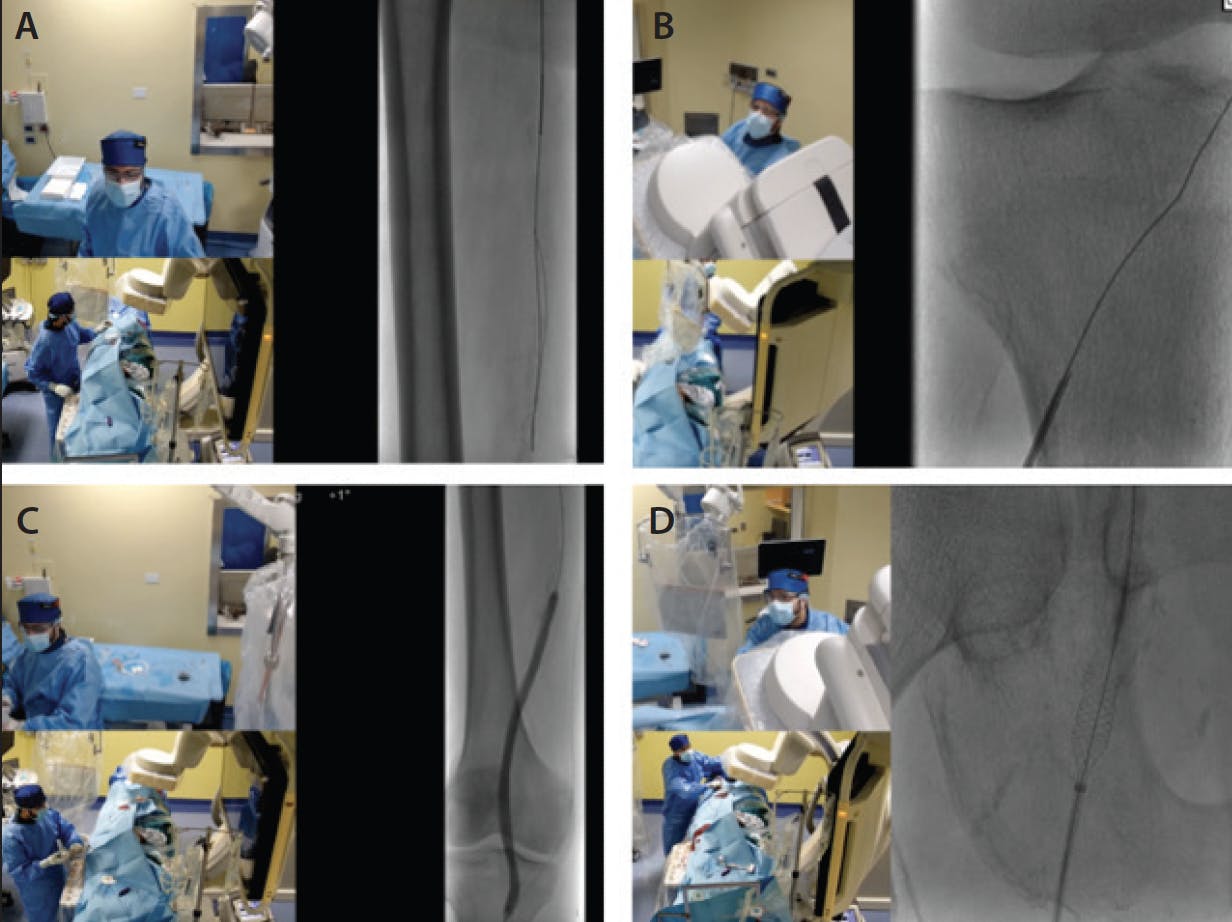
Figure 2. Crossing and treatment. Antegrade subintimal recanalization and retrograde (P3) access and crossing (A, B). Vessel preparation by balloon angioplasty and retrograde stenting from the ostium of the SFA to the popliteal artery; two mimetic stents were deployed, with the first stent in PRESTO fashion and the second in antegrade fashion (C, D).
The retrograde access location is chosen based on the “most patent” vessel, always trying to use the largest patent artery to minimize the risk of acute occlusion, dissection, or perforation, which increases when using smaller and diseased vessels. When retrograde access is performed in the distal SFA or P1 segment of the PA, a 6-F dilator is advanced into the artery and removed to create a channel through which the stent shaft can be later advanced. If access is achieved in the tibial arteries, either a 4/5-F or 5/6-F Slender sheath (Terumo Interventional Systems) can be temporarily placed to allow retrograde passage of the stent shaft (after which, the sheath is immediately removed to decrease the risk of spasm/dissection/acute occlusion of the tibial vessels), and precise alignment of the first crown of the stent at the level of the ostium of the SFA is achieved with road mapping guidance. Once the stent is in place, the antegrade wire is pulled just proximal to the stent, and the prosthesis is safely deployed and postdilated (Figure 2C and 2D). When the stent is deployed from the ostium to the proximal or medial SFA (most commonly a 6.5-mm stent, the antegrade wire is advanced past the point of retrograde access; the retrograde sheath/wire is removed, and angioplasty is performed in conjunction with either external manual pressure (retrograde tibial access points) or application of an external blood pressure cuff inflated to 20 mm Hg higher than the mean blood pressure for 2 to 3 minutes (distal SFA, PA).
RETROGRADE STENTING–RELATED COMPLICATIONS AND MANAGEMENT
In our experience, the most frequent complications are related to vessel perforation and hematoma in the previously occluded arterial segment, which can be reduced with a sequential angioplasty protocol.Other previously described complications could be at the retrograde access level (extravasation, hematomas, pseudoaneurysms) after 6-F devices are passed through the small distal arteries. The first rule to reduce the risk of complications at the retrograde access is to perform the puncture in a place without calcium and with an ideal diameter (> 2 mm). The second step is to avoid using 6-F sheath in tibial arteries, and the third step is to obtain hemostasis with simultaneous endovascular angioplasty and external compression.7
Another interesting point to analyze is the control of anticoagulation. This procedure is considered relatively aggressive (aggressive crossing in long and calcified lesions, prolonged procedural time, aggressive vessel preparation, multiple access required), so we must ensure that the anticoagulation level is satisfactory before starting with retrograde stenting to avoid thrombotic complication.
CLINICAL AND VASCULAR FOLLOW-UP
Clinical improvement (as measured by resolution of rest pain, ulcer improvement or surgical incision healing, WIfI class changes) is the first and best marker of success after revascularization (Figure 3). Our patients undergo a very strict vascular follow-up protocol that includes DUS examination at 30 days; 3, 6, and 12 months postprocedure; and a yearly DUS thereafter.
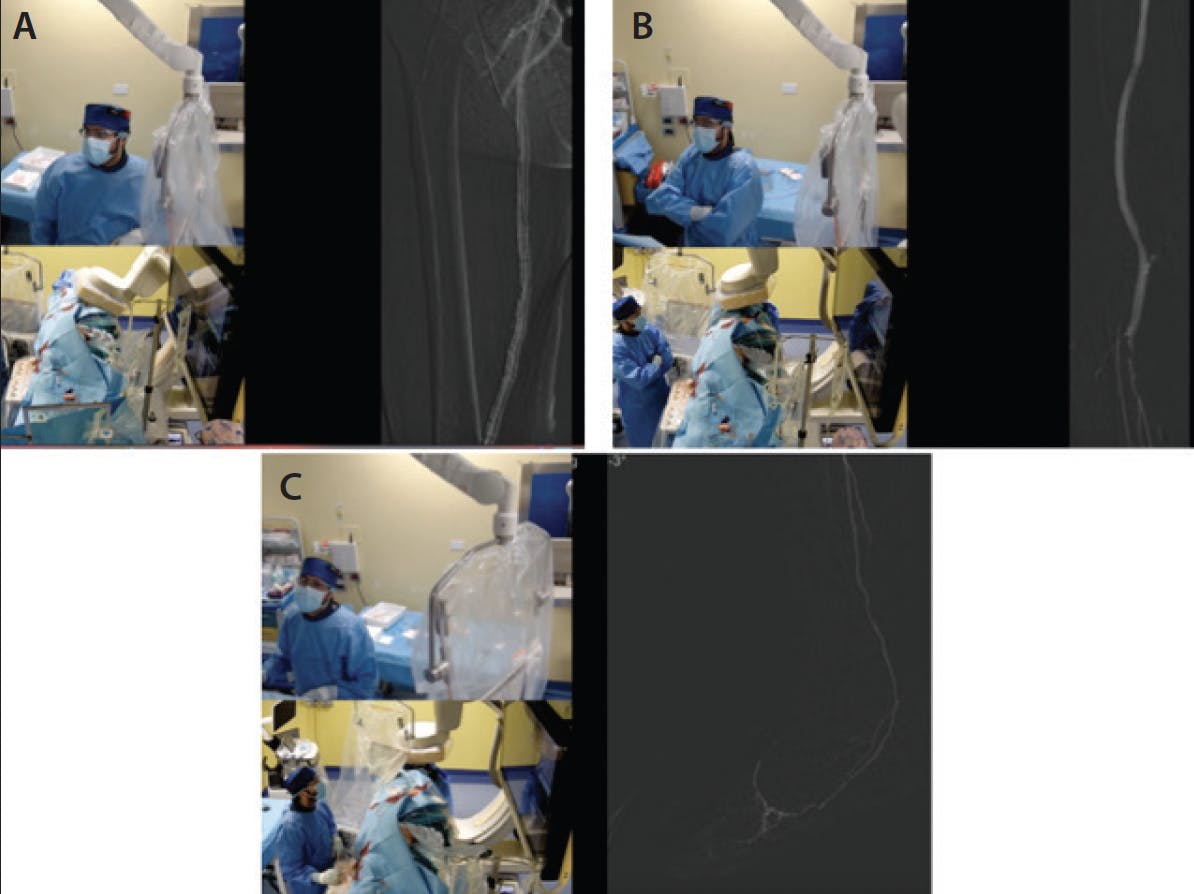
Figure 3. Final control with CO2 showing patent stent in the SFA and PA, without signs of profunda jailing (A, B). Below-the-knee angiography showing direct blood flow in the peroneal, PT, and lateral plantar arteries and the arch (previously treated by 2.5- and 3-mm balloon angioplasty) (C).
This protocol helps immediately identify any changes in flow, waveforms, velocities, and runoff vessels, which in turn allows prompt reintervention if needed.
CONCLUSION
The PRESTO strategy was described for the first time by the authors in 2018 with a multicenter series of 21 cases performed in different centers all around the world.7 Multiple cases have since been performed by the authors and other physicians, demonstrating the utility of the PRESTO approach, which provides acceptable long-term results and very low complication rates.
1. Shi R, Babu S. Modern approaches and innovations in the diagnosis and treatment of peripheral vascular diseases. Front Biosci (Schol Ed). 2021;13:173-180. doi: 10.52586/S560
2. Saglietto A, Manfredi R, Elia E, et al. Cardiovascular disease burden: Italian and global perspectives. Minerva Cardiol Angiol. 2021;69:231-240. doi: 10.23736/S2724-5683.21.05538-9
3. Aru RG, Tyagi SC. Endovascular treatment of femoropopliteal arterial occlusive disease: current techniques and limitations. Semin Vasc Surg. 2022;35:180-189. doi: 10.1053/j.semvascsurg.2022.04.010
4. Ferraresi R, Palena LM, Mauri G, Manzi M. Tips and tricks for a correct “endo approach”. J Cardiovasc Surg (Torino). 2013;54:685-711.
5. Giannopoulos S, Armstrong EJ. Newly approved devices for endovascular treatment of femoropopliteal disease: a review of clinical evidence. Expert Rev Cardiovasc Ther. 2019;17:729-740. doi: 10.1080/14779072.2019.1675512
6. Chun JY, Markose G, Bolia A. Developments in subintimal angioplasty in the infrainguinal segment. J Cardiovasc Surg (Torino). 2010;51:213-21.
7. Palena LM, Diaz-Sandoval LJ, Raja LM, et al. Precise retrograde supera stenting of the ostium (PRESTO) of the superficial femoral artery for complex femoropopliteal occlusions: the PRESTO technique. J Endovasc Ther. 2018;25(5):588-591. doi: 10.1177/1526602817753388
8. Palena LM, Diaz-Sandoval LJ, Sultato E, et al. Feasibility and 1-year outcomes of subintimal revascularization with Supera® stenting of long femoropopliteal occlusions in critical limb ischemia: The “Supersub” Study. Catheter Cardiovasc Interv. 2017;89:910-920. doi: 10.1002/ccd.26863
9. Yamawaki M, Hirano K, Nakano M, et al. Deployment of self-expandable stent for complex proximal superficial femoral artery lesions involving the femoral bifurcation with or without jailed deep femoral artery. Catheter Cardiovasc Interv. 2013;81:1031-1041. doi: 10.1002/ccd.24502
10. Wieker C, Schonefeld E, Osada N, et al. Results of common femoral artery thromboendarterectomy evaluation of a traditional surgical management in the endovascular era. J Vasc Surg. 2016;64:995-1001. doi: 10.1016/j.jvs.2016.04.036
11. Scheinert D, Werner M, Scheinert S, et al. Treatment of complex atherosclerotic popliteal artery disease with a new self-expanding interwoven nitinol stent: 12-month results of the Leipzig SUPERA popliteal artery stent registry. J Am Coll Cardiol Intv. 2013;6:65-71. doi: 10.1016/j.jcin.2012.09.011
12. Manzi M, Palena LM, Cester G. Endovascular techniques for limb salvage in diabetics with crural and pedal disease. J Cardiovasc Surg (Torino). 2011;52:485-492.
Advertisement
Advertisement