Advertisement
Advertisement
September 2023
Retrograde Tibiopedal Access for Crossing Complex Lesions
Patient evaluation and preintervention planning, key devices, and a stepwise approach to access and percutaneous revascularization of complex infrapopliteal lesions.
Among patients with advanced peripheral artery disease (PAD) and chronic limb-threatening ischemia (CLTI), reconstitution of inline flow with guideline-directed medical therapy optimizes the potential for limb salvage.1 Surgical bypass, as well as endovascular techniques, in isolation or combined, provide revascularization with excellent patency rates. Surgical bypass remains the gold standard for CLTI revascularization for robust patients with an extended life expectancy and adequate vein conduits.2 However, among aged patients who have comorbid cardiovascular, renal, and pulmonary conditions, the risk of a physiologically stressful surgical intervention may appropriately deter providers from a bypass-first approach.3 Further, advancements in endovascular technologies, including more diverse strategies for endoluminal (ie, radial and tibial) access and mechanisms for reestablishing and maintaining vessel patency, present an attractive option for limb salvage. Specifically, retrograde tibiopedal access is a key tool in the access and percutaneous revascularization of complex infrapopliteal lesions and is the main topic of this article.
PATIENT CANDIDACY AND WORKUP
Initial evaluation begins with a review of the patients’ guideline-directed medical therapy, which includes antiplatelet medications, lipid-lowering therapies, blood pressure and glucose control, and the need for smoking cessation. A physical examination should evaluate patients’ frailty status as well as for the stigmata of PAD, wound categorization, and pulse examinations. Noninvasive vascular lab testing can provide potential conduit vein mapping and also include ankle-brachial indices (ABIs) with segmental (or at least toe) pressures and pulse volume recordings (PVRs) to quantify the severity of disease and determine potential multilevel disease.1,4 However, tibial disease is best evaluated by invasive, intra-arterial angiography via antegrade imaging (Figure 1).
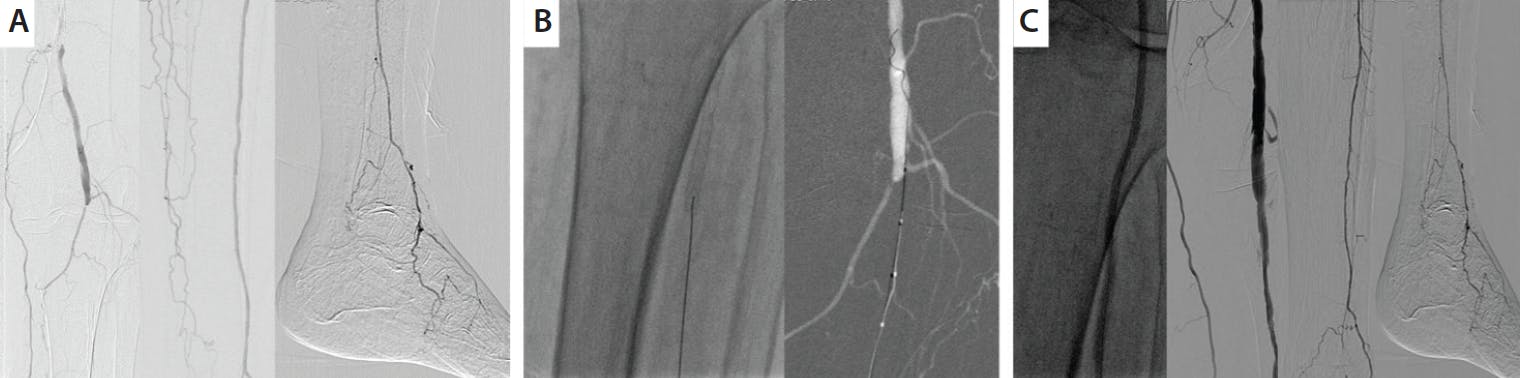
Figure 1. Retrograde peroneal access for treatment of a popliteal lesion. A woman in her early 90s with forefoot ischemia (gangrene of the first and fifth toe; toe pressures, 0 mm Hg) had previously undergone superficial femoral and popliteal artery stenting, with failed antegrade recanalization of the popliteal artery, an occluded TPT stent, and single-vessel peroneal artery runoff, which collateralized to the dorsalis pedis. A prolonged-delay DSA was obtained from the antegrade sheath (A). The peroneal artery was accessed in a retrograde fashion above the ankle, crossing both the stent and the occlusive lesion using an 0.018-inch V-18 ControlWire guidewire (Boston Scientific Corporation) with Quick-Cross catheter (B). Final imaging after percutaneous angioplasty showed inline flow to the ankle (C). The intervention was patent for 3 months with a toe pressure of 65 mm Hg and resulted in healing of her fifth toe amputation, allowing the patient to continue to ambulate independently with a walker.
Initial arteriographic imaging through antegrade access with the patient supine is achievable through a variety of points including upper extremity (brachial or radial) or common femoral (contralateral [up and over] or ipsilateral [antegrade]) artery access. Each has its risks and benefits and requires consideration of the available sheath diameters and lengths to allow use of appropriate devices for treatment. A detailed review of these access options is out of the scope of this work; however, we will highlight key aspects to consider for the treatment of tibial disease.
The indications for retrograde tibiopedal access are expansive and are up to the discretion of the interventionalist. Most commonly, the indication is failed revascularization from an antegrade approach (Figure 1A). Another indication is a hostile femoral access (ie, severe scar, very high femoral bifurcation, body habitus, infected groin).
PREINTERVENTION PLANNING
An interventionalist must first review the antegrade arteriographic imaging to develop a treatment plan. A sheath (4-6 F) should be selected with adequate length to reach (contralateral [5-6 F, 90-110 cm] and ipsilateral [5-6 F, 45-55 cm] common femoral artery or 4-5 F, 120-150 cm for radial or brachial artery access) just above the target lesion and ideally in the popliteal artery just above the lesion, maximizing the pushability for the eventual intervention.
Concurrent with sheath deployment, heparin boluses (80 units/kg) should aim to achieve and maintain activated clotted time > 250 seconds. Imaging must include multiple projections through the antegrade sheaths with sufficient opacification of the tibial and pedal vascular anatomy with delayed views (prolonged digital subtraction angiography [DSA] times; Figure 1B). Withdrawing the sheath into or above the femoral bifurcation may allow for the opacification of distal tibial and pedal segments through key collaterals emanating from the profunda femoral artery.
DEVICES TO HAVE ON HAND
Retrograde tibiopedal access can be an adjunct to the treatment of infrainguinal lesions both above (superficial femoral artery and popliteal arteries) and below (popliteal, tibioperoneal trunk [TPT], tibial arteries) the knee. Through antegrade sheaths, administration of vasodilators can facilitate tibial visualization as well as access and minimize vasospasm. We suggest a cocktail of heparin saline, 2.5 to 5 mg verapamil, and 100 to 1,000 µg nitroglycerin.5
After antegrade imaging delineating anatomy, ultrasound- (and/or fluoroscopic-) guided identification, and judicious administration of local anesthesia (large volumes can distort anatomy), a 21-gauge micropuncture needle is an ideal tool for gaining distal arterial access. Once back-bleeding is established, a 0.014- or 0.018-inch, soft-tipped hydrophilic (300 cm) guidewire should be advanced under fluoroscopic guidance. In general, we caution the use of a retrograde sheath, which can damage the distal target artery. A support catheter, balloon, or the inner dilator of a 4-F microsheath can all help support the access site. The intraluminal position must be confirmed by retrograde angiography; yet, if a venous puncture was inadvertently achieved, leaving the access in place will guide subsequent arterial access attempts.
Following retrograde lesion crossing with the guidewire and 0.014- or 0.018-inch crossing catheter (eg, Quick-Cross [Philips], CXI [Cook Medical], TrailBlazer [Medtronic]), the guidewire should be exchanged for a 0.014-inch stiffer working wire (eg, Hi-Torque Spartacore or Iron Man [Abbott], Choice ES or ES PT [Boston Scientific Corporation]). Subsequently, treatment devices (ie, angioplasty and stenting) on a 0.014-inch system will be required.
STEPWISE PROCEDURE
This article’s main goal is to highlight the potential advancement of endovascular revascularization through the retrograde access of tibiopedal vessels. However, whenever possible, antegrade lesion crossing should be considered first, as direct tibiopedal vessel puncture carries a risk of trauma and rupture of these delicate and important distal vessels for limb salvage. Yet, flush occlusions or large collaterals adjacent to the occluded origin may prove difficult to access antegrade, yielding a nearly 20% failure rate.6 After unsuccessful attempts at antegrade luminal crossing or reentry, retrograde access may be an alternative solution given that nearly all lesions, even chronic and recalcitrant occlusions, can be crossed more easily due to the tapered and often softer cap.7
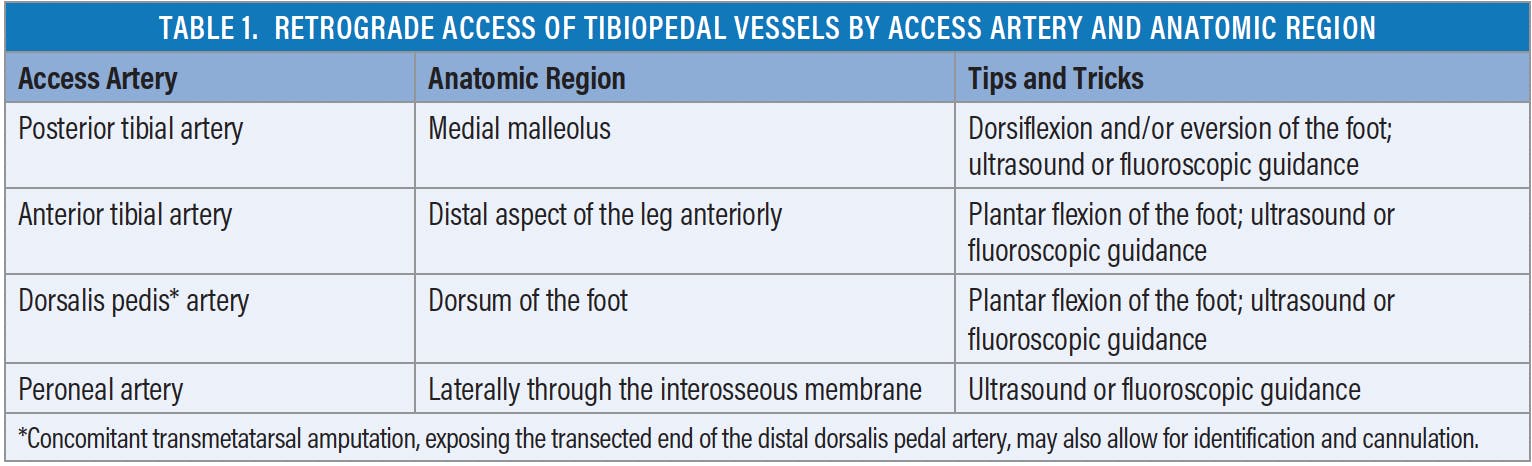
First, distal artery access is achieved as described previously through the anatomic regions noted in Table 1. After the intraluminal distal access is confirmed and antegrade imaging has delineated the extent of the target lesion, retrograde recanalization is achieved through crossing with a 0.014- or 0.018-inch guidewire supported by a crossing catheter or a low-profile angioplasty balloon. As with antegrade crossing, remaining intraluminal is preferred over subintimal lesion crossing.8 If the antegrade and retrograde wires are unable to regain access into the true lumen, an antegrade-retrograde approach may be used, which creates adjacent subintimal planes in opposing directions. The described technique and its variants include SAFARI (subintimal arterial flossing with antegrade-retrograde interventions) or CART (controlled antegrade and retrograde subintimal tracking) (Figure 2).5,9 Simultaneously, two appropriately sized balloons infiltrated from both directions may disrupt the dissection flaps, allowing for true lumen visualization and recanalization.
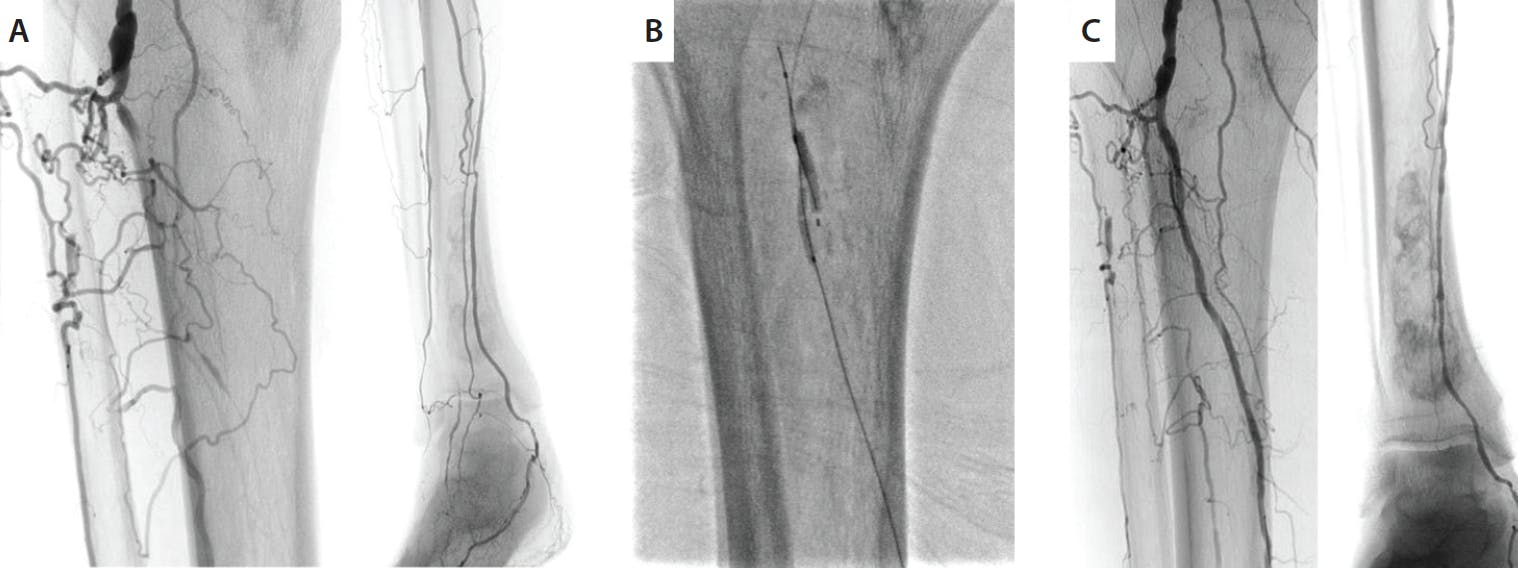
Figure 2. Controlled antegrade and retrograde subintimal tracking for a posterior tibial (PT) and TPT chronic total occlusion. A frail man in his early 70s with diabetes presented with an infected first toe (toe pressure, 20 mm Hg). Delayed DSA demonstrated a PT artery occlusion with reconstitution in the middle third of the calf and a diseased segment patent to the foot (A). Antegrade recanalization was not possible due to the extensive collateral network. The PT artery was accessed at the ankle with ultrasound guidance, and the lesion was crossed in a subintimal plane. Using the CART technique, the subintimal flap was disrupted with balloon angioplasty simultaneously in the distal popliteal artery and TPT (2.5-mm balloon, retrograde) and PT (2-mm balloon, antegrade) artery (B). The true lumen was selected, and from the antegrade approach, angioplasty of the PT artery was performed proximally with a 3-mm balloon and throughout with a 2.5-mm plain balloon. The final angiogram showed good radiographic result with inline flow to the foot (C). The patient’s toe amputation successfully healed.
After successful intraluminal lesion crossing or luminal reentry, the crossing catheter is advanced from the retrograde access proximally, crossing the lesion (Figure 1B). The retrograde catheter should be brought into the popliteal artery with aspiration and angiography confirming the intraluminal position.
Then, the wire is exteriorized through the proximal access site, creating through-and-through wire access. Ideally, the wire can be advanced directly into the antegrade sheath or catheter. A snare, deployed through the antegrade sheath, can capture and externalize the retrograde wire if needed. Now, from an antegrade fashion, over the wire, the crossing catheter can be extended beyond the target lesion(s) to allow exchange from the crossing wire to a stiffer working wire (0.014-inch, 300-cm) with further antegrade angiographic evaluation and treatment (Figure 1C). The distal supporting micropuncture or catheter is removed, and hemostasis is achieved with manual pressure, a blood pressure cuff, or a radial compression device. Quick removal of all access in the retrograde site is paramount to minimize the potential for arterial injury and distal thrombosis.
Finally, the desired intervention is performed from the antegrade approach using standard techniques. Specific tools commonly successful for treatment include balloon angioplasty and use of Tacks (Philips) or stenting (uncoated or drug eluting) for more proximal lesions. Other adjuncts, such as atherectomy with distal embolic protection devices, facilitate crossing balloons through heavily calcified target lesions and may improve vessel preparation prior to use of drug-eluting therapies. Although drug-coated balloons have not yet found a role in tibial interventions,10 alterative up-and-coming technologies including tacrolimus-coated devices and bioabsorbable scaffolds are promising.
PITFALLS AND COMPLICATIONS
Tibial interventions can generate significant radiation exposure. Well-fitting personal lead, protective shields, and ultrasound-guided access can protect all participants. Specifically, avoiding fluoroscopic-guided tibiopedal access will minimize the operator’s hand exposure.
As highlighted previously, damage to the distal access vessels (eg, perforation, dissection, pseudoaneurysm, arteriovenous fistula) and tibiopedal vessel embolization or thrombosis are significant risks of tibiopedal access and retrograde lesion crossing. Accordingly, not only is the intended revascularization procedure unsuccessful, but adverse distal vessel outcomes may also eliminate distal bypass targets as well as potential outflow. Therefore, care must be taken to not only choose the appropriate endovascular intervention but also consider the risk and benefits of surgical bypass. As such, we work to avoid the placement of a sheath into the retrograde access vessel and prefer deploying treatments through the antegrade access site. However, success using the TAMI (tibiopedal arterial minimally invasive) technique has been published.11
Intervention patency does not appear affected by antegrade or retrograde lesion crossing.12 However, along with the aforementioned risk to distal vessels, tibial angioplasty has low 1-year primary and secondary patency rates of 30% to 40% and 60%, respectively.12,13 These rates are even lower for interventions below the malleolar level. However, retrograde interventions allow for a 1-year limb salvage rate of nearly 80%.14
POSTPROCEDURAL FOLLOW-UP
The data available for optimizing antithrombotic therapies after complex lesion crossing are minimal and require further evaluation. When possible, all patients should be maintained on 81 mg of aspirin daily. We suggest a same-day 300 mg load of clopidogrel, followed by 75 mg daily for at least 90 days.15 Longer durations should be considered following stent placement. Among patients with high-risk lesions and low risk of bleeding, the addition of 2.5 mg rivaroxaban may be considered to reduce subsequent cardiovascular events and potentially improve limb outcomes.16,17
Due to the low rate of primary patency, we complete postintervention monitoring within 2 to 4 weeks, including wound evaluation, symptom monitoring, and noninvasive vascular lab testing (ABI, PVR, and duplex ultrasound imaging). Monitoring is paramount to achieve suitable secondary patency rates and limb salvage and should be repeated every 3 to 6 months.
1. Stoner MC, Calligaro KD, Chaer RA, et al. Reporting standards of the Society for Vascular Surgery for endovascular treatment of chronic lower extremity peripheral artery disease. J Vasc Surg. 2016;64:e1-e21. doi: 10.1016/j.jvs.2016.03.420
2. Farber A, Menard MT, Conte MS, et al. Surgery or endovascular therapy for chronic limb-threatening ischemia. N Engl J Med. 2022;387:2305-2316. doi: 10.1056/NEJMoa2207899
3. Bradbury AW, Hewitt C, Popplewell M, et al. A vein bypass first versus a best endovascular treatment first revascularisation strategy for chronic limb threatening ischaemia requiring an infra-popliteal with or without a more proximal procedure to restore limb perfusion (BASIL-2): an open-label, randomised, multicentre, phase 3 trial. Lancet. 2023;401:1798-1809. doi: 10.1016/S0140-6736(23)00462-2
4. Al Khoury G, Abou Ali A, Chear R. Tibial interventions: tibial-specific angioplasty considerations and retrograde approaches. In: Brown K, editor. Operative Techniques in Vascular Surgery. 2nd ed. LWW; 2023:293-308.
5. Welling RHA, Bakker OJ, Scheinert D, et al. Below-the-knee retrograde access for peripheral interventions: a systematic review. J Endovasc Ther. 2018;25:345-352. doi: 10.1177/1526602818765248
6. Montero-Baker M, Schmidt A, Bräunlich S, et al. Retrograde approach for complex popliteal and tibioperoneal occlusions. J Endovasc Ther. 2008;15:594-604. doi: 10.1583/08-2440.1
7. El-Sayed H, Bennett ME, Loh TM, Davies MG. Retrograde pedal access and endovascular revascularization: a safe and effective technique for high-risk patients with complex tibial vessel disease. Ann Vasc Surg. 2016;31:91-98. doi: 10.1016/j.avsg.2015.09.015
8. Kondapalli A, Jeon-Slaughter H, Lu H, et al. Comparative assessment of patient outcomes with intraluminal or subintimal crossing of infrainguinal peripheral artery chronic total occlusions. Vasc Med. 2018;23:39-45. doi: 10.1177/1358863X17735192
9. Spinosa DJ, Harthun NL, Bissonette EA, Cage D, Leung DA, Angle JF, et al. Subintimal arterial flossing with antegrade-retrograde intervention (SAFARI) for subintimal recanalization to treat chronic critical limb ischemia. J Vasc Interv Radiol. 2005;16:37-44. doi: 10.1097/01.RVI.0000141336.53745.4A
10. Kayssi A, Al-Atassi T, Oreopoulos G, et al. Drug-eluting balloon angioplasty versus uncoated balloon angioplasty for peripheral arterial disease of the lower limbs. Cochrane Database Syst Rev. 2016;2016:CD001319. doi: 10.1002/14651858.CD011319.pub2
11. Mustapha JA, Saab F, McGoff T, et al. Tibio-pedal arterial minimally invasive retrograde revascularization in patients with advanced peripheral vascular disease: the TAMI technique, original case series. Catheter Cardiovasc Interv. 2014;83:987-994. doi: 10.1002/ccd.25227
12. Taha AG, Abou Ali AN, Al-Khoury G, et al. Outcomes of infrageniculate retrograde versus transfemoral access for endovascular intervention for chronic lower extremity ischemia. J Vasc Surg. 2018;68:1088-1095. doi: 10.1016/j.jvs.2018.01.028
13. Fernandez N, McEnaney R, Marone LK, et al. Multilevel versus isolated endovascular tibial interventions for critical limb ischemia. J Vasc Surg. 2011;54:722-729. doi: 10.1016/j.jvs.2011.03.232
14. Bazan HA, Le L, Donovan M, et al. Retrograde pedal access for patients with critical limb ischemia. J Vasc Surg. 2014;60:375-382. doi: 10.1016/j.jvs.2014.02.038
15. Cho S, Lee YJ, Ko YG, et al. Optimal strategy for antiplatelet therapy after endovascular revascularization for lower extremity peripheral artery disease. JACC Cardiovasc Interv. 2019;12:2359-2370. doi: 10.1016/j.jcin.2019.08.006
16. Bonaca MP, Bauersachs RM, Anand SS, et al. Rivaroxaban in peripheral artery disease after revascularization. N Engl J Med. 2020;382:1994-2004. doi: 10.1056/NEJMoa2000052
17. Hiatt WR, Bonaca MP, Patel MR, et al. Rivaroxaban and aspirin in peripheral artery disease lower extremity revascularization impact of concomitant clopidogrel on efficacy and safety. Circulation. 2020;142:2219-2230. doi: 10.1161/CIRCULATIONAHA.120.050465
Advertisement
Advertisement