Advertisement
Advertisement
July 2024
Sponsored by Inari Medical
Breaking New Ground to Address Challenging Venous Occlusions
First case reports using VenaCore, the only mechanical thrombectomy device designed to remove challenging venous occlusions that may be associated with chronic venous disease states.
With Daniel Fremed, MD, FACS; Lorena De Marco-Garcia, MD, RACS, RPVI, CWSP; and Turna Mukherjee, MD
Deep vein thrombosis (DVT) is a common condition with an annual incidence rate of approximately one case per 1,000 individuals.1 One of its most insidious complications is postthrombotic syndrome (PTS), a chronic venous disease (CVD) state affecting up to 50% of DVT patients. The debilitating symptoms of PTS—from relentless leg pain to recalcitrant venous leg ulcers—drastically deteriorate patient quality of life.2 The financial toll of DVT is equally staggering, with an estimated annual cost of $7.5 billion in the United States alone.3 The associated progression to PTS leads to approximately 2 million workdays lost each year.4
Incomplete thrombus clearance leaves behind residual venous obstructions that can progress into chronic venous occlusions, which can restrict blood flow and trigger or exacerbate PTS.5,6 Treatments to clear these chronic venous occlusions can be complicated. Current guidelines recommend anticoagulation paired with compression therapy,7 yet these measures fail to remove existing obstructions and are limited to temporary symptom relief. Alternative treatments for challenging venous occlusions, such as stenting, venoplasty, and surgery, offer limited success. Venoplasty reshapes the lumen without removing obstructions, while venous stents, although more durable, often fail due to occlusions impeding proper inflow or stent expansion. These limitations underscore the urgent need for advanced technologies that target the root cause and effectively create flow channels to reestablish patency.
Inari Medical has risen to the challenge by developing the only comprehensive suite of endovascular mechanical thrombectomy tools designed for not only the effective clearance of thrombus but also for addressing venous occlusions. The ClotTriever System (Inari Medical) stands out with its unique design to capture wall-to-wall emboli and thrombi of all chronicities. It is also the only mechanical thrombectomy device with long-term data, most recently showing the lowest rates of PTS ever reported at 2 years.8 These outcomes demonstrated complete or near-complete thrombus removal in 91% of patients, resulting in sustained 2-year patency rate of 95%, and a moderate or severe PTS rate of only 7%.8-11 Currently enrolling, the international, randomized controlled DEFIANCE study (NCT05701917) is assessing mechanical thrombectomy with the ClotTriever System versus anticoagulation alone.
Additionally, the ClotTriever BOLD catheter (Inari Medical) was engineered for extracting more organized thrombus. Reports on ClotTriever BOLD have shown promising outcomes, with a recent study reporting 100% median total thrombus removal.12,13 Not long ago, Inari expanded its tool kit with the RevCore catheter (Inari Medical), the only mechanical thrombectomy device specifically designed to treat in-stent thrombosis.14-16 The REVIT registry (NCT06394739) is currently recruiting patients to understand the extent of stent recanalization postthrombectomy and long-term clinical outcomes. These advances highlight Inari’s dedication to developing a comprehensive, purpose-built tool kit, advancing research, and commitment to treating the full spectrum of venous disease.
Most recently, Inari has expanded its device armamentarium with the FDA-cleared VenaCore thrombectomy catheter (Figure 1), designed to debulk and remove challenging venous occlusions from native vessels. VenaCore is a minimally invasive, over-the-wire device intended for use in peripheral vasculature. The device features a unique coring element with notched leading edges specifically designed to engage, separate, and remove difficult venous occlusions. Its handle includes a compressible lever for quick element collapse, ensuring effective treatment of focal areas with challenging venous occlusions.
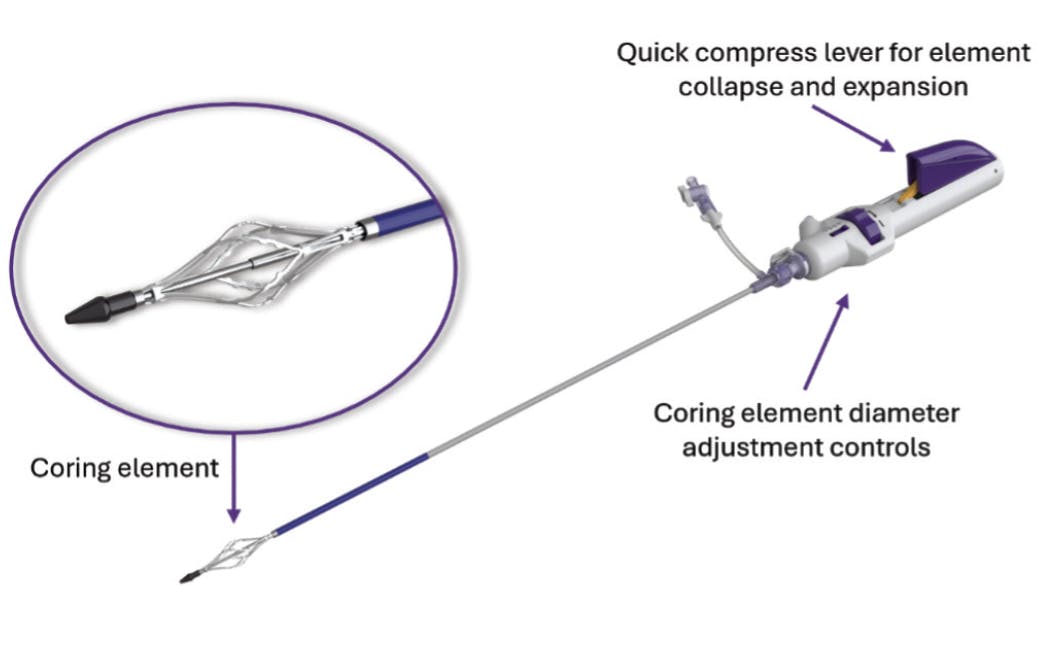
Figure 1. The VenaCore thrombectomy catheter includes an expandable, laser-cut coring element for in-line treatment of venous occlusions.
In this article, we present two compelling cases of patients with challenging venous occlusions treated with VenaCore. These case reports illustrate the early success of VenaCore in managing challenging venous occlusions and providing immediate symptom resolution and improved quality of life.
Case 1: Active Lifestyle Restored Using VenaCore in a Young Patient With Extensive Venous Occlusions

PATIENT PRESENTATION
A woman in her mid 30s was diagnosed with an acute DVT from the left external iliac vein (EIV) to the popliteal vein. An enlarged uterus with multiple large fibroids appeared to compress the adjacent left iliac vein resulting in subsequent venous thrombosis. Due to excessive uterine bleeding in the setting of extensive DVT, our service was consulted, and a retrievable inferior vena cava (IVC) filter was placed. After an interval myomectomy to remove the fibroids, the patient was prescribed apixaban. Compression stockings and exercise were recommended. The IVC filter was subsequently retrieved. At 3-month follow-up, the patient presented with severe persistent leg swelling and pain with ambulation, significantly limiting her lifestyle. Duplex ultrasound (DUS) revealed mostly nonacute DVT with extensive venous obstructions from the common iliac vein (CIV) through the popliteal veins, prompting the physician to offer intervention with the new VenaCore thrombectomy catheter.
PROCEDURAL OVERVIEW
The patient was positioned in a supine, frog-leg position, and general anesthesia was induced. Ultrasound guidance was used to achieve access in the distal left popliteal vein with micropuncture. Venography demonstrated chronic occlusion at the common femoral vein (CFV) with abundant collateralization in the pelvis (Figure 2A and 2B). Systemic heparin was administered, and the lesion was crossed with a stiff Glidewire (Terumo Interventional Systems) and a 0.035-inch Navicross catheter (Terumo Interventional Systems). The iliac veins were predilated with an 8-mm balloon, and micropuncture was exchanged for a 16-F ClotTriever sheath. As is our routine practice, the ClotTriever catheter was passed four times with a 90° rotation of the element prior to each successive pass. After four successful passes, the underlying residual venous occlusion was visualized. In lieu of additional ClotTriever passes, we elected to move to the VenaCore device and proceed with a more precise thrombectomy targeting only the specific residual occlusions.
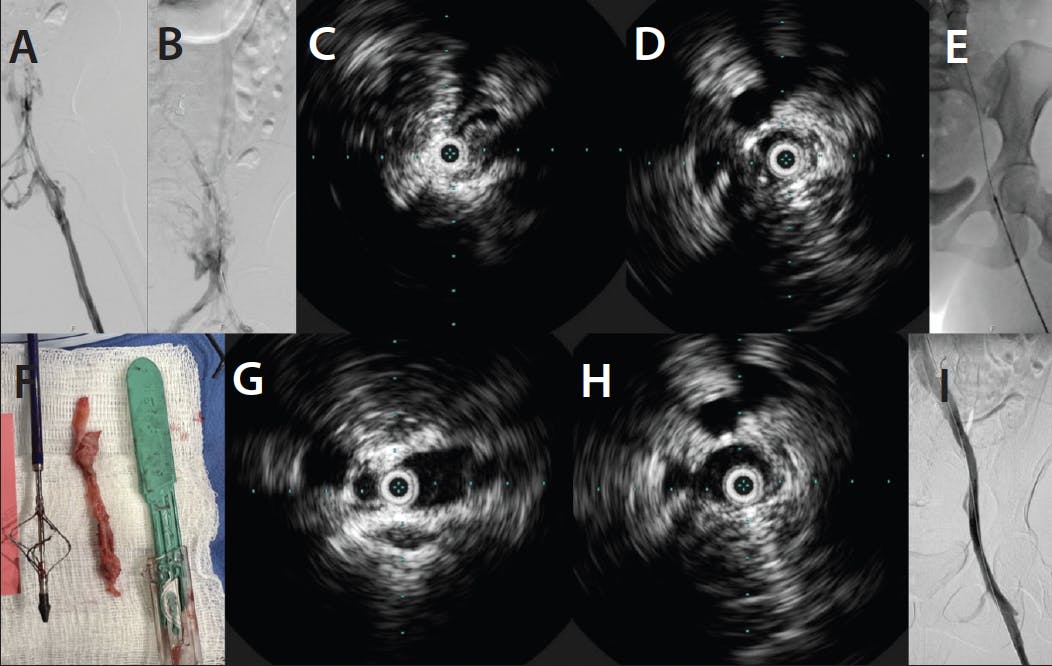
Figure 2. Preprocedure venogram of chronically occluded CFV (A) and iliac veins (B). Preprocedure IVUS demonstrating chronic DVT adherent to CIV, EIV (C), and CFV at the femoral vein (FV)/profunda femoris vein (PFV) confluence (D). VenaCore device introduced with sequential targeted deployment sized to vessel (E). Extracted occlusion (F). Postprocedure IVUS of EIV (G) and CFV at the FV/PFV confluence showing fully patent vessels (H). Postprocedure venogram after 14-mm percutaneous transluminal angioplasty showing strong cephalad flow (I).
A Protrieve sheath (Inari Medical) was deployed from the right internal jugular (IJ) access to trap and remove procedural embolus. Intravascular ultrasound (IVUS) was used to further characterize the lesion and revealed chronic venous occlusions throughout the iliofemoral venous system (Figure 2C and 2D). Vessel diameters were obtained for VenaCore sizing, and the VenaCore catheter was advanced from the popliteal access to the IVC in maximum constrained configuration.
The VenaCore device was set to a 1:1 size match with the IVUS vessel diameter measurement (Figure 2E). Several targeted deployments were performed over a Lunderquist wire (Cook Medical) until a “give” was felt at the EIV/CFV junction. A large amount of organized thrombus was extracted (Figure 2F). Repeat IVUS demonstrated resolution of the EIV and CFV fibrosis (Figure 2G and 2H). Areas with residual stenosis were treated with venoplasty using a 14-mm balloon. A completion venogram revealed satisfactory removal of the occlusive material and brisk uninterrupted flow through the iliofemoral venous system (Figure 2I). IVUS with and without Valsalva did not suggest May-Thurner pathology, and stenting was not performed. Aspirations were performed from the Protrieve sheath to remove captured emboli prior to final removal of all wires and catheters. Total procedure time was 120 minutes, and total VenaCore device time was 30 minutes. All aspirated blood was returned to the patient with the FlowSaver Blood Return System (Inari Medical), resulting in negligible blood loss. The patient was discharged the same day and resumed apixaban 5 mg twice daily for a total of 6 months.
At 10-day follow-up, the patient reported improvement in symptoms. DUS imaging showed patent iliac and CFVs with good respiratory phasicity and appropriate response to Valsalva.
DISCUSSION
Although conservative therapy is recommended for the treatment of DVT,7 anticoagulation and compression cannot clear existing thrombus burden. Hence, it is imperative that treatments are adequately designed to address collagen-rich thrombotic materials since the majority of fibrin in thrombus converts to collagen as early as day 15.5 Over time, incomplete thrombus clearance can develop into challenging venous occlusions that impede cephalad flow and provoke or worsen PTS symptoms.5,6 People living with PTS suffer from a debilitating quality of life.17
This case highlights the stark inadequacy of conservative therapy as a young patient developed persistent challenging venous occlusions despite anticoagulation therapy. The extent of occlusive material extracted from targeted treatments with VenaCore was astonishing. The collapsible coring element of VenaCore provided wall-to-wall contact that facilitated successful engagement and retrieval of chronic material, restoring full patency in 2 hours and enabling the patient to resume their active lifestyle.
Case 2: Thrombectomy of Challenging Venous Occlusions With VenaCore Results in Earlier Than Expected Return to Work


PATIENT PRESENTATION
A man in his early 70s with a history of protein C deficiency and lifelong anticoagulation for his hypercoagulable state initially presented at another hospital with a right CFV and FV DVT after a disruption in his anticoagulation regimen. The patient was discharged home on apixaban and compression therapy.
Eight weeks later, the patient presented to our facility with persistent right lower extremity (RLE) swelling and pain. He stated that his inability to stand for long periods prevented him from working. The patient was noted to have severe bilateral ankle edema and a CEAP (clinical, etiology, anatomy, pathophysiology) score of 4, defined as changes in skin and subcutaneous tissues secondary to CVD. CT venography confirmed thrombosis of the right CFV and FV.
Endovascular thrombectomy was attempted 2 days postpresentation. Venography and IVUS demonstrated occluded femoropopliteal veins and multiple collateral veins at the CFV. The lesion was treated with venoplasty, but the procedure was aborted due to inadequate visualization of the PFV, preventing optimal venous stent placement and sufficient inflow. During an office visit 10 days later, persistent significant RLE edema and severe bilateral ankle edema were observed. A decision was made to reattempt intervention in 2 weeks with VenaCore, which was recently introduced to our facility.
PROCEDURAL OVERVIEW
The patient was placed supine, and general anesthesia was administered. The right popliteal vein was accessed under ultrasound guidance. A 0.035-inch Glidewire Advantage was advanced into the FV, and an 8-F sheath was placed. The same procedure was performed in the right IJ vein, with the Glidewire advanced into the IVC.
Venography from the IJ access showed a patent iliac vein and complete occlusion of the CFV (Figure 3A). Subsequent venography via popliteal access demonstrated occlusion of the FV with extensive collateralization (Figure 3B). Using a combination of a TrailBlazer support catheter (Medtronic) and a 0.035-inch Glidewire Advantage from the IJ access, the occlusion was crossed in approximately 30 minutes. IVUS identified a mix of subacute thrombus and chronic occlusions extending from the CFV through the FV (Figure 3C).
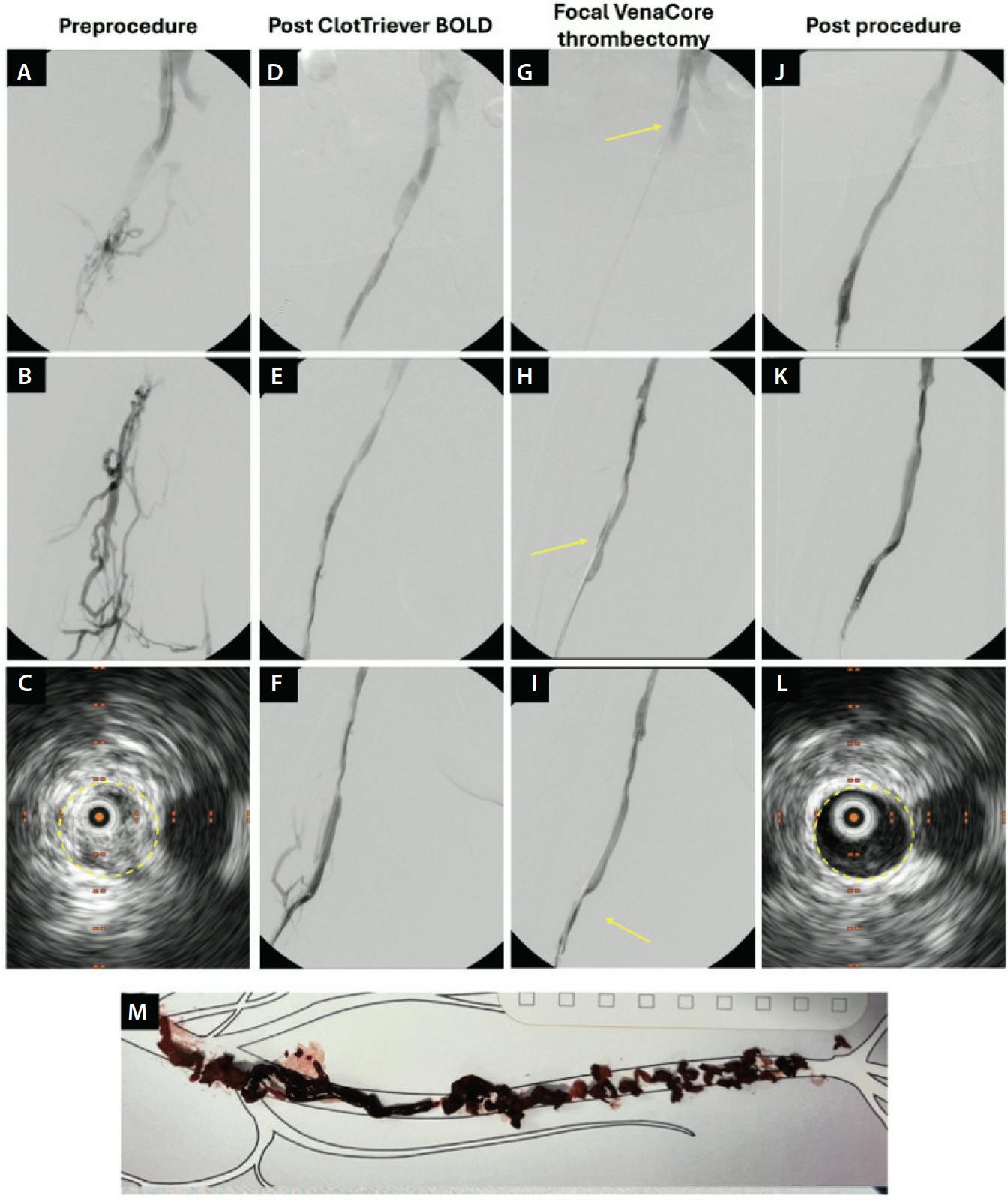
Figure 3. Preprocedural venograms of the occluded CFV (A) and FV, showing extensive collateralization (B). IVUS image of the CFV showing complete obstruction (C). Venograms of the CFV (D) and FV (E, F) after mechanical thrombectomy with ClotTriever BOLD showing substantially improved flow with residual focal obstructions. Venograms of focal treatment with VenaCore in the CFV (G) and FV (H, I), with arrows identifying the VenaCore coring element. Postprocedure venograms of the CFV (J) and FV (K) and IVUS imaging of the CFV (L) showing significantly improved opacification and complete recanalization. Photograph of extracted occlusive material (M).
Systemic heparin was administered, and a 20-F Protrieve sheath was placed in the IJ access. The sheath’s funnel was deployed infrarenally to trap and capture procedural emboli. The 8-F sheath in the popliteal access was replaced with a 16-F ClotTriever sheath.
The ClotTriever BOLD catheter was introduced through the popliteal access and advanced to the IVC. Four passes with ClotTriever BOLD removed subacute thrombus. Repeat venography showed significantly improved flow, with focal chronic venous obstructions (Figure 3D-3F). The VenaCore catheter was then introduced, and the coring element was deployed to target three focal challenging venous occlusions with a scrubbing motion, extracting collagenous occlusive material (Figure 3G-3I). Each targeted VenaCore deployment was followed by a pass with ClotTriever BOLD to extract additional occlusive material that had been freed with VenaCore. Venography showed complete removal of occlusive material and focal points of minor residual stenosis, which was addressed with venoplasty using a 10-mm balloon. Completion IVUS and venography demonstrated complete patency of the CFV and FV, extending into the iliac system and with no residual occlusions or stenoses (Figure 3J-3L). Prior to removal, aspiration was performed through the sheaths in both accesses to extract trapped emboli. All aspirated blood was returned to the system via the FlowSaver device, resulting in negligible blood loss.
Total procedure time was 200 minutes, and VenaCore device time, including intermittent passes with ClotTriever BOLD, was 45 minutes. The patient tolerated the procedure well and was discharged the following day on apixaban. Substantial symptom improvement led the patient to return 1.5 weeks before his scheduled 6-week follow-up appointment to request a return-to-work letter. The patient was able to stand for long periods without pain, and reduced edema and leg swelling was observed.
DISCUSSION
This case illustrates the limitations of traditional endovascular interventions to address challenging venous obstructions. Venoplasty was attempted to create a landing zone for stent placement. However, venoplasty failed to effectively remodel the chronic venous occlusion for complete stent expansion, and adequate inflow could not be established with available tools. At the time of this procedure, VenaCore was not yet available, and the procedure was aborted without stent placement. Subsequent referral and intervention with the newly available VenaCore catheter allowed for extensive luminal gain, and stenting was ultimately deemed unnecessary. After intervention with VenaCore, the patient was able to return to work earlier than expected. In contrast, 90% of PTS patients treated with conventional therapy are unable to work 10 years after diagnosis due to associated symptoms.18
Although a staggering number of people are affected by DVT and proceed to develop long-term symptoms,19 many are not promptly identified for treatment. Instead, they often become lost in the health care system due to the lack of effective treatment options and/or the absence of an established referral pathway. Fortunately, in this case, the physician was able to refer the patient to a colleague who had VenaCore readily available. Through this collaboration, we were pleased with the ability to target and debulk chronic occlusions and treat the root cause of the disease state in a single session with VenaCore to swiftly alleviate the patient’s symptoms. With purpose-built, minimally invasive devices such as VenaCore, challenging occlusions can be removed in a single session, which can swiftly alleviate symptoms and improve quality of life.
CONCLUSION
In these cases, VenaCore demonstrated efficient and successful debulking and removal of challenging venous occlusions to reestablish cephalad blood flow, facilitating rapid symptom improvement after a single session. Procedure times with VenaCore were relatively faster compared to traditional recanalization procedures. These initial reports are promising and may represent a significant advancement in CVD management, providing an alternative for patients who either had no other option for treatment or in which traditional endovascular techniques have failed. Efforts to foster collaboration between venous disease specialists and interventionalists and streamline patient referral pathways are essential to facilitate the widespread adoption of innovative treatment options like VenaCore.
All views and opinions expressed here by Dr. Fremed, Dr. De Marco-Garcia, and Dr. Mukherjee are their own and do not represent those of Inari Medical.
1. Virani SS, Alonso A, Aparicio HJ, et al. Heart disease and stroke statistics-2021 update: a report from the American Heart Association. Circulation. 2021;143:e254-e743. doi: 10.1161/CIR.0000000000000950
2. Wang J, Smeath E, Lim HY, et al. Current challenges in the prevention and management of post-thrombotic syndrome-towards improved prevention. Int J Hematol. 2023;118:547-567. doi: 10.1007/s12185-023-03651-6
3. Mahan CE, Borrego ME, Woersching AL, et al. Venous thromboembolism: annualised United States models for total, hospital-acquired and preventable costs utilising long-term attack rates. Thromb Haemost. 2012;108:291-302. doi: 10.1160/TH12-03-0162
4. Bergan JJ, Schmid-Schönbein GW, Smith PD, et al. Chronic venous disease. N Engl J Med. 2006;355:488-98. doi: 10.1056/NEJMra055289
5. Czaplicki C, Albadawi H, Partovi S, et al. Can thrombus age guide thrombolytic therapy? Cardiovasc Diagn Ther. 2017;7(suppl 3):S186-S196. doi: 10.21037/cdt.2017.11.05
6. Iding AFJ, Kremers BMM, Pallares Robles A, et al. Residual venous obstruction as an indicator of clinical outcomes following deep vein thrombosis: a management study. Thromb Haemost. 2023;123:763-772. doi: 10.1055/a-2059-4737
7. Stevens SM, Woller SC, Baumann Kreuziger L, et al. Executive summary: antithrombotic therapy for VTE disease: second update of the CHEST guideline and expert panel report. Chest. 2021;160:2247-2259. doi: 10.1016/j.chest.2021.07.056
8. Dexter DJ. Interim two-year outcomes following mechanical thrombectomy for deep vein thrombosis from the real-world CLOUT registry. J Vasc Surg Venous Lymphat Disord. 2024;12:101795. https://doi.org/10.1016/j.jvsv.2024.101795
9. Dexter D. One-year interim outcomes of mechanical thrombectomy for deep vein thrombosis from the real-world CLOUT registry. J Vasc Surg Venous Lymphat Disord. 2023;11:458-459.
10. Jolly MA, Lockhart MM, Shah D, et al. Outcomes from a tertiary care center using a catheter thrombectomy system for managing acute iliofemoral deep vein thrombosis. J Vasc Surg Venous Lymphat Disord. 2022;10:1044-1050. doi: 10.1016/j.jvsv.2022.04.010
11. Ramalingam V, Weinstein J, Gimenez J, et al. Technical feasibility of suction thrombectomy using a large-bore aspiration system in the portomesenteric venous system. J Vasc Interv Radiol. 2023;34:351-356. doi: 10.1016/j.jvir.2022.12.012
12. De Marco Garcia LP. Single-center experience with the ClotTriever BOLD catheter for deep vein thrombosis percutaneous mechanical thrombectomy of the lower extremity. Front Surg. Published online November 2, 2023. doi: 10.3389/fsurg.2023.1268338
13. Mouawad NJ. Percutaneous mechanical thrombectomy to remove post-thrombotic obstructions and manage post-thrombotic syndrome-associated venous leg ulceration. J Vasc Surg Venous Lymphat Disord. 2023;11:964-971.e1. doi: 10.1016/j.jvsv.2023.05.011
14. Montoya C, Polania-Sandoval C, Almeida JI. Endovascular mechanical thrombectomy of iliofemoral venous stent occlusion with the novel RevCore thrombectomy system: case reports and literature review. J Vasc Surg Cases Innov Tech. Published online February 13, 2024. doi: 10.1016/j.jvscit.2024.101432
15. Shaikh A. Mechanical thrombectomy of venous in-stent thrombosis with the novel RevCore thrombectomy system: a report of 2 cases. Radiol Case Rep. 2024;19:576-580. doi: 10.1016/j.radcr.2023.10.072
16. Solano A, Klein A, Gonzalez-Guardiola G, et al. RevCore thrombectomy system for treatment of chronic left external and common iliac vein stent occlusion. J Vasc Surg Cases Innov Tech. 2024;10:101482. doi: 10.1016/j.jvscit.2024.101482
17. Kahn SR, Hirsch A, Shrier I. Effect of postthrombotic syndrome on health-related quality of life after deep venous thrombosis. Arch Intern Med. 2002;162:1144-1148. doi: 10.1001/archinte.162.10.1144
18. Kahn SR, Ginsberg JS. Relationship between deep venous thrombosis and the postthrombotic syndrome. Arch Intern Med. 2004;164:17-26. doi: 10.1001/archinte.164.1.17
19. Salim S, Machin M, Patterson BO, et al. Global epidemiology of chronic venous disease: a systematic review with pooled prevalence analysis. Ann Surg. 2021;274:971-976. doi: 10.1097/SLA.0000000000004631
Indications for Use:
The ClotTriever Thrombectomy System and ClotTriever BOLD Catheter are indicated for: (1) The non-surgical removal of thrombi and emboli from blood vessels, (2) Injection, infusion, and/or aspiration of contrast media and other fluids into or from a blood vessel. The ClotTriever Thrombectomy System is intended for use in the peripheral vasculature including deep vein thrombosis (DVT).
The RevCore Thrombectomy Catheter and VenaCore Thrombectomy Catheter are indicated for: (1) The non-surgical removal of thrombi and emboli from blood vessels, (2) Injection, infusion and/or aspiration of contrast media and other fluids into or from a blood vessel. The RevCore Thrombectomy Catheter and VenaCore Thrombectomy Catheter are intended for use in the peripheral vasculature.
Advertisement
Advertisement